
ISO 21001 vs. other educational standards

ISO 21001 vs Other Education Standards: Certification & Training
Educational organisations confront growing demands to demonstrate quality management, compliance, and learner satisfaction. ISO 21001 and ISO 9001 training resources empower institutions to structure management systems that meet stakeholder expectations and regulatory requirements. This guide compares ISO 21001 with other educational standards, explains key benefits, outlines certification pathways, and shows how ISO 9001 certification often underpins client requirements. Readers will discover:
- Foundational concepts and implementation of ISO 21001
- Direct comparison of ISO 21001 vs ISO 9001 quality principles
- Tangible benefits for service delivery, risk management, and digital transformation
- Training pathways from foundation courses to lead implementer accreditation
- Integration strategies with ISO 9001, ISO 31000, and additional management frameworks
By the end, IT directors, business leaders, and founders will possess a clear roadmap for selecting and implementing the right management system standard, supported by Stratlane’s expert training and consulting services.
What Is ISO 21001 and How Does It Define Educational Management Systems?
ISO 21001 is the Educational Organisations Management System (EOMS) standard that defines requirements to enhance learner satisfaction through a consistent educational framework. It formalises quality management principles for any institution delivering educational services, from universities to vocational centres, ensuring outcomes align with stakeholder needs and ethical conduct. Understanding ISO 21001 lays the groundwork for comparing it with generic quality standards and planning effective training and certification.
What Are the Key Principles and Scope of ISO 21001?
ISO 21001 revolves around five core principles that guide educational management:
- Learner focus – prioritising individual requirements, expectations, and learning outcomes
- Leadership involvement – securing commitment from top management for strategic direction
- Process approach – mapping educational workflows, from curriculum design to assessment
- Continuous improvement – applying Plan-Do-Check-Act cycles to refine processes
- Ethical conduct – ensuring inclusivity, transparency, and educational integrity
These principles extend across teaching, support services, and administrative activities, enabling institutions to address both academic and operational dimensions under a unified management system.
How Does ISO 21001 Enhance Learner Satisfaction and Educational Quality?
ISO 21001 improves educational quality by embedding feedback loops, performance metrics, and stakeholder engagement into daily operations. By requiring regular surveys, course evaluations, and advisory committee reviews, the standard ensures educational services adapt to student needs. Ultimately, enhanced learner satisfaction arises from structured curricula, transparent communication channels, and evidence-based teaching methodologies.
What Are the Essential Requirements of ISO 21001 for Educational Institutions?
ISO 21001’s clause structure mandates specific actions:
| Clause | Requirement | Purpose |
|---|---|---|
| 4 | Context and stakeholder analysis | Define internal/external factors and stakeholder needs |
| 5 | Leadership and commitment | Ensure governance and resource allocation |
| 6 | Planning actions to address risks and opportunities | Apply risk-based thinking to educational services |
| 7 | Support and operation | Manage resources, infrastructure, and documented information |
| 8 | Performance evaluation | Measure learning outcomes and satisfaction rates |
| 9 | Improvement | Implement corrective actions and continuous enhancement |
These requirements align institutional strategy with daily teaching and support processes, fostering a robust EOMS.
How Is ISO 21001 Implemented in Educational Organisations?

Implementing ISO 21001 involves a structured sequence:
- Gap analysis – compare existing processes against ISO 21001 requirements
- Management system design – document procedures, policies, and objectives
- Training and awareness – educate staff on roles, responsibilities, and EOMS framework
- Internal audit – verify compliance and identify improvement opportunities
- Certification audit – engage an accredited body to confirm full conformance
Effective implementation combines strategic planning with hands-on training to embed quality culture and ensure readiness for certification.
How Does ISO 21001 Compare to ISO 9001 for Education?
Educational organisations often consider ISO 9001 certification before adopting sector-specific standards like ISO 21001. ISO 9001 offers a generic quality management system (QMS) foundation that key clients frequently mandate, while ISO 21001 builds on those principles to address educational contexts.
What Are the Core Differences Between ISO 21001 and ISO 9001?
ISO 21001 applies quality management concepts specifically to learning services, emphasising learner outcomes, educational performance indicators, and ethical educational conduct. ISO 9001 targets any organisation, prioritising customer satisfaction, process efficiency, and continual improvement without sector nuance. ISO 21001 adopts ISO 9001’s PDCA cycle but adds requirements for curriculum development, learner support, and educational governance.
Why Is ISO 9001 Considered a Foundational Standard for Educational Institutions?
ISO 9001 certification demonstrates a universally recognised commitment to robust quality management that many government tenders and international partnerships demand. Key clients, such as accreditation agencies and funding bodies, often require ISO 9001 as proof of reliable processes before considering sector-specific credentials. This foundational status builds trust in operational excellence and reduces risk in large-scale educational projects.
International Organization for Standardization, ISO 9001:2015 Quality management systems — Requirements (2015)
This ISO standard provides a framework for any organization to improve its quality management system.
How Do ISO 21001 and ISO 9001 Complement Each Other in Education?
Integrating ISO 9001 and ISO 21001 provides a layered approach:
- ISO 9001 QMS establishes core process controls, document management, and customer-focused culture.
- ISO 21001 EOMS adds specialised requirements for teaching, learning support, and stakeholder engagement.
Together, they create a comprehensive management system that assures both generic quality management and sector-specific educational integrity.
What Are the Similarities in Quality Management Principles Between ISO 21001 and ISO 9001?
Both standards share:
- A process-based approach using PDCA cycles
- Emphasis on leadership commitment and resource management
- Requirement for risk-based thinking and performance evaluation
- Focus on stakeholder satisfaction and documented information control
These common elements enable seamless integration and dual-certification pathways.
Can Educational Organisations Achieve Dual Certification for ISO 21001 and ISO 9001?
Yes, institutions can pursue simultaneous certification through integrated audits. Accrediting bodies often assess overlapping clauses together, reducing duplication. Dual certification maximises credibility, addresses client prerequisites for ISO 9001, and demonstrates advanced sector competence via ISO 21001.
What Are the Benefits of ISO 21001 Certification for Educational Institutions?
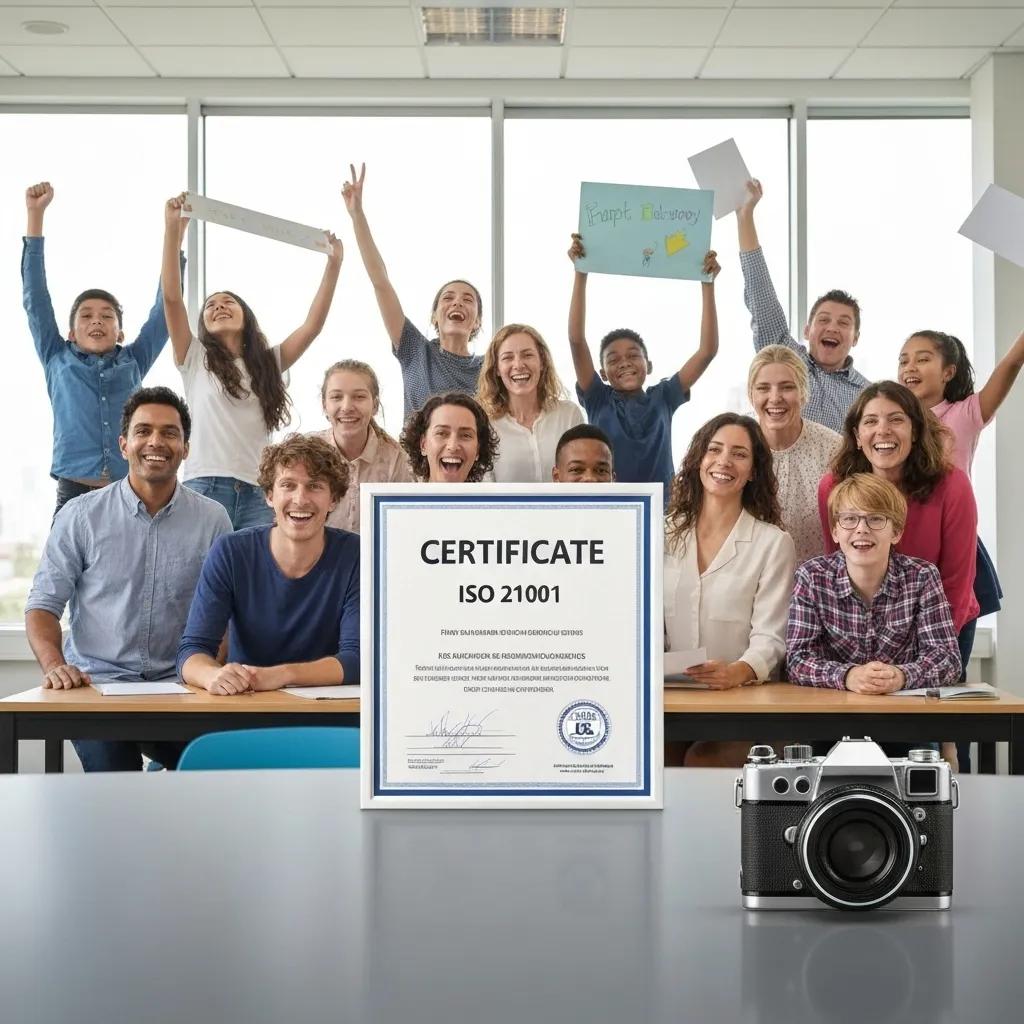
ISO 21001 certification equips institutions with a recognised framework to enhance operational efficiency, learner engagement, and market reputation. Certification signals commitment to quality, risk management, and continuous improvement.
International Organization for Standardization, ISO 21001:2018 Educational organizations — Management systems for educational organizations — Requirements with guidance for use (2018)
This ISO standard provides a framework for educational organizations to improve their management systems and achieve better outcomes.
How Does ISO 21001 Improve Educational Service Delivery and Stakeholder Engagement?
By mandating clear process documentation, defined learning objectives, and stakeholder feedback mechanisms, ISO 21001 ensures consistent course delivery and responsive administration. Transparent performance metrics and advisory committee input foster active engagement among students, faculty, and external partners.
What Impact Does ISO 21001 Have on Risk Management and Compliance in Education?
ISO 21001’s risk-based thinking requires institutions to identify, assess, and mitigate threats to educational outcomes—whether related to curriculum gaps, resource constraints, or regulatory changes. This proactive approach strengthens compliance with accreditation bodies and legal requirements, reducing reputational and operational risks.
How Does ISO 21001 Support Digital Transformation in Educational Settings?
ISO 21001 provides guidelines for managing e-learning platforms, digital content quality, and cybersecurity controls for learner data. Integrating information-technology procedures into the EOMS promotes consistent online delivery, robust technical infrastructure, and ongoing evaluation of virtual learning outcomes.
What Are Real-World Success Stories of ISO 21001 Implementation?
Educational organisations that adopt ISO 21001 report measurable improvements:
- Increased student retention – systematic feedback loops reduced dropout rates by 15 percent
- Enhanced faculty collaboration – documented processes elevated cross-departmental project success
- Operational cost savings – streamlined administrative tasks yielded a 10 percent efficiency gain
These outcomes illustrate the tangible returns on EOMS investment.
What Training Pathways Are Available for ISO 21001 and ISO 9001 Certification?
Educational organisations can choose from foundation courses, internal auditor programmes, and lead implementer training to build in-house expertise for ISO 21001 and ISO 9001.
What Does ISO 21001 Foundation Training Cover?
Foundation training introduces EOMS concepts, clause structure, and implementation logic. Participants learn:
- Standard scope and key definitions
- ISO 21001 principles and terminology
- Steps for gap analysis and system design
This course equips teams to support initial EOMS planning.
How Does Internal Auditor Training Ensure Compliance with Educational Standards?
Internal auditor training focuses on audit methodology, evidence collection, and nonconformity reporting:
- Audit planning – defining scope, objectives, and criteria
- Audit execution – conducting interviews, reviewing documents, and observing processes
- Reporting – identifying findings and suggesting corrective actions
Skilled auditors drive continuous improvement through systematic compliance checks.
What Are the Benefits of Lead Implementer Training for ISO 21001?
Lead implementer training develops advanced skills in EOMS design, risk management, and performance evaluation. Trainers cover:
- Strategic planning for integrated management systems
- Project management for certification readiness
- Coaching teams on best-practice process controls
Graduates often lead institutional certification projects with confidence and authority.
How Does PECB Certification Support ISO 21001 and ISO 9001 Training?
PECB-accredited courses confer recognised credentials and continuing professional development units. PECB certificates validate trainer expertise and assure clients of course quality, reinforcing institutional credibility in both ISO 21001 and ISO 9001 domains.
What Is the Recommended Training Journey for Educational Organisations?
An effective learning path aligns resources and roles:
| Course Level | Target Participants | Outcome |
|---|---|---|
| Foundation | Management team | EOMS awareness and gap identification |
| Internal Auditor | Quality managers | In-house audit capability and compliance checks |
| Lead Implementer | Project leads | Strategic implementation and certification leadership |
This progression builds layered competence and sustains a culture of quality.
How Can Educational Organisations Integrate ISO 21001 with Other Relevant ISO Standards?
Combining ISO 21001 with complementary standards enhances risk control, environmental management, and business continuity.
What Role Does ISO 9001 Play as a Foundation for ISO 21001?
ISO 9001 establishes generic quality management practices such as document control, corrective actions, and performance reviews. These form the baseline upon which ISO 21001’s educational-specific requirements—like curriculum oversight and learner engagement—are built, ensuring robust process integrity.
How Can Risk Management Standards Like ISO 31000 Enhance Educational Compliance?
ISO 31000 provides a structured risk management framework that complements ISO 21001’s risk-based clauses. By integrating risk identification, risk assessment, and mitigation planning, educational organisations achieve a comprehensive approach to protecting learners, assets, and institutional reputation.
What Other ISO Standards Are Relevant to Educational Institutions?
Additional standards that align with educational objectives include:
- ISO 14001 (Environmental management) to reduce campus environmental impact
- ISO 22301 (Business continuity) to maintain operations during disruptions
- ISO 27001 (Information security) to safeguard learner and staff data
Integrating these standards creates a holistic management system spanning quality, environmental, and security domains.
How Do Internal Audits Support Continuous Improvement Across Multiple Standards?
Internal audits serve as a unified mechanism to verify compliance with ISO 9001, ISO 21001, and related standards. A consolidated audit programme minimises duplication, reinforces cross-standard insights, and drives systematic upgrades in process efficiency and risk control.
What Are the Common Questions About ISO 21001 vs Other Educational Standards?
This section addresses critical queries that influence standard selection, client expectations, and certification processes. Each answer clarifies misconceptions and guides decision-making.
What Is the Primary Difference Between ISO 21001 and ISO 9001?
ISO 21001 targets educational organisations with requirements for curriculum design, learner support, and educational performance metrics, while ISO 9001 applies broadly to any organisation’s quality management processes. The sector specificity of ISO 21001 ensures that learning outcomes and ethical educational governance are central to system design.
Why Is ISO 9001 Certification Often Required by Key Clients in Education?
Key clients, including accreditation bodies and government agencies, view ISO 9001 certification as proof of mature quality management capable of reducing project risk and ensuring consistent service delivery. This endorsement builds trust with stakeholders and unlocks opportunities for partnerships and funding.
How Do Educational Institutions Get Certified for ISO 21001?
Certification follows these steps:
- Select a certification body – choose an accredited auditor
- Conduct a readiness assessment – address gaps and refine processes
- Complete internal audits – verify conformance with EOMS clauses
- Host the certification audit – present evidence and records
- Receive the certificate – maintain and improve through surveillance audits
This cycle embeds a culture of continuous quality enhancement.
What Are the Benefits of an Educational Organisation Management System (EOMS)?
An EOMS framework delivers standardised processes for curriculum control, stakeholder engagement, and outcome measurement. Institutions realise consistent teaching quality, enhanced transparency, and measurable performance improvements across academic and administrative functions.
Is ISO 9001 Mandatory for Educational Institutions Pursuing ISO 21001?
No, ISO 21001 does not explicitly require prior ISO 9001 certification. However, achieving ISO 9001 first simplifies implementation by establishing general quality controls, streamlining documentation, and satisfying many key client prerequisites for process maturity.
How to Choose the Right Educational Management Standard and Training Path?
Selecting an appropriate standard and training path hinges on organisational goals, compliance requirements, and stakeholder expectations. A structured decision-making framework ensures alignment with quality objectives and market demands.
What Factors Should Influence the Choice Between ISO 21001 and Other Standards?
Institutions should evaluate:
- Scope and objectives – alignment of standard requirements with educational missions
- Client requirements – baseline needs for ISO 9001 versus sector-specific EOMS
- Resource capability – existing process maturity and staff expertise
- Strategic priorities – digital transformation, risk management, or environmental goals
Balancing these factors optimises standard selection.
How to Align Training and Certification with Institutional Quality Objectives?
Training courses must map to organisational roles and objectives:
- Leadership attends foundation courses to champion the standard
- Quality managers complete internal auditor training for compliance
- Project leads undertake lead implementer programmes to steer certification
This role-based alignment embeds expertise precisely where it drives the greatest impact.
What Are the Steps to Develop a Successful Implementation Plan?
An effective implementation plan includes:
- Define objectives – specify quality goals and stakeholder expectations
- Perform gap analysis – benchmark current practices against standard requirements
- Develop an implementation roadmap – assign responsibilities, timelines, and resources
- Deliver training – equip staff with necessary skills and knowledge
- Conduct pilot audits – refine processes before certification
A detailed plan ensures on-time delivery and certification readiness.
How Can Stratlane Support Your ISO 21001 and ISO 9001 Training Needs?
Stratlane offers tailored training services, from ISO 21001 foundation courses to ISO 9001 lead implementer programmes. By leveraging expert consultants and PECB-accredited instructors, Stratlane enables educational organisations to build in-house capability, achieve certification, and meet key client requirements. Explore our ISO 21001 for Educational Organizations service to access targeted training and consulting resources.
Achieving robust management system certification enhances learner satisfaction, operational efficiency, and institutional credibility. Partner with Stratlane for expert guidance and comprehensive ISO 21001 and ISO 9001 training pathways that align with your strategic objectives.