
Unlock Enterprise-Level ISO: Ensure Global Compliance Now

Enterprise ISO Certification at Scale: Global Compliance Faster with AI-Enabled Audits
Enterprise ISO certification applies standardized management systems across complex, multi-site organizations to deliver consistent quality, lower risk, and verifiable compliance at scale. This guide shows how large corporations, universities, and distributed business groups can implement ISO 9001, ISO 14001, ISO 27001, and ISO 42001 while using AI-assisted auditing to speed certification and maintain cross-border conformity. You’ll get the strategic benefits, how AI-enabled audits work, where each standard fits in an enterprise, and a practical roadmap for rollout and certification. We also cover ethical AI governance under ISO 42001 and methods to run multi-region programs without duplicating workstreams. Throughout, we include enterprise examples, measurable KPIs, and action-oriented checklists so compliance teams, CISOs, and operations leaders can make procurement and program decisions that map to global standards and modern audit automation.
What benefits does enterprise ISO certification deliver for large organizations?
Enterprise ISO certification builds market trust, aligns with regulators, and creates operational consistency across sites and jurisdictions. Standardized management systems reduce process variability, strengthen supplier assurance, and give procurement teams a single certification to evaluate vendors and support bids. Certification also reduces risk through documented controls and audit trails, simplifying executive reporting and regulatory responses across regions. Operationally, ISO frameworks harmonize processes, cut defect rates, and establish repeatable KPIs that drive continuous improvement and better supplier oversight.
The table below compares measurable outcomes for core enterprise stakeholders and shows typical impacts on risk, time, and cost.
| Stakeholder | Measurable Outcome | Typical Impact |
|---|---|---|
| Executive | Stronger market credibility and procurement outcomes | Higher win rates; clearer governance |
| CISO | Fewer compliance gaps and documented controls | Lower incident risk; streamlined audits |
| Operations | Consistent processes and supplier performance metrics | Fewer defects; improved throughput |
| Procurement | Single certification for supplier evaluation | Faster onboarding; fewer audits |
This side-by-side view demonstrates how certification creates value for different teams while eliminating duplicate effort across the enterprise. Next, we look at how ISO strengthens quality and risk management at scale.
How does ISO certification improve quality and risk management across an enterprise?
ISO certification enforces a process approach, risk-based thinking, and documented controls that tie directly to enterprise KPIs. Standard clauses require clear inputs and outputs, measurement criteria, and role accountability, turning informal practices into auditable systems. For both manufacturing and IT, this reduces variability—fewer production defects and clearer change control in IT—while enabling risk registers to prioritize and track remediation. The outcome is measurable: consistent change control, for example, lowers post-deployment incidents and speeds root-cause analysis across sites.
These governance practices also strengthen supplier oversight through defined requirements and evidence trails, giving operations teams the leverage to enforce consistency across third parties. That supplier assurance becomes a natural point of leverage when audits are enhanced with automation and analytics.
How much time and cost do AI-driven audits save?

AI-driven auditing lowers time and cost by automating evidence collection, prioritizing audit scope via predictive analytics, and enabling remote continuous monitoring that reduces onsite days. Automated evidence aggregation pulls logs, configuration snapshots, and policy attestations, cutting manual checklist work and compressing prep cycles. Predictive models highlight higher-risk areas so auditors focus on material controls instead of routine checks—often reducing audit hours per site substantially depending on scope and maturity.
In a typical enterprise program, you’ll see faster pre-audit preparation, fewer full-scope onsite days, and quicker decisions on nonconformities because cross-system correlations are presented up front. Those savings compound across sites and surveillance cycles, freeing compliance teams to spend time on remediation and improvement rather than repetitive evidence collection.
How does Stratlane’s AI-assisted auditing speed ISO certification?
Stratlane Certification combines predictive analytics, automated evidence aggregation, and auditor augmentation to accelerate certification without sacrificing rigor. Our platform ingests telemetry and documented information to prioritize controls and surface anomaly alerts, then bundles correlated evidence for auditor review. The result is a hybrid model that keeps auditors central to judgment while eliminating repetitive tasks and shortening audit cycles.
Operational features include multi-site scheduling automation, an AI audit module that flags anomalous patterns, and certificate management to track lifecycle events and surveillance cadences. These capabilities shorten lead times and give compliance teams dashboards that turn raw data into audit-ready evidence and prioritized risk lists. If you’re ready to act, Stratlane accepts quote requests with scope and site details and schedules AI-assisted audits to fit your program timeline.
Here are the core mechanisms that deliver those efficiencies.
- Predictive prioritization: AI ranks controls by risk likelihood so auditors focus where it matters most.
- Automated evidence aggregation: Systems pull logs, policy versions, and registry snapshots into audit-ready bundles.
- Auditor augmentation: Data-driven insights reduce review time while expanding effective coverage.
These features increase throughput and accuracy and lead into the value of predictive analytics and continuous monitoring.
What advantages do predictive analytics and continuous monitoring provide?
Predictive analytics identifies trends and emerging risks by modeling historical incidents, configuration drift, and operational telemetry to deliver early warnings. Continuous monitoring supports a rolling assurance model, letting compliance teams remediate issues before they become reportable incidents or audit failures. Useful KPIs include mean time to remediate (MTTR) for nonconformities, percent of issues caught pre-release, and reduction in audit cycle time.
Shifting to ongoing risk surveillance is especially important given the fast pace of change in modern AI and ML systems.
Continuous automated auditing for ML certification
Traditional point-in-time certifications struggle with MLOps because models and pipelines change frequently. Continuous Audit-Based Certification (CABC) addresses this by automating assessments of MLOps artifacts to issue or revoke certificates dynamically. The approach uses lifecycle artifacts for quality measurements, risk-based metric selection, a standardized audit API for data retrieval, tamper-resistant data collection, and separation-of-duties in certification architecture. CABC aims to raise efficiency, improve trust in ML systems, and help regulated industries meet quality goals.
Practically, combining anomaly detection in access logs with recent change requests can trigger a narrow review that stops an unauthorized deployment. That early action reduces incident costs and shrinks remediation timelines. Continuous monitoring moves assurance from periodic checkpoints to constant surveillance, enabling lighter surveillance cadences and faster certification cycles.
Those monitoring gains lead directly to how AI reduces human error and improves audit accuracy when datasets are correlated.
How does AI improve audit accuracy and reduce compliance risk?
AI raises audit accuracy through cross-data correlation, anomaly detection, and reproducible evidence scoring that flags inconsistencies for human review. By linking change records to deployment logs and policies, AI reduces false negatives and uncovers control gaps that manual sampling can miss at scale. That lowers compliance risk and directs corrective actions toward root causes rather than symptoms.
For auditors, AI provides ranked findings and contextual evidence bundles that speed decisions and reduce rework from incomplete documentation. Less manual review cuts human error and creates more consistent outcomes across sites and auditors—critical for complex ISMS and AI governance programs where compliance signals live in dispersed systems.
Which ISO standards matter most for large organizations — and how are they used?
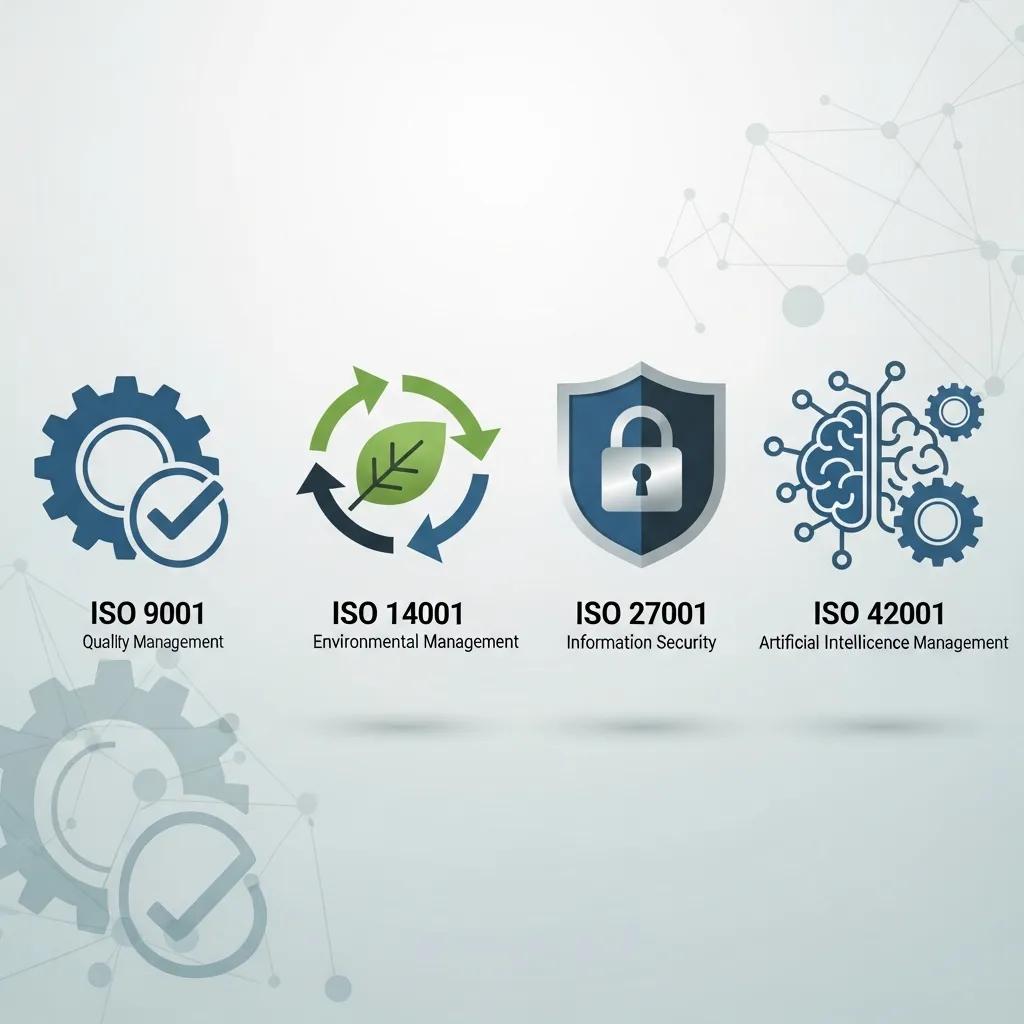
Enterprises commonly adopt ISO 9001, ISO 14001, ISO 27001, and ISO 42001 to cover quality, environmental responsibility, information security, and AI governance. Each standard defines a management system with clauses for leadership, context, planning, support, operation, and performance evaluation—making it possible to integrate multiple standards into a unified management system. Which combination you choose depends on industry, regulation, and strategic priorities; integrating standards reduces duplicate audits and aligns reporting across functions.
The table below summarizes each standard’s focus and a concise enterprise application.
| Standard | Core focus | Enterprise application |
|---|---|---|
| ISO 9001 | Quality management systems | Multi-site process standardization and supplier quality metrics |
| ISO 14001 | Environmental management | Corporate sustainability programs and regulatory alignment |
| ISO 27001 | Information security management (ISMS) | Data protection, vendor risk, and incident response coordination |
| ISO 42001 | AI management systems | AI lifecycle governance, ethical controls, and auditability |
This side-by-side view helps enterprises prioritize standards based on operational risk and stakeholder expectations. Next, we dive into how ISO 9001 scales enterprise quality management.
How does ISO 9001 support enterprise quality management?
ISO 9001 scales quality through a process approach that defines inputs, outputs, metrics, and ownership across sites. Key clauses—context of the organization, operational planning, and performance evaluation—require documented information and traceability that enterprises use to harmonize procedures and KPIs. Practical steps include standardized process maps, a central internal-audit cadence, and supplier scorecards tied into procurement.
By turning tacit knowledge into documented processes, ISO 9001 enables measurable improvement programs and supports dashboards that track defect rates, on-time delivery, and customer satisfaction. Those outcomes improve governance and reduce variation, clearing the way for environmental and security standards to be layered into the same management system.
What role does ISO 14001 play in corporate environmental responsibility?
ISO 14001 provides a structured approach to environmental policy, lifecycle thinking, and compliance obligations that enterprises use to manage environmental risk and stakeholder reporting. It requires identification of environmental aspects, regulatory obligations, and measurable objectives—like emissions reduction and waste management. Companies often use ISO 14001 to coordinate supply-chain footprint reduction, set sustainability KPIs, and align reporting with investors and regulators.
Operational integrations with ERP and procurement systems let teams track supplier environmental certifications and lifecycle assessments. Those integrations reduce duplication and produce consolidated sustainability reporting, which in turn highlights the need for robust information security under ISO 27001 where data and reporting must be protected.
Why is ISO 27001 essential for enterprise information security?
ISO 27001 creates an ISMS framework that structures risk assessment, controls, and incident response for large-scale data and process environments. It supports data protection requirements and provides a disciplined approach to vendor risk, cross-border data flows, and incident coordination. For organizations subject to GDPR or similar regimes, ISO 27001 helps demonstrate due diligence and provides evidence of systematic risk treatment.
Best practices include a central risk register, vendor assurance workflows tied to procurement, and incident playbooks integrated with security operations. These measures ensure information security underpins both operational resilience and regulatory compliance—and they dovetail with AI governance when AI systems handle sensitive data.
How does ISO 42001 govern AI in large organizations?
ISO 42001 defines expectations for AI lifecycle governance, including risk assessment, transparency, and control mechanisms specific to AI systems. The standard emphasizes documentation of datasets, model validation, monitoring, and ethical considerations such as fairness and explainability. Enterprises should apply ISO 42001 across product and operational AI by establishing model registries, validation gates, and monitoring telemetry.
ISO 42001 is increasingly seen as a foundational framework for practical, certifiable AI governance.
ISO 42001: AI management system certification & governance
ISO/IEC 42001:2023 is the first international voluntary certifiable standard offering a comprehensive framework for AI governance.
Practically, ISO 42001 requires audit trails for training data, performance baselines, and mitigation plans for bias and drift. Those governance artifacts feed into the enterprise management system where security and quality controls intersect, supporting accountability and regulatory readiness.
How can large organizations implement ISO 42001 for AI governance and ethics?
Implementing ISO 42001 means building governance structures, running AI-specific risk assessments, and producing documentation and monitoring that support continuous improvement. Governance should define roles—model owners, data stewards, ethics reviewers—and create approval gates that require validation before deployment. Risk assessments evaluate harm vectors, bias, and privacy impacts, with prioritized treatment plans entered into the enterprise risk register.
A practical roadmap balances centralized policy with local controls and leverages automated monitoring to detect model drift or fairness regressions. Those steps produce audit-ready evidence and controls that scale across diverse AI initiatives—critical for organizations deploying many models and use cases.
The next section offers a concise checklist to establish an AI management system.
What steps establish an AI management system?
To set up an AI management system, follow these stages: define scope, assign governance, assess risks, implement controls, validate models, monitor performance, and iterate for continual improvement. Scoping identifies AI assets and critical use cases; governance assigns accountable owners and review boards; risk assessments quantify harms and regulatory exposure. Controls include dataset governance, validation procedures, and deployment gates that require documented approvals.
Monitoring should track performance, fairness, and security metrics while lessons from incidents feed continual improvement. Depending on complexity, initial scoping through first validation can often be completed within a quarter for well-resourced teams. These tasks tie directly into how ISO 42001 frames ethics and risk treatment.
How does ISO 42001 embed ethical AI and risk management?
ISO 42001 embeds fairness, transparency, and accountability into AI lifecycle controls by requiring documentation and mitigation measures for bias, explainability, and impact. Controls include dataset governance, model validation protocols, and audit trails to enable retrospective review of model decisions. Policy templates typically cover acceptable use, validation thresholds, and escalation steps when models behave unexpectedly.
Operational bias mitigation may involve diverse dataset curation, fairness testing, and human-in-the-loop review for high-risk outputs. Combined, these practices produce auditability and accountability that integrate with certification and compliance workflows under enterprise management systems.
What is the process for obtaining enterprise ISO certification with Stratlane?
Getting enterprise ISO certification with Stratlane follows a clear path: request a quote, prepare (readiness and evidence collection), undergo an AI-assisted audit, remediate any nonconformities, receive certification, and enroll in certificate management for surveillance and renewal. Stratlane offers quoting, AI-assisted audit scheduling, certificate issuance, and ongoing certificate management to support multi-site programs. Enterprises typically provide scope, site counts, and systems up front so we can deliver an accurate quote and coordinated audit schedule across regions.
The table below outlines each certification stage with inputs and expected outputs so procurement and compliance teams can coordinate responsibilities.
| Stage | Inputs / Requirements | Output / Deliverable |
|---|---|---|
| Quote & planning | Scope, standards, sites, key systems | Formal proposal and schedule |
| Preparation | Documented processes, evidence repositories | Readiness checklist and gap list |
| AI-driven audit | Telemetry feeds, access to records, auditor time | Audit report with findings |
| Remediation | Corrective action plans, evidence updates | Closure evidence and corrective verification |
| Certification & management | Final decision and certificate issuance | Certificate and surveillance schedule |
This stage-by-stage map clarifies what Stratlane delivers and what client teams must prepare, and it leads into practical guidance for requesting a quote and scheduling an audit.
How do you request a quote and schedule an AI-assisted audit?
To request a quote and schedule an AI-assisted audit with Stratlane, prepare these inputs: defined scope (which standards you need), a list of sites and key systems, expected user counts or transaction volumes, and target timelines. Sharing this information up front lets us estimate resources and align AI scheduling for multi-site campaigns. Lead times depend on scope and site count; initial readiness checks usually surface gaps that reduce scheduling risk.
When coordinating with procurement and compliance, specify standards (for example, ISO 9001 and ISO 27001), the number of sites, and preferred audit windows to speed quoting. Stratlane’s AI-driven scheduling aligns auditor availability and automated pre-audit checks to compress remote and onsite timelines and keep certification moving efficiently.
What are the stages from audit to certificate issuance and ongoing management?
The audit-to-certificate lifecycle includes readiness assessment, AI-assisted remote or onsite audit, remediation of nonconformities, final decision and certificate issuance, followed by surveillance audits and re-certification cycles. Timelines vary by scope: readiness and remediation can take weeks to months depending on gap complexity, while certification decisions follow closure evidence and auditor recommendations. Surveillance audits run on agreed cadences to validate continued conformity.
Stratlane’s certificate management tracks renewal windows, surveillance schedules, and cross-border recognition so enterprise teams keep a single source of truth for certification status. Clear role delineation—Stratlane issues certificates and manages audit logistics while client teams supply evidence and remediation—is essential for smooth program delivery.
How does Stratlane support global ISO compliance across regions?
Stratlane Certification supports global ISO programs through wide accreditation recognition and a distributed auditor network that coordinates multi-country engagements. We’re accredited to issue certificates in 27+ countries and have auditors in 29+ countries, enabling consistent audit approaches and local recognition where required. Centralized workflows and AI-driven scheduling let enterprise teams run harmonized programs across jurisdictions while accounting for regional legal and regulatory differences.
This global capability reduces duplication for multinational certification and simplifies evidence collection—important for enterprises seeking a consolidated compliance posture. The next section explains accreditation scope and how our auditor network scales programs.
What is the scope of Stratlane’s accreditation and auditor network?
Stratlane’s accreditation spans 27+ countries and we maintain auditors in 29+ countries, allowing multi-site and multi-region programs to be delivered with local expertise. Auditor selection balances technical specialization and industry experience to match program needs, and centralized QA ensures consistent audit outcomes across regions. Enterprises can request multi-site engagements that tap distributed auditors while preserving a single audit methodology.
This networked approach reduces the burden on enterprise teams by minimizing the number of certification partners and centralizing certificate management, easing program governance and supporting consistent compliance reporting across subsidiaries.
How do you navigate cross-border certification and regulatory requirements?
To manage cross-border certification, centralize policy with regional annexes, coordinate legal reviews for data transfers and reporting, and use a single certification partner to harmonize evidence and reduce duplication. A central compliance playbook with regional appendices ensures consistent controls while addressing local legal variations. Regular coordination among central compliance, local legal teams, and the certification body prevents surprises during audits.
Working with a certification partner that handles cross-border program management, certificate issuance in multiple countries, and local auditor coverage simplifies logistics and maintains continuity for enterprise certification. For teams ready to scale, program-level certificate management closes the loop on long-term assurance and operational continuity.
Frequently asked questions
What role does AI play in enhancing ISO certification?
AI accelerates certification by automating evidence collection, prioritizing audit scope, and enabling continuous monitoring. It reduces time and cost by streamlining data aggregation and analysis, and by focusing auditors on higher-risk areas. With AI, organizations can shorten certification cycles while preserving audit rigor and improving resource allocation and risk management.
How can organizations maintain compliance after certification?
Ongoing compliance requires a strong management system: regular internal audits, continuous monitoring, and targeted employee training. Build a culture where everyone understands their role in compliance, run periodic process reviews, and keep documentation current. Surveillance audits from a certification body help surface improvement opportunities and ensure standards are maintained.
What challenges do large organizations face when implementing ISO standards?
Common challenges include coordinating multiple sites, aligning diverse teams, and managing different regulatory regimes. Resistance to change and the resource demands of documentation and evidence collection also slow progress. Overcome these by investing in training, adopting automation, and maintaining clear communication across stakeholders.
How does ISO 42001 address AI governance specifically?
ISO 42001 frames AI governance around risk assessment, transparency, and ethics across the AI lifecycle. It requires documentation of datasets, model validation, and ongoing monitoring to manage bias, explainability, and accountability. Following ISO 42001 helps organizations build trustworthy AI and demonstrate responsible practices to regulators and stakeholders.
What are the key steps to prepare for an ISO audit?
Start with a readiness assessment to identify gaps, then gather and organize documentation—policies, procedures, and evidence. Train staff on audit expectations, set a remediation timeline, and run internal audits to simulate the real audit. Thorough preparation reduces surprises and helps ensure a smoother audit.
How can predictive analytics improve ISO compliance efforts?
Predictive analytics spots trends and risks before they become compliance issues by analyzing historical incidents and operational telemetry. This lets teams prioritize remediation early, reducing nonconformities during audits. Analytics also show how controls are performing, improving decision-making and making compliance management more efficient.
Conclusion
Enterprise ISO certification combined with AI-driven auditing delivers clearer compliance, lower operational risk, and streamlined processes across sites. This approach builds market trust, aligns teams to global standards, and helps organizations adapt to changing regulations. To move forward, explore Stratlane’s tailored solutions and request a quote to align certification with your organization’s priorities. Partner with us to simplify certification and scale compliance across your enterprise.