
Top ISO Benefits for Your Business Growth Strategy

Top Benefits of ISO Certification: Drive Growth, Boost Efficiency, and Win a Competitive Edge
ISO certification is an independent verification that your management system meets internationally recognized standards for quality, environmental stewardship, information security, or AI governance — and that verification delivers measurable business results. This article explains what ISO certification is, which standards matter by sector, and how certification translates into operational excellence, stronger customer relationships, improved market access, and financial returns. If your organisation struggles with inconsistent processes, supplier friction, or procurement barriers, ISO certification offers a structured fix: it codifies how you work, reduces risk, and signals reliability to partners and customers. Below we cover the core standards (9001, 14001, 27001, 42001), show how standardisation cuts waste and raises throughput, outline customer- and market-facing benefits, quantify ROI, and explain how AI-enabled audits can speed the path to certification. Read on for practical guidance and a framework to prioritise certification efforts that align with your growth and compliance goals.
What Is ISO Certification and Why Does It Matter for Your Business?
ISO certification is a third‑party attestation that a management system conforms to an International Organization for Standardization (ISO) standard. It’s earned through documented processes, independent audits, and ongoing improvement cycles. Certification asks organisations to set policies, apply controls, and show evidence of effectiveness via records and audits — which reduces variability and aligns operations to measurable goals. The outcome: more predictable operations, a stronger compliance posture, and a recognised trust signal to customers and supply chains that supports growth and competitive positioning. The next sections map core standards to business contexts and explain how independent accreditation builds credibility.
ISO covers multiple standards tailored to distinct risk domains and market requirements — for example, quality management (ISO 9001), environmental management (ISO 14001), information security (ISO 27001), and AI governance (ISO 42001, currently under development). Each standard uses a management system framework (Plan‑Do‑Check‑Act, PDCA) so organisations can identify risks, put controls in place, and measure outcomes continuously. Knowing which standard aligns with your strategy helps you focus resources and speed time‑to‑benefit through targeted process and documentation work. Below is a quick guide to common standards when planning certification.
Which ISO standards to consider depends on your sector, risk profile, and growth objectives:
- ISO 9001 — for consistent product and service quality across manufacturing, services, and SMEs.
- ISO 14001 — for regulatory access and to meet stakeholder expectations around sustainability in manufacturing and supply chains.
- ISO 27001 — for protecting sensitive data and qualifying for contracts that require strong information security controls.
- ISO 42001 — for governance and risk management of AI systems as organisations scale AI products or services (note: ISO 42001 is still in development and not yet published).
How Does ISO Certification Enhance Business Standards and Trust?
ISO certification raises business standards by requiring documented management systems, clear responsibilities, and periodic audits that together lower process variation and increase predictability. The mechanism is straightforward: written procedures create repeatable workflows, internal audits identify deviations, and corrective actions close the loop — raising baseline performance and cutting defects. Third‑party accreditation adds independent verification that signals to customers, regulators, and partners that your systems are effective and auditable, which builds confidence in commercial relationships. Understanding how documentation and external validation work together helps organisations convert process changes into measurable trust gains.
Documented processes and external audits also boost supplier and stakeholder confidence by providing observable evidence of control and accountability. In procurement reviews, certificates and audit reports act as clear indicators that a supplier manages quality, risk, or data responsibly. That reduces procurement friction and shortens vendor onboarding. The next section maps specific standards to common growth scenarios and procurement requirements.
Which ISO Standards Are Most Relevant for Business Growth?
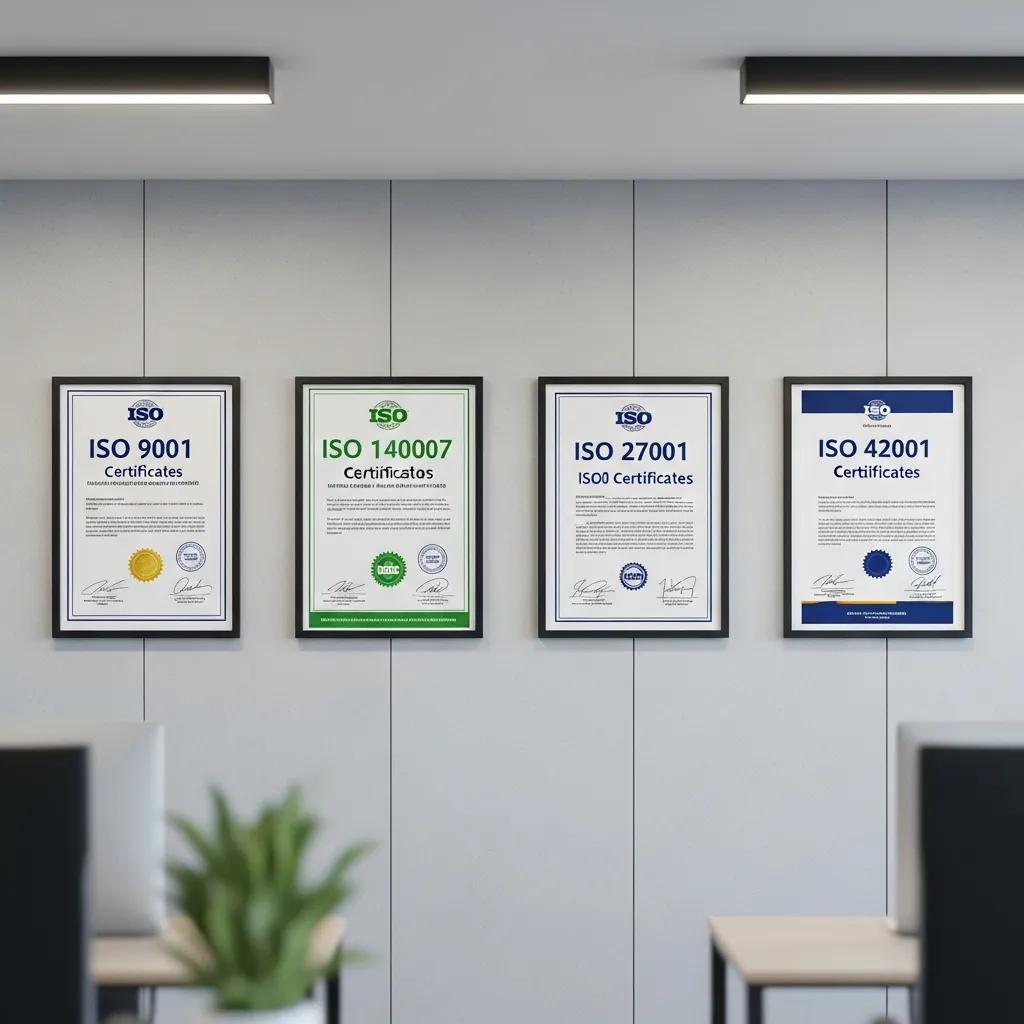
ISO 9001 is the foundational quality standard that supports operational consistency and customer satisfaction through a process‑based approach, customer focus, and leadership commitment. ISO 14001 helps organisations meet environmental regulations and access markets that prioritise sustainability — often a requirement for tenders and corporate procurement. ISO 27001 is critical for companies handling sensitive customer or IP data, turning information security into a competitive differentiator. ISO 42001 will help organisations govern AI systems and demonstrate responsible AI practices — increasingly important for technology vendors and data‑driven service providers, though the standard is not finalised yet.
Choose the standard that matches your strategic priorities: start with ISO 9001 to stabilise operations and quality; ISO 27001 to win security‑sensitive contracts; ISO 14001 to reach sustainability‑focused markets; and ISO 42001 to address AI governance risks once published. Picking the right entry point focuses resources and speeds the realisation of benefits aligned to your business case.
How Does ISO Certification Improve Operational Efficiency and Productivity?
ISO certification improves efficiency by standardising processes, clarifying roles, and embedding continual improvement — which reduces variation, lowers defects, and increases throughput. The working mechanism is the process approach combined with PDCA cycles: identify key processes, measure performance with KPIs, implement controls, and use internal audits to iterate. That creates sustained productivity gains instead of one‑off fixes. Organisations adopting ISO frameworks translate policy into shop‑floor actions, simplify training, cut rework, and shorten lead times. The following subsections spell out concrete process changes and how ISO 9001 drives consistent quality and smoother operations.
For quick clarity, here are three primary ways ISO certification boosts efficiency:
- Standardised process mapping and documented workflows that reduce variation and speed onboarding.
- KPI‑driven monitoring and root‑cause analysis that focus interventions on measurable cost savings.
- Continual improvement (PDCA) and internal audits that institutionalise steady productivity gains.
These practices turn abstract quality aims into daily routines that reveal waste and enable systematic elimination, preparing the organisation for targeted process improvements described next.
What process changes produce cost savings and waste reduction? Teams implement process mapping, standard work, visual controls, and KPIs to uncover inefficiencies and quantify losses. Root‑cause analysis and corrective actions eliminate recurring defects, while standard work reduces output and labour variability. Typical results often show single‑ to double‑digit reductions in scrap and rework within the first audit cycle, lowering direct costs and improving throughput. The table below summarises common controls and estimated impacts to help prioritise interventions.
| Process Control | Characteristic | Typical Impact |
|---|---|---|
| Process mapping | Visualises flows and handoffs | Reduces cycle time by 10-20% |
| Standard work | Documents best practice steps | Lowers error rates by 15-25% |
| KPI monitoring | Tracks defect and throughput metrics | Enables targeted reductions in waste |
| Root-cause analysis | Structured problem solving | Prevents recurrence of defects |
This comparison shows how specific controls map to measurable outcomes, helping teams decide which process changes to deploy first. From there, ISO 9001 codifies those controls into a repeatable quality system.
What Process Improvements Lead to Cost Savings and Waste Reduction?
Process improvements begin with mapping end‑to‑end flows, setting standard work, and tracking metrics that reveal non‑value activities and bottlenecks. With KPIs exposing variation, teams can run small PDCA experiments that reduce defects and shorten lead times — lowering waste and labour costs. Examples include tightening inspection criteria to cut rework, automating handoffs to remove delays, and using visual controls to prevent errors. Each change contributes to a measurable reduction in operating costs and feeds into a management system that sustains those gains.
By focusing on repeatable interventions and data‑driven improvements, organisations preserve gains and scale them across functions — the essence of efficiency improvement under ISO frameworks. The next subsection explains how ISO 9001 specifically drives these outcomes.
How Does ISO 9001 Drive Consistent Quality and Streamlined Operations?
ISO 9001 emphasises a process approach, leadership commitment, customer focus, and evidence‑based decisions to ensure consistent delivery. The standard requires documented procedures, clear responsibilities, internal audits, and corrective action systems that identify deviations and trigger root‑cause resolution — producing fewer defects and steadier throughput. Implementing ISO 9001 converts ad hoc practices into documented routines, lowering variability and accelerating onboarding. As organisations mature, those documents and audit records also make automation and IT integration easier, further streamlining operations.
ISO 9001’s clauses map directly to practical actions — creating work instructions, running internal audits, and establishing supplier controls — that produce operational outcomes. That direct link makes ISO 9001 a strong starting point for businesses seeking measurable efficiency and quality gains, and it primes the organisation for the customer‑facing credibility improvements discussed next.
In What Ways Does ISO Certification Boost Customer Satisfaction and Business Reputation?
ISO certification increases customer satisfaction by ensuring consistent quality, reliable delivery, and documented processes that reduce complaints and variability. Certification institutionalises a customer‑focused approach — requirements, monitoring, and corrective actions — that aligns product and service performance with expectations. Third‑party certification also serves as a trust signal where procurement teams, partners, and customers look for verifiable controls before committing to long‑term contracts. Below we explore how consistency builds loyalty and how certification shows up as credibility in the market.
Consistent quality improves customer loyalty by reducing defects, improving on‑time delivery, and creating predictable service experiences customers can rely on. When customers face fewer issues, they spend less time on escalations and are more likely to renew or recommend the supplier, increasing lifetime value. Documented processes also enable faster, traceable responses to feedback because corrective actions are prioritised and auditable. These customer‑level improvements translate into measurable retention gains that support revenue growth.
ISO certification also strengthens brand credibility in procurement and partner evaluations because certificates and audit evidence are tangible artifacts buyers use to vet suppliers. Including certificate details in proposals, along with auditable evidence like certificate numbers or registry entries, signals readiness for complex supply chains and regulated environments. That visibility shortens due diligence and positions certified organisations as lower‑risk partners, opening the door to higher‑value engagements and referrals.
How Does Consistent Quality Increase Customer Loyalty and Trust?
Consistent quality removes the variability that causes customer dissatisfaction and service failures; when outcomes are predictable, customers trust your performance and are more likely to stay. The mechanism includes reducing defects, improving first‑time‑right delivery, and using feedback loops to iterate on service design — all supported by documented processes and KPIs. Better service consistency lowers support costs, freeing resources to invest in relationship building and value‑added services that deepen loyalty. Over repeated positive interactions, trust accumulates and creates competitive insulation.
Because loyalty grows from repeatable, positive experiences, ISO‑driven improvements that remove root causes of complaints directly support retention and referral metrics. The next subsection covers how to position certification in brand and procurement communications to maximise credibility.
What Role Does ISO Certification Play in Enhancing Brand Credibility?
ISO certification is a visible, verifiable credential marketing, sales, and procurement teams can cite to demonstrate control, compliance, and reliability. Showing certification in proposals, capability statements, and supplier profiles gives buyers a quick signal of competence and reduces perceived supply risk. In tender evaluations, certification often shortens assessment timelines because auditors and procurement teams can rely on the third‑party assessment instead of running costly independent checks. That credibility effect helps organisations win larger deals, enter regulated markets, and negotiate stronger commercial terms.
Used strategically alongside case studies and measurable outcomes, certification becomes a commercial asset that amplifies your market position. With credibility established, organisations can pursue broader market access — as explained next.
How Can ISO Certification Provide a Competitive Advantage and Expand Market Access?

ISO certification creates a competitive advantage by meeting tender prerequisites, reducing buyer risk, and signalling operational maturity many customers require before engagement. The certificate acts as a credential that unlocks participation in global tenders, supply chains, and regulated markets by demonstrating system‑level controls and independent verification. This advantage is particularly valuable for SMEs scaling up: certification reduces onboarding friction and places them on a level with larger vendors. The subsections below outline common tender requirements and how certification opens partnership opportunities.
Why is ISO certification often a tender prerequisite? Many buyers include clauses that require suppliers to hold relevant certifications to ensure compliance with quality, environmental, or information security expectations. Auditors use certificates to prioritise suppliers in contract awards. Certification simplifies supplier evaluation by offering a consistent baseline of controls and documented evidence, reducing the buyer’s due diligence burden. Below is a practical checklist to prepare for tenders that reference ISO requirements.
When preparing to bid on tenders that reference ISO requirements, consider this checklist:
- Confirm the relevant management system certificate (e.g., ISO 9001, ISO 27001) is current and auditable.
- Prepare documented procedures and evidence for key clauses the tender references, such as risk assessment or change control.
- Have internal audit reports and corrective action records available to demonstrate system effectiveness.
Why Is ISO Certification a Prerequisite for Global Tenders and Supply Chains?
Procurement frameworks often require or favour suppliers with ISO certification because it reduces buyer risk and standardises expectations across vendors. Typical tender language asks for certificates, evidence of internal audit programmes, and a history of corrective actions; having this documentation ready streamlines evaluation. Certification also eases cross‑border trade because recognised standards provide a common compliance language for buyers in different jurisdictions. Preparing documentation and audit evidence in advance cuts bid preparation time and increases the chance of meeting tender prerequisites.
By meeting tender conditions proactively, organisations remove a major procurement barrier and gain access to larger contracts that can accelerate growth. That leads into how certification creates new partnership opportunities.
How Does Certification Open New Business Opportunities and Partnerships?
Certification signals that your organisation is a reliable partner by demonstrating systems for quality, sustainability, security, or AI governance — criteria many larger companies require before formal supplier relationships. That trusted‑partner status reduces onboarding checks, shortens negotiations, and makes you eligible for preferred‑supplier lists, joint ventures, or distribution agreements. Distributors and international buyers often ask for ISO certificates before adding a supplier to their portfolio. Certification cuts transactional friction and creates pathways to scale both domestically and abroad.
Organisations that leverage certification in partnership outreach can convert compliance into commercial advantage by showcasing measurable outcomes tied to their management systems.
What Are the Financial Benefits and ROI of ISO Certification for Businesses?
ISO certification typically delivers financial benefits through reduced waste, higher productivity, lower risk‑related costs, and access to higher‑value contracts — often producing a positive ROI within one to three years depending on scope and scale. The economic drivers are twofold: direct operational savings (fewer defects, less rework, improved throughput) and indirect gains (higher win rates, premium pricing, reduced insurance or compliance costs). Quantifying these effects requires mapping baseline metrics to post‑certification performance, but industry ranges below help set realistic expectations. Use these figures to build your business case.
To compare expected returns across standards, the table below summarises typical ROI‑related metrics for common ISO certifications using conservative industry ranges as planning inputs. This overview helps leaders prioritise which standard may yield the strongest near‑term financial impact.
| Standard | Primary Financial Driver | Typical Range |
|---|---|---|
| ISO 9001 | Productivity & defect reduction | 5-20% improvement in throughput and defect reduction |
| ISO 14001 | Compliance & operational efficiency | 5-15% savings in waste/disposal costs |
| ISO 27001 | Risk reduction & contract wins | Reduced breach risk; higher contract eligibility |
| ISO 42001 | AI governance & market trust | Lowers model risk; enables AI-focused partnerships (standard under development) |
How Does Certification Lead to Long-Term Cost Savings and Productivity Gains?
Certification embeds continuous improvement into everyday routines: documented processes and KPIs expose inefficiencies, audits prompt corrective action, and standard work reduces variability that drives waste. Over time, repeated PDCA cycles compound into steady productivity gains — small, repeatable improvements that lower labour and material costs while increasing capacity. Organisations commonly report measurable drops in scrap, rework, and returns alongside improved throughput that supports revenue growth without a proportional headcount increase. These operational gains underpin ROI models that justify the initial certification investment.
Estimating ROI requires mapping current defect rates, throughput metrics, and tender win probabilities to projected post‑certification improvements; the following subsection summarises supporting evidence for profitability improvements.
What Evidence Supports Increased Profitability from ISO-Certified Companies?
Industry studies and case examples consistently show certified firms achieve measurable improvements in efficiency and market outcomes: fewer defects, faster delivery, and higher customer satisfaction that drives repeat business. Aggregated analyses indicate productivity gains and cost reductions in the ranges noted earlier, and procurement teams report higher selection rates for certified suppliers when certification is a stated requirement. Results vary by industry and implementation quality, but the weight of evidence supports a positive net present value for well‑executed certification programmes. Use documented KPIs to demonstrate the link between certification activities and financial performance during internal buy‑in.
After quantifying benefits, many organisations look for a faster, lower‑friction route to certification — the next section explains how AI‑driven audits can accelerate that path.
How Does Stratlane’s AI-Driven Auditing Enhance the ISO Certification Experience?
Stratlane Certification is an accredited certification body that combines AI‑driven audit tools with experienced industry auditors to streamline ISO certification across ISO 9001, ISO 14001, ISO 27001, and ISO 42001 (once published). Our approach pairs automated evidence analysis with professional judgement to improve audit accuracy, shorten time‑to‑certification, and reduce cost, while supporting certificate issuance and ongoing management in over 27 countries with auditors operating in more than 29 countries. The typical workflow follows a clear path: quote → schedule → audit → certificate issuance and ongoing management. We also provide supporting resources like insights, FAQs, training, a certificate database, and certificate downloads. Below we explain the technology and compare it to traditional audit methods.
AI‑powered audits increase accuracy and efficiency by automating document analysis, spotting anomalies, and prioritising risk areas for human auditors to review — enabling broader evidence coverage with fewer auditor hours. Automated pattern detection surfaces inconsistent records and missing controls faster than manual review, allowing auditors to focus on context and judgment that machines can’t replicate. This hybrid model shortens audit time, speeds remediation cycles, and delivers clear, prioritised findings teams can act on. The table below contrasts traditional audits with AI‑driven approaches on typical time and cost characteristics.
| Audit Approach | Characteristic | Typical Impact |
|---|---|---|
| Traditional audit | Manual evidence review and sampling | Longer time; higher labour cost |
| AI-driven audit | Automated document analysis and risk prioritisation | Reduced audit hours; faster certification |
| Hybrid model | AI + accredited auditors | Improved accuracy and lower overall cost |
What Are the Advantages of AI-Powered Audits in Accuracy and Efficiency?
AI quickly identifies patterns, outliers, and missing evidence across document sets, enabling auditors to focus on high‑risk areas and complex judgments instead of routine sampling. Automated checks can scan policies, records, and logs for consistency, flag anomalies, and surface correlations manual review might miss — improving audit coverage and reducing false negatives. Combining AI outputs with experienced auditors creates a complementary workflow: technology handles repetitive analysis while humans validate context and implementation, increasing confidence in findings. That leads to more targeted corrective actions and a higher chance of first‑cycle certification success.
By improving the signal‑to‑noise ratio in findings, AI reduces wasted remediation effort and shortens the time between initial assessment and final certification decisions. The next subsection quantifies typical time and cost reductions and outlines how to request an audit.
How Does AI Reduce Certification Time and Costs for Businesses?
AI shortens certification timelines by automating evidence collection, applying intelligent sampling, and prioritising nonconformities so remediation focuses on the highest‑impact issues first. This commonly shortens audit cycles and follow‑ups. Automated analysis reduces auditor hours and cuts travel and coordination overhead, and faster remediation lowers total certification cost. Organisations using AI‑enabled audits typically see quicker scheduling and a clearer path from quote to certificate because scope and evidence needs are identified earlier. If you’re ready to pursue certification, requesting a quote, scheduling an AI‑assisted readiness assessment, or using certificate management services will streamline the route to recognised certification.
For quick planning, consider these practical next steps:
- Request a tailored quote to align audit scope with business objectives and timeline.
- Schedule an AI‑assisted readiness assessment to identify high‑priority nonconformities.
- Use certificate management services to store evidence and support renewals over time.
Frequently Asked Questions
What is the process for obtaining ISO certification?
The certification process typically includes these steps: choose the ISO standard that fits your objectives; develop and document the management system to meet the standard’s requirements; run internal audits to verify readiness; engage an accredited certification body for an external audit; and, if successful, maintain certification through regular surveillance audits and continual improvement. Each step focuses on evidence, controls, and demonstrable effectiveness.
How long does the ISO certification process typically take?
Timelines vary by organisation size, complexity, and readiness. It can take a few months up to more than a year. Smaller organisations with simpler processes often certify faster, while larger or more complex organisations need more time to implement changes and prepare evidence. Resource availability, staff training, and the quality of internal audits also affect the schedule. Clear planning and commitment make the journey smoother.
What are the costs associated with ISO certification?
Certification costs depend on size, process complexity, and the standard chosen. Typical expenses include fees for the certification body, internal audit costs, staff training, and any consultancy support during implementation. There are also ongoing costs such as surveillance audits and periodic recertification (usually every three years). A well‑planned approach helps manage and forecast these costs effectively.
Can small businesses benefit from ISO certification?
Yes. Small businesses gain operational clarity, improved product or service quality, and stronger customer confidence — all of which support growth. Certification can give a competitive edge in regulated markets and make it easier to win contracts. It also helps small teams streamline processes, cut waste, and lower costs, contributing to long‑term sustainability and profitability.
How often do organizations need to renew their ISO certification?
ISO certifications are typically renewed every three years, with regular surveillance audits (commonly annual) to ensure ongoing compliance. These surveillance activities identify improvement opportunities and confirm the management system remains effective. Significant organisational changes or updates to the ISO standard may trigger additional assessments. Maintaining certification requires an ongoing commitment to continual improvement.
What role does employee training play in achieving ISO certification?
Employee training is essential. Staff must understand the processes, policies, and responsibilities required for compliance. Training helps people play their part in the management system, participate in audits, and contribute to corrective actions. Investing in training supports the certification process and strengthens overall performance and engagement across the organisation.
Conclusion
ISO certification unlocks clear benefits: improved operational efficiency, higher customer satisfaction, and a stronger market position. By following internationally recognised standards, organisations can streamline processes, cut waste, and build trust with stakeholders. Taking the first step toward certification can transform how you operate and open new opportunities. Explore our services to start your ISO certification journey.