
What is ISO 9001? Explore Quality Standards and Definitions

ISO 9001:2015 — Practical Quality Management Guidance for Businesses
ISO 9001:2015 is the global standard for Quality Management Systems (QMS). It sets out requirements that help organizations reliably meet customer and regulatory expectations while improving operational performance. The standard uses a process-based, risk-aware framework and the Plan–Do–Check–Act cycle to reduce variation, increase predictability, and deliver measurable improvement. This article translates ISO 9001 into practical terms: what the standard requires, which clauses matter most, how certification works, and how modern tools — including AI-assisted auditing — speed evidence collection and readiness. We focus on turning clause language into operational controls and measurable KPIs, with checklists and guidance you can act on. After a short definition and context, we walk through core clauses, benefits and KPIs, the certification pathway, the role of AI in audits, and steps to prepare for the ISO 9001:2025 update so you can plan a clear compliance roadmap.
Weat Stratlane Certification support organizations pursuing certification with AI-enabled audit tooling, gap analyses, and certificate management to streamline readiness and shorten time-to-certification. Mentioned here to show where specialist help typically fits, Stratlane Certification operates across the US, EU, and UK and emphasizes AI-driven evidence collection to improve audit accuracy and efficiency. This introduction frames practical next steps while keeping the focus on ISO 9001 fundamentals and implementation strategy.
What is ISO 9001:2015 and Why is it Important for Quality Management?
ISO 9001:2015 defines the requirements for a QMS that helps organizations consistently deliver products and services that meet customer and regulatory needs. It’s built around mapping key processes, setting measurable objectives, identifying and managing risks and opportunities, and using monitoring and corrective actions to drive continual improvement. The outcome is stronger customer confidence, fewer defects, and more predictable operations — all of which support growth and eligibility for procurement opportunities. Grasping the standard’s purpose helps leaders prioritize resources and tie quality objectives to business outcomes.
ISO 9001 delivers several practical benefits for organizations:
- Stronger customer confidence through documented processes and consistent outputs.
- Lower variability and defects thanks to process controls and performance tracking.
- Better alignment with suppliers and stakeholders through defined requirements and metrics.
- Evidence-based decisions driven by monitoring, analysis, and management reviews.
- A repeatable approach to continual improvement using the PDCA cycle.
These principles form the backbone of a QMS and lead into a concrete view of how ISO 9001 looks in practice.
How Does ISO 9001 Define a Quality Management System?
Under ISO 9001:2015, a QMS is a coordinated set of policies, processes, procedures, and records that enable an organization to meet its quality objectives and manage risk. Typical QMS elements include a quality policy, measurable objectives, documented processes for core activities, performance records and nonconformity logs, plus scheduled management reviews to check effectiveness. Common operational tools are process maps, work instructions, document control systems, internal audit plans, and CAPA logs that demonstrate conformity. Continual improvement is driven by linking performance data to root-cause analysis and corrective actions, then updating procedures and objectives accordingly.
This process-focused view connects directly to the standard’s guiding principles, which explain why these elements are required and how they combine to deliver consistent quality.
What Are the Key Principles Behind ISO 9001:2015?
ISO 9001:2015 is built on seven quality management principles: customer focus, leadership, engagement of people, process approach, improvement, evidence-based decision making, and relationship management. These principles justify clause requirements and help organizations align quality goals with business priorities. In practice they become actions like setting customer-centered metrics, clarifying leadership responsibilities, and maintaining supplier performance controls. Applying these principles ensures the QMS supports both operational discipline and the ability to adapt as context or stakeholder needs change.
With those principles in mind, the next section walks through the standard clause by clause to show where requirements map to operational controls and evidence.
What Are the Core Requirements and Clauses of ISO 9001:2015?
ISO 9001:2015 organizes requirements into clause groups that guide an organization from context and leadership through operation, performance evaluation, and improvement. The structure helps management demonstrate conformity through documented evidence, records, and objective data. Practically, conformity means a documented scope and context, a quality policy, risk-based planning, process controls, documented support activities, monitoring and audits, and an effective corrective action process. The list below highlights the main clause groups with a concise focus for each.
- Context of the organization: Define internal and external issues and interested parties.
- Leadership: Top management responsibility, policy, and strategic alignment.
- Planning: Quality objectives, risk-based thinking, and change management.
- Support: Resources, competence, awareness, communication, and documented information.
- Operation: Process controls, product/service delivery, and control of externally provided processes.
- Performance evaluation: Monitoring, internal audit, and management review.
- Improvement: Nonconformity handling, corrective actions, and continual improvement.
Below is a quick reference linking each clause to its purpose and practical tools organizations use to demonstrate compliance.
Introductory table summarizing key clauses, practical purposes, and example tools for compliance:
| Clause | Purpose | Practical Example / Tool |
|---|---|---|
| Context of the organization | Establish scope and relevant issues | SWOT/context matrix, stakeholder map |
| Leadership | Ensure top management ownership | Quality policy, leadership meeting minutes |
| Planning | Set objectives and address risks | Risk register, SMART objectives |
| Support | Provide resources and control information | Training records, document control system |
| Operation | Control product/service delivery | Process maps, work instructions |
| Performance evaluation | Measure and review system performance | KPI dashboards, internal audit reports |
| Improvement | Correct and prevent nonconformities | CAPA logs, root-cause analysis tools |
This clause map clarifies where practical evidence should be collected and how tools — including digital systems — support compliance and traceability.
How Does the Context of the Organization Influence ISO 9001 Compliance?
Context sets the scope and priorities of the QMS by identifying internal and external issues, interested parties, and their requirements. Internal factors include structure, capabilities, and culture; external factors include market conditions, regulations, and supply-chain dependencies. Capturing these factors in a concise context statement and a stakeholder requirements list defines the QMS boundary and helps prioritize risks and opportunities. A simple checklist — identify issues, list interested parties, capture requirements, confirm scope — documents the rationale for including or excluding processes from the QMS.
From context analysis you move to leadership and planning steps that turn the findings into policies, objectives, and resource allocation.
What Roles Do Leadership and Planning Play in ISO 9001 Implementation?
Leadership must embed the QMS into business strategy by setting a clear quality policy, assigning responsibilities, and securing resources; planning translates that direction into measurable objectives and risk-based controls. Top management should visibly demonstrate commitment — for example by chairing management reviews and ensuring quality objectives cascade into operational plans. Planning includes setting SMART objectives, identifying risks and opportunities, and designing controls into processes. When leaders tie QMS goals to business KPIs and resource commitments, the organization creates sustainable conditions for compliance and continual improvement.
Strong leadership and disciplined planning set the stage for measurable benefits, outlined next.
What Are the Benefits of ISO 9001 Certification for Businesses?
ISO 9001 certification delivers both qualitative and quantitative benefits across customer trust, operational performance, and market access. Certification provides external validation of your QMS and often yields measurable KPI improvements such as fewer defects, faster delivery, and reduced customer complaints. It also strengthens supplier management and procurement eligibility, potentially unlocking new contracts. Below are common benefits organizations achieve with an effective ISO 9001 QMS.
- Higher customer satisfaction from consistent delivery and structured complaint handling.
- Operational efficiency through standardized processes and reduced waste.
- Clearer supplier expectations and improved supplier performance.
- Stronger regulatory and contractual compliance via documented controls.
- A culture of continuous improvement driven by data and corrective actions.
To make benefits easy to scan, the table below links each benefit to typical KPI improvements and how AI-assisted audits can speed results.
| Benefit | Typical KPI Improvement | How Stratlane’s AI audits accelerate achievement |
|---|---|---|
| Customer Satisfaction | Reduced complaints by 20-40% | Automated evidence collection identifies recurring causes faster |
| Operational Efficiency | Cycle time reduction of 10-30% | Process mining speeds detection of bottlenecks |
| Defect Reduction | Decreased nonconformities per unit | Anomaly detection targets high-risk batches quickly |
| Supplier Performance | Fewer supplier deviations | AI-assisted supplier scoring highlights weak links |
| Compliance Confidence | Faster audit preparation time | Automated document control and evidence bundling |
This comparison shows how objective KPIs map to certification benefits and where modern audit techniques deliver measurable acceleration.
Stratlane Certification’s AI-driven auditing and certificate management can amplify these outcomes by automating gap analysis, improving audit coverage, and handling certificate administration. These services supplement internal work to shorten time-to-certification while keeping evidence quality and audit readiness high.
How Does ISO 9001 Improve Customer Satisfaction and Operational Efficiency?
ISO 9001 increases customer satisfaction and efficiency by formalizing process controls, measurement plans, and feedback loops that catch and correct deviations before they reach customers. Typical mechanisms include defined acceptance criteria, monitoring plans, nonconformity handling, and corrective-action cycles that turn customer feedback into systemic fixes. KPIs that commonly improve under a QMS include first-pass yield, on-time delivery, and mean time to resolution for complaints. For example, a successful corrective action that removes a recurring defect can shorten lead times and raise satisfaction scores.
Those operational gains also support commercial differentiation, discussed next.
What Competitive Advantages Does ISO 9001 Certification Provide?
ISO 9001 certification offers practical market advantages: eligibility for regulated tenders, stronger procurement credibility, and a clearer value proposition for clients who prioritize consistency and compliance. Many buyers prefer or require certified suppliers, so certification becomes a market-access lever and a signal of lower supply risk. Over time, organizations often see better ROI through less rework, lower warranty costs, and higher customer retention driven by consistent quality. Framing benefits in ROI and reputation terms helps management justify investment in the QMS and continuous improvement.
Understanding benefits leads naturally to the next section on the certification pathway and what each step requires.
How Does the ISO 9001 Certification Process Work?
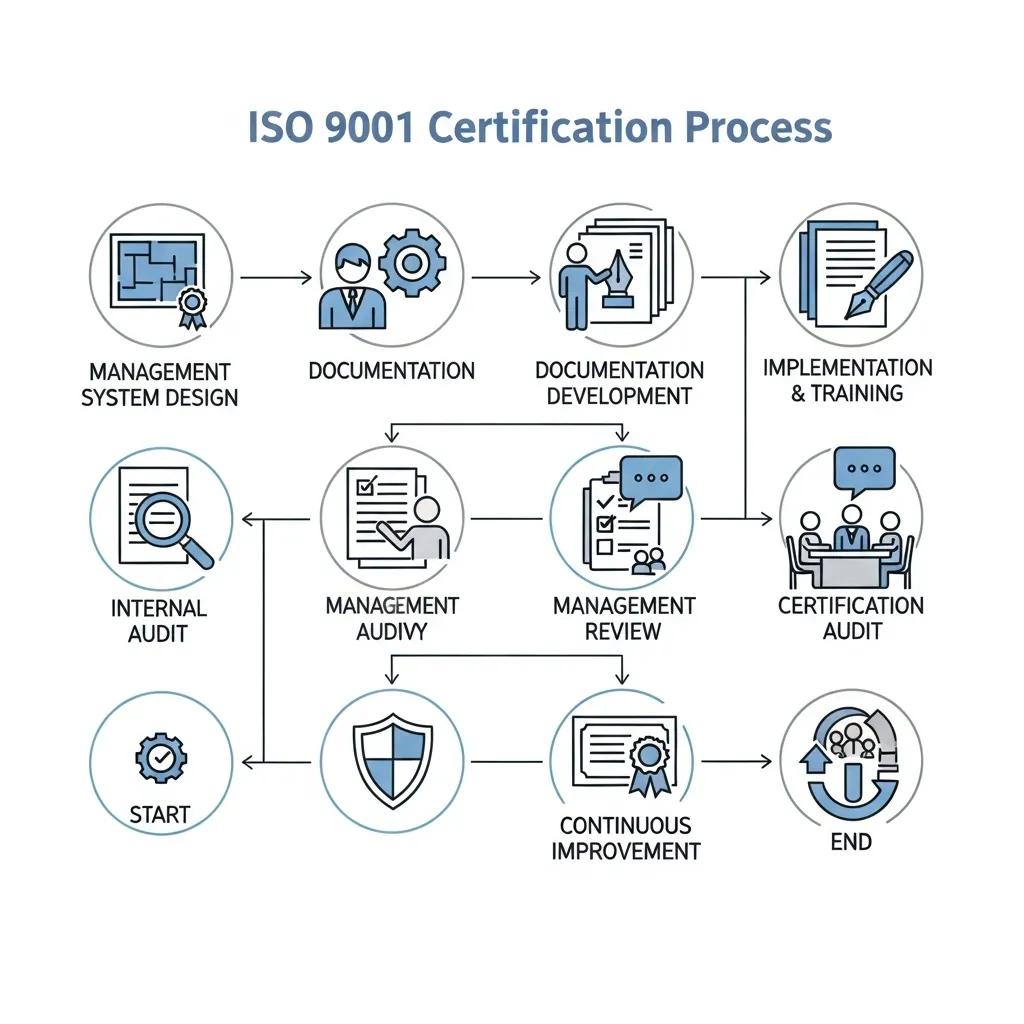
The certification process follows a predictable sequence from readiness assessment through external audit and ongoing surveillance, which makes planning timelines and responsibilities straightforward. Typical flow: perform a gap analysis to find nonconformities, implement corrective actions, run internal audits and management reviews, then undergo a two-stage external certification audit (stage 1 documentation review and stage 2 on-site verification). After certification, surveillance audits and periodic re-certification keep the QMS current and effective.
Here’s a concise numbered view of the usual certification journey and where teams focus effort.
- Gap analysis: Assess your QMS against ISO 9001 and identify remediation tasks.
- Implementation: Update processes, documents, and train staff to close gaps.
- Internal audit and management review: Verify effectiveness and certification readiness.
- Certification audit (Stage 1 and Stage 2): External body reviews documentation, then verifies implementation.
- Maintenance and surveillance: Ongoing internal controls and scheduled external surveillance audits.
Each step needs specific evidence and roles. The checklist below summarizes key deliverables and shows how providers like Stratlane typically assist.
- Gap analysis: Deliverables include gap reports and prioritized remediation plans; Stratlane can provide AI-assisted gap assessments to speed discovery.
- Implementation: Deliverables include updated procedures and training records; Stratlane’s advisory support maps corrective actions to clause requirements.
- Internal audit: Deliverables include internal audit reports and corrective action logs; Stratlane offers AI-assisted internal audit tools to increase coverage.
- Certification audit: Deliverables include audit evidence packs and nonconformity responses; Stratlane supports evidence bundling and certificate management.
- Maintenance: Deliverables include surveillance reports and KPI tracking; Stratlane provides certificate management to track expiry and surveillance readiness.
These mappings show where specialist services commonly complement in-house work to reduce time-to-certification and administrative overhead.
What Are the Steps from Gap Analysis to External Certification Audit?
A gap analysis is a clause-by-clause review that identifies missing controls and required documentation and produces a remediation plan with priorities and owners. Implementation turns those changes into documented processes, training materials, and records that show competence and control. Internal audits test implementation and feed corrective actions into management reviews that confirm readiness for external audit. During certification, stage 1 verifies documentation and scope; stage 2 assesses operational evidence and effectiveness. Auditors look for objective records, traceability, and closure of corrective actions. Preparing concise audit packs and evidence matrices reduces auditor queries and speeds certification.
Each preparatory step links to tools and processes that accelerate readiness, as outlined above and in potential specialist support mappings.
How Can Businesses Maintain Certification and Ensure Continuous Improvement?
Maintaining certification requires scheduled surveillance audits, continuous internal monitoring, regular management reviews, and timely corrective-action follow-up that shows continual improvement and risk management. Keep a surveillance calendar with internal audits, KPI reviews, supplier checks, and training refreshers so evidence stays current. Track metrics such as nonconformity trends, corrective-action closure time, customer satisfaction indices, and process performance indicators for management review. Strong document control and automated reminders for evidence updates reduce last-minute audit work.
Consistent monitoring and prompt corrective actions create the feedback loop that sustains certification and supports strategic quality improvements.
How is AI-Driven Auditing Transforming ISO 9001 Quality Management?

AI-driven auditing applies machine learning and automation to evidence collection, sampling, anomaly detection, and risk scoring in QMS audits. These tools improve coverage and reduce manual effort by automating document classification, recognizing patterns across records, and using process mining to spot inefficiencies and nonconformance patterns that manual review can miss. The main benefits are faster gap detection, broader audit coverage, and prioritized risk insights that enable focused corrective actions. Importantly, AI augments audits — human judgment is still essential to interpret findings and validate context.
To map capabilities to audit phases, the table below shows common AI features, the phase they support, and typical benefits.
| AI Capability | Audit Phase | Benefit / Metric |
|---|---|---|
| Automated evidence gathering | Preparation & sampling | Audit prep time reduced by up to 50% |
| Anomaly detection | Field audit & review | Higher detection rates of hidden deviations |
| Process mining | Operational analysis | Bottleneck identification in hours vs weeks |
| Document classification | Document control | Faster retrieval and version control alerts |
| Predictive risk scoring | Risk-based planning | Prioritized audit areas with higher ROI |
This mapping shows where AI adds measurable value and where auditors retain judgment and governance responsibilities.
Stratlane Certification integrates AI-driven tools to improve assessment quality, efficiency, and cost-effectiveness for clients seeking ISO 9001 and related certifications. Our approach focuses on AI-assisted gap analysis, automated evidence bundling, process mining to reveal improvement opportunities, and certificate management to reduce administrative burden. By combining AI with human oversight, we help reduce time-to-certification and improve corrective-action precision while maintaining audit defensibility.
What Are the Benefits of Using AI in ISO 9001 Audits?
Using AI in audits increases sampling coverage, speeds up evidence collation, and applies audit criteria consistently to reduce human error and bias. Automated sampling and pattern recognition let auditors analyze larger datasets and surface systemic issues that manual sampling might miss. Measured benefits often include fewer audit hours, higher anomaly detection rates, and shorter remediation cycles. For example, process mining can reveal a workflow loop that causes repeated nonconformities — enabling a targeted corrective action that improves performance measurably.
These gains should be balanced with governance and human review to ensure conclusions are contextually accurate and data quality is managed.
How Does AI Enhance Risk Management and Document Control in QMS?
AI supports risk management by continuously analyzing operational data, flagging emerging risks, and prioritizing audit focus areas with predictive scoring — so audit resources go where they have most impact. For document control, AI-assisted classification and version tracking cut manual search time and alert teams to outdated procedures or missing records before audits. Practical implementations include automated risk registers that update as anomalies appear and document alerts that notify owners of version mismatches. Governance requires human validation of AI findings and clear data-quality protocols to avoid false positives and preserve audit defensibility.
Well-integrated AI capabilities make the QMS more proactive and data-driven, improving risk mitigation and long-term compliance.
What Are the Upcoming Changes in ISO 9001:2025 and Their Impact?
ISO 9001:2025 is expected to place greater emphasis on digital transformation, data management, and clearer integration of modern risk approaches. Anticipated changes may highlight how organizations manage information, digital controls, and emerging technologies within the QMS. Possible updates include stronger language on digital evidence, clarified expectations for risk-based thinking, and guidance related to AI or automated decision-support used as documented information. These shifts will raise the bar for information integrity, data governance, and automated controls in QMS design and audit evidence collection. Organizations should watch ISO announcements and start readiness work for likely editorial and substantive updates.
What Updates Are Expected in the ISO 9001:2025 Revision?
Industry indicators suggest ISO 9001:2025 will include updated terminology for digital data management, clearer guidance on managing outsourced digital services, and tighter alignment of risk-based thinking with modern analytical tools. Expected topics may cover control over automated processes and the integrity of digital records used as audit evidence. Organizations should be ready to demonstrate oversight of algorithmic decision-making and controls around digital evidence. While final text awaits publication, acting now to strengthen digital controls and data governance will be advantageous.
How Should Businesses Prepare for the Transition from ISO 9001:2015 to 2025?
Prepare for 2025 by running a readiness gap analysis focused on digital controls, data governance, and AI oversight. Update QMS documents and training plans where needed. Practical actions: inventory systems that produce quality evidence, define ownership and validation for automated outputs, and pilot AI-assisted audit tools to build experience and governance. Prioritize traceability of digital records, clear responsibilities for algorithmic decisions, and adding digital risks to your risk register. A phased approach — assess, pilot, update documents, retrain staff — keeps disruption low and preserves audit readiness.
- Key readiness actions: Conduct gap analysis, update documentation, pilot AI audits, and retrain staff.
- Timeline suggestion: Immediate assessment, 3–6 month pilots, 6–12 month documentation updates, ongoing monitoring.
- Priority areas: Data governance, digital evidence control, AI oversight, and supplier digital risk.
These priorities help align your QMS with likely 2025 changes and sustain continual improvement as the standard modernizes.
Frequently Asked Questions
What types of organizations can benefit from ISO 9001:2015 certification?
ISO 9001:2015 suits organizations of all sizes and sectors — manufacturing, services, healthcare, non-profits, and more. Any organization that wants to strengthen its quality practices and improve customer satisfaction can apply the standard. ISO 9001 is flexible and scalable, so it can be tailored to both small businesses and large enterprises to streamline operations, boost efficiency, and enhance competitive positioning.
How long does the ISO 9001 certification process typically take?
Timing varies with organization size, complexity, and current readiness. The process can take a few months to over a year. Key timeline drivers are the initial gap analysis, the scope of implementation work, internal audits, and scheduling the external certification audit. Organizations with mature quality practices usually move faster than those starting from scratch.
What are the costs associated with obtaining ISO 9001 certification?
Costs vary depending on company size, process complexity, and the certification body you choose. Typical expenses include audit fees, training, and any investments in process improvements or documentation. Don’t forget ongoing costs for surveillance audits and internal auditing. Budget for both initial certification and the activities needed to maintain compliance over time.
How can organizations ensure they remain compliant with ISO 9001 after certification?
To stay compliant, keep a robust internal audit schedule, hold regular management reviews, and continuously monitor KPIs. Foster a culture of continual improvement so audit findings and customer feedback drive process changes. Stay alert to standard updates and revise your QMS accordingly. Ongoing training and awareness help keep staff aligned with quality objectives and procedures.
What role does employee training play in ISO 9001 compliance?
Training is essential. It ensures staff understand the QMS, their roles, and the importance of following documented processes. Training builds a quality-minded culture and empowers people to spot improvement opportunities. Provide ongoing learning and refreshers to keep teams current on procedures, best practices, and any changes to the QMS.
How does ISO 9001 certification impact supplier relationships?
Certification clarifies quality expectations and performance metrics for suppliers, which improves collaboration across the supply chain. Certified organizations often require suppliers to meet comparable standards, reducing defects and improving communication. Being ISO 9001 certified also makes you a more attractive partner, signaling consistent processes and a commitment to continuous improvement.
Conclusion
Adopting ISO 9001:2015 gives organizations a structured, repeatable way to raise quality, reduce risk, and improve customer outcomes. By understanding core requirements and using modern tools like AI-assisted audits, teams can simplify the certification journey and keep compliance sustainable. The practical guidance here is designed to help you take clear steps toward achieving and maintaining ISO 9001 certification. Start planning your next steps today — review your gaps, define priorities, and consider specialist support to accelerate readiness.