
Essential Guide to QMS Documentation for ISO 9001:2015

ISO 9001:2015 Documentation — What it Requires and How to Implement It
Under ISO 9001:2015, “documented information” is the controlled evidence that defines and proves how your Quality Management System (QMS) works. It covers both the documents that direct work and the records that prove results, giving you consistency, traceability, and auditability. This guide unpacks clause 7.5, explains why having fewer mandatory documents doesn’t mean less documentation work, and shows how good documentation supports risk-based thinking and continual improvement. You’ll find which documents and records are required or commonly used, how to write a quality policy and measurable objectives, how to control documentation in practice, and how AI-driven auditing can speed certification readiness. Expect practical checklists, quick-reference tables, and step-by-step implementation guidance to prepare for internal and external audits. When you finish this guide, you’ll be able to map documented information to ISO clauses, design record-keeping for audit evidence, and use modern tools — including AI examples — to streamline certification prep.
What is Documented Information in ISO 9001:2015 and Why is it Important?
“Documented information” is any information your organization must control and keep to support the QMS and show that processes are carried out as planned. It includes both active documents (procedures, work instructions) and static records (inspection reports, certificates). Documented information turns tacit knowledge into auditable, repeatable practices so teams can deliver consistent results and auditors can verify compliance. Although ISO 9001:2015 removed many prescriptive lists, it still requires you to determine what documented information is necessary for an effective QMS and for regulatory conformity. Clear, well-controlled documented information makes audits faster, corrective actions quicker, and performance easier to measure. That distinction between documents and records matters for how you control and retain each item.
Experts explain how the standard shifted from prescriptive documents to a flexible “documented information” model.
ISO 9001:2015 — Documented Information & QMS Implementation
This paper examines the paperwork needed to implement a Quality Management System. The 2015 revision defines “documented information” as the data organizations must control and maintain to support operations and to be confident processes run as intended. A compliant QMS must include the documented information explicitly required by the standard and any additional documentation the organization needs to ensure the system is effective.
From documented procedure to documented information: The new approach of ISO 9001: 2015, L Borsacchi, 2015
Clause 7.5 places documented information at the heart of control and traceability — the next section explains how documents and records serve different roles.
How do Documents and Records Differ in ISO 9001:2015?
Documents are living instructions that guide how work should be done; records are the frozen evidence that shows what actually happened. Documents — such as procedures or work instructions — need version control, approval, and a named owner so teams always use the current requirement. Records — like completed checklists or calibration certificates — are static once created and must be retained, protected from unintended changes, and easy to retrieve. Control requirements therefore diverge: documents require review and approval workflows and clear accessibility rules; records need retention schedules, protection against alteration, and indexing for retrieval. This separation explains why document control focuses on preventing obsolete instructions from circulating, while record management focuses on preserving audit evidence.
With that distinction clear, the next section highlights the practical benefits of good documentation for your QMS.
What Benefits Does Effective Documentation Bring to a Quality Management System?
Good documentation makes work consistent by translating requirements into clear steps teams can follow, which reduces variability and defects. It makes audits more efficient because auditors can trace decisions and results through indexed records and controlled documents, often cutting audit time and findings. Documentation speeds onboarding and training with authoritative work instructions and process maps, lowering error rates and boosting productivity. It also supports continual improvement by preserving evidence of nonconformities and corrective actions for root-cause analysis and prevention. Together, these benefits increase customer confidence, simplify regulatory compliance, and help you decide which documents are mandatory or recommended for ISO 9001:2015 compliance.
Next, we list the documents you must keep and the ones most organizations maintain.
Which Mandatory Documents are Required for ISO 9001:2015 Compliance?
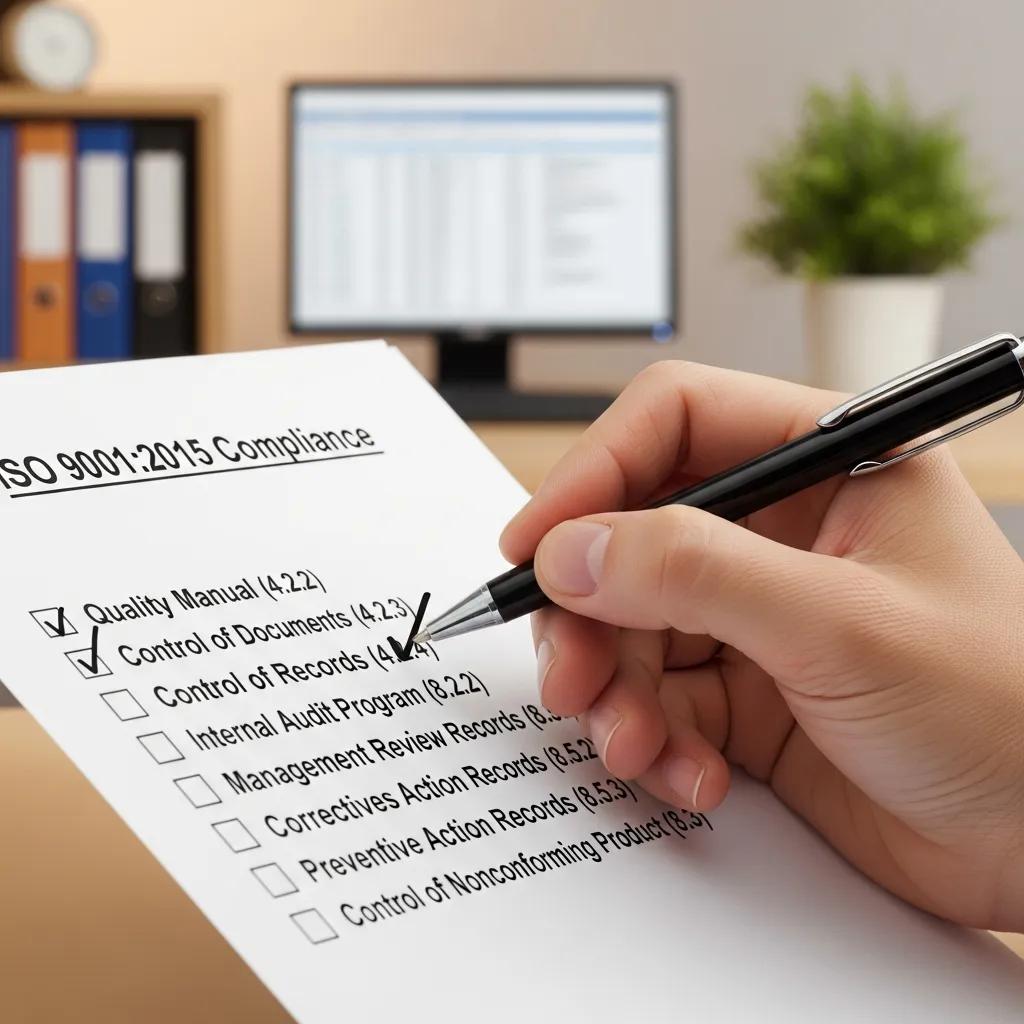
ISO 9001:2015 favors a flexible “documented information” approach rather than a fixed list, but some items are still essential. At minimum you must have a quality policy (clause 5.2) and quality objectives (clause 6.2), plus whatever documented information is necessary to plan, operate, and control your processes. Records the standard requires — such as audit and calibration records — must also be retained. Many organizations also keep a quality manual, process maps, documented procedures where needed, and work instructions for complex or high-risk activities. The checklist below helps you map required content to clauses so you can prepare audit evidence while keeping documentation lean.
Below is a quick reference table of recommended and mandatory documentation with clause references, purpose, and example templates.
This table lists essential documented information for compliance and practical use.
| Document | ISO Clause | Purpose / Required Content | Example Template (description) |
|---|---|---|---|
| Quality Policy | 5.2 | Statement of commitment to quality and alignment with context; must be communicated and reviewed | Concise policy template with commitments and review cadence |
| Quality Objectives | 6.2 | Measurable objectives tied to the policy and monitored for progress | SMART objective template with KPIs and assigned owners |
| Scope of QMS | 4.3 | Defines QMS boundaries and applicability, including any justified exclusions | Scope statement template with exclusion rationale |
| Control of Documented Information Procedure | 7.5 | Rules for approval, versioning, access, retention and ownership | SOP outline for document control workflows |
| Records (internal audits, calibration) | Multiple (e.g., 9.2, 7.1.5) | Evidence of conformity and ongoing process performance | Record index template showing retention periods |
This mapping helps teams identify what to create or update. Next, we focus on building an effective quality policy.
The quality policy sets direction; below are the requirements and concise examples.
What are the ISO 9001:2015 Quality Policy Requirements and Examples?
Your quality policy must suit your organization’s purpose, include a commitment to meeting requirements and continually improving the QMS, and provide a framework for setting quality objectives (clause 5.2). It becomes effective when top management approves it, communicates it across the organization, and ties it into objectives and performance measures. A practical policy is short, measurable, and owned — for example: “We commit to meeting customer requirements, reducing defects, and reviewing objectives annually.” Make the policy easy to find, include it in training, and reference it during management reviews so it clearly links strategy to operations and audit evidence.
Objectives should flow directly from the policy; the next section explains how to set them using SMART criteria.
How to Define Quality Objectives According to ISO 9001:2015?
Quality objectives must be measurable, aligned with the quality policy, and assigned owners and timelines (clause 6.2). Use SMART criteria — Specific, Measurable, Achievable, Relevant, Time-bound — for clarity. Example: “Reduce product defect rate by 15% within 12 months through process control and targeted training.” Link objectives to processes and define how you’ll measure them (control charts, KPIs, management review inputs). Assign owners, name data sources, and schedule regular reviews so objectives feed continual improvement and corrective actions. Clear measurement and review make effectiveness easy to demonstrate during audits.
With documents and objectives defined, you need records to prove performance. The next section lists essential records and ownership.
What ISO 9001:2015 Records Must Organizations Maintain?
Records are the retained evidence that show processes ran as planned and outputs met requirements — they form the audit trail. Common records include internal audit reports, management review minutes, training records, nonconformity and corrective action files, calibration certificates, and supplier evaluations. Each record should show who did what, when, and with what result, and include metadata (owner, date, version) for retrieval and integrity. Best practice is a records index, retention rules aligned with legal and business needs, protection against alteration, and searchable storage (digital or paper) so auditors can find evidence quickly. Clear ownership and retention policies reduce findings and speed surveillance cycles.
Below is a practical table clarifying record types, clause references, recommended retention guidance, and typical evidence formats.
This table clarifies ownership and formats auditors typically expect.
| Record Type | ISO Clause | Retention / Who Records It | Typical Evidence Format |
|---|---|---|---|
| Internal Audit Reports | 9.2 | Audit manager / 3 years recommended minimum | PDF reports, findings log, corrective action records |
| Management Review Minutes | 9.3 | Top management / 3 years recommended minimum | Meeting minutes with action items and decisions |
| Training Records | 7.2 | HR / process owners / retained for period of demonstrated competence | Attendance sheets, competence matrix, certificates |
| Nonconformity & Corrective Actions | 10.2 | Process owners / retained until closure plus supporting evidence | CAPA logs, root cause analysis reports, verification records |
Keeping these records supports traceability across your QMS. The following section explains which records auditors commonly request for audits and management reviews.
Which Records are Essential for Internal Audits and Management Reviews?
Auditors typically request internal audit schedules and reports, corrective action records that link findings to remediation and verification, and management review minutes showing top-management engagement with QMS performance. These records demonstrate the loop of monitoring, measurement, and improvement: audits identify gaps, corrective actions close them, and management review confirms effectiveness and resource needs. Useful evidence includes audit checklists, sampled objective data, trend analysis, and action-item tracking with closure verification. Organize these items in a searchable index and link evidence to objective metrics to reduce auditor time and strengthen continual improvement reporting. Well-linked records also speed preparation for external certification and surveillance audits.
How to Manage Nonconformity and Corrective Action Records Effectively?
Handle nonconformities with a clear lifecycle: record the event, investigate and document root cause, plan corrective actions with owners and due dates, capture implementation evidence, and verify effectiveness before closure.
Design the flow to include containment, root-cause tools (5 Whys, fishbone), corrective-action planning, implementation evidence, and post-implementation verification.
Typical corrective-action log fields include nonconformity ID, date, description, root cause, corrective actions, responsible person, target date, closure evidence, and verification notes.
Maintain audit trails and link corrective actions to trends and management review outcomes so improvement is demonstrable and recurring issues are reduced. Clear lifecycle management strengthens evidence for certification audits.
With records and corrective actions managed, you need practical controls for document implementation — the next section covers how to implement and control documentation.
How to Implement and Control ISO 9001:2015 Documentation Effectively?
Implementing and controlling documentation starts with a document-control policy, plus defined owners for each document, versioning rules, approval workflows, access permissions, and review cadences. Process governance works like this: owners keep content accurate, approvers validate suitability, and access controls prevent use of obsolete instructions. The payoff is fewer nonconformities caused by outdated procedures, better-scaled training, and improved audit readiness. Choose between manual methods, cloud QMS platforms, or hybrid solutions based on your organization’s size, regulatory needs, and integration requirements.
A reliable system for controlling documented information is central to compliance and operational effectiveness.
ISO 9001:2015 — Document Control System Guide
This guide outlines a process-based approach for controlling all forms of documented information required by the standard. It covers approval, version control, distribution, retention, and protection of documentation to meet ISO 9001:2015 and related regulatory needs.
How to Establish a Document Control System for Compliance with ISO 9001: 2015, ISO 13485: 2016, and FDA Requirements: A Comprehensive Guide to …, 2015
Below is a comparison table mapping document-control steps to roles, frequencies, and best practices — including AI-enhanced options.
| Process / Document Control Step | Attribute (owner, frequency, tool) | Best Practice / AI-enhanced option |
|---|---|---|
| Document Approval | Owner: Process manager; Frequency: on change | Formal approval workflow with signatures; AI can flag outdated references |
| Versioning & Naming | Owner: Document controller; Tool: DMS | Standard naming (v1.0) and automated version history; AI can suggest version tags |
| Access Control | Owner: IT/Security; Frequency: review annually | Role-based permissions and audit logs; AI can surface permission drift |
| Review Cadence | Owner: Process owner; Frequency: periodic (e.g., annual) | Scheduled reviews with checklists; AI recommends documents due for review |
Applying these practices improves traceability and audit readiness. Below are operational recommendations to make document control effective day-to-day.
Operational best practices include consistent naming conventions, restricted edit access, documented approval trails, and a central index to find current versions quickly. Create a simple SOP that defines responsibilities, naming rules, approval steps, retention periods, and archiving. That SOP itself becomes auditable. Train staff on where to find authoritative documents and how to use the latest work instructions to reduce errors. For higher efficiency and reduced risk, consider tools with AI-assisted auditing to identify obsolete content, classify documented information automatically, and speed gap remediation for certification. Choose tools by balancing cost, integration, and your appetite for automation.
What are Best Practices for Document Control Processes and Procedures?
Adopt standardized file naming that encodes document type, process, and version; enforce version control so superseded files can’t be edited; use explicit approval workflows with role-based sign-offs; and maintain an indexed records register for retrieval. These practices remove ambiguity: when every document shows owner, version, and effective date, teams follow the right process and auditors find evidence fast. Require metadata fields (owner, next review date) and mandate periodic reviews. Use access controls and change logs to protect integrity, and include regular training that shows staff where to find authoritative documents during daily work.
A concise quality manual can pull these controls together for both auditors and staff — the next section explains how.
What is the Role and Structure of a Quality Manual in ISO 9001:2015?
ISO 9001:2015 no longer requires a quality manual, but one still helps as a compact overview that maps scope, key processes, interactions, and responsibilities. A good manual contains the QMS scope, referenced processes, the quality policy, a high-level process map, and notes on how clauses are addressed — acting as a single reference point during audits. Keep it concise and link to detailed work instructions rather than duplicating content. Recommended contents: scope, policy, process interactions, responsibilities, and references to core procedures. Whether you maintain a formal manual or lean documentation depends on your complexity and the needs of auditors and stakeholders.
With implementation and control in place, AI-driven auditing can further improve documentation efficiency — the next section explores how.
How Can AI-driven Auditing Enhance ISO 9001:2015 Documentation Management?

AI-driven auditing can speed documentation management by automating classification, spotting gaps against ISO clauses, and surfacing prioritized remediation actions that reduce manual review time and audit findings. Using pattern recognition and natural language processing, AI maps document content to clause requirements and highlights missing evidence or inconsistent terminology. Benefits include faster gap analysis, focused checklists for high-risk areas, and predictive signals that flag likely nonconformities before audits. AI complements human auditors by accelerating evidence indexing and enabling continuous monitoring of documentation health — it doesn’t replace expert judgment. These capabilities shorten pre-audit cycles and improve the overall quality of your documented information.
Intelligent frameworks and research support automated evaluation of QMS compliance against ISO 9001:2015.
ISO 9001:2015 QMS Compliance & AI Framework
This research proposes a framework to assess whether an organization’s QMS meets ISO 9001:2015 requirements. It defines objectives and methods for automated evaluation to support compliance activities.
An Intelligent Framework for the Evaluation of Compliance with the Requirements of ISO 9001: 2015, J Andres-Jimenez, 2015
Core AI benefits for documentation management include:
- Automated classification — NLP groups documents and links them to relevant ISO clauses.
- Gap detection — algorithms flag missing evidence or inconsistent records.
- Prioritized remediation — AI ranks findings by risk and business impact.
- Continuous monitoring — ongoing scans reduce last-minute audit surprises.
These capabilities cut manual review time and move organizations toward continuous audit readiness.
What AI Tools Improve Documentation Review and Compliance Efficiency?
Useful AI tools include OCR to digitize paper records, NLP classifiers that tag documents to clauses, automated gap-report generators that produce prioritized action lists, and dashboards that surface overdue reviews and version drift. OCR and NLP turn unstructured content into searchable, structured data you can query against compliance checklists. Typical outputs are clause-mapped gap reports, document risk scores, and suggested corrective actions with owners and deadlines. When selecting tools, ensure they can export evidence logs, respect access controls, and integrate with your document management system to preserve audit trails. Combine tooling with disciplined governance for the best results.
Understanding how AI maps documents to clauses clarifies how gap analysis works and shortens time to certification — explained next.
How Does AI Help Identify Documentation Gaps and Streamline Certification?
AI gap analysis ingests your document corpus, classifies each item against ISO clauses, and generates a gap report that lists missing or insufficient documented information with recommended actions and risk prioritization. The typical flow is: ingest documents → classify content → map to clause requirements → produce prioritized gap reports → assign remediation tasks. Outcomes often include much faster reviews compared with manual methods and fewer low-value audit findings because AI highlights systemic issues earlier. AI can also track corrective actions and verify closure evidence, linking remediation to records auditors can review. These efficiencies shorten the path to certification readiness while retaining human validation and context-sensitive judgment.
AI-driven auditing is an emerging capability many certification bodies and service providers now offer, and below we explain how Stratlane Certification supports this need.
Stratlane Certification, an accredited certification body, provides ISO 9001 certification services and integrates AI-assisted auditing to accelerate documentation readiness. We use AI tools to classify documents and run gap analyses across your QMS, helping you identify missing evidence and prioritize corrective actions. If you want hands-on implementation support or an AI-assisted audit demo, Stratlane Certification can provide accredited auditors and practical assistance across multiple standards. Our services are designed to supplement your internal effort and speed certification preparation without replacing your governance.
After reviewing AI options and service support, you can apply the checklists and templates in your certification plan. The next block explains actionable next steps.
Stratlane Certification combines accredited auditors with AI-augmented audit tools to streamline documentation management and evidence assembly. We classify documents, generate gap reports, and recommend prioritized remediation to reduce pre-audit cycles and improve surveillance outcomes. To explore a hands-on assessment or request an AI-audit demo, contact Stratlane Certification for a quote and see how these capabilities can accelerate your certification readiness.
Frequently Asked Questions
What is the role of top management in ISO 9001:2015 documentation?
Top management must ensure the QMS aligns with the organization’s strategic direction. That includes approving the quality policy, setting measurable objectives, providing resources, and promoting a culture of quality. They should engage with the QMS through regular management reviews to confirm effectiveness and allocate resources where needed — actions auditors expect to see as evidence of leadership commitment.
How can organizations ensure their documentation remains up-to-date?
Keep documentation current with a systematic review process: schedule periodic reviews, update documents when processes or regulations change, and enforce version control and approval workflows. A document-control policy and a document-management system make tracking easier. Train staff to use the latest documents and monitor review due dates so outdated versions don’t circulate.
What are the common challenges in maintaining ISO 9001:2015 documentation?
Typical challenges include resistance to change, low employee engagement, and weak version control. Rapid process or regulatory changes can outpace documentation updates, and inadequate systems can create confusion over which versions are authoritative. Overcome these issues by building a culture of quality, providing ongoing training, and investing in an effective document-management solution.
How does AI enhance the effectiveness of ISO 9001:2015 documentation?
AI speeds classification and gap detection, surfaces inconsistent language or missing evidence, and helps prioritize remediation by risk. It automates routine review work, reduces manual effort, and supports continuous monitoring so you’re less likely to encounter last-minute surprises before an audit. AI augments human review — it improves efficiency without replacing expert judgment.
What is the significance of employee training in ISO 9001:2015 documentation?
Training ensures staff understand the QMS, their responsibilities, and how to follow documented procedures. Well-trained employees reduce errors and increase compliance. Regular refreshers also keep people aligned with updated documents and process changes, reinforcing a culture of quality and ownership.
How can organizations measure the effectiveness of their documentation practices?
Measure documentation effectiveness with metrics such as number and severity of audit findings, nonconformity rates, time to close corrective actions, and employee feedback. Internal audits, trend analysis of objective data, and surveys on document usability provide insight into where documentation supports operations — or where it needs improvement.
Conclusion
Clear, well-controlled ISO 9001:2015 documentation is a foundation for compliance, operational efficiency, and continuous improvement. By treating documents and records according to their roles, you build a QMS that’s audit-ready and resilient. AI tools can accelerate gap identification and remediation, but strong governance and ownership remain essential. Ready to move toward certification? Explore our resources or contact Stratlane Certification to see how our accredited auditors and AI-augmented services can help you get audit-ready sooner.