
ISO 27001 vs. GDPR: Ensuring Data Privacy Compliance

Navigating ISO 27001 and GDPR Compliance with Stratlane
If your organisation processes personal data, you’re working across two complementary but different systems: ISO 27001 — an international information‑security standard — and the EU’s General Data Protection Regulation (GDPR), a binding legal framework for personal data. This guide walks through both, shows how an Information Security Management System (ISMS) supports GDPR goals, and gives a practical route to integrated compliance. Certification helps, but it doesn’t replace GDPR’s legal duties — for example, lawful basis, data subject rights, and breach notification. Read on to see where ISO 27001 aligns with GDPR, which gaps need privacy-specific measures, how ISO 27701 and AI-assisted auditing simplify privacy management, and a hands‑on roadmap that includes gap analysis, ISMS design, control implementation, audit preparation, and certification. We also explain how Stratlane Certification’s AI-enabled audit and certificate management tools can speed your path to demonstrable compliance.
What are the core differences between ISO 27001 and GDPR?
ISO 27001 is a voluntary, auditable standard that defines an ISMS and a risk‑based approach to protect information assets. GDPR is a legal regulation that prescribes how organisations must process personal data and protect individual rights. ISO 27001 focuses on confidentiality, integrity and availability across all types of information and promotes continual improvement; it supports GDPR but does not replace legal obligations like documenting lawful basis or processing subject‑rights requests. Knowing these differences lets you use ISO 27001 as a security foundation while separately addressing GDPR’s legal, procedural and recordkeeping requirements. The table below summarizes the key distinctions and enforcement mechanisms.
This high‑level comparison sets up the control mappings and gap analysis that follow.
| Framework | Characteristic | Key Point |
|---|---|---|
| GDPR | Legal status | Binding EU regulation with penalties for non‑compliance |
| ISO 27001 | Legal status | Voluntary, certifiable international standard |
| GDPR | Primary focus | Personal data rights, lawful processing and transparency |
| ISO 27001 | Primary focus | Risk‑based ISMS protecting information assets broadly |
| GDPR | Enforcement body | Data protection authorities with powers to fine and order corrective measures |
| ISO 27001 | Enforcement body | Certification bodies provide third‑party assurance (non‑regulatory) |
The takeaway: GDPR creates legal duties; ISO 27001 provides structured, auditable security practices that can demonstrate good intent and controls but do not remove regulatory obligations. Next we unpack scope and legal requirements in more detail.
How do ISO 27001 and GDPR differ in scope and legal requirements?
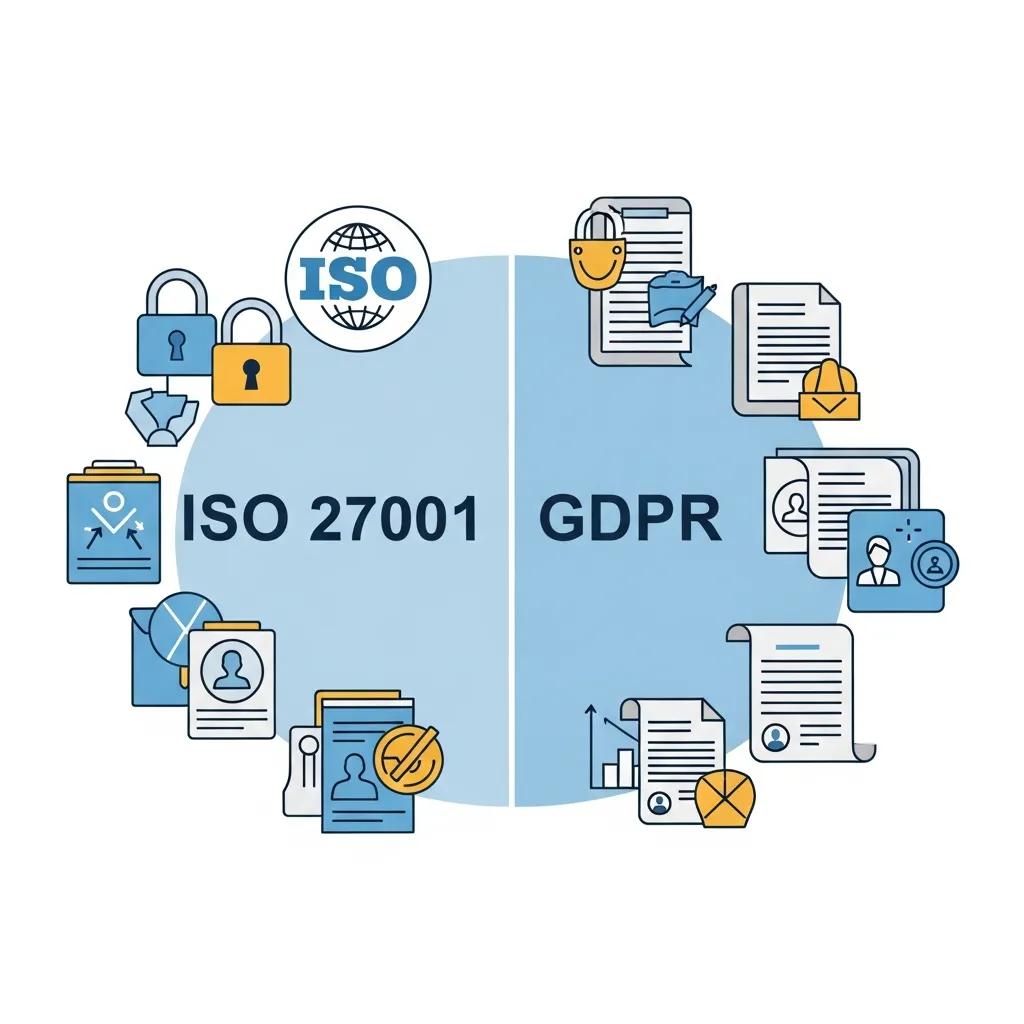
ISO 27001 typically covers an organisation’s information assets, systems, processes and interfaces; GDPR applies specifically to personal data and processing that affects people in the EU. ISO 27001 requires an ISMS lifecycle (Plan‑Do‑Check‑Act) and controls based on risk assessment, while GDPR requires demonstrable lawful bases, purpose limitation and clear transparency to data subjects. An ISMS will reduce many risks to personal data through inventories and access controls, but GDPR also requires documented processing records, a Data Protection Officer when applicable, and mechanisms for consent and other lawful bases. In short: security controls reduce risk, but legal accountability artifacts are needed for full GDPR compliance.
These normative vs legal differences point to related standards and regulations that affect privacy and security programmes.
What are the key data protection regulations to consider?
Beyond ISO 27001 and GDPR, several instruments shape a modern privacy programme: ISO 27701 for privacy information management, national data protection laws that adjust GDPR implementation, sector rules, and emerging frameworks such as NIS2 and the EU AI Act. ISO 27701 extends ISO 27001 with privacy‑specific controls and processing records. NIS2 strengthens network and information system resilience in critical sectors, and the EU AI Act targets high‑risk AI processing — both intersect with GDPR’s security and accountability expectations. The list below summarizes the main instruments and their roles.
This quick map shows where frameworks overlap and where a layered approach creates efficiency.
- GDPR: EU legal framework protecting personal data and enforcing data subject rights.
- ISO 27001: Voluntary standard for an ISMS and information security risk management.
- ISO 27701: Privacy extension to ISO 27001 that formalises PIMS controls and records.
- NIS2 & EU AI Act: Sector‑focused rules complementing GDPR on resilience and AI risk.
Together, these instruments form a compliance ecosystem where ISO standards operationalise many technical and management controls while GDPR defines enforceable legal duties.
How does an ISO 27001 ISMS support GDPR compliance?
An Information Security Management System (ISMS) under ISO 27001 gives you a risk‑based framework to protect personal data through policies, controls, monitoring and continual improvement. The ISMS sets governance, asset inventories, risk assessments and incident response capabilities that lower the likelihood and impact of personal‑data breaches — meeting GDPR expectations for appropriate technical and organisational measures. Still, ISO 27001 maps mainly to security‑related GDPR requirements, so you should do targeted mappings to see which controls fully, partially or do not address specific GDPR articles.
Integrating ISO 27001 into privacy planning helps ensure identified privacy risks are treated effectively.
Integrating ISO 27001 with GDPR for privacy compliance
A focused integration aligns ISO 27001 controls with GDPR obligations so identified privacy risks are assessed and treated within the ISMS framework.
Below is a representative control mapping that highlights overlaps and gaps between ISO 27001 controls and GDPR obligations.
This mapping makes clear where ISO 27001 gives full coverage and where privacy‑specific actions are still required.
| ISO 27001 Control Area | GDPR Requirement Addressed | Degree of Coverage |
|---|---|---|
| Access control (A.9) | Confidentiality of personal data | Full |
| Cryptography (A.10) | Security of processing (integrity, confidentiality) | Full |
| Asset management (A.8) | Data inventory / record‑keeping | Partial |
| Logging & monitoring (A.12.4) | Breach detection and evidence | Partial |
| Supplier relationships (A.15) | Controller‑processor obligations | Partial |
| Data masking & anonymization (A.14) | Data minimisation and pseudonymisation | Partial |
The table shows many ISO controls cover technical safeguards, but GDPR also requires governance, records and legal artefacts. The next sections define an ISMS and drill into control alignments.
What is an Information Security Management System and why it matters
An ISMS is a formal management system that identifies, assesses and treats information‑security risks using Plan‑Do‑Check‑Act and documented policies, procedures and controls. With an ISMS you maintain asset inventories, perform risk assessments, enforce access controls, manage change and run incident response — all actions that reduce exposure when you process personal data. The ISMS lifecycle drives continual improvement through internal audits, management reviews and corrective actions, keeping GDPR‑relevant safeguards effective over time. Examples include linking processing inventories to asset classification, enforcing role‑based access to limit exposure, and using incident response playbooks to trigger GDPR breach notifications.
Those ISMS foundations make meeting GDPR’s security expectations easier, though privacy‑specific steps remain necessary.
Which ISO 27001 controls align with GDPR?
Several ISO 27001 controls align directly or partially with GDPR — notably access control, cryptography, incident management and supplier security — but GDPR duties such as DPIAs, lawful‑basis records and data‑subject request handling need extra processes. Use a control‑to‑article mapping to prepare for audits. Strong access management and logging support confidentiality and accountability, and supplier due diligence helps meet processor obligations under GDPR. However, controls alone won’t document lawful processing or subject‑rights procedures; you also need policies, records of processing activities and operational workflows.
Strategically applying ISO 27001’s Annex A controls builds a robust security baseline that improves compliance and operational efficiency.
ISO 27001 integration for GDPR compliance and efficiency
Integrating Annex A controls with privacy processes enhances both compliance and operational efficiency, reducing duplicated effort and strengthening evidence for regulators.
To operationalise alignment, prioritise controls that cut personal‑data risk while adding privacy governance artifacts to meet GDPR requirements.
Which GDPR requirements go beyond ISO 27001?
ISO 27001 does not cover all GDPR obligations. GDPR adds legal duties around lawful basis, data‑subject rights, transparency, DPIAs and strict breach‑notification timelines that sit outside purely technical security controls. While ISO 27001 provides disciplined processes and security baselines, GDPR requires demonstrable accountability: records of processing activities, privacy notices, subject‑rights procedures and more. Organisations therefore need to augment an ISMS with privacy‑specific processes, templates and roles. The table below highlights common GDPR requirements that exceed ISO 27001 coverage and recommended remedial actions.
This helps teams prioritise privacy artifacts that complement ISO‑driven controls.
| GDPR Requirement | ISO 27001 Coverage | Recommended Action |
|---|---|---|
| Data subject rights management | None/Partial | Implement DSR workflows, verification and logging |
| Lawful basis documentation | None | Maintain records of processing activities and legal bases |
| DPIAs for high‑risk processing | None | Conduct DPIAs and retain findings |
| Appointment of DPO (if required) | None | Appoint or designate a DPO/privacy lead and define responsibilities |
| Breach notification timelines | Partial | Integrate incident response with GDPR notification procedures and SLAs |
The table highlights where privacy artifacts and roles must be created in addition to ISO 27001 security controls. The next subsections unpack data‑subject rights, consent and other GDPR specifics.
How do data subject rights and consent affect compliance?
Data‑subject rights — access, rectification, erasure, restriction, portability and objection — demand practical workflows to capture requests, verify identities and respond within legal timelines (typically one month). Consent, when used as a lawful basis, must be freely given, specific, informed and withdrawable, with records retained to show compliance. Other lawful bases (contract, legal obligation, legitimate interests) require documented assessments. Operational steps include mapping data flows to locate affected systems, integrating request triage into ticketing platforms, training staff on identity verification and redaction, and setting SLAs for responses.
Meeting rights and consent obligations therefore needs governance and process work that complements ISMS controls and demonstrates accountability.
What GDPR obligations are not covered by ISO 27001?
GDPR obligations not fully addressed by ISO 27001 include conducting Data Protection Impact Assessments (DPIAs) for high‑risk processing, keeping detailed records of processing activities, implementing privacy‑by‑design and default, and ensuring lawful mechanisms for international data transfers. These require legal and privacy expertise to create templates, run assessments and document mitigations, plus changes to product development and supplier contracts. Recommended steps include deploying DPIA templates, appointing a DPO or privacy lead if needed, implementing transfer agreements or safeguards, and publishing clear privacy notices mapped to processing activities. Each action produces evidence regulators expect and supports a demonstrable accountability posture.
Addressing these GDPR duties alongside ISO 27001 closes compliance gaps when integrated correctly.
How does ISO 27701 bridge ISO 27001 and GDPR?
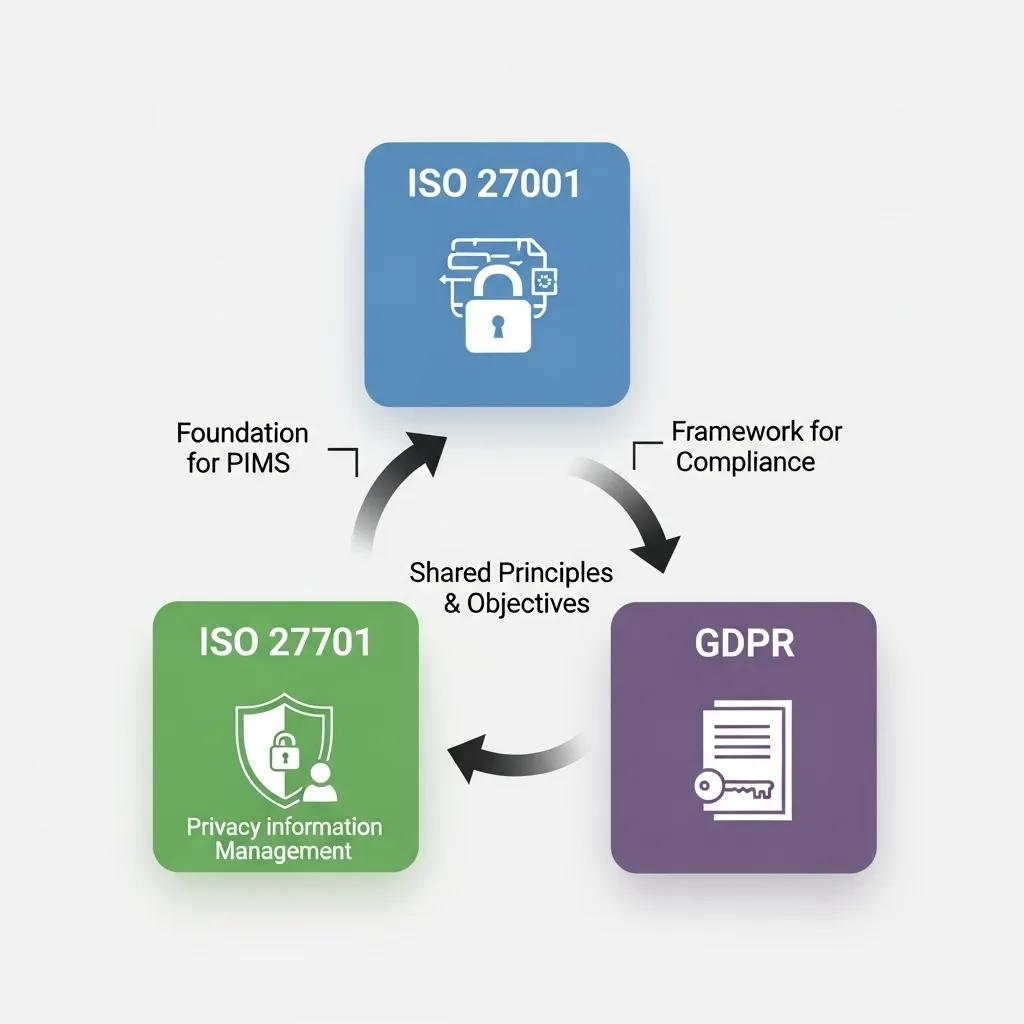
ISO 27701 is a Privacy Information Management System (PIMS) extension to ISO 27001 that defines privacy roles, records and controls to operationalise privacy objectives and align ISMS processes with GDPR. By adding privacy‑specific controls — processing inventories, DPIA procedures and controller/processor mappings — ISO 27701 gives you a structured way to show privacy governance and accountability. Organisations already certified to ISO 27001 can adopt ISO 27701 with less duplication by reusing ISMS processes and adding targeted privacy artifacts, producing auditable evidence aligned to GDPR.
Research and practical experience show ISO 27701 explicitly integrates personal‑data management into the ISMS, strengthening GDPR posture.
ISO 27701, ISMS and GDPR personal‑data compliance
ISO 27701 builds on the ISMS to ensure personal data is included in risk management and that privacy controls and records meet regulatory expectations.
Key benefits of ISO 27701 include:
- Structured privacy records and processing inventories that map to GDPR article requirements.
- Clear roles and responsibilities (controller/processor and PIMS roles) to demonstrate accountability.
- DPIA procedures and privacy‑by‑design controls embedded in ISMS practices.
In short, ISO 27701 formalises privacy operations inside an existing ISMS to strengthen GDPR compliance.
What is ISO 27701 and its role in privacy management?
ISO 27701 specifies requirements and guidance for a PIMS built on ISO 27001 and ISO 27002. It defines privacy controls, documentation and roles to manage personal‑data processing. Typical deliverables include maintained processing registers, DPIA templates, PIMS policies and processing agreements that directly support GDPR accountability. For organisations with an ISMS, ISO 27701 maps privacy responsibilities into existing management processes and creates auditable evidence that privacy is integrated into risk management and operational controls.
Implementing ISO 27701 converts ISMS discipline into demonstrable privacy governance that aligns with regulatory expectations.
How does ISO 27701 improve GDPR compliance?
ISO 27701 strengthens GDPR compliance by specifying privacy‑centric controls — structured DPIA workflows, processing logs and privacy‑by‑design measures — that address accountability and documentation requirements. Adopting ISO 27701 produces artifacts regulators expect: records of processing activities, processor agreements and necessity/proportionality assessments. Practical tips include folding DPIAs into change control, aligning privacy notices with processing records, and updating supplier contracts to reflect processor obligations. Those steps help you show both technical safeguards and governance measures required by GDPR.
By bridging ISO 27001 and GDPR, ISO 27701 reduces audit friction and improves your ability to prove compliance with structured evidence.
How does Stratlane’s AI‑driven auditing enhance integrated compliance?
AI‑driven auditing speeds and improves evidence collection, control mapping and risk identification for both ISO 27001 certification and GDPR readiness assessments. Machine‑assisted analysis can parse logs, surface anomalous access patterns and correlate processing inventories with policies — reducing manual effort and highlighting risk areas faster. Stratlane Certification is an accredited certification body specialising in ISO standards (including ISO 27001:2022). We combine AI‑driven audit tools with a distributed auditor network operating across 27+ countries and professional auditors in 29+ countries to guide clients from quotes and audit scheduling to certificate issuance and management. That mix of accreditation, global capacity and tooling helps organisations move from gap analysis to certification while producing evidence that also supports GDPR tasks like DPIAs and processing inventories.
These advances improve audit efficiency, tighten the link between security controls and privacy obligations, shorten certification timelines and increase documentation quality for regulators.
- AI‑driven auditing automates evidence collection, standardises risk scoring and detects patterns across systems.
- AI tools can pre‑populate processing inventories and flag DPIA triggers based on activity and data classification.
- Ethical AI guardrails, explainability and human review are essential to keep audit results objective and defensible.
These use cases show AI supporting both ISO certification workflows and GDPR compliance while preserving human oversight and audit rigor.
What are the benefits of AI‑driven audit tools for ISO 27001 certification?
AI tools bring measurable benefits to ISO 27001 certification: they automate repetitive evidence collection, standardise control assessments and accelerate risk analysis so auditors can focus on governance gaps and high‑risk exceptions. Automated log analysis and anomaly detection cut manual review time and provide repeatable evidence of control effectiveness. In practice this means shorter readiness phases, reduced friction during on‑site assessments and more comprehensive coverage of systems and suppliers. Organisations adopting AI‑driven audits typically see improved audit consistency, clearer traceability of findings and faster remediation cycles backed by prioritised risk reports.
Those efficiencies speed certification while producing richer artifact sets that also help with GDPR documentation.
How does AI improve GDPR compliance efficiency and accuracy?
AI helps GDPR tasks by mapping processing activity across systems, suggesting DPIA needs based on risk patterns, and automating consent and subject‑request workflows to reduce manual errors and response times. Typical use cases include discovering personal data on endpoints, pre‑populating processing registers and predicting breach likelihood from anomalous access behaviour. Deploy AI with clear governance — log model decisions, maintain explainability and ensure human oversight — to align with GDPR principles. Organisations using these tools can reduce time‑to‑respond for subject access requests, prioritise DPIAs for high‑risk processing and keep processing records more accurate with less overhead.
Combined with policy‑led workflows, AI insights let teams operationalise privacy more effectively while retaining accountability and transparency.
What is a practical roadmap to achieve ISO 27001 certification and GDPR compliance?
A practical roadmap aligns security and privacy activities across assessment, design, implementation, validation and continual improvement to deliver ISO 27001 certification alongside GDPR readiness. Sequence actions from combined gap analysis to ISMS design, control implementation, internal audits, certification audits and ongoing monitoring — and embed GDPR tasks (DPIAs, processing records, DSR procedures) into each phase. The checklist below gives concrete steps, suggested outputs and likely owners to guide an integrated programme. After the checklist we explain how organisations can use Stratlane’s services — quotes, AI‑driven audits, certification and certificate management — to streamline the roadmap and reduce administrative effort.
This structured timeline helps teams plan resources and track compliance milestones across security and privacy domains.
- Perform a combined gap analysis: inventory information assets and personal data, map processing activities, and identify GDPR and ISO control gaps.
- Define scope and governance: set the ISMS scope, assign ownership, and establish privacy roles (DPO or privacy lead).
- Conduct risk assessment and DPIA prioritisation: evaluate threats to personal data and run DPIAs for high‑risk processing.
- Design controls and privacy processes: implement access controls, encryption, logging and subject‑request workflows.
- Implement policies and training: publish privacy notices, maintain processing records, and train staff on DSR handling and breach reporting.
- Run internal audits and corrective actions: test controls, remediate gaps and iterate on risk treatment.
- Engage certification and perform certification audit: prepare evidence packs and complete Stage 1 and Stage 2 audits for ISO 27001.
- Maintain continual improvement: monitor controls, refresh DPIAs and review processing registers on a regular cadence.
These steps provide a clear path from discovery to certification, with checkpoints for GDPR‑specific reviews and artifact preparation aligned to audit needs.
What are the step‑by‑step actions for integrated compliance?
To operationalise the roadmap, set clear deliverables, owners and timelines. Form a cross‑functional team with security, privacy, legal and IT operations and appoint a programme manager to coordinate ISMS and GDPR tasks. Deliverables per phase include an asset and processing inventory, a documented risk assessment, DPIAs for priority processes, implemented controls with evidence packs, internal audit reports and a certification‑ready evidence repository. Timelines vary by organisation size; many teams reach a baseline implementation in 6–12 months with focused resources and tooling. Use templates — DPIA checklists, processing‑register formats and incident response playbooks — to speed delivery and create consistent audit evidence.
Clear ownership and artifacts at each step ensure the programme delivers ISO readiness and demonstrable GDPR accountability.
How can organisations leverage Stratlane’s services for compliance success?
Stratlane Certification is an accredited certification body specialising in ISO standards (including ISO 27001:2022). We combine AI‑driven audit tooling with global auditor capacity — operating in 27+ countries and offering professional auditors in 29+ locations — to guide clients from quote and audit scheduling through certificate issuance and ongoing management. Organisations can request an AI‑assisted audit to speed evidence collection, book certification audits with experienced auditors, and use our certificate management service to track renewals and compliance records. Working with an accredited partner that offers distributed auditor capacity and AI tooling reduces administrative load, shortens certification timelines and produces audit‑ready artifacts that also support GDPR documentation.
This integrated service model helps teams turn ISMS maturity into certified assurance while preserving evidence for privacy‑related obligations.
This guide has outlined the differences and operational mappings between ISO 27001 and GDPR, explained how ISO 27701 and AI‑assisted auditing bridge gaps, and offered a step‑by‑step roadmap. For organisations planning integrated compliance, combining a structured ISMS, privacy‑specific artifacts and targeted certification support delivers the strongest demonstrable posture for both security and legal obligations.
Frequently Asked Questions
1. What are the main benefits of integrating ISO 27701 with ISO 27001 for GDPR compliance?
Integrating ISO 27701 with ISO 27001 gives you a structured privacy layer over your ISMS. ISO 27701 adds privacy‑specific controls — DPIAs, processing inventories and PIMS roles — so you can show accountability and governance for personal data. By reusing ISMS processes, organisations reduce duplicated effort and create a single set of auditable artifacts that meet both security and privacy expectations.
2. How can organisations meet GDPR’s data‑subject rights requirements?
Meet GDPR rights by implementing clear workflows for access, rectification, erasure and portability requests: triage requests, verify identities, log actions and respond within statutory timelines (typically one month). Embed DSR handling in ticketing or CRM systems, train staff on verification and redaction, and standardise response templates and SLAs to ensure consistent, auditable handling.
3. What role does a Data Protection Officer (DPO) play in GDPR compliance?
A DPO oversees data protection strategy and ensures GDPR compliance across the organisation. Responsibilities include monitoring compliance, advising on DPIAs, liaising with regulators and serving as a contact point for data subjects. Organisations that process large volumes of personal data or run high‑risk processing activities are required to appoint a DPO to support accountability and oversight.
4. What are the consequences of non‑compliance with GDPR?
Non‑compliance can result in fines up to 4% of annual global turnover or €20 million (whichever is higher), plus reputational damage, loss of customer trust and potential legal claims. Regulators can also impose corrective measures, including orders to stop processing activities. Maintaining GDPR compliance protects both financial and reputational interests.
5. How does AI‑driven auditing improve GDPR compliance processes?
AI‑driven auditing automates evidence collection, identifies risks and maps processing across systems. It can surface anomalous access patterns, suggest DPIA triggers and streamline subject‑request workflows. By reducing manual effort and improving accuracy, AI helps keep processing records current and speeds regulatory‑required responses — provided tools are used with governance, explainability and human oversight.
6. What steps should organisations take to prepare for an ISO 27001 certification audit?
Prepare by conducting a thorough gap analysis, then build an ISMS with documented policies, risk assessments and controls. Run internal audits to validate control effectiveness and remediate findings. Finally, compile a well‑organised evidence repository so audit teams can quickly verify conformity during Stage 1 and Stage 2 certification audits.
7. How can organisations leverage Stratlane’s services for compliance success?
Organisations can work with Stratlane to access AI‑assisted audit tools, experienced auditors and end‑to‑end certification support. We help with gap analysis, evidence collection, audit delivery and certificate management — reducing administrative burden and accelerating the path to ISO certification and GDPR readiness.
Conclusion
Complying with ISO 27001 and GDPR matters if you handle personal data: ISO 27001 strengthens your security posture, while GDPR provides the legal accountability framework. Together, they help you protect data and demonstrate responsibility to customers and regulators. For teams ready to move faster, Stratlane’s AI‑driven auditing and certificate management services can streamline evidence collection and certification. Contact us to see how our approach helps you manage the complexity of data protection with confidence.