
Meet Stratlane's Certified Auditors: Your ISO Experts

Meet Stratlane’s ISO Certification Auditors — AI-Enhanced Audits for Consistent, Global Compliance
Our auditors combine professional audit qualifications with AI-augmented tools to deliver ISO certification that’s accurate, faster, and easier to maintain. This guide explains who our certified auditors are, how AI changes the certification lifecycle, and which ISO standards and services we deliver across sectors. Many organisations face inconsistent audit rigor, gaps in technical controls, and complex certificate management across borders — here we show how experienced auditors plus automated analysis address those issues in practical terms. You’ll find a clear map of auditor qualifications and impartiality safeguards, the real benefits of AI for ISO 9001, ISO 14001, ISO 27001 and ISO 42001 audits, and a step-by-step client journey from quote to certificate management. Read on for comparisons, decision tables, and straightforward steps to request a quote and plan certification activities.
Why Stratlane’s ISO Auditors Lead the Field
We pair recognised auditor credentials with sector experience and strict adherence to international audit standards. That combination produces dependable findings and clear, actionable recommendations. Our audits follow defined plans, assign lead auditor responsibilities, and use impartial assessment methods so results are repeatable and defensible. That credibility speeds remediation and drives measurable improvements in management systems — and it creates the stable foundation AI tools need to boost consistency and risk detection. Below we list the core qualifications, sector experience, and standards that support our audit integrity.
What industry experience do Stratlane’s ISO auditors bring?
Our auditors have hands-on experience across defence-adjacent processes, manufacturing operations, healthcare settings and academic research environments. That domain knowledge shapes where we look for evidence — from supply-chain controls and production traceability to clinical safety and research governance. Experienced auditors spend less time on orientation and more time on high-value observations and corrective actions, so reports and management reviews map directly to operational priorities and faster remediation.
How do professional standards protect audit integrity?
Accreditation frameworks and audit guidance documents keep audits impartial and consistent. They require documented procedures, conflict-of-interest controls, clearly defined audit plans and evidence-based reporting so results are reproducible and defensible. Independent accreditation provides an external check against consistent criteria, and scheduled surveillance audits preserve certification validity. These procedural safeguards explain why organisations can rely on certified auditors — and clarify how AI fits into established, audited practices.
How Stratlane’s AI-Driven Auditing Improves Certification
AI accelerates data analysis, reduces variability in findings and enables continuous monitoring that complements scheduled audits. Our tools surface anomalies and suggest evidence linkages that human auditors validate, combining machine speed with professional judgment. The outcome: leaner audits, tighter scopes and earlier detection of emerging risks — all of which reduce disruption and support proactive remediation. Below are four core benefits and a brief note on governance alignment, including AI-specific controls.
Independent research shows AI and machine learning are reshaping auditing — especially for cybersecurity and compliance in regulated sectors.
AI & ML for Stronger Cybersecurity Audits and Compliance
As cyber threats grow in complexity and regulation tightens, traditional manual audits struggle to scale. This study examines how artificial intelligence (AI) and machine learning (ML) improve cybersecurity auditing by automating compliance checks, detecting threats earlier, supporting continuous monitoring, and increasing assurance in sectors such as finance and healthcare.
ADVANCING THREAT DETECTION THROUGH ARTIFICIAL INTELLIGENCE AND MACHINE LEARNING ENHANCED CYBERSECURITY AUDITS, D Goswami, 2025
AI delivers clear operational gains for both auditors and audited organisations.
- Faster evidence review: AI filters and organises large datasets so auditors prioritise the highest-risk items.
- Greater consistency: Automated criteria help reduce variability across audits and sites.
- Continuous monitoring signals: Ongoing analytics expose trends between formal audits.
- Lower cost and shorter timelines: Efficiency gains shrink audit cycles and sharpen corrective focus.
These advantages improve audit planning and execution — we describe practical business impacts in the next section.
Stratlane combines AI capabilities with experienced auditors across multiple jurisdictions. Organisations can request AI-assisted audit quotes and see how automated analysis maps to their compliance needs. Our approach uses AI for data-intensive tasks while preserving human oversight for judgement and corrective guidance.
How does AI benefit ISO certification audits?
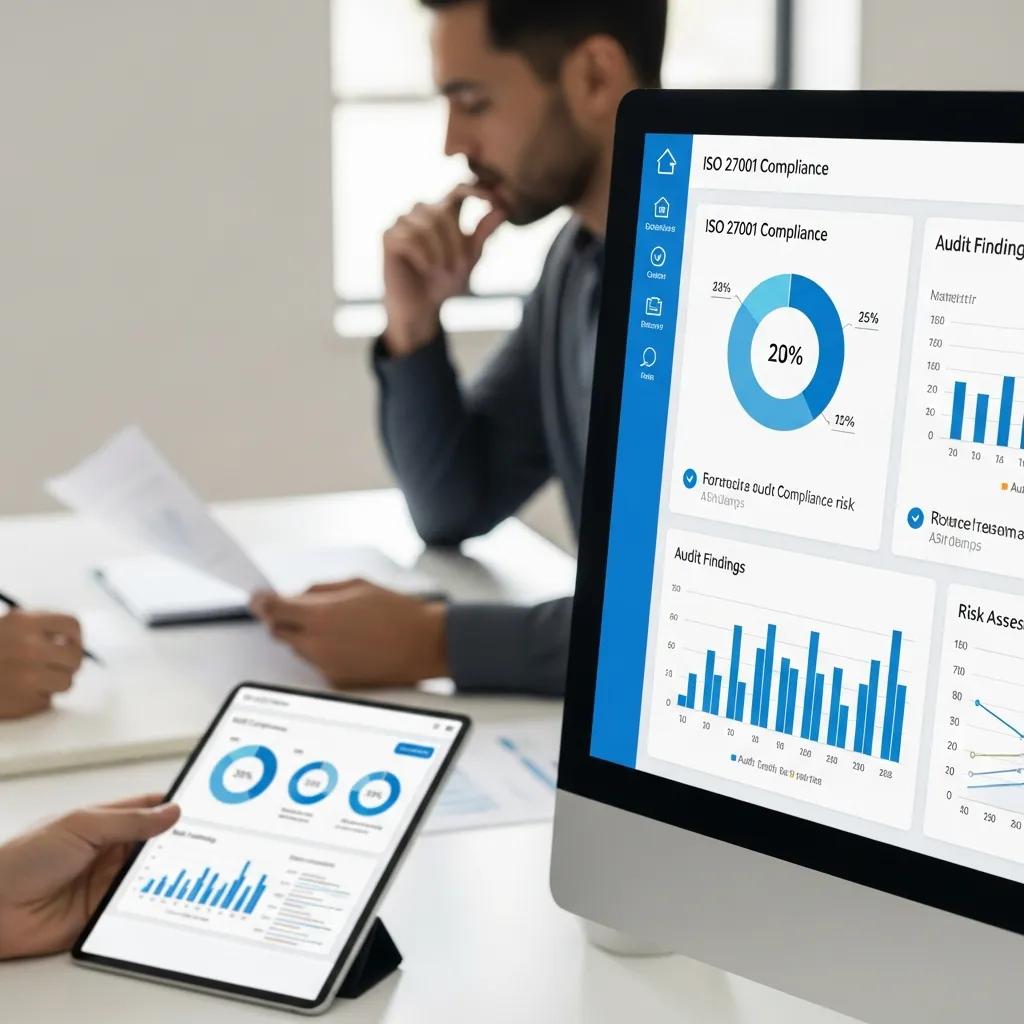
AI reduces manual review time, standardises evidence assessment and helps identify systemic issues earlier. Pattern detection guides auditors on which interviews, records and controls to prioritise, focusing effort on areas that matter most and reducing secondary findings. Standardised criteria improve scoring and reporting consistency across sites, reducing disputes over findings. These efficiencies let audit teams deliver clearer improvement roadmaps and help management reduce operational risk faster than traditional, manual-only reviews.
How is AI assessed alongside ISO 42001 and other standards?
When auditing AI governance under ISO 42001, we map AI controls to audit criteria — assessing risk management, monitoring and oversight alongside traditional QMS, EMS and ISMS controls. AI audit tools can extract policies, control evidence and monitoring outputs for auditor review; auditors then validate provenance and effectiveness against documented procedures and ethical risk frameworks. Human oversight remains central: auditors interpret AI signals, verify evidence origins and confirm governance controls are effective. This combined workflow ensures AI capabilities are evaluated both technically and through established ISO compliance requirements.
Which ISO certification services do Stratlane auditors provide?
We offer audits and certification for ISO 9001, ISO 14001, ISO 27001 and ISO 42001, delivered remotely, onsite or via hybrid engagements to match organisational needs. Every service includes defined deliverables — audit reports, corrective-action guidance and accredited certificate issuance — so you get both the compliance decision and practical next steps. The table below summarises audit focus and typical deliverables to help you pick the right service.
| Standard | Audit Focus | Typical Deliverables |
|---|---|---|
| ISO 9001 | Quality management processes and customer satisfaction | Audit report, corrective-action plan, certification decision |
| ISO 14001 | Environmental aspects, compliance obligations and impact control | Environmental compliance review, improvement recommendations, certificate |
| ISO 27001 | Information security controls, risk assessments and incident readiness | ISMS gap analysis, risk treatment suggestions, certification report |
| ISO 42001 | AI governance, risk assessment for AI systems and ethical controls | Governance assessment, compliance roadmap, certification outcome |
This comparison makes it easier to prioritise audits based on strategic compliance and operational needs.
Key features of ISO 9001 quality-management audits
ISO 9001 audits assess process control, customer satisfaction and continual improvement within a Quality Management System. We review process performance metrics, non-conformity trends and management-review effectiveness to identify where controls work and where they need strengthening. Deliverables typically include an audit report with observations, a corrective-action plan and recommendations to embed a quality culture through measurement and leadership engagement. Organisations gain more consistent operations, fewer defects and better alignment between processes and customer expectations.
How do ISO 14001, ISO 27001 and ISO 42001 audits differ?
Each standard focuses on a different control domain: ISO 14001 targets environmental aspects and regulatory compliance; ISO 27001 concentrates on confidentiality, integrity and availability of information; ISO 42001 addresses governance, risk and controls for AI systems. The evidence we review varies accordingly — environmental permits and impact assessments for ISO 14001; risk registers and control implementation for ISO 27001; model governance artifacts and monitoring outputs for ISO 42001. Industry priorities drive standard choice: manufacturing often prioritises ISO 14001, tech firms ISO 27001, and organisations using AI consider ISO 42001. Knowing these differences helps allocate audit effort where it delivers the greatest business value.
How we tailor ISO certification for diverse industries

We tailor audits by matching auditor expertise to sector risk profiles, adjusting sampling and aligning scope with regulatory overlays and operational realities. Auditor selection emphasises relevant experience — for example, safety-critical processes in healthcare or supplier controls in manufacturing — so assessments focus on the most material risks. Tailored audit design reduces disruption, prioritises high-risk processes and produces recommendations operations teams can implement. The table below maps industries to auditor expertise and typical audit adjustments.
| Industry | Auditor Expertise | Typical Audit Adjustment |
|---|---|---|
| Defence-related | Supply-chain security and controlled processes | Enhanced supplier sampling and strict documentation checks |
| Manufacturing | Process control and traceability | Expanded production-line sampling and maintenance record reviews |
| Healthcare | Patient safety and data protection | Focus on clinical governance and health-data access controls |
| Academia | Research governance and data integrity | Emphasis on research protocols and data-management practices |
This mapping shows how we adapt evidence collection and sampling to sector priorities so organisations receive relevant, actionable findings.
What expertise do auditors bring to defence, manufacturing and healthcare?
For defence-adjacent clients, auditors focus on supply-chain security, need-to-know controls and supplier qualification. Manufacturing audits emphasise traceability, calibration and change control. Healthcare audits prioritise patient-safety systems, clinical governance and health-data confidentiality. In every sector, auditors use sector-specific checklists and evidence-gathering techniques to assess compliance against ISO standards and applicable regulations. That specialised focus speeds assessment and delivers recommendations operational teams can apply directly to reduce risk.
How do we address SME and corporate certification needs differently?
SMEs usually need streamlined audits that minimise disruption and focus on essential controls. Large corporations often require multi-site strategies and integrated management-system approaches. For SMEs we favour practical sampling and clear corrective actions that fit limited resources; for corporate clients we assess governance, consistency across sites and integration across business units. Tailoring includes adjusting scope, cadence and reporting detail so certification is proportionate to organisational complexity and supports sustainable compliance improvements.
The Stratlane certification journey: from quote to certificate management
Our certification process follows a clear sequence: request a quote, plan the audit, complete stage 1 and stage 2 activities where applicable, issue a certification decision, and provide ongoing certificate management. Each step needs inputs — scope, documents and access arrangements — and produces client deliverables like audit plans, reports and certificate files. The numbered summary below gives a practical, step-by-step path to help teams plan.
- Request quote: Share scope, sites and standards so we can propose effort and delivery options.
- Audit planning: Confirm scope, dates and remote/onsite modality; auditors prepare the audit plan and sampling.
- Stage 1 / Stage 2 audit: Conduct a readiness review (Stage 1) and the full conformity assessment (Stage 2) with evidence collection.
- Certificate issuance: We make an accreditation-aligned decision and issue a certificate when conformity is demonstrated.
- Ongoing certificate management: Surveillance audits, recertification planning and downloadable certificate storage support continuity.
Below is an EAV-style table that clarifies each step with required inputs and client deliverables to aid planning and conversion.
| Process Step | Required Inputs | Client Deliverables |
|---|---|---|
| Request quote | Scope, standards, number of sites | Quotation and proposed timeline |
| Audit planning | Documents, access, stakeholders | Audit plan and logistics confirmation |
| Stage 1 / Stage 2 audit | Records, interviews, evidence | Audit report, non-conformities, findings |
| Certificate issuance | Final corrective actions | Certification decision and certificate file |
| Ongoing management | Surveillance schedule | Surveillance reports and certificate downloads |
This process table helps teams assemble required documentation and understand typical outputs so audits run efficiently and predictably.
How can businesses request a quote and plan their audit?
To request a quote, prepare a short scope summary, list of locations and the ISO standard(s) you want, plus key contacts for logistics. Typical scheduling starts with scoping, a proposal, and mutually agreed dates for stage 1 and stage 2 activities; remote or hybrid options can reduce onsite time. Having core documents ready — policies, risk assessments and process maps — speeds the move to audit start. Early clarity on scope and modality improves resource planning and reduces delays.
What post-audit support do we provide for certificate management?
After the audit we issue formal reports, advise on corrective actions, schedule surveillance audits and provide tools for certificate storage and downloads so you can demonstrate ongoing conformity. Surveillance checks confirm corrective actions are effective and that management systems continue to meet the standard. We also offer advisory support for recertification planning and aligning management reviews with continuous improvement. These services make certification a managed lifecycle, not a one-off event.
Success stories that show the impact of our auditors
Our methodology — experienced auditors plus AI analysis — consistently improves audit clarity, remediation prioritisation and certificate delivery. Case summaries show clients gained clearer risk priorities, faster report turnaround and more actionable corrective plans after AI-augmented audits. Our accreditation and global reach — certificate issuance across 27 countries and auditor presence in 29 countries — support multinational compliance continuity. These credibility signals make it easier to scale certification programmes while keeping audit standards consistent.
How have AI-driven audits improved client compliance and efficiency?
AI-driven audits speed identification of evidence, letting auditors spend more time on interpretation and remediation instead of repetitive review. Clients see shorter audit cycles and clearer prioritisation of high-impact findings, enabling faster corrective action and more durable compliance. AI analytics also supply continuous monitoring signals that help organisations fix issues between formal audits, reducing repeat non-conformities. Together, these changes produce a more responsive compliance programme and tighter alignment between audits and operational change.
What do clients say about working with Stratlane’s auditors?
Clients say our auditors deliver clear, structured findings and practical guidance that helps management teams act on priorities. Auditors are consistently praised for professionalism, clarity and support during remediation. Clients value the balance of AI-assisted evidence review and experienced auditor judgement, noting reports are more focused and actionable than many conventional engagements. This combination of automation and human oversight builds confidence in certification decisions and in follow-up surveillance. If you’re considering certification or a quote, we provide guided planning to recommend the right standard and audit approach.
Requesting a quote or consultation starts by defining scope and objectives so we can recommend an efficient audit approach and timeline. Stratlane Certification supports that planning to ensure a smooth path from quote to certificate management.
Frequently Asked Questions
Which organisations benefit from Stratlane’s ISO certification services?
We work with a wide range of organisations: SMEs, large corporations and specialised sectors such as healthcare, manufacturing and technology. Each client receives a tailored audit approach that fits their operational needs and compliance obligations. By focusing on sector-specific challenges, we deliver relevant insights and actionable recommendations that help teams achieve certification efficiently.
How does AI improve the accuracy of ISO audits?
AI automates data analysis and surfaces patterns that may not be obvious in manual reviews. By processing large volumes of records quickly, AI lets auditors focus on interpreting results and validating evidence. It highlights anomalies and suggests evidence linkages, which supports more precise findings and recommendations grounded in comprehensive data.
What role does continuous monitoring play in ISO certification?
Continuous monitoring provides ongoing oversight between formal audits, helping organisations spot and fix issues before they become major non-conformities. Using AI-driven analytics, continuous monitoring maintains management-system integrity and demonstrates sustained improvement over time, which strengthens certification outcomes.
How can organisations prepare for an ISO certification audit?
Prepare by gathering key documentation — policies, procedures and past audits — and by defining the audit scope and identifying staff who will help during the audit. Running internal assessments before the audit highlights gaps and gives you time to implement corrective actions. Clear communication across the team streamlines the process and improves readiness.
What common challenges do organisations face during ISO certification?
Typical challenges include limited understanding of the standards, incomplete documentation and resistance to change. Resource constraints for preparation and ongoing compliance are also common. To overcome these issues, engage stakeholders early, provide targeted training and set out a clear plan to address non-conformities and implement corrective actions.
Why is post-audit support important for maintaining ISO certification?
Post-audit support helps organisations stay compliant and continuously improve. It includes corrective-action guidance, scheduled surveillance audits and certificate-management tools. Ongoing assistance ensures issues found during audits are resolved and that management systems evolve, which is essential for sustaining certification and improving operational performance.
Conclusion
Stratlane’s ISO auditors pair deep professional expertise with AI-driven tools to improve accuracy, speed and ongoing compliance. Our tailored audit approaches address industry-specific challenges and deliver practical next steps for operations teams. That commitment to quality and continuous improvement helps organisations maintain compliance and raise operational standards. To discuss how we can support your certification journey, request a quote today.