
Empower Your Team Through ISO Awareness Employee Training
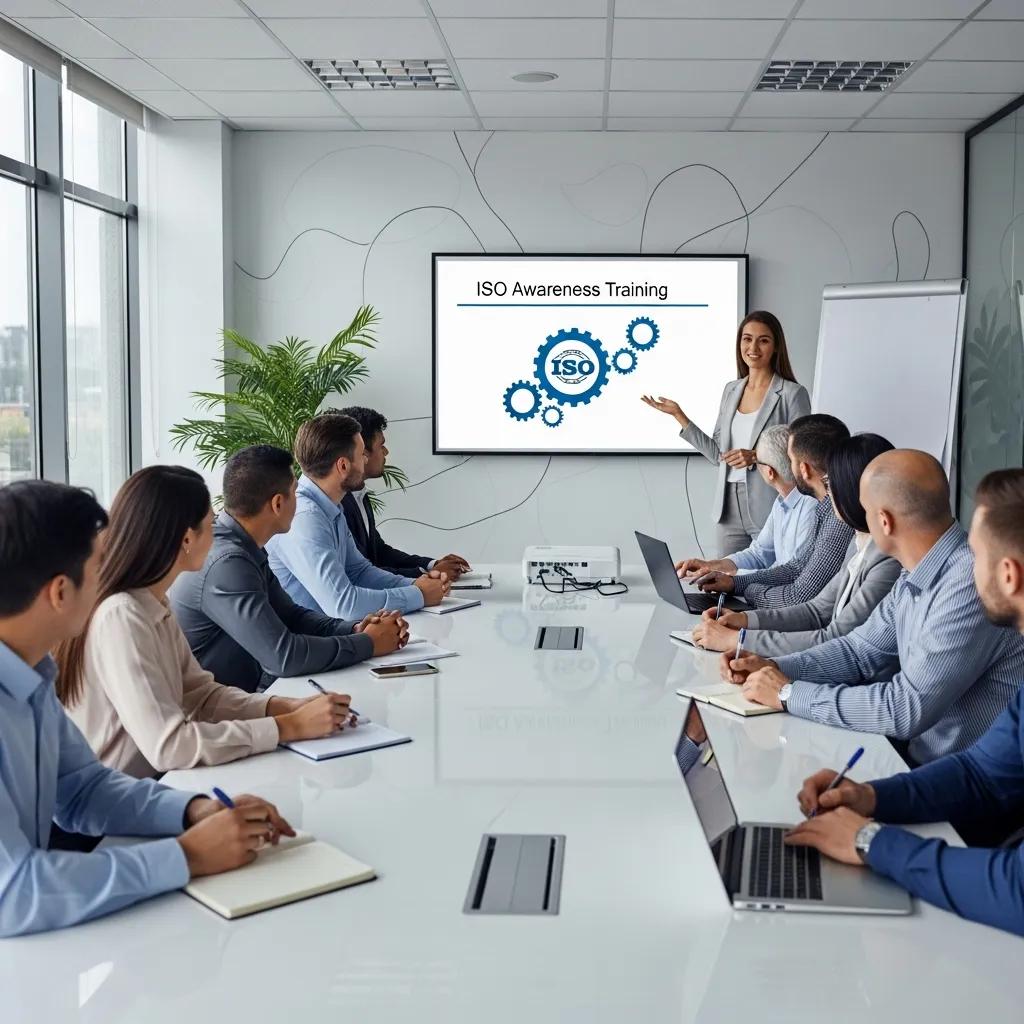
The Strategic Value of ISO Awareness Training for Organizations
ISO awareness training gives every team member a clear, practical view of relevant management-system principles, their specific responsibilities, and the everyday behaviours that reduce risk and improve results. This guide defines awareness training, explains why it raises engagement and operational quality, and shows how targeted learning readies teams for modern, AI-assisted audits while shortening time to certification. Many organisations stall because staff aren’t sure who owns which process, how to keep records tidy, or how to apply risk-based thinking—well-crafted awareness sessions fix those gaps by mapping routine tasks to standard clauses and audit evidence. You’ll find the main benefits for people and teams, the operational levers that lift efficiency and quality, which ISO standards matter for different roles, and practical steps—needs assessment, delivery options, and measurement—that help you build a training program that delivers measurable competence and lowers audit friction. Finally, we explain how accredited, AI-enabled certification services can validate progress and speed certification where needed.
What Are the Key Benefits of ISO Awareness Training for Employees?
Awareness training provides the baseline knowledge everyone needs: what a standard expects, how daily work links to controls, and why compliance matters for customers and risk management. It translates abstract clauses into role-specific actions, which increases ownership and makes evidence collection part of normal work instead of an emergency scramble. The practical outcomes are greater engagement, stronger competence, and fewer process mistakes—effects that scale from individuals to teams and the whole organisation. Below are the most important benefits leaders should target.
ISO awareness training delivers several direct benefits to employees and the organisation:
- Clear role expectations: People know how their tasks support objectives and compliance requirements.
- Stronger engagement: Understanding the “why” behind processes increases ownership and willingness to follow them.
- Better risk detection: Staff spot control gaps earlier and escalate issues before they become incidents.
- Fewer errors: Competence-focused learning reduces deviations and rework.
Those benefits form a virtuous cycle: clarity boosts engagement, engagement improves adherence, and adherence yields better outcomes. The section below breaks down how training drives engagement and accountability in daily operations.
| Audience Level | Primary Attribute Improved | Typical Outcome |
|---|---|---|
| Employee | Engagement and role clarity | Stronger ownership; more proactive reporting |
| Team | Coordination and handoffs | Fewer interface errors; consistent outputs |
| Organization | Risk posture and compliance readiness | Shorter audits; fewer corrective actions |
This side-by-side view shows how the same training inputs scale from individual behaviour change to measurable organisational results. Use these levels to tailor content and KPIs for each cohort so training investments show clear returns.
How Does ISO Training Improve Employee Engagement and Accountability?

Awareness training links everyday tasks to concrete outcomes—customer satisfaction, data accuracy, or environmental impact—so employees see the difference their work makes. When staff recognise that a control prevents a recurring problem, they treat procedures as practical safeguards rather than paperwork. Role-based scenarios and real examples make consequences tangible and reinforce accountability. Hands-on exercises—simulated incident reports, role-focused checklists, and quick audits—turn responsibilities into observable behaviours managers can acknowledge and reward. Clear behavioural expectations reduce ambiguity about ownership, limit blame-shifting, and strengthen peer-level compliance.
In What Ways Does ISO Awareness Enhance Workforce Competence and Risk Management?
Awareness programs grow competence by teaching not only the requirements but also how to spot weak controls and escalate issues quickly—strengthening frontline risk management. Employees trained to recognise anomalies—like unexplained data edits, missing calibration logs, or odd access patterns—become the organisation’s first line of defence. Aligning learning objectives to specific clauses and audit evidence helps staff collect and retain the records auditors need, turning routine tasks into proactive risk controls. Regular refreshers and competency checks keep skills current so detection and response remain effective as risks evolve. Faster detection reduces impact and shortens recovery time when incidents occur.
How Does ISO Awareness Training Drive Operational Efficiency and Quality?

Awareness training improves efficiency by creating a shared, repeatable way of working that reduces variation and rework. By turning documented procedures into consistent behaviours, organisations cut the time spent fixing errors and lower the cost of poor quality. Teams trained on inputs, outputs and critical controls usually see measurable drops in cycle time and quality-related costs. The mechanisms below explain how awareness training delivers these gains.
- Standardisation: A common understanding reduces variation and clarifies expectations.
- Error reduction: Trained staff make fewer mistakes and detect deviations sooner.
- Continuous improvement: Employees identify small changes that feed PDCA cycles.
The next section explains how training converts documented processes into reliable daily practice and fewer audit findings.
What Role Does ISO Training Play in Standardizing Processes and Reducing Errors?
Training makes sure documented procedures are not just words on a page but behaviours people follow consistently. When employees use the same naming conventions, retention steps, and verification checks, downstream activities—production, service delivery, or analytics—get reliable inputs. Typical outcomes include lower defect rates, fewer corrective actions, and better first-pass yields. Regular competence assessments and observed work checks confirm that standardisation sticks. It also speeds onboarding: new hires learn a single, repeatable way of working that aligns with audit expectations and performance goals.
How Does Workforce Training Foster a Culture of Continuous Improvement?
Awareness training embeds the PDCA mindset and empowers employees to spot frequent, small improvements. When staff know how to log a nonconformity, propose a fix, and measure the result, they add directly to performance gains. Short tools—simple root-cause templates, quick Kaizen sessions—create low-friction channels for suggestions. Management’s visible follow-through on those ideas closes the feedback loop and encourages more input. Over time, compliance activity becomes value-adding practice rather than checkbox work.
Which ISO Standards Should Your Workforce Be Aware Of?
Different standards demand different frontline behaviours. Awareness training focuses on the essentials every employee needs to act on—not auditor-level detail. Common standards to include in broad awareness curricula are ISO 9001 (quality), ISO 14001 (environment), ISO 27001 (information security), and ISO 42001 (AI management). For each, staff need concise takeaways: what to do day-to-day, what to watch for, and how to escalate concerns. The short bullets below summarise essentials; the table that follows helps trainers build role-based modules.
- ISO 9001: Customer focus, process outcomes, and everyone’s role in maintaining quality.
- ISO 14001: Environmental responsibilities, waste controls, and permit awareness.
- ISO 27001: Everyday cyber hygiene, asset care, and incident reporting.
- ISO 42001: AI risk awareness, transparency, and human oversight for AI users and owners.
These essentials tell non-specialists what to do in routine work and what evidence auditors will expect. The table below maps standards to key topics and practical staff actions.
| Standard | Key Awareness Topics | Practical Actions / Examples |
|---|---|---|
| ISO 9001 | Customer focus, process outcomes, PDCA | Use process checklists, log customer feedback, record corrective actions |
| ISO 14001 | Environmental aspects, permits, controls | Segregate waste, report spills, record resource-use changes |
| ISO 27001 | Asset handling, access control, incident reporting | Use strong passwords, report phishing, follow data-handling rules |
| ISO 42001 | AI risk, transparency, human oversight | Document model purpose, log datasets, escalate unusual model behaviour |
This table helps trainers turn standard requirements into short, testable behaviours and role-based checklists auditors recognise. Organisations ready for external validation can request a standard-specific audit or quote—Stratlane offers certification for ISO 9001, ISO 14001, ISO 27001, and ISO 42001.
Recent research underscores the growing need to integrate AI management systems with established quality frameworks.
Integrating AI (ISO/IEC 42001) into ISO 9001 Management Systems
A practical roadmap for aligning ISO/IEC 42001 with an ISO 9001 quality management system, highlighting clauses and implementation steps needed to manage AI responsibly within existing QMS structures.
An approach to integrate Artificial Intelligence in ISO 9001-based quality management systems, T Gueorguiev, 2025
What Are the Essentials of ISO 9001 Awareness Training for Quality Management?
For non-QMS specialists, ISO 9001 awareness should cover customer focus, process ownership, and simple PDCA practice so employees understand how daily actions affect quality. Staff need to spot quality-related inputs and outputs in their roles, record deviations, and take part in improvements.
Practical essentials include following SOPs, using checklists, and documenting customer complaints or compliments for analysis. Short role-play scenarios that simulate customer issues or process deviations make the concepts concrete and teach escalation paths. Small competence checks after training help ensure lessons stick and are applied.
How Does ISO 27001 Training Safeguard Information Security in Your Organization?
ISO 27001 awareness teaches practical cyber hygiene—strong authentication, safe handling of sensitive data, and prompt incident reporting—to reduce breach risk. Scenario-based exercises on phishing, removable media, and secure file sharing make everyday threats and correct responses obvious.
Establishing a robust Information Security Management System (ISMS) under ISO 27001 is a core step in protecting an organisation’s critical information assets.
ISO 27001 & Information Security Awareness for Data Protection
This study highlights how an ISMS based on ISO 27001 supports data protection, identifies common threats, and outlines awareness measures relevant to institutions responsible for handling sensitive information.
Information Security Awareness Analysis of the Threat of Data Leakage in Educational Institutions with the ISO 27001 Framework, 2024
Staff should know where sensitive data lives, who may access it, and the immediate steps to take when a potential breach or suspicious activity is spotted. Simple do/don’t guidance paired with reporting templates reduces confusion and speeds response. Regular refreshers and simulated phishing campaigns measure readiness and strengthen secure habits.
How Does ISO Awareness Training Prepare Your Workforce for AI-Driven Audits?
Yes—ISO awareness training materially improves readiness for AI-driven audits by promoting data consistency, structured records, and clear evidence trails that automated tools can analyse reliably. Trained staff create records with consistent names, timestamps, and contextual notes so AI audit tools locate and interpret evidence with fewer false positives. That reduces clarification cycles between auditors and auditees and shortens audit windows. Because AI audits depend on high-quality inputs, teaching staff how to produce those inputs speeds assessments and clarifies findings. The checklist below highlights the most impactful behaviours for AI-ready audits.
Essential staff checklist for AI-driven audit readiness:
- Adopt standard file names and folder structures for records.
- Include metadata (timestamps, owner, version) on documents.
- Maintain single sources of truth and avoid fragmented copies.
- Tag evidence with short contextual notes to aid indexing.
These habits create cleaner datasets and more reliable audit outputs, accelerating certification timelines. The following section gives concrete documentation practices that help AI tools extract evidence quickly.
Responsible AI adoption in auditing also requires ongoing upskilling and strong data governance to protect audit integrity.
AI in Auditing: Upskilling & Certification for Responsible Adoption
The study emphasises robust data governance, ethical safeguards, and redesigned audit workflows. While AI automates many tasks, auditors remain essential for judgement and stakeholder trust. Structured upskilling, bias checks, and transparent governance are central to responsible AI use in audits.
Implementing AI in auditing in organizations, K Singh, 2025
Stratlane Certification is an accredited certification body that combines AI-driven audit tools with experienced industry auditors to deliver audits globally, with a strong footprint in Europe and the UK. We provide certification for ISO 9001, ISO 14001, ISO 27001, and ISO 42001. Key services include ‘Get your Company ISO Certified’ and ‘Get your Management System audited with AI.’ Our certificates are recognised by academia, corporations and SMEs worldwide. We issue certificates across 27+ countries and our auditors bring experience from 29+ countries. Stratlane focuses on AI-enabled audit tools, digital certificate management, and streamlining certification through digital transformation.
In What Ways Does Workforce Training Optimize AI-Driven Auditing Efficiency?
Training optimises AI-driven audits by producing predictable, structured inputs—consistent filenames, standard metadata fields, and single-source records—that cut noise for machine analysis. When employees tag documents with context and use agreed templates, AI can map evidence to clauses faster and highlight genuine exceptions. Examples include naming conventions with date and owner, structured change logs, and central repositories for key records. These practices reduce auditor time spent verifying context, lower follow-up queries, and speed certification decisions. Teaching straightforward evidence habits delivers long-term gains in audit efficiency and repeatability.
How Does Preparedness Accelerate Certification and Ensure Sustained Compliance?
Being prepared shortens certification timelines by reducing time spent locating evidence and by lowering initial nonconformities that delay audits. Organisations with role-based awareness training typically move from assessment to certificate issuance in fewer cycles than those that must remediate documentation or behaviour gaps. Sustained compliance is easier when staff consistently maintain evidence and monitoring routines expected in surveillance audits. Ongoing competence checks and refreshers keep behaviours current so certification becomes an ongoing state, not a one-off event.
What Are Effective Strategies for Implementing ISO Awareness Training?
Start with a focused needs assessment, then build a training plan that maps learning objectives to specific clauses and role behaviours, and finish with metrics tied to audit readiness. A practical rollout uses blended delivery—short e-learning for basics, instructor-led sessions for scenario practice, and on-the-job coaching to embed behaviours—so training covers knowledge, skill and application. Measure success with completion rates, assessment scores, observed behaviour change, and fewer audit findings among trained cohorts. Below is a stepwise guide and a comparative table to help choose the right mix for your organisation.
- Conduct a needs assessment to map gaps between role tasks and standard requirements.
- Develop a training plan with clear objectives, schedules, and role-specific modules.
- Deliver blended learning combining e-learning, workshops, and coaching to reinforce change.
- Measure effectiveness using KPIs tied to audit evidence, assessments, and incident trends.
This structured process links training spend to audit readiness and measurable performance improvement. The table below compares common methods so you can pick the right approach for your goals and resources.
| Training Method | Best Use Case | Measured Outcome |
|---|---|---|
| E-learning modules | Wide, repeatable awareness for many staff | Completion rates, assessment scores |
| Instructor-led workshops | Interactive scenario practice and role skills | Observed behaviour changes, engagement |
| On-the-job coaching | Embed behaviours in daily routines | Fewer nonconformities, better evidence quality |
| Blended approaches | Complex rollouts needing both scale and depth | Combined KPIs across learning and practice |
In practice, blended approaches often deliver the best balance between reach and lasting behavioural change. Pilot a mix, track outcomes, and iterate on content and delivery.
Stratlane Certification is an accredited body that uses AI-driven audit tools and experienced auditors to provide global certification services with strong coverage in Europe and the UK. We certify ISO 9001, ISO 14001, ISO 27001 and ISO 42001. Our core offers include ‘Get your Company ISO Certified’ and ‘Get your Management System audited with AI.’ Certificates we issue are recognised by academic institutions, corporations and SMEs worldwide. Our accreditation enables certificate issuance in 27+ countries, and our auditors have operated across 29+ countries. We emphasise AI-enabled audit workflows, digital certificate management, and a focus on digital transformation to speed certification.
How to Conduct Needs Assessment and Develop a Training Plan?
Begin by mapping roles to clause requirements and auditing current evidence practices to uncover gaps in documentation, skills and behaviours. Use stakeholder interviews, process observations and a short checklist to capture where staff lack clarity or where records are inconsistent. From that gap analysis, set measurable learning objectives (for example, “All production operators will complete the QMS checklist with 95% accuracy”). Schedule critical-role modules before audit windows and define refresher cadence for sustained competence. A simple template listing role, required evidence, current gaps and training action gives a compact roadmap for planning and resourcing.
Which Training Methods Best Enhance ISO Compliance and Operational Efficiency?
Method choice depends on scale, complexity and desired behaviour change. E-learning provides consistent baseline knowledge; workshops and on-the-job coaching change practical habits through guided practice. Simulations and role-plays teach incident response and escalation—things hard to convey through self-study alone. Evaluate methods with completion rates, assessment scores and observed improvements in compliance or reduced corrective actions. A blended model—e-learning for scope, workshops for scenarios, coaching for habit formation—usually strikes the best balance. Keep measuring and refreshing content to match evolving risks and audit expectations.
Stratlane Certification combines accredited processes, AI-assisted audits and international auditors to help organisations certify efficiently and consistently across multiple standards. We support companies through the training-to-certification journey with tools and services that scale.
Frequently Asked Questions
What is the difference between ISO awareness training and ISO certification?
ISO awareness training teaches employees the principles and practical behaviours needed to comply with relevant standards. Certification is the formal, third-party confirmation that an organisation meets those standards after a full audit. Training prepares your people; certification validates your system and builds stakeholder trust.
How often should ISO awareness training be conducted?
Run initial training at onboarding and schedule refreshers at least annually or whenever processes, regulations, or standards change. You should also run targeted sessions before audit windows or after process changes. Regular touchpoints keep knowledge fresh and behaviour consistent.
What are the key components of an effective ISO awareness training program?
An effective program starts with a needs assessment, defines role-based learning objectives, uses engaging materials (e-learning, workshops), includes hands-on exercises tied to real work, and measures effectiveness. Feedback loops and periodic content updates ensure the program stays relevant.
How can organizations measure the effectiveness of ISO awareness training?
Measure completion and assessment scores, observe behaviour changes, and track reductions in nonconformities and audit findings tied to trained groups. Participant surveys and follow-up checks give qualitative insight you can use to refine content.
What challenges might organizations face when implementing ISO awareness training?
Common challenges include change resistance, limited management buy-in, and constrained training resources. Overcome these by engaging leaders, tailoring content to job roles, and showing quick wins—like fewer audit findings—to build momentum.
Can ISO awareness training be delivered online, and what are the benefits?
Yes. Online training offers scheduling flexibility, broad reach and self-paced learning. It works well for baseline awareness, supports quizzes and tracking, and keeps digital completion records for compliance reporting. Combine online modules with live scenarios for best results.
How does ISO awareness training contribute to a culture of quality within an organization?
Awareness training builds shared understanding of quality principles and clarifies how individual actions matter. When staff know what to do and why, they take ownership, contribute ideas for improvement, and treat compliance as part of daily work—not a checkbox—strengthening trust with customers and stakeholders.
Conclusion
ISO awareness training equips your people with the knowledge and behaviours that raise competence, reduce errors, and build a culture of quality. By clarifying roles and linking daily tasks to evidence and outcomes, training improves engagement, operational efficiency and audit readiness—especially for AI-assisted audits. Investing in a structured program makes certification smoother and sustainable. When you’re ready, explore our accredited certification services to validate your progress and accelerate time to certificate.