
Top QMS Software Solutions for Streamlined ISO Compliance

Top Software for ISO Management Systems: Choosing the Right ISO Compliance and AI Audit Tools
ISO management system software brings policies, evidence and workflows into one place so certification readiness becomes repeatable and measurable — whether you’re addressing QMS, ISMS, EMS or emerging AI governance standards. This guide shows what these platforms do, how QMS/ISMS/EMS tools map to specific ISO clauses, and why AI-assisted auditing shortens audit cycles while improving consistency. Many teams still wrestle with scattered files, manual evidence collection and last-minute audit pressures; this article lays out concrete capabilities, evaluation criteria, and integration patterns that tackle those pain points. You’ll learn which features matter most for ISO 9001, ISO 14001, ISO 27001 and ISO 42001, how AI augments audits, and a practical decision framework for vendor selection and certification readiness. The sections that follow cover core benefits, vendor mapping, AI-driven audit effects, essential feature checklists, procurement guidance, and market trends to inform buying decisions in 12/2024 and beyond.
What Are ISO Management System Software and Their Key Benefits?
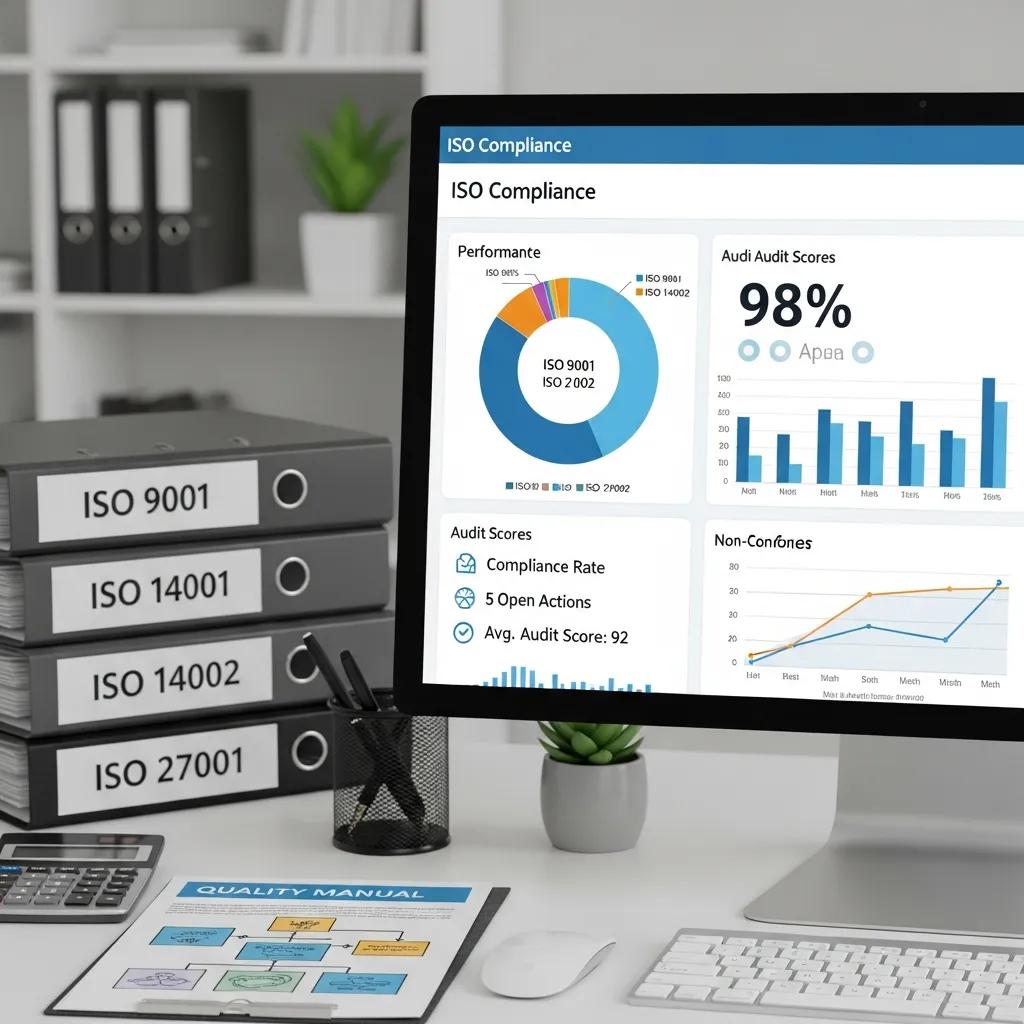
ISO management system software is enterprise-grade tooling for document control, compliance workflows, risk registers and audit evidence — everything you need to demonstrate conformity with ISO standards. It centralizes policies, automates repeatable tasks and preserves auditable trails tied to clause requirements. The practical payoff is improved audit readiness: teams can produce evidence on demand, assign and track corrective actions, and demonstrate ongoing improvement. Knowing these benefits helps buyers prioritize features that cut audit effort and strengthen compliance outcomes.
ISO management platforms deliver several concrete business advantages for certification and day-to-day operations:
- Stronger audit readiness via centralized evidence and searchable audit trails.
- Less manual effort through workflow automation and reusable templates.
- Faster corrective cycles using CAPA workflows and root-cause tools.
- Clearer risk visibility with integrated registers and monitoring dashboards.
Those gains create a virtuous cycle: better evidence and workflows reduce audit time, lowering compliance costs and enabling continuous improvement across the management system. The next section explains how compliance software streamlines the certification journey from gap analysis to issuance.
How Does ISO Compliance Software Streamline Certification Processes?
ISO compliance software speeds certification by automating repeatable tasks: gap analysis, document versioning, control mapping and internal audit schedules. When documents and processes are mapped to specific ISO clauses, the platform builds an evidence trail auditors can validate quickly — cutting down ad-hoc searches and manual consolidation. Automated workflows assign owners, set deadlines and send reminders for corrective actions and management reviews, shortening the time between discovery and CAPA closure. Organizations that adopt these workflows typically run internal audits faster and face fewer last-minute evidence requests.
A typical process looks like this: run an initial gap analysis, import or create clause-mapped documents, schedule internal audits with automated checklists, record findings in the CAPA workflow, and generate a readiness report for the certification body. That flow reduces administrative overhead and improves traceability for each requirement. Consistent workflows and templates also help ensure evidence is uniform across departments — essential for a smooth Stage 2 certification audit.
What Efficiency and Cost Advantages Do QMS, ISMS, and EMS Software Offer?
QMS, ISMS and EMS platforms cut effort and cost by consolidating data, streamlining audits and enabling template reuse across sites and processes. QMS tools automate nonconformance logging, CAPA tracking and KPI reporting so teams spend less time on paperwork and more on corrective work. ISMS solutions consolidate risk registers, asset inventories and incident logs to reduce the time needed to produce control evidence. EMS platforms centralize environmental data — emissions, permits and supplier sustainability inputs — minimizing manual reporting and regulatory tracking overhead.
Compare manual versus software-driven processes: gathering evidence across spreadsheets can take many hours per audit cycle, while automated document control and dashboards shrink preparation time substantially. And these efficiency gains scale — centralized software prevents administrative costs from multiplying as you grow or add sites.
Research also reinforces the value of integrating enterprise systems to support ISO 9001 compliance and automated audit records.
Automating ISO 9001 Compliance & Audit Records
As regulated manufacturing environments become more complex, strong data architectures are essential. This paper proposes automating compliance-ready data flows by integrating ERP, MES and PLM systems with compliance engines that use rules, metadata-driven traceability and automated audit records.
AUTOMATING COMPLIANCE-READY DATA FLOWS IN ITAR AND ISO 9001 CERTIFIED MANUFACTURING SYSTEMS, 2025
The next section maps software categories to the ISO standards they best support and highlights typical certification needs.
Which Software Solutions Support ISO 9001, ISO 14001, ISO 27001, and ISO 42001 Certifications?
ISO standards emphasize different capabilities, and vendors either specialize or offer integrated IMS platforms that cover multiple standards. QMS products focus on process mapping, CAPA and performance metrics for ISO 9001. EMS platforms prioritize environmental data, regulatory tracking and carbon accounting for ISO 14001. ISMS tools center on risk assessment, asset inventories and incident response for ISO 27001. For ISO 42001 and AI governance, look for policy mapping, model-governance logs and decision-traceability. The choice between specialized tools and an integrated IMS depends on scale, existing systems and how much evidence you need to share across standards.
The growing landscape of AI governance standards like ISO 42001 underscores the need for auditable AI management systems.
ISO 42001 for Auditable AI Management Systems
ISO 42001 defines a structure for auditable AI Management Systems (AIMS) to support oversight by regulators and payers. This standard is becoming important for organizations deploying responsible generative AI solutions, particularly in healthcare.
The emerging role of ISO 42001 certification in fostering the deployment of responsible generative
AI healthcare solutions, FA Thiers, 2024
The table below helps you scan which platform types and feature sets align with specific standards and industry targets:
Introductory note: the table compares representative software product types by the standards they support, typical key features, target industries, and common pricing models to help shortlist options during vendor evaluation.
| Software Category | Supported ISO Standard | Key Features | Target Industry | Pricing model |
|---|---|---|---|---|
| QMS Software | ISO 9001 | Process mapping, CAPA, NCR logging, KPI dashboards | Manufacturing, Healthcare | Subscription per user/site |
| EMS Software | ISO 14001 | Emissions tracking, permits, supplier sustainability | Energy, Manufacturing, Construction | Tiered subscription |
| ISMS Tools | ISO 27001 | Risk register, asset inventory, incident logging, controls mapping | Finance, IT, Telecom | Per asset or per user |
| Integrated IMS Platforms | Multiple (QMS/ISMS/EMS) | Unified document control, workflows, cross-standard mapping | Multisite enterprises | Enterprise licensing |
This side-by-side view shows how product categories translate to certification support and helps procurement teams match needs to vendor capabilities. The following subsections break down the features that define leading QMS and ISMS offerings and how they support audit evidence requirements.
What Features Define Leading QMS Software for ISO 9001 Compliance?
Top QMS platforms combine process mapping, document control, CAPA management and performance measurement to directly support ISO 9001 clauses on quality planning and improvement. Process mapping lets teams document core workflows and link outputs to KPIs, making performance auditable. CAPA and nonconformance modules offer root-cause analysis, action assignment and closure evidence to show continual improvement. Document control preserves version histories, approvals and distribution logs — the traceable records auditors expect.
Practical examples include linking a corrective action to a specific clause and attaching inspection reports or test records as evidence. KPI dashboards and management-review tools aggregate metrics auditors use in Stage 2 audits to evaluate effectiveness. These capabilities lighten the burden of proving conformity by making evidence searchable and directly traceable to quality objectives.
How Do ISMS Tools Enhance Information Security for ISO 27001?
ISMS platforms centralize risk assessments, asset inventories, control implementations and incident records so auditors can see how confidentiality, integrity and availability are managed. Risk registers let teams score and prioritize risks, document treatment plans and attach control evidence. Asset management ties hardware, software and data classifications to controls and monitoring tools, enabling auditors to verify coverage. Integrations with SIEMs and vulnerability scanners let ISMS tools ingest logs and build audit-ready reports.
Incident workflows capture timelines, impact assessments and remedial actions so organizations can demonstrate incident handling and lessons learned. By combining control mapping and evidence attachments, ISMS tools shorten auditor verification time and show a repeatable, defensible security posture. The next section explains how AI-driven audit tooling further reshapes certification and ongoing compliance.
How Does AI-Driven Audit Software Transform ISO Certification and Compliance?

AI-driven audit software applies automation, anomaly detection and predictive analytics to continuous monitoring and evidence validation, changing how organizations prepare for and maintain certification. By analyzing document stores, process logs and system telemetry, AI surfaces gaps, ranks risky items and flags anomalies that need auditor attention. That reduces manual evidence sorting and lets auditors focus on substantive findings, not clerical checks. AI also delivers predictive risk signals so teams can act before nonconformities escalate.
The strategic effect is twofold: operational efficiency from automated evidence triage, and improved audit quality through data-driven risk prioritization. AI doesn’t replace human auditors — the best results come from hybrid models where AI augments human judgment and auditors validate AI findings. The following subsection lists specific AI audit benefits and then describes how a certification body such as Stratlane integrates AI auditing with customer software to streamline certification.
What Are the Benefits of AI Audit Software for ISO Management Systems?
AI audit tools enable continuous compliance monitoring, speed evidence validation and improve consistency across findings, delivering measurable time savings and higher accuracy. Continuous monitoring checks datasets and documents against expected controls, surfacing exceptions in near real time that used to require manual checks. Automated evidence analysis can parse versions, spot inconsistencies and flag missing approvals, shortening pre-audit preparation.
AI’s value also shows in keeping pace with evolving regulatory requirements and automating routine verification tasks.
AI for Continuous Compliance Monitoring
AI adds meaningful value to compliance monitoring, helping organizations keep up with fast-changing regulations and detect risks earlier.
From Periodic Audits to Continuous Assurance: Leveraging AI for Real-Time Risk Detection and Compliance, 2025
Other advantages include anomaly detection that highlights unusual trends or outliers in process data, and predictive analytics that point to where nonconformities are most likely to appear. Together these features reduce auditor time on routine checks and let teams focus on remediation and improvement, shifting organizations from reactive fixes to continuous assurance.
How Does Stratlane's AI-Driven Auditing Complement ISO Software Solutions?
Stratlane Certification pairs AI-driven audit tooling with experienced auditors to deliver ISO certification services for ISO 9001, ISO 14001, ISO 27001 and ISO 42001. Our AI triages evidence and highlights high-risk areas for human auditors, cutting redundant checks while preserving expert judgment. Stratlane is accredited to issue certificates in over 27 countries and works with professional auditors across more than 29 countries, with certificates recognized by corporations and academic institutions worldwide.
Typical integration points include evidence export from QMS/ISMS platforms, API-based pulls for logs and dashboards, and pre-audit readiness checks that produce prioritized remediation lists. Organizations that connect their ISO management software with AI-enabled certification workflows can shorten certification timelines and make audits more predictable. To get started, teams can use “Get a Quote” or “Book an Audit” forms to schedule a readiness assessment.
What Essential Features Should You Look for in ISO Certification Software?
Choose ISO certification software using a checklist of core features that map directly to audit evidence and control requirements. Essential capabilities include robust document control and versioning, risk-assessment modules with treatment tracking, CAPA workflows with root-cause analysis, and reporting dashboards that surface auditor-friendly KPIs. Integration capabilities (APIs and connectors) are critical to pull evidence from security tools, ERP systems and environmental monitors.
Below is a concise feature-to-certification mapping that explains why each capability matters and the audit benefit it delivers.
Introductory paragraph: this table explains essential features as entities, why they matter for certification, and the concrete benefit each feature delivers in audit scenarios.
| Feature | Why it matters for certification | Benefit / Example |
|---|---|---|
| Document Control | Provides traceable records and version history | Auditors can verify approvals and historical changes |
| Risk Management | Demonstrates proactive identification and treatment | Shows risk register entries with mitigations and dates |
| CAPA Module | Records corrective cycles and outcomes | Evidence of root-cause analysis and closure dates |
| Reporting Dashboards | Aggregates KPIs for management review | Shows open CAPAs, overdue actions and trends |
This feature map helps procurement teams prioritize must-haves versus nice-to-haves when shortlisting vendors. The subsections below explain why document control, risk management and CAPA are especially critical, and how reporting and integrations support audit readiness.
Why Are Document Control, Risk Management, and CAPA Critical in ISO Software?
Document control, risk management and CAPA are the backbone of audit evidence because they capture decisions, mitigation steps and continuous-improvement cycles required by ISO standards. Document control ensures policies, procedures and records are versioned, approved and distributed with metadata that proves authenticity and timing. Risk management shows that the organization identifies, assesses and treats risks systematically — a key auditor focus. CAPA modules record nonconformities, corrective actions, root-cause analyses and closure evidence, making improvement cycles auditable and measurable.
For audit readiness, ensure these modules support attachments, timestamps and owner assignments so evidence is complete and searchable. When documented processes, treated risks and closed CAPAs work together, auditors can verify conformity quickly and concentrate on system effectiveness. The next subsection explains how reporting and integrations centralize evidence and reduce manual assembly.
How Do Reporting and Integration Capabilities Improve Compliance Management?
Reporting and integrations create a single source of truth auditors and managers can trust. APIs and connectors let ISO software ingest SIEM logs, pull data from ERP or HR systems, and consolidate environmental measurements for EMS reporting. Dashboards surface KPIs like open CAPAs, overdue actions and risk heatmaps, offering auditors summarized evidence of system performance.
Integrations cut manual evidence collection by automating data pulls and attaching source logs to findings, shortening audit prep time. Strong reporting features also generate auditor-ready packages that include clause-mapped documents, change histories and trend charts. These capabilities materially improve audit preparedness and support continuous compliance monitoring — which feeds into the vendor selection framework below.
How to Choose the Right ISO Management System Software for Your Organization?
Selecting the right ISO management system software requires a decision framework that balances industry fit, scale, integrations, vendor support and total cost of ownership against certification goals. Start by defining which ISO standards you need and which internal systems must integrate with the platform (ERP, SIEM, environmental sensors). Use pilot evaluations to measure how the software reduces audit prep time, improves evidence retrieval and accelerates CAPA closure. Vendor responsiveness, professional services and templated clause mappings are often decisive for first-time implementers.
A practical checklist helps operationalize selection during procurement:
- Identify required standards and prioritize features tied to audit outcomes.
- List integration endpoints (SIEM, ERP, HR, environmental sensors) and test connectivity.
- Run a time-and-effort pilot to measure audit-prep reductions and CAPA closure improvements.
These steps create measurable criteria to compare vendors and shortlist candidates. Close collaboration with certification bodies can further refine requirements and reduce surprises during formal audits, as explained in the next subsection.
Stratlane Certification is a certification body that combines AI-driven audit tooling with experienced industry auditors to deliver ISO certification services. We offer certification for ISO 9001, ISO 14001, ISO 27001 and ISO 42001, using AI to boost efficiency and effectiveness while reducing time and cost. Stratlane is accredited to issue certificates in over 27 countries and works with professional auditors in more than 29 countries; our certificates are accepted by corporations and academic institutions globally.
After shortlisting vendors, request demos with realistic datasets, validate API integrations, and ask for references that can speak to audit-readiness gains. Let pilot outcomes and certification-body alignment guide the final procurement choice, then proceed to “Get a Quote” or “Book an Audit” forms to schedule vendor pilots or readiness assessments.
What Factors Influence Software Selection Based on Industry and ISO Standards?
Industry needs shape vendor choice because regulated sectors and complex operations demand tailored controls and integrations. Healthcare and finance require strong access controls, auditable trails and strict change control; software that integrates with identity and access management tools is essential. Manufacturing needs process control, NCR/CAPA workflows and supplier quality modules to handle nonconformances across production lines. Services and IT organizations prioritize ISMS integrations, incident tracking and log ingestion from security tools to evidence technical controls.
Match feature priorities to your industry and use pilot scenarios that mirror common operational events. Simulating incident handling, nonconformance flows and management reviews reveals how well a product supports real-world certification activities and reduces the risk of costly customizations later.
How Can Integration with Certification Bodies Enhance Audit Readiness?
Working closely with certification bodies aligns expectations, reduces format mismatches and enables pre-audit checks that surface issues early. Agreed evidence formats or export templates let organizations present packages in the auditor’s preferred structure, cutting back-and-forth during Stage 2 audits. Joint pre-audit readiness assessments identify high-risk areas and deliver prioritized remediation plans that often shorten the formal certification timeline.
Practical steps include agreeing on evidence scope, using secure data exchange for sensitive documents, and scheduling joint readiness reviews to validate corrective action plans. This collaborative approach minimizes surprises during formal audits and supports a smoother certification experience.
What Are the Latest Trends and Market Insights in ISO Software and AI Auditing?
As of 12/2024, buyers are accelerating adoption of cloud-native IMS platforms, expanding AI-assisted auditing, and demanding sustainability-focused EMS features for ISO 14001. SaaS models enable faster deployments and multi-site rollouts, while automation trims audit preparation and administrative overhead. AI in audit workflows is moving from pilots into operational tooling for continuous compliance monitoring and anomaly detection. These trends push vendors to deliver richer integrations and prebuilt templates for audit evidence.
Primary market drivers shaping buyer expectations and vendor roadmaps include:
- Cloud and SaaS delivery that shortens deployment and ensures multi-location consistency.
- Automation that reduces manual audit prep and streamlines CAPA processes.
- AI-powered monitoring and predictive analytics that surface risks earlier and enable continuous assurance.
These trends mean buyers should favor vendors with mature cloud architectures, robust APIs and measurable AI capabilities that augment — not replace — human auditors. The next subsection explains how digital transformation accelerates adoption and then highlights emerging EMS sustainability features.
How Is Digital Transformation Driving Growth in ISO Certification Software?
Digital transformation accelerates adoption by replacing paper and spreadsheet-based approaches with integrated, cloud-hosted platforms that scale across sites and business units. Automating routine compliance tasks reduces labor-driven costs and shortens audit cycles, making SaaS solutions attractive even for mid-market organizations. AI and analytics enable continuous monitoring that surfaces deviations between expected and actual process performance, prompting proactive remediation.
Buyers should evaluate a vendor’s cloud maturity, data retention and backup policies, and integration support for existing enterprise systems. Digital-first vendors that provide pre-configured ISO templates and scalable user models simplify rollout and speed certification readiness, improving time-to-value.
What Are the Emerging Sustainability Features in EMS Software for ISO 14001?
EMS software increasingly includes carbon accounting, supplier sustainability scoring and lifecycle impact assessment modules to meet growing regulatory and stakeholder expectations tied to ISO 14001. Carbon-footprint calculators and emissions-tracking modules help organizations aggregate scopes 1–3 data, produce trend reports and demonstrate year-over-year environmental performance. Supplier sustainability features let teams assess upstream impacts and fold supplier data into environmental risk registers.
Lifecycle assessment tools and regulatory mapping help teams demonstrate compliance with evolving environmental rules and give auditors structured evidence of performance. These features turn EMS platforms into strategic sustainability tools rather than mere record-keeping systems, and they feed directly into ISO 14001 audit evidence packages.
Frequently Asked Questions
What is the role of AI in ISO management systems?
AI improves ISO management by automating evidence checks, spotting anomalies and offering predictive analytics to identify likely nonconformities before they escalate. That lets teams focus on substantive remediation instead of clerical tasks, raising audit quality and streamlining preparation. AI-driven tools support continuous readiness and help teams respond proactively to compliance changes.
How can organizations ensure successful integration of ISO software with existing systems?
Successful integration starts with mapping your data flows and identifying key endpoints — ERP, HR, security tooling and environmental sensors. Choose software with robust APIs and conduct pilot tests to validate connectivity and data exchange. Involve IT and vendor support early, and test realistic scenarios to uncover issues before full rollout.
What are the common challenges organizations face when implementing ISO management software?
Common challenges include user resistance to change, data migration complexity, and aligning software features to specific ISO requirements. Address these with role-based training, a phased migration plan, and selecting solutions with prebuilt clause mappings to reduce customization. Strong vendor professional services can also smooth implementation.
How does the choice of software impact the audit process?
Software choice determines how efficiently evidence is collected, managed and presented. Solutions with robust document control, automated workflows and integrated reporting shorten audit preparation and reduce auditor verification time. Poorly matched software can create disorganized records, extra manual work and longer audit cycles — so align your choice to audit needs.
What should organizations consider when evaluating vendors for ISO management software?
Evaluate a vendor’s experience with your target standards, the product’s scalability, integration capabilities and the quality of customer support. Request demos with realistic datasets, run pilot programs and check references that can confirm audit-readiness improvements. Consider total cost of ownership and available professional services for configuration and training.
How can organizations measure the effectiveness of their ISO management software?
Measure effectiveness with KPIs tied to compliance and operations: time to prepare for audits, number and severity of nonconformities, CAPA closure time, and user adoption rates. Solicit feedback from auditors and users, and run periodic reviews to ensure the platform continues to deliver measurable improvements.
Conclusion
Adopting ISO management system software strengthens audit readiness, streamlines compliance workflows and reduces costs through automation. By centralizing documentation, integrating workflows and connecting to enterprise systems, organizations can meet ISO requirements more reliably and efficiently. To move toward certification readiness, evaluate platforms against the feature checklist and integration needs described here, then schedule a pilot or a readiness assessment to validate performance in your environment. Start your path to better compliance and operational excellence today.