
How ISO Standardization Shaped Modern Industry Practices

The History and Evolution of ISO International Standards: A Practical Timeline and Impact Analysis
The International Organization for Standardization (ISO) creates voluntary international standards that help companies, regulators, and markets work together reliably—enabling interoperability, quality, safety, and cross‑border trade. This article tracks ISO’s origin, key milestones for standards such as ISO 9001, ISO 14001 and ISO 27001, and how ISO has responded to modern forces like AI, digital transformation and sustainability. You’ll find a concise timeline, clear comparisons of major revisions, an introduction to emerging guidance such as ISO 42001, and an analysis of how standards influence global commerce and certification practices. We also review AI‑driven auditing, measurable benefits for stakeholders, and likely trends that will shape future standardization. Practical guidance appears throughout so organizations can connect historical lessons to today’s compliance and certification strategies, supported by structured comparisons to speed decision‑making.
The Evolution and Strategic Impact of ISO Standards
ISO was established in 1947 in Geneva to coordinate international standardization and reduce technical barriers to trade after World War II. The organization brought national standards bodies together to agree on technical specifications that could be adopted across borders—improving interoperability, simplifying procurement, and accelerating economic recovery. At its core the founding goal was harmonization: a shared language for quality, safety and compatibility so manufacturers, regulators and buyers could operate with less friction. That founding purpose explains why later ISO standards emphasize mutual recognition and interoperable systems through technical committees and consensus-based development.
What Led to the Creation of ISO After World War II?
Reconstruction after World War II created urgent demand for standardized components, measurement systems and processes to rebuild infrastructure and restart international trade. When countries used different technical rules, parts were often incompatible, supply chains slowed and costs rose. Industry and governments therefore pushed for international alignment to reduce these frictions. Standardization also supported diplomatic aims: common technical rules lowered trade disputes and let production scale more quickly. These economic, technical and political drivers shaped ISO’s consensus-based model and its emphasis on neutrality and broad stakeholder involvement.
How Did the International Federation of the National Standardizing Associations Influence ISO's Formation?
The International Federation of the National Standardizing Associations (ISA) existed before World War II and provided a practical template—technical committees, draft standards and institutional know‑how—that ISO drew on. When ISA disbanded during the war, its network of experts and procedural lessons helped ISO set up governance and committee structures rapidly. That continuity shortened the ramp from idea to producing internationally accepted standards, while ISO introduced improvements in transparency and wider national representation.
What Are the Key Milestones in the Development of ISO Standards?
ISO’s progress is best understood as a sequence of milestones where standards evolved in response to technology, regulation and societal priorities. Periodic reviews led by technical committees and stakeholders moved many standards from prescriptive checklists to risk‑based, performance‑oriented frameworks. Mapping these changes against specific standards highlights how management system thinking matured and how standards enabled market access worldwide. The timeline and table below summarize the core milestones and revision themes that shaped modern standardization.
Major milestones at a glance:
- 1947: ISO founded in Geneva to harmonize international standards and support post‑war trade.
- 1987: First edition of ISO 9001 introduced a formal quality management system standard.
- 1994–2015: Successive ISO 9001 revisions shift focus to process performance and risk‑based thinking.
- 1996: ISO 14001 published to provide a structured environmental management framework.
- 2005: ISO 27001 published to formalize information security management systems.
- 2013/2017: ISO 27001 updates align the standard with evolving risk and governance expectations.
- 2020s: Emerging work on AI governance and digital assurance, including ISO 42001 initiatives.
| Standard | First Published | Latest Revision / Notable Theme |
|---|---|---|
| ISO 9001 (Quality management) | 1987 | 2015 — shift to risk‑based thinking and performance orientation |
| ISO 14001 (Environmental management) | 1996 | 2015 — greater emphasis on lifecycle and strategic environmental aspects |
| ISO 27001 (Information security) | 2005 | 2013/2017 updates — alignment with risk and governance frameworks |
| ISO 42001 (AI management systems) | Emerging (2020s) | Focus on AI governance, risk oversight, and accountability |
That table shows how each standard’s lifecycle tracks broader social and technological shifts and why organizations need to follow revision themes to keep management systems compliant and effective. The next section looks specifically at ISO 9001 and what its evolution means in practice.
How Did ISO 9001 Evolve as a Quality Management Standard?
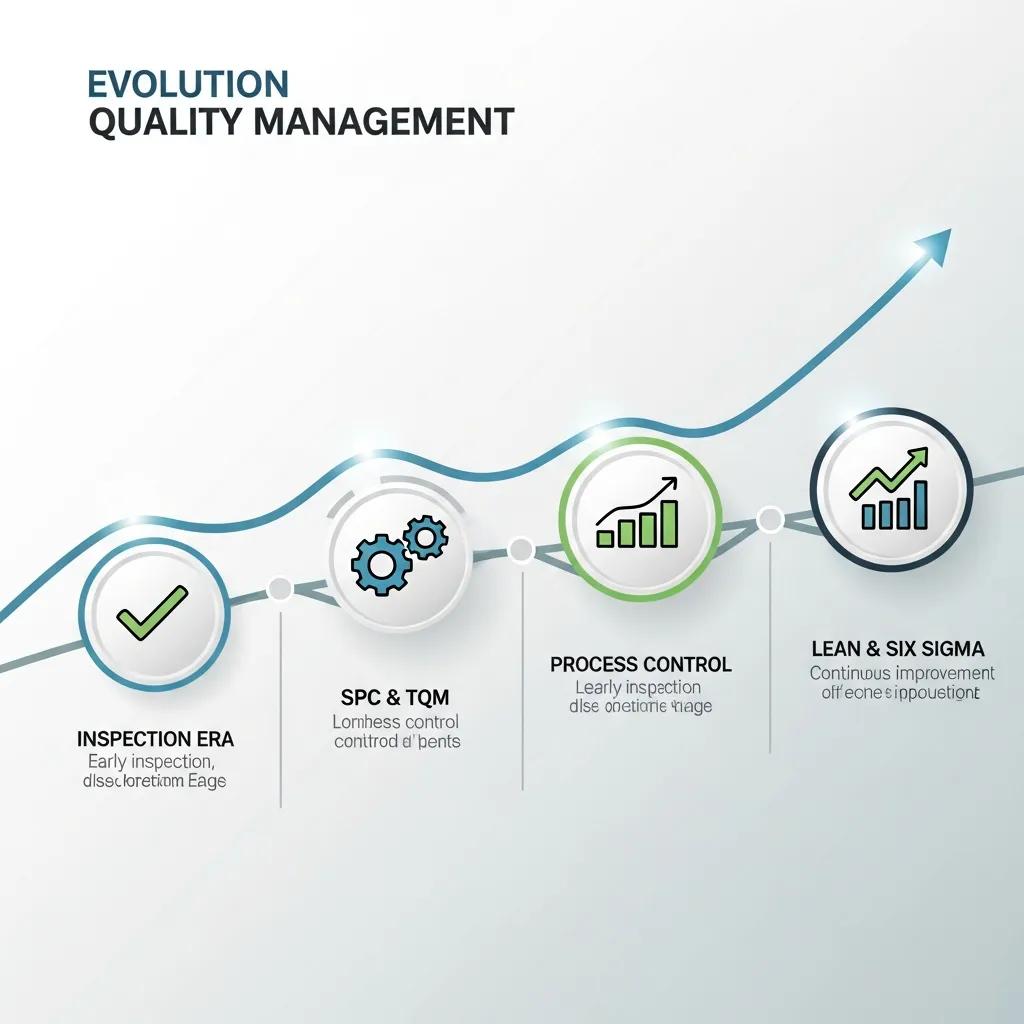
ISO 9001 started as a framework for documenting quality assurance activities and controlling suppliers to prevent defects. Over successive revisions it moved from procedural compliance toward process performance, embedding continual improvement and customer focus as central elements. The 2015 edition introduced the High‑Level Structure (HLS) and risk‑based thinking, making it easier to integrate ISO 9001 with other management standards and align quality efforts with organizational strategy. In practice this reduced time spent auditing paperwork and increased emphasis on measurable outcomes—leadership involvement, performance indicators and effective risk mitigation now matter more than rote documentation. Organizations that implement ISO 9001 today focus on results, integrated governance and extracting real business value beyond certification.
What Are the Historical Developments of ISO 14001 and ISO 27001?
ISO 14001 emerged as environmental regulation and corporate sustainability expectations rose, offering a management system to reduce pollution, manage regulatory risk and improve resource efficiency. Revisions expanded the standard from operational controls to lifecycle thinking and strategic environmental priorities, delivering measurable reductions in waste and compliance incidents for many adopters. ISO 27001 developed as information became a core business asset and cyber threats multiplied; it formalized an Information Security Management System (ISMS) that ties risk assessment, controls and governance together. Both standards migrated toward risk‑based approaches and closer alignment with organizational strategy, reflecting how environmental and cybersecurity risks moved onto boardroom agendas.
How Has ISO Adapted to Modern Challenges Through Emerging Standards?
ISO adapts to technological and societal change by creating new standards and updating existing ones to reflect digital transformation, AI governance and sustainability imperatives. The technical committee model brings cross‑sector experts together to draft standards that anticipate operational realities, regulatory trends and ethical concerns. The result is an ecosystem of standards that helps organizations manage new risks, adopt technologies responsibly and demonstrate accountable governance.
Early practical steps organizations often take to align with emerging standards include assessing governance gaps, updating risk registers for AI and digital systems, and mapping evidence flows for continuous assurance. The table below highlights core attributes of ISO 42001 alongside comparable management standards to guide compliance planning.
| Standard | Scope | Key Requirement |
|---|---|---|
| ISO 42001 | AI management systems | Risk governance for AI, ethical oversight, and lifecycle controls |
| ISO 27001 | Information security management | Risk assessment, control selection, and continual improvement |
| ISO 14001 | Environmental management | Lifecycle impact evaluation and strategic environmental objectives |
This comparison makes clear where AI governance overlaps with established management system expectations and helps organizations prioritize governance, data lineage and evidence collection. The next subsection defines ISO 42001 and outlines concrete compliance steps.
What Is ISO 42001 and Its Role in AI Management Systems?
ISO 42001 is an emerging management system standard designed to help organizations govern AI responsibly—focusing on risk management, transparency and accountability. It centers on defining roles and responsibilities, risk assessment methods, lifecycle controls and documentation so AI deployments can be demonstrated as trustworthy and auditable. The main benefit is a consistent framework to reassure regulators, customers and partners that AI systems meet governance and safety expectations. Practical steps toward compliance include mapping AI assets, assessing model and data risks, establishing human oversight, and collecting evidence that links design decisions to operational outcomes.
How Is Digital Transformation Shaping the Evolution of ISO Standards?
Digital transformation—cloud migration, automation and data‑driven operations—is reshaping how ISO standards are written and applied by prioritizing continuous controls, software‑integrated evidence and resilience metrics. Standards now recognize real‑time monitoring, API audit trails and configuration management as valid audit evidence, which speeds conformity assessment and broadens coverage. That benefits organizations by enabling near‑continuous assurance and faster detection of deviations, but it also requires investment in data integrity, logging and observability. As standards evolve to include digital‑native controls, auditors and certification bodies adapt their methods to assess software and algorithmic governance effectively.
What Is the Impact of ISO Standards on Global Business and Trade?
ISO standards lower technical barriers, set common expectations for quality and safety, and make international commerce more predictable by simplifying supplier evaluation and regulatory alignment. Harmonization—buyers and regulators referencing the same standards—reduces transaction costs and speeds market entry. Economic benefits include improved operational efficiency, fewer nonconformities and expanded market access; societal benefits include safer products, better environmental outcomes and stronger data protection. These structural advantages encourage organizations to adopt management standards as tools for competitive differentiation and risk reduction.
ISO certifications support trade through mutual recognition, accredited conformity assessment and standards‑based procurement practices that simplify supplier qualification. The list below summarizes the primary economic and societal benefits of ISO standardization.
- Market Access and Trust: Shared standards reduce buyer uncertainty and support cross‑border acceptance.
- Operational Efficiency: Standardized processes lower defects, rework and transaction costs.
- Regulatory Alignment: Standards help organizations meet or exceed regulatory requirements with documented systems.
- Public‑Interest Outcomes: Standards promote safety, environmental stewardship and data protection across sectors.
These benefits make standards a lever for private value creation and public good, influencing organizational choices about certification and continuous improvement. The next section explains how certification mechanisms deliver those outcomes in practice.
How Do ISO Certifications Facilitate International Commerce?
ISO certification provides third‑party assurance that an organization’s management system meets internationally agreed requirements—streamlining supplier selection and cutting duplicate audits across jurisdictions. The mechanism relies on accredited certification bodies and mutual recognition arrangements so certificates are trusted by customers and regulators worldwide. The practical benefits are faster supplier qualification, smoother contract negotiations and lower due diligence costs—particularly for exporters and global supply chains. Certified organizations often see shorter onboarding and clearer evidence when responding to procurement requests, which supports ongoing international trade.
What Are the Economic and Societal Benefits of ISO Standardization?
On the economic side, ISO adoption often correlates with fewer defects, higher productivity and lower compliance penalties, producing measurable cost savings and revenue opportunities. Societally, standardization embeds best practices that advance public safety, environmental protection and data security. These outcomes build trust with customers, investors and regulators, making standards a strategic investment rather than a paperwork exercise. For SMEs and academic organizations, standards offer a practical route to demonstrate capability and participate in international markets—supporting inclusive economic growth and knowledge sharing.
How Does AI-Driven Auditing Enhance the ISO Certification Process?

AI‑driven auditing complements traditional audits by automating data collection, enabling continuous monitoring and improving anomaly detection—together raising audit accuracy and efficiency. The approach uses machine‑assisted evidence aggregation, pattern analysis across large datasets and predictive analytics to surface risks earlier than periodic manual reviews. The result is richer evidence, shorter audit cycles and more focused corrective actions—reducing certification time and cost while increasing confidence in compliance outcomes. By integrating AI into conformity assessment, certification bodies can scale coverage, keep evaluations consistent and deliver actionable insights to clients.
AI auditing delivers several high‑impact benefits:
- Automated Data Collection: Cuts manual sampling and speeds evidence assembly.
- Continuous Monitoring: Detects deviations near real time, improving response times.
- Predictive Insights: Surfaces emerging risk patterns before they materialize.
- Improved Sampling Accuracy: Algorithms identify representative samples across large datasets.
| AI Audit Feature | Attribute | Benefit |
|---|---|---|
| Automated evidence harvesting | Integrates logs, metrics, and configuration data | Faster audit preparation and broader coverage |
| Anomaly detection | Machine learning pattern recognition | Early detection of compliance drift |
| Continuous assurance dashboards | Real-time analytics | Ongoing visibility into control effectiveness |
| Predictive risk scoring | Statistical forecasting | Prioritized remediation and resource allocation |
This mapping shows how AI capabilities translate into measurable audit outcomes, helping organizations maintain stronger, evidence‑based management systems. The next subsection outlines concrete benefits and KPI examples for AI integration in auditing.
What Are the Benefits of Integrating Artificial Intelligence in Auditing?
AI in auditing expands speed, scope and insight by automating routine work, increasing data coverage and surfacing trends that manual reviews may miss. Organizations that adopt AI‑driven audits typically track KPIs such as reduced audit preparation time, higher sample coverage and faster closure of corrective actions. In practice, AI frees auditors to spend more time on judgment‑based work while algorithms handle large‑scale data triage—improving both accuracy and scalability. The net effect is a more resilient assessment process that supports continuous improvement and delivers clearer, data‑rich assurance to stakeholders.
How Is Stratlane Certification Leading Innovation with AI-Driven Audits?
Stratlane Certification positions itself as an accredited, forward‑looking certification body offering ISO services for standards including ISO 9001, ISO 14001, ISO 27001 and emerging frameworks such as ISO 42001. We combine traditional audit expertise with AI‑assisted evidence collection and continuous monitoring to improve assessment quality and shorten time‑to‑certification—delivering cost‑effective, reliable certification pathways. Operating across more than 27 countries with professional auditors in over 29, Stratlane’s certificates are recognized by corporations, academia and SMEs worldwide. Organizations can request a quote, schedule an AI‑driven audit or explore certificate management services to meet modern assurance expectations.
What Does the Future Hold for ISO Standards and Certification?
ISO standards will evolve under the influence of AI governance, sustainability requirements, cybersecurity resilience and digital assurance practices—creating cross‑disciplinary clauses and new evidence models. Future standards are likely to emphasize explainability, lifecycle impact and continuous compliance, pushing organizations to unify governance, ethical oversight and technical controls into integrated management systems. Standards development will remain expert‑driven but faster and more iterative, drawing broader stakeholder input to keep pace with technology. Preparing now—by improving data governance, aligning risk frameworks and piloting continuous assurance—positions organizations to adapt smoothly as standards change.
Key trends shaping the next generation of standards include AI oversight, climate and carbon management, resilient digital supply chains and integrated risk governance. The list below highlights practical readiness steps organizations should adopt to navigate these trends.
- Map critical digital and AI assets to clarify ownership and risk profiles.
- Embed sustainability metrics into performance dashboards to inform decisions.
- Deploy continuous monitoring tools to produce audit‑grade evidence in real time.
- Strengthen cross‑functional governance to align legal, technical and ethical controls.
These actions turn macro trends into operational practices that reduce disruption when new standards are published. The final subsection summarizes how AI and sustainability will intersect to shape future standards and certification processes.
Which Trends Are Driving the Next Generation of ISO Standards?
AI governance and ethics, sustainability and carbon accounting, cybersecurity, and supply‑chain resilience are the main trends reshaping standardization—driven by regulatory pressure and stakeholder expectations. ISO committees are drafting requirements that combine technical controls with governance structures, increasing overlap between formerly separate standards. That means organizations should pursue integrated management systems that address multiple risk domains at once, improving efficiency and reducing duplicated evidence. Early adopters of cross‑disciplinary controls will gain an advantage as certifications evolve to require multi‑attribute proof of compliance.
How Will AI and Sustainability Influence Future ISO Developments?
AI and sustainability will converge in standards that demand traceability for algorithmic decisions alongside lifecycle environmental impact assessments—creating hybrid clauses that attest to both ethical operation and ecological responsibility. Compliance will rely increasingly on data provenance, model documentation and carbon accounting tied to digital services, shifting audit evidence toward machine‑readable logs and automated reporting. For certification, auditors will evaluate algorithmic governance and sustainability metrics as integrated evidence streams, which requires investment in data infrastructure and interdisciplinary audit skills. Organizations that build these capabilities early will find certification processes smoother and more robust as international expectations evolve.
Stratlane Certification helps organizations prepare by offering AI‑aware audit methodologies, certification against emerging standards such as ISO 42001, and certificate management services to simplify ongoing compliance. Organizations seeking a practical readiness assessment can request a quote or schedule an AI‑driven audit to map gaps and implement prioritized remediation plans aligned with future ISO developments.
Frequently Asked Questions
What is the role of ISO in promoting sustainability?
ISO promotes sustainability by creating standards that help organizations manage environmental impacts. Standards like ISO 14001 provide a structured approach to reduce waste, boost resource efficiency and meet regulatory obligations. Adopting these standards lets organizations demonstrate their sustainability commitments, improve reputation and contribute to broader climate goals. The ongoing evolution of ISO reflects how sustainability has become central to business and societal expectations.
How do ISO standards impact small and medium-sized enterprises (SMEs)?
ISO standards give SMEs a clear framework for improving quality, efficiency and market credibility. By implementing ISO requirements, smaller firms can streamline processes, raise customer confidence and access new markets where certification is a procurement advantage. While certification requires effort, the payoff often includes cost savings, stronger customer relationships and growth opportunities in global supply chains.
What are the challenges organizations face when implementing ISO standards?
Common challenges include limited resources, gaps in expertise and resistance to change. Smaller organizations may find certification costs and implementation time‑consuming, and aligning legacy practices with ISO requirements can be complex. To overcome these hurdles, organizations can use external guidance, invest in targeted training and cultivate a culture of continuous improvement that highlights the practical benefits of standardization.
How do ISO standards facilitate international trade?
ISO standards ease international trade by offering a common framework for quality, safety and interoperability that’s recognized globally. When businesses follow the same standards, buyers and regulators can assess suppliers more predictably, reducing technical barriers and speeding market entry. This harmonization simplifies procurement and compliance, making cross‑border transactions smoother and more reliable.
What is the significance of AI in the evolution of ISO standards?
AI is reshaping ISO standards by introducing governance and ethical questions that standards must address. Emerging frameworks like ISO 42001 focus on managing AI risks, transparency and accountability—helping organizations adopt AI responsibly. As AI technologies advance, ISO will continue to develop guidance that balances innovation with safety, fairness and regulatory expectations.
How can organizations prepare for future ISO standards?
Organizations can prepare by assessing current governance frameworks, identifying gaps and aligning practices with trends like AI governance and sustainability. Implementing continuous monitoring, integrating sustainability metrics and promoting cross‑functional collaboration helps build readiness. These steps make it easier to adapt when new standards are published and keep compliance efforts efficient and resilient.
Conclusion
ISO standards have played a central role in improving quality, safety and interoperability across global markets. Adopting and staying current with these standards helps organizations streamline compliance, boost operational performance and build trust with customers and regulators. As standards evolve to address AI, sustainability and digital assurance, staying informed and investing in governance and data infrastructure will preserve competitive advantage. Explore our resources to understand how your organization can prepare for the next wave of standardization.