
Master the Deming Cycle: A Guide to the PDCA Process
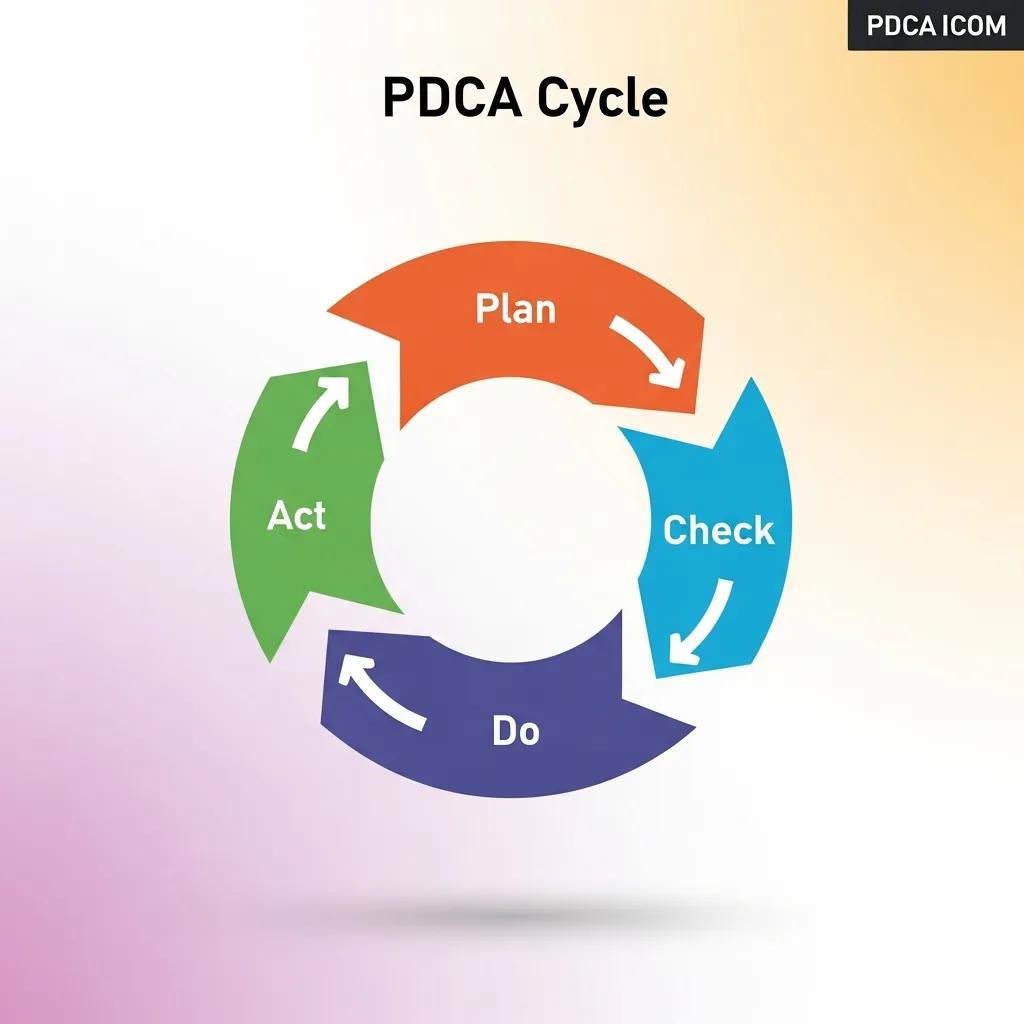
The PDCA Cycle: Plan‑Do‑Check‑Act for Continuous Improvement in Management Systems
The PDCA Cycle — Plan, Do, Check, Act — is a practical, repeatable framework for continuous improvement. It breaks management work into four short, linked stages so teams can reduce risk, improve processes, and deliver reliable outcomes. PDCA turns audit and measurement data into a tight feedback loop that refines objectives, tightens controls, and produces measurable quality gains across management systems. Many organizations fail to sustain improvements because fixes remain one-off. PDCA fixes that by connecting planning, implementation, verification, and standardization into a routine governance cycle. This guide traces PDCA’s Shewhart‑Deming roots, defines each phase with hands‑on activities, maps PDCA to ISO 9001 evidence, and explains how AI can strengthen the Check and Act stages. You’ll also get comparative EAV tables for ISO 9001, ISO 27001, and ISO 42001, a step‑by‑step roadmap for adding AI to PDCA, plus practical metrics and audit‑ready lists you can apply immediately. By the end, you’ll know how to make PDCA work for certification readiness, continuous compliance, and measurable risk‑based performance.
What is the PDCA Cycle and Why is it Essential for Quality Management?
PDCA is a four‑stage improvement loop: Plan (set objectives), Do (implement), Check (measure and audit), Act (standardize or correct). Its power comes from short feedback cycles: data from Check informs the next Plan, which reduces variation and accelerates learning. In a quality management context, PDCA links strategy to day‑to‑day control — objectives become measurable targets, processes produce evidence, audits reveal gaps, and successful changes are institutionalized. Understanding PDCA helps teams pick which processes to pilot, which success metrics to track, and how to show auditors the thread from intent to outcome.
What are the Four Phases of the Plan-Do-Check-Act Cycle?
The PDCA phases translate strategy into actionable, measurable control.
- Plan: Define scope, objectives, success metrics, and resources for the change — aligned to your organizational context.
- Do: Run the plan as a controlled pilot or rollout, documenting steps, responsibilities, and data collection.
- Check: Measure results and audit evidence against success criteria, using quantitative metrics and qualitative observations to spot deviations.
- Act: Standardize successful changes or apply corrective/preventive actions, update procedures and training, and prepare the next Plan.
These phase summaries are designed for quick reference, SEO snippets, and to set expectations about ISO evidence during certification cycles.
How Does the Deming Cycle Influence Continuous Improvement?

PDCA builds on Shewhart’s statistical control and Deming’s managerial focus on systems. Deming shifted quality from inspection to prevention, arguing that system design and leadership determine outcomes. That legacy pushes organizations to bake monitoring and data analysis into governance so management review drives strategic PDCA cycles. Recognizing this lineage explains why modern QMS standards insist on documented objectives, measurable indicators, and evidence of continual improvement.
How is the PDCA Cycle Implemented in ISO 9001 Quality Management Systems?
PDCA aligns cleanly with ISO 9001: planning ties to context and quality objectives, doing covers operational controls and delivery, checking maps to monitoring, measurement and internal audits, and acting ties to management review and corrective action. Implementation needs documented processes, performance records, evidence of risk‑based thinking, and proof of iterative improvement across cycles. When teams match PDCA artifacts to ISO clauses, audits shift from paperwork checks to performance validation that demonstrates measurable improvements. The table below lists Plan‑phase activities, the ISO evidence auditors expect, and AI tools that speed readiness.
| Plan Activity | ISO 9001 Evidence | AI-enabled Tool / Metric |
|---|---|---|
| Context & stakeholder analysis | Documented context, interested parties matrix | Natural language analysis of stakeholder inputs; sentiment tagging |
| Quality objectives & KPIs | Documented quality objectives, KPI dashboard | Automated KPI generation and anomaly detection |
| Risk-based process mapping | Risk registers and process maps | Process mining to identify variation and bottlenecks |
| Resource & competence planning | Training records, responsibility matrix | Skill-gap analytics and training prioritization metrics |
This quick mapping helps teams focus which Plan artifacts to tighten before making operational changes and shows where AI can convert existing records into audit‑ready evidence.
What are the Key Activities in the Plan Phase for ISO 9001 Compliance?
During Plan for ISO 9001, teams fix context, translate goals into measurable quality objectives, apply risk‑based thinking, and design process controls that meet customer and regulatory needs. Typical artifacts include scope statements, objective targets, risk registers, process maps, and clear responsibility assignments — the baseline evidence auditors request at initial and surveillance audits.
Practical advice: choose KPIs that tie to customer outcomes, record decision rationales, and assign owners and review dates. AI tools can structure unstructured inputs and surface hidden risks, helping you move into Do with a validated control design.
How Does PDCA Drive Process Improvement in ISO 9001 Certification?
PDCA creates a steady cadence of test, measure, and institutionalize that cuts nonconformities and boosts efficiency. For example, a pilot change in an operational control can be tracked by cycle time and defect‑rate KPIs during Check; results then inform Act — updating procedures and training.
Recommended KPIs include:
- Process cycle time
- First‑pass yield
- Customer complaint rates
- Number of audit findings per period
Monitoring these across PDCA iterations demonstrates continual improvement and builds a defensible narrative for certification bodies about how changes were planned, verified, and standardized.
How Does AI-Driven Auditing Enhance the Check and Act Phases of PDCA?

AI‑driven auditing strengthens Check and Act by enabling continuous analysis, faster anomaly detection, and prioritized corrective work — all of which shrink time‑to‑detection and improve remediation repeatability. AI aggregates evidence, correlates signals across sources, and surfaces trends humans might miss, enabling deeper, more frequent audits. In Act, AI can recommend standardized responses based on prior outcomes, assign actions to the right owners, and track verification automatically to close the loop. The table below links AI features to Check/Act attributes and measurable outcomes so decision makers can quantify audit ROI.
| AI Feature | Check Phase Attribute | Measurable Outcome |
|---|---|---|
| Continuous log analysis | Real-time anomaly detection | Faster detection (hours vs days) |
| Automated evidence aggregation | Consistent audit trail | Reduced audit preparation time |
| Predictive risk scoring | Prioritized findings | Higher remediation efficiency |
| Action recommendation engine | Standardized corrective actions | Lower recurrence of nonconformities |
The table shows how AI features translate into concrete gains: shorter audit cycles and better corrective actions.
What Benefits Does AI Bring to the Check Phase in Management Systems?
AI enhances Check by delivering continuous assurance through automated ingestion, anomaly detection, and cross‑record correlation that would otherwise be manual and slow. Capabilities include pattern detection in process metrics, automated sampling of records for evidence, and early warning indicators that flag emerging nonconformities before they escalate.
Typical, measurable benefits include fewer audit hours, earlier issue detection, and broader audit coverage thanks to automation. Freed from repetitive tasks, audit teams focus on root‑cause work and strategic risk assessment, which feeds a stronger Act phase where corrective actions are properly prioritized and verified.
How Does AI Support Standardizing Improvements in the Act Phase?
In Act, AI helps prioritize, recommend, assign, and verify corrective and preventive actions — creating a closed‑loop that reduces recurrence and speeds remediation. AI can assess past remediation success to suggest the most effective fixes, match actions to owners using workload and competence data, and re‑check controls automatically to confirm closure. Dashboards and automated follow‑ups ensure verification evidence is recorded, improving auditability and traceability. For organizations managing certificates and surveillance, these capabilities provide clear, auditable proof of sustained improvement.
After outlining AI’s role, it’s natural to link these benefits to practical services. Stratlane Certification is a certification body specializing in ISO services — ISO 9001, ISO 14001, ISO 27001, and ISO 42001 — and we use AI‑enabled audit tools to boost audit efficiency and effectiveness. Our aim is to attract organizations pursuing ISO certification, explain AI‑driven auditing, convert interest into quotes and audits, and manage certificates. Stratlane Certification is accredited in 27+ countries, works with auditors operating in 29+ countries, and issues certificates trusted by academia, corporations, and SMEs worldwide. If you want to quantify the Check and Act improvements described here, our services focus on faster evidence collection, prioritized remediation, and managed certificate issuance.
What are the Benefits of Applying the PDCA Cycle Across ISO Certifications?
Applying PDCA across ISO standards harmonizes improvement work, cuts duplicated effort, and strengthens resilience through unified processes for planning, execution, verification, and standardization. PDCA is a generic improvement framework that supports different objectives — quality, information security, and AI governance — while enabling reuse of monitoring tools and audit evidence. Cross‑standard application reduces audit fatigue by aligning surveillance schedules and evidence collection, and it gives management review consolidated metrics to guide decisions. The EAV table below compares PDCA impacts across ISO 9001, ISO 27001, and ISO 42001 to clarify practical benefits in each domain.
| Standard | PDCA Impact Area | Specific Benefit / Metric |
|---|---|---|
| ISO 9001 | Operational quality | Reduced defect rate; faster corrective action closure |
| ISO 27001 | Information security | Continuous risk detection; fewer security incidents |
| ISO 42001 | AI governance | Transparent model lifecycle controls; bias monitoring |
This comparison helps leaders decide which PDCA elements to centralize and which to tailor for each standard.
How Does PDCA Improve Compliance and Operational Efficiency?
PDCA improves compliance by ensuring planned controls are verified and corrected in measurable ways, reducing nonconformities and keeping operations aligned with policy and legal requirements. Operationally, PDCA lowers variability by applying data‑driven controls and iterative standardization, which improves throughput and cuts rework and waste.
KPIs we recommend to monitor PDCA effectiveness include:
- Number of nonconformities per audit
- Average time to close corrective actions
- Process cycle time
- Customer satisfaction metrics
Tracking these KPIs across cycles demonstrates sustained improvement. Teams that apply PDCA consistently see audit findings fall and predictability rise — lowering compliance costs and improving delivery reliability.
Why is PDCA Critical for Sustaining ISO 27001 and ISO 42001 Certifications?
PDCA is vital for ISO 27001 because information security requires continuous risk assessment, control monitoring, and regular verification — without iterative checks, control effectiveness erodes. For ISO 42001 (AI management systems), PDCA supports ongoing model validation, governance of data and training processes, and monitoring for bias and performance drift across model lifecycles. PDCA activities map directly to controls: risk assessment and treatment in Plan, security/AI control implementation in Do, monitoring in Check, and remediation or model retraining in Act — all evidence auditors expect during surveillance and re‑certification. PDCA therefore delivers the process discipline auditors look for to demonstrate sustained compliance and readiness.
Further research highlights how PDCA principles apply to AI management systems, including ISO/IEC 42001.
PDCA Cycle in AI Management Systems & ISO Standards
The Plan – Do – Check – Act (PDCA) cycle is the basis of the process approach applied in ISO management system standards. The experience gained in working with management systems and summarized in the author’s monograph have been creatively adapted and applied in the analysis of the requirements of ISO/IEC 42001:2023 – the first standard for artificial intelligence management systems. This paper presents a method for determining the type of each requirement of the ISO/IEC 42001:2023 standard in relation to the PDCA cycle.
Research and Application of The PDCA Cycle in Artificial Intelligence Management Systems, T Gueorguiev, 2023
Given these benefits, many organizations look for practical help to implement AI‑enabled PDCA and to manage certificates. Stratlane Certification offers support services aligned with those needs: AI‑driven auditing to strengthen Check and Act, and certificate management to maintain ongoing compliance. Our accreditation in 27+ countries and auditor network covering 29+ countries can help multi‑jurisdictional organizations streamline surveillance and re‑certification. External support complements internal PDCA routines by providing audited validation, managed certificate issuance, and expertise in integrating AI into audit workflows.
How Can Organizations Integrate PDCA with AI for Superior Management System Optimization?
Integrating AI into PDCA follows a clear roadmap: assess maturity and data readiness, pick priority processes for a pilot, deploy AI for continuous Check, use AI outputs to prioritize Act interventions, and scale with governance and measurement controls. Data preparation and governance come first — clean, labeled, accessible records are prerequisites for reliable AI outputs that feed PDCA. Pilots should be scoped narrowly with clear KPIs and success criteria so teams can measure detection speed, false positive rates, and remediation efficiency. Governance must define roles, responsibilities, audit trails, and periodic review so AI recommendations stay valid and aligned with your risk appetite.
What Steps Facilitate Seamless Integration of AI into the PDCA Cycle?
- Assess Maturity and Data Readiness: Inventory data sources, quality, and accessibility to confirm AI feasibility.
- Select Pilot Processes: Choose processes with measurable outcomes and clear owners to limit risk and prove impact.
- Define KPIs and Success Criteria: Set metrics for detection speed, accuracy, remediation time, and audit coverage.
- Deploy AI for Check: Implement monitoring and anomaly detection with human‑in‑the‑loop oversight at first.
- Operationalize Act Workflows: Integrate recommendation engines, assignment, verification, and records into incident management.
What Case Studies Demonstrate Success with AI-Enhanced PDCA?
Aggregated vignettes show measurable gains from AI in PDCA: a manufacturing client cut audit preparation hours by 40% after automating evidence aggregation; an ISMS detected security anomalies 60% faster with continuous log analysis; and an AI governance pilot shortened corrective cycles for model drift by automating retraining triggers. Each case follows the same pattern: baseline measurement, targeted AI‑enabled Check, Act standardization of the successful response, and re‑measurement to quantify improvement. Lessons learned include the need for human oversight early on, careful KPI choice, and governance to prevent automation drift.
These examples demonstrate that disciplined PDCA cycles and careful piloting let organizations capture tangible operational and compliance benefits from responsible AI integration.
For teams that prefer external guidance, Stratlane Certification can help with implementation planning, AI‑enhanced audit services, and certificate management to scale PDCA improvements. Our services turn AI outputs into audit‑grade evidence, streamline surveillance cycles, and maintain certificates across jurisdictions. As noted earlier, our primary goal is to help organizations seeking ISO certification, explain AI‑driven auditing, convert interest into quotes and audits, and provide certificate management. Partnering with an accredited body that has an international auditor footprint reduces administrative burden while ensuring AI‑enabled evidence meets auditor expectations.
- Benefits of external support: Improved audit readiness, access to auditor expertise, and managed certificate workflows.
- When to engage: During pilot validation, before surveillance audits, and when scaling AI governance across borders.
- Expected outcomes: Faster detection‑to‑remediation cycles and more consistent audit evidence.
Frequently Asked Questions
What challenges do organizations face when implementing the PDCA Cycle?
Common challenges include resistance to change, limited management sponsorship, and insufficient training on PDCA practices. Teams also struggle when PDCA isn’t integrated into existing processes, causing unclear roles and weak measurement. Without clear success metrics, sustaining improvements is difficult. Addressing these gaps requires visible leadership support, targeted communication, practical training, and a simple measurement plan to prove progress.
How can organizations measure the effectiveness of the PDCA Cycle?
Measure PDCA effectiveness with KPIs set during Plan. Track metrics such as the number of nonconformities, average time to close corrective actions, and customer satisfaction scores. Combine these quantitative indicators with qualitative feedback from teams involved in PDCA work. Regular audits and management reviews then validate whether implemented changes achieved the intended outcomes.
What role does leadership play in the success of the PDCA Cycle?
Leadership is decisive. Leaders set the vision, allocate resources, and model the behaviors needed for continual improvement. Effective leaders communicate PDCA’s purpose, remove barriers, and join reviews and audits to demonstrate commitment. That engagement builds accountability and keeps improvement work moving forward.
Can the PDCA Cycle be applied to non-manufacturing sectors?
Absolutely. PDCA is industry‑agnostic and works in healthcare, education, services, and beyond. In healthcare, for example, PDCA can streamline patient flow, reduce wait times, and improve outcomes. The cycle’s flexibility lets teams adapt the steps and metrics to their context while keeping the same improvement discipline.
How does the PDCA Cycle support risk management?
PDCA supports risk management by structuring how teams identify, assess, and mitigate risks. In Plan you capture and evaluate risks, Do implements treatments, Check monitors control effectiveness, and Act standardizes successful mitigations or adjusts strategies. Repeating this loop makes risk management an ongoing, measurable activity that strengthens resilience.
What are some common pitfalls to avoid when using the PDCA Cycle?
Avoid rushing the Plan phase, failing to engage stakeholders, and skipping documentation. Poorly defined objectives and unclear success metrics sap momentum. Not reviewing data properly in Check also undermines decision making. To avoid these pitfalls, invest time in a clear Plan, involve the right people, and keep concise records that show what changed and why.
Conclusion
PDCA gives organizations a structured, repeatable way to improve operations that aligns with ISO standards. Used consistently, it reduces nonconformities, builds accountability, and produces measurable outcomes. When paired with AI‑enabled auditing, the Check and Act phases become faster and more reliable, so issues are detected earlier and closed more consistently. If you’re preparing for certification or want to scale continuous improvement, our certification services can help you turn PDCA cycles and AI outputs into audit‑grade evidence and lasting operational gains.