
Find ISO Expert: Your Guide to Choosing the Right Consultant

How to Choose the Right ISO Consultant for Your Business: A Practical Guide to Selecting and Hiring the Best Partner
An ISO consultant helps organizations build, implement, and prepare management systems for certification. Picking the right consultant speeds certification, lowers compliance risk, and increases the chance your system will run smoothly after the audit. This guide walks you through how to define your needs, vet credentials, compare pricing structures, and manage the hiring and onboarding process so you can find a consultant who fits your objectives and industry. Many organizations stumble on vague scopes, mismatched experience, or poor communication — problems that delay audits and create extra corrective actions. Here you’ll get practical criteria, step-by-step actions, checklists, and interview questions to avoid those pitfalls. We also cover how industry expertise and AI-driven audit tools affect selection, and include vendor-agnostic advice to help you locate a reputable partner using resources like an ISO consultant directory or other ways to find an ISO expert.
What Are the Key Qualities and Experience to Look for in an ISO Consultant?
The best ISO consultants combine formal credentials, hands-on implementation experience, and disciplined project governance to deliver auditable systems on schedule. Look for someone who can set a clear scope, run a gap analysis, design compliant processes, and coach your internal team — and who can show sample reports and client references that prove results. Verifying certifications and reviewing a transparent methodology reduces the risk of vague deliverables and expensive rework. Equally important: assess communication style and cultural fit so the consultant integrates smoothly with your stakeholders.
The sections that follow break down required qualifications and explain how industry-specific experience changes outcomes so you can validate claims and choose a consultant whose track record matches your sector and scale.
Which Certifications and Qualifications Should an ISO Consultant Have?
A credible ISO consultant will usually hold a relevant lead auditor certification and formal training in management system design — credentials that show they can interpret requirements and lead assessments. Verify qualifications by asking for certificate copies, checking public registries where available, and requesting audit reports or client references that confirm their role and outcomes. Beware of unverifiable certificates, generic claims without examples, or reluctance to define scope and milestones — those are red flags for execution risk. Confirming both academic and practical credentials ensures the consultant can turn standard clauses into operational controls and support you through implementation and internal audits.
How Does Industry-Specific Experience Impact Consultant Effectiveness?
Industry experience matters because domain knowledge shortens the learning curve, surfaces sector-specific risks, and produces practical controls auditors accept without heavy rework. A consultant versed in manufacturing workflows, healthcare privacy, or IT security will map your processes to clause requirements faster and concentrate remediation where it matters. Generalists can work for small scopes or mature systems, but if specialized controls are needed, confirm the consultant has access to technical advisors or partners. Request anonymized case studies and references to verify prior engagements tackled comparable scale, regulatory pressure, and technical complexity before you negotiate a contract.
How Does Stratlane’s AI-Driven Auditing Enhance the ISO Consultant Selection Process?
AI-driven auditing uses automated tools to analyze documents, process outputs, and risk indicators to find gaps, inconsistencies, and priority findings faster and more consistently than a purely manual review. These systems combine inputs like process maps, past nonconformities, and control evidence to produce ranked risk areas and recommended focus for implementation — information that helps you define the consultant skills and approach you need.
Below we summarize measurable benefits and explain how AI-based matching can speed vetting, sharpen interview questions, and complement — but not replace — human judgment when you select a consultant.
What Are the Benefits of AI-Driven Auditing in ISO Certification?
AI-driven auditing raises efficiency by processing large volumes of documents and historical findings to highlight high-risk areas, which reduces manual review time and directs consultant effort to priority gaps. It brings consistency through standardized checks, lowering auditor variability and enabling comparable readiness assessments across sites. AI can improve cost-effectiveness by shortening preparation timelines and predicting common corrective actions, so you allocate resources more accurately and avoid surprise remediation. Those measurable benefits make RFPs more specific and simplify proposal evaluation by giving you a data-driven baseline.
How Can AI Tools Help Identify the Best ISO Consultant for Your Business?
AI tools can match your inputs — industry, scope, prior nonconformities, and documentation maturity — to consultant profiles and past outcomes, producing ranked recommendations that reflect fit and likely impact. Typical inputs include management system scope, process maturity, number and severity of prior findings, and sector controls; outputs suggest engagement scope, prioritized tasks, and a shortlist of consultant competencies to validate in interviews. Use AI results to build targeted interview questions — for example, ask candidates how they’d address the top three AI-flagged risks, request timelines for remediation, and compare approaches. Then validate AI suggestions with human references and work samples to close the loop between automated insight and practical capability.
What Is the Step-by-Step Process for Hiring an ISO Consultant?
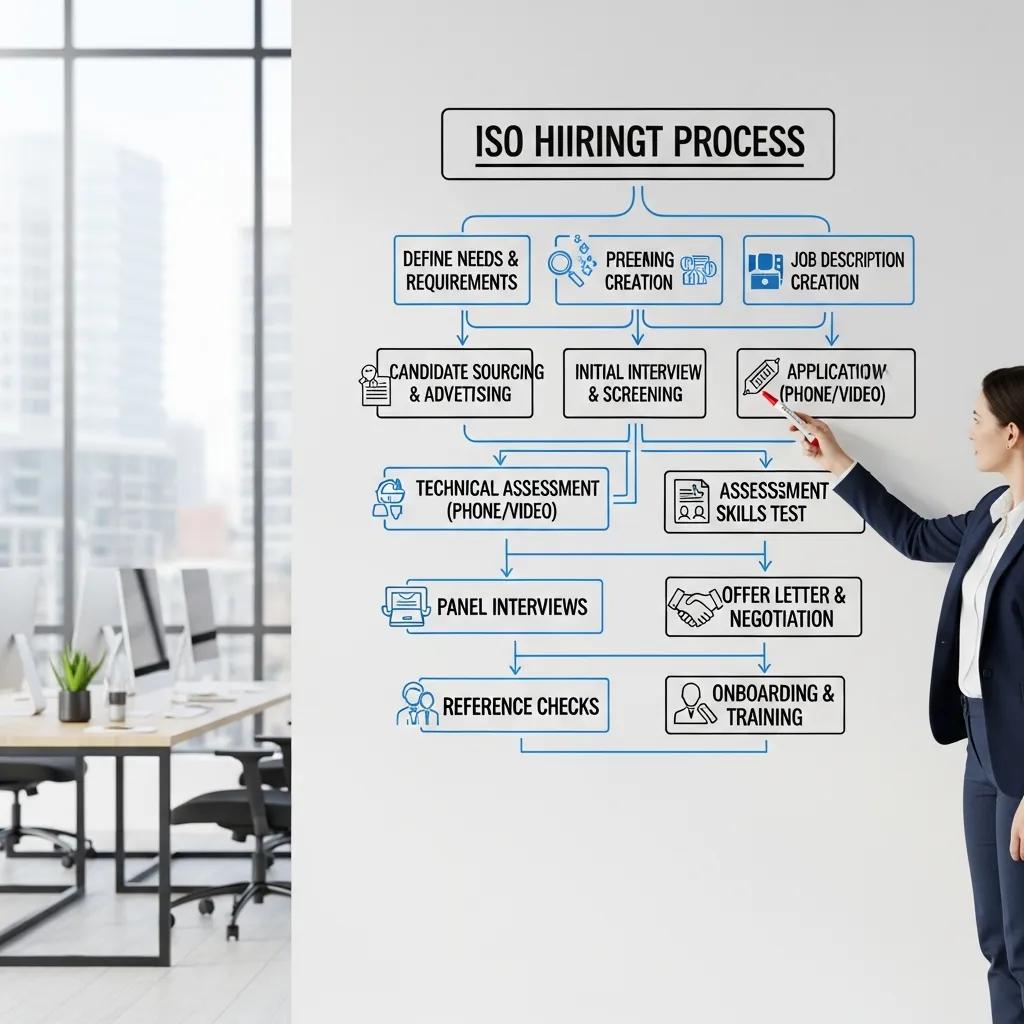
Hiring an ISO consultant follows a structured sequence from scoping to kickoff that reduces ambiguity and speeds certification readiness by aligning objectives, roles, and deliverables. Start with a needs assessment to clarify certification goals, scope, and internal stakeholders. Move to vendor selection with an RFP or targeted interviews, then finalize contracting, onboarding, and a project plan with milestones, responsibilities, and acceptance criteria. Each step creates a decision checkpoint — scope validation, proposal evaluation, pilot tasks, and pre-certification review — so you can measure progress and limit scope creep. The checklist below is actionable and ready to use in procurement.
- Assess Needs and Define Scope: Document management system boundaries, certification goals, and internal resource commitments to set evaluation criteria.
- Prepare an RFP or Shortlist: Request methodology descriptions, sample deliverables, references, and fixed-price or milestone fee structures for objective comparisons.
- Interview and Vet Finalists: Use scenario-based questions, review sample reports, and verify credentials and reference outcomes to judge practical competence.
- Negotiate Contract and Onboard: Agree milestones, reporting cadence, escalation paths, and acceptance criteria; include confidentiality and IP clauses where needed.
- Start with Gap Analysis and Pilot Tasks: Validate initial findings, agree remediation plans, and revise scope if unexpected risks or complexities appear.
- Maintain Governance and Prepare for Audit: Run internal audits, hold management review, and complete a pre-assessment before scheduling the certification audit.
Each step tightens requirements and informs the next decision, keeping your project measurable and reducing schedule or cost surprises.
How to Evaluate ISO Consultant Methodologies and Approaches?
Focus on whether a consultant provides a clear, risk-based plan that links tasks to deliverables and milestones, and whether they include training and internal audit support so your team can sustain the system. Ask for a sample project plan, change-management approach, and document control workflow. Require milestones tied to tangible outputs — gap reports, procedure drafts, and internal audit schedules. Red flags include vague timelines, no measurable acceptance criteria, or lack of knowledge-transfer plans; these increase dependency and long-term costs. A good methodology shows the consultant can turn clauses into controls while enabling your team to maintain the system after certification.
What Are the Best Practices for Communication and Compatibility with Your Consultant?
Clear communication rhythms and governance keep stakeholders aligned and prevent misunderstandings during implementation and audits. Agree a meeting cadence (weekly or biweekly), reporting formats (issue logs, progress dashboards), escalation paths for critical nonconformities, and a simple RACI for responsibilities. Check cultural and operational fit — language, timezone coverage, and collaboration style — during interviews to confirm the consultant will work effectively with your team. Strong communication practices reduce rework and help staff adopt new processes faster, improving resilience and audit readiness.
How to Assess Cost and Value When Hiring an ISO Consultant?
Assess cost and value by understanding common pricing models and calculating the total cost of certification — consultant fees, internal labor, corrective actions, and certification body charges — then comparing that to expected benefits and risk reduction. Typical pricing models include hourly/day rates, fixed-price projects, milestone-based fees, and retainers, each with trade-offs between predictability, flexibility, and incentive alignment.
| Consultant Type | Pricing Model | Typical Range / Notes |
|---|---|---|
| Independent Consultant | Day rate or hourly | Good for small, focused scopes; lower overhead but may lack broader team support |
| Consultancy Firm | Fixed-price or milestone fees | Better for complex, multi-site work; offers multidisciplinary teams and scalability |
| In-house / Seconded Expert | Salary or retainer | High initial cost but deep organizational knowledge; limited external audit perspective |
This comparison shows independents suit focused projects while firms are better for larger, multi-disciplinary efforts — choose based on scope, timeline, and internal capacity.
What Pricing Models Are Common for ISO Consulting Services?
Common models include hourly/day rates for ad-hoc help, fixed-price projects for scoped implementations, milestone-based fees tied to deliverables, and retainers for ongoing advisory. Hourly rates offer flexibility but uncertain totals; fixed-price gives budget certainty but needs a well-defined scope; milestone fees balance risk and accountability; retainers provide ongoing access for evolving systems. When negotiating, define acceptance criteria for each milestone, clarify out-of-scope work, and request a sample SOW listing deliverables and timelines. Pick the model that fits your ability to define scope and your preference for price certainty versus flexibility.
How to Calculate the ROI of Hiring an ISO Consultant?
Estimate ROI with (Total Benefits – Total Costs) / Total Costs and quantify benefits such as reduced audit hours, fewer nonconformities, improved process efficiency, and avoided penalties. For example, if consultant fees and certification costs total $40,000 and measurable annual benefits are $80,000, ROI = (80,000 – 40,000) / 40,000 = 1.0 (100% payback in one year). AI-driven auditing can improve ROI by cutting consultant preparation time — if AI trims audit prep by 20% and consultant hours fall by 15%, your cost baseline improves and the breakeven point moves sooner. Use conservative benefit estimates and validate assumptions with pilot tasks to keep calculations realistic.
| Engagement Type | Cost Components | Value Indicators |
|---|---|---|
| Hourly Support | Consultant hours, travel, internal time | Flexible for narrow fixes; cost varies with scope |
| Fixed-Price Project | Agreed fee, certification body costs, internal remediation | Budget certainty; success depends on scope clarity |
| Retainer / Ongoing | Monthly fee, periodic audit support | Continuous readiness; spreads costs over time |
The table links cost components to value signals so you can pick an engagement that limits surprises and aligns incentives with certification outcomes.
How to Choose an ISO Consultant for Specific ISO Standards?
Choosing a consultant for a specific ISO standard means matching the standard’s technical demands to consultant skills and verifying prior success in that area. The table below links common standards to the skills to check and the evidence to request. For ISO 9001, prioritize process improvement and metrics; for ISO 27001, focus on information security controls and risk assessments; for emerging standards like ISO 42001, look for AI governance expertise. Use the checklist and interview prompts to confirm the consultant delivers audit-ready documentation and measurable results.
| ISO Standard | Key Consultant Skills | What to Verify |
|---|---|---|
| ISO 9001 (Quality) | Process mapping, KPI design, corrective action systems | Sample quality manuals, process metrics, client outcomes |
| ISO 14001 (Environmental) | Impact assessment, compliance mapping, EMS integration | Environmental aspects registers, past audit reports, regulatory knowledge |
| ISO 27001 (Information Security) | Risk assessment, technical controls, SOC coordination | Risk treatment plans, evidence of implemented controls, pen-test coordination |
This mapping helps you focus verification steps and choose advisors who deliver audit-ready systems for the specific standard you need.
What Should You Know When Selecting a Consultant for ISO 9001 or ISO 14001?
Consultants for ISO 9001 and ISO 14001 should show hands-on experience writing procedures, setting measurable objectives, and implementing document control and corrective-action workflows that auditors accept. Ask for gap analyses, documented processes, training materials, and internal audit schedules, plus examples that show reduced findings or improved metrics. Beware of over-documentation without operational buy-in or failing to link objectives to KPIs; a strong consultant will show how they engage stakeholders and embed continuous improvement. Verifying evidence from similar projects proves whether their approach delivers sustainable systems.
Why Is Expertise in Emerging Standards Like ISO 42001 Important?
ISO 42001 covers AI management systems and requires knowledge of AI governance, model risk, data governance, and evolving regulatory expectations. Early expertise reduces compliance risk as jurisdictions introduce AI obligations, and consultants familiar with AI risk frameworks can structure governance, validation, and documentation practices auditors will evaluate. Prioritize advisors who map AI-specific risks to controls and can speak to regulatory trends so your implementation anticipates scrutiny and embeds ethical and technical safeguards. That experience accelerates readiness for certification and future regulatory change.
What Are the Next Steps After Selecting Your ISO Consultant?
Once you’ve chosen a consultant, move quickly to align stakeholders and a staged implementation plan so selection converts into measurable progress. Typical immediate steps: a formal kickoff to confirm roles, an AI-enabled or manual gap analysis to prioritize remediation, an agreed roadmap with milestones, and scheduling internal audits and management review sessions. Request a quote, book a gap analysis, or activate certificate management tools to move from planning to execution. These steps keep momentum and create governance checkpoints before the certification audit.
How Does the Certification Journey Progress from Gap Analysis to Final Audit?
The certification journey normally goes from gap analysis to implementation, internal audits, management review, pre-assessment, and finally the certification audit. Timelines typically range from three to nine months depending on scope and maturity. A gap analysis yields a prioritized remediation plan; implementation fills process and documentation gaps; internal audit validates conformance; management review confirms readiness; and a pre-assessment surfaces issues before the formal audit. Complex variables — multi-site work, regulatory interfaces, or technical controls — can extend timelines, so build buffers and use milestone reviews to spot slippage early. This staged approach keeps progress visible and evidence-ready for the final audit.
Where Can You Find Trusted ISO Consultants and Request a Quote?
Look for consultants via ISO consultant directories, certification body referrals, industry networks, and vetted marketplaces that list firms by standard and sector. Use a short RFP that states scope, objectives, timeline, required deliverables, and asks for sample deliverables and references — this standardizes responses and enables apples-to-apples comparisons. Consider accredited certification bodies and providers that combine AI-enabled auditing, global auditor networks, and certificate management tools; they can supply referrals and services like AI gap analysis and certificate issuance or download options.
- RFP Essentials: State scope, objectives, expected deliverables, and timeline.
- Vetting Requests: Ask for sample reports, references, and verification of lead-auditor certifications.
- Decision Criteria: Define scoring weights for methodology, results, cost, and cultural fit.
| Source | What to Request | Expected Outcome |
|---|---|---|
| Consultant Directories | Methodology, references, sample deliverables | Shortlist of candidates with verified specializations |
| Certification Body Referrals | Auditor profiles, accredited services, certificate management | Access to accredited auditors and issuance workflows |
| Industry Networks | Peer references, project outcomes | Contextual insights and real-world performance notes |
Use these channels and requests to speed sourcing and make informed comparisons that tie vendor capability to your certification goals.
Frequently Asked Questions
What is the typical timeline for ISO certification after hiring a consultant?
Timelines vary with size, complexity, and readiness, but most organizations complete the process in three to nine months. That window covers gap analysis, remediation, internal audits, and management review before the certification audit. Expect delays for multi-site programs or regulatory complexities, and plan buffer time for unexpected issues.
How can I ensure the ISO consultant I choose is a good cultural fit for my organization?
Assess fit during interviews by focusing on communication style, collaboration approach, and past experience with similar teams. Ask for examples of how they’ve managed conflicts or adapted to client culture. A pilot task or short trial engagement is a low-risk way to observe interactions and confirm the match.
What are the common pitfalls to avoid when hiring an ISO consultant?
Common mistakes include unclear scope, failing to verify credentials, and overlooking industry-specific experience. Also avoid over-reliance on external consultants without building internal capability. Finally, watch for poor communication plans — these often cause delays and rework.
How can I leverage AI tools to improve my ISO certification process?
AI tools speed document review, flag risk areas, and prioritize remediation so consultant effort targets the most important gaps. Use AI to sharpen interview questions and candidate shortlists, but always validate AI outputs with references and sample work. Combined, AI and human judgment make vetting faster and more accurate.
What should I include in my RFP when seeking an ISO consultant?
Include scope, certification objectives, timeline, required deliverables, and evaluation criteria. Ask for methodology, sample deliverables, references, and a sample SOW. Specific questions about your unique challenges will produce more useful proposals.
How do I measure the success of my ISO consultant after the certification process?
Measure success with qualitative and quantitative indicators: number and severity of nonconformities at certification, internal process efficiency after implementation, and stakeholder feedback on training and knowledge transfer. A successful engagement leaves you with sustainable processes and an internal capability for continuous compliance.
Conclusion
Choosing the right ISO consultant is a decisive step toward timely certification and a durable management system. Use the criteria, checklists, and practical steps in this guide to make a measured choice that fits your needs and industry context. When you’re ready, request quotes, run a gap analysis, or shortlist candidates from trusted directories — the right partner will help you move from gaps to certification with confidence.