
Understanding ISO 9000: Key Principles of Quality Management

Understanding the ISO 9000 Family of Quality Standards: A Practical Guide to ISO Certification and Quality Management
The ISO 9000 family sets the international baseline for quality management and the common language organizations use to design, operate, and improve their Quality Management Systems (QMS). This guide walks through what the family covers, how ISO 9001 differs as a certifiable requirements standard versus guidance, and why these standards matter for consistent operations and market access. You’ll get a clear summary of ISO 9001’s core requirements, the seven quality management principles that support the standards, a practical outline of how certification is achieved, and how modern tools — including AI-assisted auditing — are changing assessment and compliance. We also explain how Stratlane Certification supports organizations pursuing ISO 9001 with accredited auditors and technology-enabled assessment methods. By the end, you’ll have readiness steps, a clause-to-evidence mapping approach, and straightforward criteria for choosing a certification body.
What is the ISO 9000 Family of Standards and Its Scope?
The ISO 9000 family, published by the International Organization for Standardization, provides fundamentals, vocabulary, requirements, and guidance for QMS design and operation across industries. Collectively these documents promote a process approach, risk-based thinking, and continual improvement so organizations can reliably meet customer and regulatory expectations. The family includes foundational terminology, a certifiable requirements standard, and guidance on long-term performance — and applies to manufacturing, services, government, and non-profit sectors. Knowing which documents are prescriptive (requirements) and which are advisory (guidance) helps you decide whether to pursue certification or to use guidance for internal improvement.
The table below compares the principal ISO 9000 documents and their intended use.
This table summarizes the roles of the main standards within the ISO 9000 family.
| Standard | Purpose | Certifiable / Guidance |
|---|---|---|
| ISO 9000 (fundamentals and vocabulary) | Establishes core QMS terms and foundational concepts like the process approach and PDCA | Guidance (non-certifiable) |
| ISO 9001 (requirements) | Specifies the auditable requirements organizations must meet to obtain QMS certification | Certifiable |
| ISO 9004 (guidance for sustained success) | Offers extended guidance on performance improvement and long-term organizational success | Guidance (non-certifiable) |
In short: ISO 9001 is the certifiable core, while ISO 9000 and ISO 9004 provide the language and improvement-focused context that help organizations implement an effective QMS. Recognizing these distinctions directs teams to the right starting point for compliance or internal improvement.
How does the ISO 9000 family define quality management fundamentals?
ISO 9000 defines a Quality Management System as a set of interrelated elements an organization uses to set policy, establish objectives, and achieve those objectives. The standard emphasizes a process approach — linking inputs, activities, outputs, and measures across value streams — and incorporates Plan-Do-Check-Act (PDCA) cycles to drive continual improvement. Key terms such as “quality,” “nonconformity,” “corrective action,” and “risk” are defined to ensure consistent interpretation across audits and global operations. Understanding these fundamentals reduces ambiguity during implementation and makes evidence collection more predictable for internal teams and external auditors.
Those fundamentals directly inform practical QMS design choices: how to document processes, assign responsibilities, and select indicators that demonstrate conformance and improvement over time.
What are the key components and relationships within the ISO 9000 family?
The ISO 9000 family is organized so ISO 9000 supplies vocabulary and fundamentals that underpin ISO 9001’s requirements, while ISO 9004 provides extended guidance for organizations aiming for sustained success beyond certification. ISO 9001 contains clauses that set mandatory expectations auditors evaluate — leadership, planning, support, operation, performance evaluation, and improvement. ISO 9004 complements ISO 9001 by advising on maturity, strategic alignment, and long-term performance measures rather than adding certifiable requirements. In practice, teams use ISO 9000 to align terminology, implement ISO 9001 to achieve certification, and consult ISO 9004 when scaling quality into enterprise strategy and resilience.
Grasping these relationships helps teams prioritize certification tasks while planning longer-term quality objectives that go beyond the audit checklist.
What are the ISO 9001 Requirements for Quality Management Systems?
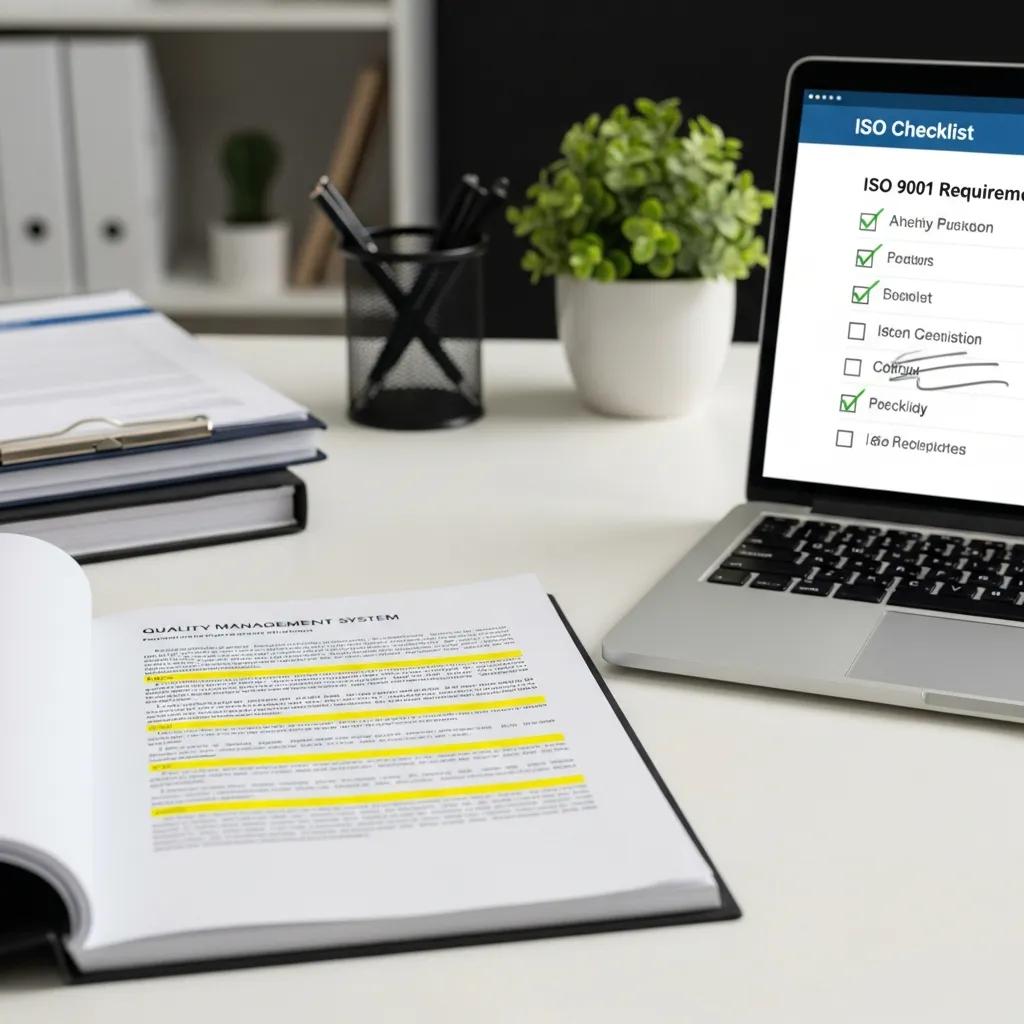
ISO 9001 groups auditable criteria into broad requirement areas that together ensure an organization can consistently deliver conforming products and services. At a high level, clause groups include context of the organization, leadership, planning, support, operation, performance evaluation, and improvement. Each group defines obligations auditors verify through records and observations. Implementing these requirements means defining scope and interested parties, documenting a quality policy, addressing risks and opportunities, ensuring competence and resources, controlling operational processes, conducting internal audits, and demonstrating continual improvement. Organizations preparing for certification should map each clause to documented controls and objective evidence before inviting external assessment.
Below is a concise, numbered summary of the core ISO 9001 requirement groups — useful for readiness checks and quick reference.
- Context and Scope: Define the organization’s context, interested parties, and the QMS scope.
- Leadership: Show top management commitment, a clear quality policy, and assigned responsibilities.
- Planning: Address risks and opportunities, set measurable quality objectives, and plan changes.
- Support: Provide resources, competence records, documented information, and effective communication.
- Operation: Control processes for product/service realization, including design, production, and delivery.
- Performance Evaluation: Monitor, measure, analyze, and evaluate processes and customer satisfaction.
- Improvement: Manage nonconformities, corrective actions, and continual improvement activities.
These requirement groups form the backbone of audit agendas and should be traceable to records such as procedures, work instructions, training records, performance data, and audit reports. Mapping evidence to clauses reduces surprises during stage audits and speeds closure of nonconformities.
Which specific criteria must organizations meet for ISO 9001 certification?
Auditors expect objective evidence for each clause group: a documented scope and context analysis, an approved quality policy and measurable objectives, evidence of risk treatment, records showing resource allocation and competence, process controls and acceptance criteria, internal audit schedules and results, management review outputs, and corrective action records. Typical evidence includes process maps or procedures, training matrices, calibration and maintenance logs, contracts and specifications, customer feedback, and performance dashboards. Readiness assessments often reveal gaps in documented information or inconsistent operational controls; addressing these gaps before external assessment accelerates certification and reduces corrective actions. Preparing a clause-to-evidence matrix is a practical, high-impact step to complete well before Stage 1 review.
Stratlane Certification evaluates these criteria with accredited auditors who blend traditional audit practice and technology-enabled workflows. You can request a formal quote or a pre-assessment to identify priority gaps before scheduling a stage audit.
How does ISO 9001 structure documentation and internal audits?
ISO 9001 requires organizations to retain the documented information necessary for the QMS to be effective — but it doesn’t prescribe rigid manuals or formats. Documentation should fit organizational scale and complexity. Typical items include a quality policy, scope statement, documented procedures where needed, work instructions, training and competence records, process performance data, and evidence of calibration and supplier controls. Internal audits are planned and performed by competent auditors to verify conformance and effectiveness; audit findings feed corrective actions and management review. Best practices include a risk-based audit schedule that targets higher-risk processes more frequently and electronic document control to manage versioning, access, and traceability.
Using audit results as inputs to continual improvement closes the PDCA loop: nonconformities drive root-cause analysis and corrective actions, which are then tracked for effectiveness through KPIs and follow-up audits.
What are the 7 Quality Management Principles Guiding ISO Standards?
The ISO 9000 family rests on seven quality management principles that shape QMS design and how ISO 9001 is applied. These are: customer focus; leadership; engagement of people; process approach; improvement; evidence-based decision making; and relationship management. Each principle explains why particular practices matter — for example, leadership creates direction and accountability, while the process approach clarifies control over inputs and outputs. Applying these principles helps organizations prioritize actions that deliver consistent quality, reduce risk, and improve customer outcomes.
The seven principles, with short explanations, are useful for training and for mapping strategy to operational controls.
- Customer Focus: Understand and meet customer requirements to improve satisfaction.
- Leadership: Ensure top management sets direction, policy, and an environment to achieve objectives.
- Engagement of People: Involve competent, empowered staff at all levels to drive and sustain improvements.
- Process Approach: Manage interrelated activities as processes to get predictable, consistent results.
- Improvement: Pursue continual enhancement of QMS performance to adapt to change.
- Evidence-Based Decision Making: Rely on reliable data and analysis to guide decisions and validate actions.
- Relationship Management: Maintain beneficial relationships with suppliers and stakeholders to support long-term success.
These principles map directly to ISO 9001 clauses and turn abstract ideas into concrete audit criteria like documented objectives, training records, process measures, and supplier evaluations.
How does customer focus drive quality management success?
Customer focus means systematically capturing and using customer requirements, feedback, and complaints to shape product and service design, delivery, and improvement. Organizations implement this principle through requirement-capture processes, satisfaction surveys, service-level monitoring, root-cause analysis of complaints, and corrective-action cycles that close the feedback loop. KPIs tied to customer focus — complaint rates, on-time delivery, first-pass yield, and Net Promoter Score analogues — show whether controls and improvements deliver real customer benefit. Embedding customer focus into management reviews and planning ensures market signals influence resource allocation and process changes.
This customer-centered approach naturally connects back to leadership and workforce engagement as the mechanisms that sustain improvements identified through feedback.
What roles do leadership and engagement of people play in QMS?
Leadership sets quality direction, demonstrates commitment through policy and resources, and builds accountability structures that empower people to manage processes effectively. Engagement of people emphasizes competence, awareness, and participation so employees contribute to problem solving, process optimization, and continuous improvement. Practical leadership actions include defining clear roles, removing performance barriers, reviewing objectives regularly, and recognizing improvement contributions. Engagement is supported by documented training, competence matrices, and opportunities to participate in audits and improvement teams — all of which increase ownership and reduce resistance to change.
Strong leadership and engaged personnel form the governance and execution layer that turns QMS design into consistent operational performance and measurable improvement.
How Does the ISO Certification Process Work with Stratlane?
Stratlane Certification follows a standard certification workflow tailored to your context, combining accredited auditors with AI-enabled tools to boost assessment efficiency and consistency. Typical stages are: initial inquiry and quote, optional pre-assessment or readiness review, Stage 1 documentation review, Stage 2 on-site or remote audit for process verification, certificate issuance after closure of any nonconformities, and periodic surveillance audits to maintain certification. Stratlane’s accredited status and global auditor coverage support multi-site and cross-border clients, while technology-assisted sampling and evidence collection accelerate the audit cycle and clarify findings for corrective actions. Request a quote or schedule a readiness assessment to get a tailored plan for timelines and resource needs.
Below is a step-by-step checklist that explains what organizations can expect when engaging Stratlane for ISO 9001 certification.
- Request Quote and Scope Definition: Share context, site count, and the desired standard to receive a tailored proposal.
- Pre-Assessment (Optional): Run a readiness review to map clauses to evidence and prioritize fixes.
- Stage 1 (Documentation Review): Evaluate documented information to confirm preparedness for the full audit.
- Stage 2 (Conformity Audit): Verify processes through interviews, observations, and record reviews.
- Certification Decision and Issuance: Close findings and receive the certificate following accreditation rules.
- Surveillance Audits and Recertification: Participate in periodic surveillance and schedule full recertification cycles.
These steps help organizations plan internal resources and timelines; Stratlane emphasizes transparent findings and pragmatic guidance to close nonconformities efficiently.
What are the step-by-step stages from quote to certificate?
The engagement starts with a scoping conversation and quote that clarifies applicable requirements and audit logistics, followed by an optional pre-assessment to identify and prioritize gaps. In Stage 1 the auditor reviews documented information remotely or on-site to confirm readiness; Stage 2 focuses on process verification through sampling, interviews, and record checks to confirm conformity. If nonconformities are raised, the organization submits corrective actions and evidence for closure, after which an accredited committee makes the certification decision. After certification, surveillance activities re-examine selected processes to ensure ongoing conformity and effectiveness.
This staged approach balances document validation with operational verification and provides predictable milestones that support effective certification planning.
How to choose the right certification body for your business?
Choosing a certification body means evaluating accreditation status, scope coverage, auditor competence, geographic reach, methodology, and the technology that supports transparent reporting and efficient audits. Accreditation from a recognized body ensures the certification will be credible to customers and regulators. Auditor competence in your sector reduces time spent explaining processes and speeds evidence collection. Geographic and multi-site coverage matters for organizations operating in multiple countries, and audit methodology — including technology use — affects audit duration and clarity of findings. Also weigh reputation for impartiality and the usefulness of post-audit reporting when making a decision.
Stratlane Certification can be evaluated across these dimensions: accredited oversight, AI-driven auditing tools, a professional auditor network in over 29 countries, and services designed for corporations and academic organizations that need recognized attestations of conformity.
How is AI Transforming ISO Auditing and Quality Management?

AI is reshaping auditing and QMS practices by automating repetitive evidence collection, improving sampling and anomaly detection, supporting predictive risk identification, and enabling continuous monitoring of documents and performance indicators. These capabilities reduce manual effort, increase consistency across audit teams, and surface trends that periodic audits can miss. AI doesn’t replace professional judgment — it augments auditors by prioritizing high-risk areas, synthesizing large datasets, and creating reproducible audit trails that speed decision-making and corrective-action verification. Responsible implementation pairs algorithmic assistance with human oversight to ensure interpretability and preserve certification integrity.
AI tools are particularly useful for organizations with complex process landscapes or large volumes of documented information where traditional sampling could miss patterns or emerging nonconformities.
What benefits does AI-driven auditing bring to ISO compliance?
AI-driven auditing delivers measurable benefits: reduced time for audit preparation and execution, better detection of outliers or control gaps, and greater consistency in evidence assessment across teams. Expect faster documentation reviews, more focused on-site verification, and earlier identification of systemic issues that need corrective action. Predictive analytics can flag processes trending toward nonconformity, enabling proactive fixes that reduce the frequency and severity of audit findings. ROI varies by organization size and complexity, but many clients report meaningful efficiency gains and clearer prioritization of improvement work after adopting AI-augmented audit workflows.
Those benefits materialize when AI is applied to good-quality data and used alongside skilled auditors who translate algorithmic signals into practical corrective actions.
How does Stratlane implement AI tools for efficient audits?
Stratlane Certification pairs accredited audit practices with AI-driven tools to improve assessment quality and efficiency while keeping human oversight and decision authority central. We use AI to speed documentation review, prioritize sampling of processes, and reveal data patterns that indicate risk or nonconformity — freeing auditors to focus on root-cause analysis and stakeholder interviews. Stratlane’s model couples these tools with professional auditors across more than 29 countries, ensuring local regulatory knowledge and consistent application of audit criteria. Clients can request demos or case studies to see how AI-assisted audits speed evidence gathering and sharpen corrective-action guidance.
This blended model preserves the rigor of accredited certification while lowering administrative burden and improving audit reliability.
What are the Benefits of Adopting the ISO 9000 Family Standards?
Adopting the ISO 9000 family and achieving ISO 9001 certification produces measurable benefits: higher customer satisfaction, more consistent operational performance, fewer defects and rework, and improved access to procurement opportunities. A QMS clarifies process ownership, provides objective performance indicators for decision-making, and institutionalizes continual improvement practices that drive efficiency. Certification signals reliability to customers and partners, helping you stand out in tenders and supply chains. Combined with modern audit techniques and technology, these benefits compound by enabling faster corrective actions and near real-time monitoring of process health.
The list below highlights core benefits and how ISO practices create measurable outcomes.
- Better Customer Satisfaction: Structured requirements and feedback loops lead to steadier delivery and fewer complaints.
- Operational Efficiency: Process controls and performance monitoring reduce variability, scrap, and rework, lowering costs.
- Market Access and Credibility: Accredited certification provides third-party validation valued by purchasers and partners.
- Risk Reduction: Risk-based planning and monitoring catch potential failures before customers are affected.
The table below links typical benefits to ISO practices and gives example measurable outcomes organizations can expect.
| Benefit | How ISO contributes | Measurable outcome (example) |
|---|---|---|
| Customer satisfaction | Systematic requirements capture and closed feedback loops | Reduced complaint rate by a measurable percentage |
| Operational efficiency | Process controls and documented work instructions | Lower defect/rework rates; faster lead times |
| Market access | Accredited certification recognized by buyers | Eligibility for tenders and supplier lists |
| Continuous improvement | Corrective action and performance-evaluation cycles | Improving KPI trends over consecutive cycles |
How does certification improve customer satisfaction and operational efficiency?
Certification enforces mechanisms for capturing customer requirements, controlling process inputs and outputs, and systematically addressing nonconformities — all of which reduce defects and improve delivery consistency. Organizations that record and monitor critical process parameters can spot deviations early and apply corrective actions before customers are affected. Metrics such as on-time delivery, defect rates, and complaint resolution time feed management review and guide resource allocation toward persistent issues. When audits validate these controls, customers gain third-party assurance that your organization manages quality consistently — strengthening trust and repeat business.
Linking operational improvements to customer-facing KPIs ensures certification delivers measurable customer value rather than becoming just an internal compliance exercise.
What competitive advantages result from ISO 9000 certification?
ISO 9001 certification offers tangible competitive advantages: it’s often a requirement for regulated contracts, helps shortlist suppliers in procurement, and signals reliability to partners and clients. Certification shows a culture of consistent quality and continuous improvement, which can reduce onboarding friction with new customers and improve positions in supply chains. Internally, improved process efficiency lowers costs and speeds response times, enabling better pricing or investment in innovation. When you communicate certification effectively in proposals and supplier profiles, compliance becomes commercial value.
Those advantages grow when quality outcomes are measured and reported transparently, demonstrating real improvements in cost, delivery, and satisfaction.
For organizations seeking an accredited certification partner with AI-enabled audit capabilities and global auditor coverage, Stratlane Certification provides assessment and certificate-management services tailored to international clients and academic institutions that need recognized attestations of conformity.
Frequently Asked Questions
What is the difference between ISO 9001 and ISO 9004?
ISO 9001 and ISO 9004 serve different roles within the ISO 9000 family. ISO 9001 defines the requirements for a QMS that organizations must meet to achieve certification and focuses on consistent product and service quality. ISO 9004 offers guidance for organizations pursuing sustained success beyond certification — it emphasizes long-term performance improvement and strategic alignment without introducing certifiable requirements.
How can organizations prepare for an ISO 9001 audit?
Prepare by conducting a thorough internal audit to identify gaps against ISO 9001 requirements, mapping each clause to documented evidence like procedures and performance data, and training staff on audit expectations. Establish corrective actions for identified gaps before the external audit; this streamlines the process and increases the chance of a smooth certification outcome.
What role does employee training play in ISO 9001 compliance?
Employee training is essential: it ensures personnel understand their roles within the QMS and how their work affects quality outcomes. Regular training builds competence, promotes engagement, and supports a culture of continuous improvement. Maintaining training records also provides audit evidence of competence and the organization’s commitment to quality.
How often should organizations conduct internal audits for ISO 9001?
Internal audits should run at planned intervals — at minimum annually, and more often for higher-risk processes. Frequency depends on organizational size, process complexity, and past audit findings. A risk-based schedule helps focus audits where the potential for issues is greatest.
What are the common challenges organizations face during ISO 9001 certification?
Common challenges include insufficient documentation, low employee engagement, and unclear understanding of the standard’s expectations. Organizations may need to align existing processes with ISO 9001 criteria, which can create gaps. Overcoming these challenges requires training, clear communication, and involving employees in the implementation to build ownership and reduce resistance.
How does ISO 9001 certification impact supplier relationships?
ISO 9001 certification strengthens supplier relationships by signaling a commitment to quality and continuous improvement. Certified organizations are often seen as more reliable partners, which can improve trust and collaboration. Certification can also simplify procurement, since many clients prefer or require certified suppliers — opening new business opportunities and reducing perceived risk.
Conclusion
Adopting the ISO 9000 family can materially improve your organization’s quality management — boosting customer satisfaction and operational consistency. Understanding ISO 9001’s requirements and the supporting principles helps you achieve certification that demonstrates reliability and commitment to quality. Working with a trusted certification partner like Stratlane can simplify the journey and ensure compliance with international standards. Ready to get started? Explore our certification services to take the next step toward stronger, measurable quality outcomes.