

Supply chain resilience is an organization’s ability to anticipate, absorb, recover from, and adapt to disruption. Achieving it requires disciplined standards and smarter oversight. This article shows how international ISO standards, paired with AI‑driven auditing, cut downtime, protect data, and lift supplier reliability. You’ll learn which ISO standards support continuity, security, quality, information protection, and AI governance; how AI changes audits and enables predictive risk management; and the step‑by‑step path to certification with an accredited provider. Each section links definitions and mechanisms to clear operational benefits you can apply across procurement, logistics, and IT. Finally, we outline a practical certification process and how Stratlane Certification’s accredited, AI‑enabled services help organizations certify and sustain resilient supply chains.
Why supply chain resilience matters in 2025 and beyond
Resilience is now a business imperative because global supply networks face more frequent climate, geopolitical, and cyber shocks that threaten continuity and revenue. The core mechanism is straightforward: better visibility, purposeful redundancy, and risk‑based controls shorten recovery time and lower recovery cost when a supplier, transport route, or IT service fails. The measurable benefits include fewer production stoppages, preserved customer trust, and faster regulatory response during incidents. With disruptive events increasing and regulators sharpening focus on continuity planning, resilience has moved from tactical to strategic. This section quantifies the main drivers and shows how organizations convert awareness into operational safeguards that limit financial and reputational damage.
What causes supply chain disruptions and what do they cost?
Common causes include natural disasters that damage facilities, geopolitical changes that close trade lanes, supplier insolvency, and targeted cyberattacks on logistics or ERP systems. Impacts show up as direct costs — expedited freight, production downtime, contract penalties — and indirect costs like lost customers and damaged supplier relationships. For example, a major port closure can add weeks to lead times and multiply freight costs; a ransomware hit on a third‑party can freeze order processing across regions. Mapping costs to specific drivers lets teams target mitigations: diversify suppliers for supplier failure, build transport redundancies for route risk, and harden cyber controls for digital threats. The next section explains how resilience practices translate into measurable continuity and growth outcomes.
How do resilient supply chains support continuity and growth?
Resilient supply chains combine end‑to‑end visibility, contingency planning, and flexible sourcing for disruption prevention, so operations can continue through disruption and recover faster afterward. Tactics include supplier segmentation to protect critical parts, real‑time inventory and shipment visibility to reroute flows, and contractual clauses that preserve service during stress. These measures protect revenue, keep customers satisfied, and let resilient firms respond faster when competitors struggle. Resilience also lowers operational risk, which can reduce the cost of capital and support strategic investment. In practice, resilient organizations not only survive shocks but often gain market share in recovery windows — a benefit we’ll connect to the standards that codify these practices.
Which ISO standards strengthen supply chain resilience?
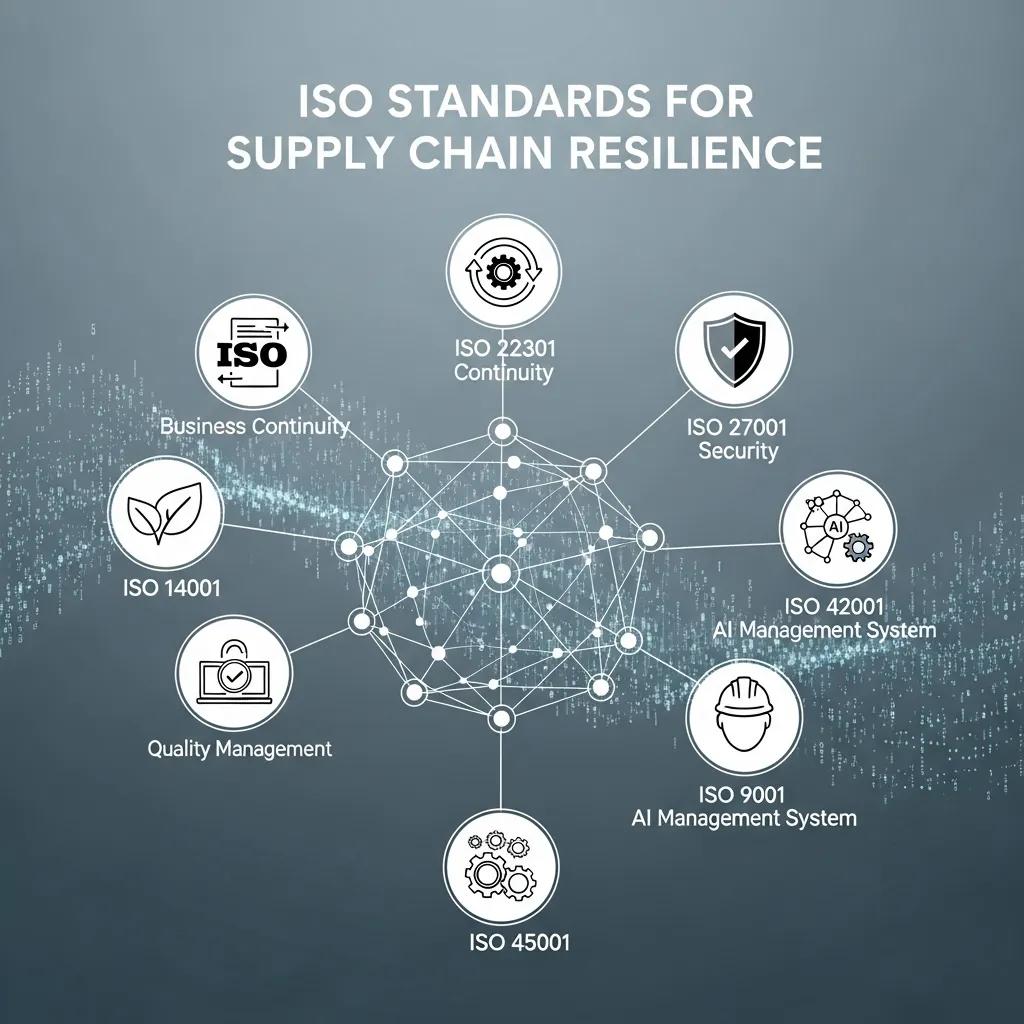
A set of complementary ISO management standards defines controls that, together, increase supply chain resilience by addressing continuity, security, quality, information protection, and AI governance. Each standard targets a specific resilience function — from business continuity to cargo security and information assurance — so organizations can prioritize based on exposure and strategy. The table below maps key ISO standards to their focus and the direct resilience gains they deliver, helping you decide what to tackle first.
The following table compares the most relevant ISO standards and the resilience benefits each provides.
| ISO Standard | Primary Focus | Benefit for Supply Chain Resilience |
|---|---|---|
| ISO 22301 | Business continuity management | Shortens downtime through formal BC planning and tested recovery procedures |
| ISO 28000 | Supply chain security management | Reduces theft, tampering, and transit disruption with risk‑based controls |
| ISO 9001 | Quality management system | Stabilizes outputs by standardizing processes and supplier controls |
| ISO 27001 | Information security management | Secures digital interfaces and data exchange across supplier networks |
| ISO 42001 | AI management systems | Ensures transparent, auditable AI that supports reliable decisions |
How does ISO 22301 ensure business continuity across supply chains?
ISO 22301 formalizes business continuity management with policy, business impact analysis (BIA), risk assessment, response plans, and exercises — practices that directly reduce downtime across supply chain nodes. Organizations use BIAs to identify critical suppliers and processes, then implement recovery options such as alternate sourcing, inventory buffers, and emergency transport routes. The standard’s focus on testing and continual improvement keeps plans current as supplier networks and risks change. By embedding these practices, firms shorten recovery time objectives and limit financial loss from interruptions. Next we contrast ISO 22301 actions with the transport and security controls covered by ISO 28000.
What role does ISO 28000 play in supply chain security?
ISO 28000 targets supply chain security through risk assessment and operational controls for cargo, facilities, and transport. Typical controls include secure packaging, carrier credential verification, warehouse access controls, CCTV, and route‑risk assessments for high‑value shipments. These measures lower the chance of theft, tampering, and fraud that can cause delays or recalls. ISO 28000 links security controls to organizational risk appetite, enabling consistent supplier audits and compliance checks. Next, we’ll show how ISO 9001’s process focus stabilizes supplier performance to complement continuity and security efforts.
How ISO 9001 improves supply chain quality and stability
ISO 9001 establishes a quality management system that standardizes processes, formalizes supplier evaluation, and drives continuous improvement — all mechanisms that reduce defects, improve on‑time‑in‑full delivery, and stabilize supplier performance. Its requirements for documented procedures and performance monitoring create predictable outputs procurement and logistics can plan around. Organizations adopting ISO 9001 typically see less variation, clearer supplier scorecards, and faster root‑cause remediation for recurring issues. This section outlines operational benefits and practical steps to apply ISO 9001 across supplier networks.
ISO 9001 improves supplier and process outcomes in measurable ways:
- Process control: Standard operating procedures reduce variability in manufacturing and handling.
- Supplier evaluation: Defined assessment criteria and regular reviews improve supplier reliability.
- Continuous improvement: Corrective actions and KPIs drive defect reduction and performance gains.
Together, these mechanisms reduce lead‑time variability and defect rates, stabilizing inventory planning and fulfillment. The next subsection lists concrete benefits organizations can expect and the metrics to track after certification.
What are the benefits of ISO 9001 certification for supply chain operations?
ISO 9001 certification delivers measurable improvements: fewer defects, higher on‑time‑in‑full (OTIF) rates, and stronger supplier performance. Supplier audits, incoming inspections, and corrective action systems cut rework and returns, lowering expedited shipping costs and protecting margins. Certification also makes procurement integration and benchmarking with partners easier. Track KPIs such as defects per million opportunities (DPMO), OTIF percentage, and supplier scorecard trends to quantify ROI. These quality controls pair naturally with information security protections that guard the digital connections between partners.
How does ISO 27001 protect information across digital supply chains?
ISO 27001 sets an information security management system with risk assessment, access control, encryption, supplier security clauses, and incident response — measures that protect confidentiality, integrity, and availability of data shared across partners. By formalizing vendor security requirements and running third‑party assessments, organizations reduce the risk of data breaches, credential compromise, and outages from cyber incidents. Encryption and access management for APIs and EDI prevent unauthorized manipulation of orders or shipment data, avoiding costly logistical errors. Combined with ISO 9001 and continuity planning, ISO 27001 builds an integrated defensive posture for modern, digital supply chains.
How AI‑driven auditing affects ISO certification for supply chains

AI‑driven auditing complements ISO certification by automating routine evidence collection, surfacing anomalies across large datasets, and producing predictive risk scores — capabilities that speed audits and broaden coverage without a linear increase in auditor effort. Machine learning applied to transaction logs, supplier performance, and configuration records highlights deviations and flags likely nonconformities. The result: faster, more consistent audits with better detection of systemic risks that manual sampling may miss. Below is a concise comparison showing how audit functions map to AI capabilities and the practical efficiency, accuracy, and predictive gains.
AI capabilities transform audit functions as follows:
| Audit Function | AI Capability | Efficiency / Accuracy / Prediction Benefit |
|---|---|---|
| Evidence collection | Automated document parsing | Faster assembly of audit packages; consistent extraction of required fields |
| Anomaly detection | Pattern recognition across datasets | Improved accuracy finding outliers and nonconforming trends |
| Risk scoring | Predictive models trained on historical events | Early warning of supplier or shipment risk with prioritized actions |
| Continuous monitoring | Real‑time KPI alerts | Shorter audit cycles and quicker corrective response |
How does AI improve audit efficiency and accuracy?
AI speeds audits by automating document review, cross‑checking policies against evidence, and extracting structured facts from unstructured records — reducing manual checklist effort. Pattern‑detection algorithms spot inconsistent entries, duplicate invoices, or missing approvals across thousands of records that humans can miss. This raises consistency of findings, lowers false positives, and lets auditors focus on judgment‑heavy issues. Efficiency gains shorten audit windows and lower cost, while accuracy improvements produce more reliable compliance outcomes. In practice, predictive analytics extend these gains by forecasting supplier and logistics risks.
Stratlane Certification combines accredited auditors with AI‑assisted audit workflows to speed evidence collection and surface nonconformities earlier, helping clients shorten certification timelines while preserving audit rigor.
What predictive capabilities does AI bring to supply chain risk management?
AI delivers predictive risk scoring by analyzing supplier history, delivery variance, weather and geopolitical signals, and transaction anomalies to flag suppliers or routes with elevated failure probability. Scenario modeling simulates cascading impacts from a supplier outage or port closure, letting planners evaluate options like alternate sourcing or inventory reallocation before an event. Early‑warning indicators — rising lead‑time variance or spikes in exception reports — trigger preemptive actions that cut exposure and recovery time. Feeding these insights into business continuity and procurement decisions turns data into operational resilience. The next section covers governance for the AI systems that generate these insights and how ISO 42001 governs transparency and accountability.
How ISO 42001 governs AI for future‑proof supply chains
ISO 42001 sets requirements for AI management systems to ensure transparency, accountability, and risk control where algorithms influence procurement, routing, or inventory decisions. The standard calls for model inventories, impact assessments, validation and testing procedures, and oversight roles — controls that prevent opaque decisioning and embed human accountability. These governance artifacts make AI outputs auditable and trustworthy, so teams can rely on them in compliance‑sensitive contexts. This section explains the core governance goals and practical controls organizations need to keep AI safe and reliable.
Why AI governance matters for resilient supply chains
Without governance, opaque or poorly validated models can amplify bias, make brittle decisions in novel situations, and introduce security gaps — all threats to operational resilience. Governance practices — documentation, version control, edge‑case testing, and human‑in‑the‑loop approvals — reduce the risk that automation will trigger avoidable disruptions. For example, an unvalidated demand‑forecast model could under‑order critical parts and create stockouts; governance requires validation and monitoring to prevent that. Strong governance builds trust across procurement, logistics, and compliance teams and enables safe AI integration into resilience workflows. The next subsection outlines the transparency and accountability artifacts ISO 42001 promotes.
How does ISO 42001 create transparency and accountability in AI systems?
ISO 42001 requires a model inventory, decision logs, impact assessments, and validation records that together make AI systems auditable and explainable. These artifacts document training data provenance, performance metrics, known limitations, and deployment rationale so auditors can trace outputs back to inputs and controls. Oversight mechanisms — designated AI risk owners and periodic model reviews — keep systems aligned with ethical and operational risk thresholds. By embedding these records and governance roles, ISO 42001 allows organizations to trust AI outputs in compliance‑sensitive processes while retaining the ability to investigate and remediate issues. Stratlane offers AI governance assessments to help organizations prepare these artifacts and align AI operations with ISO 42001 expectations.
What is the process to achieve certified supply chain resilience with Stratlane?
Certification follows a clear, client‑focused sequence from initial inquiry to certificate issuance: request a quote, accept the offer, schedule the audit (remote or on‑site), remediate any findings, and receive the ISO certificate upon approval. The process is transparent and predictable so organizations can plan resources, timelines, and documentation. Below is an ordered breakdown of operational steps and a table that clarifies actions, outputs, and typical durations to reduce friction and set realistic expectations.
The certification journey typically follows these steps:
- Request a quote — You provide scope, the standards you want, and core documentation.
- Accept offer — Agree scope, audit type (remote or on‑site), timeline, and fees.
- Arrange audit — Schedule sessions, submit evidence, and confirm auditor allocation.
- Address findings — Implement corrective actions for any nonconformities.
- Certificate issuance — After verification, receive the official ISO certificate.
This sequence supports planning and clarifies client responsibilities; the table below maps each step to expected outputs and typical timeframes.
| Process Step | What Happens | Expected Time / Output |
|---|---|---|
| Request quote | We review scope and baseline documentation | Quote delivered within the stated lead time; scope confirmed |
| Accept offer | Contracting and scheduling completed | Audit dates agreed; invoice and payment terms issued |
| Arrange audit | Evidence collection and audit execution (remote or on‑site) | Audit report with findings and auditor observations |
| Address findings | Remediation of nonconformities and verifier follow‑up | Corrective action records and acceptance evidence |
| Certificate issuance | Final review and approval | Official ISO certificate issued upon approval |
What exactly happens from quote to ISO certification?
Operationally, step one is a formal quote request where you supply scope, target standards (for example, ISO 22301 or ISO 28000), and baseline documents. Step two is accepting the offer, which finalizes scope, audit format (remote or on‑site), and timelines, and secures auditor allocation. Step three is the audit: evidence review, interviews, and documented findings; AI tools can speed evidence aggregation and identify likely nonconformities. Step four is your corrective actions and submission of remediation evidence. Step five is final verification and certificate issuance once the verifier confirms compliance. Each step includes defined client actions and deliverables to keep timelines predictable.
Why choose Stratlane’s accredited, global ISO certification services?
Stratlane Certification pairs accredited ISO services with AI‑enabled auditing and a global auditor network to deliver efficient, internationally recognized results. Certified organizations can display the Stratlane Certification mark, issued as the Stratlane ISO Certification Logo, to show stakeholders that their management system has been independently audited; questions about proper usage go to Stratlane Certification BV. Differentiators include accreditation in 27+ countries and professional auditors in 29+ countries, giving international recognition with local expertise during audits. Our AI workflows speed evidence collection and nonconformity detection, shortening audit windows without compromising rigor. If you’re seeking certification for ISO 22301, ISO 28000, ISO 9001, ISO 27001, or ISO 42001, request a quote to map the right standards to your resilience goals.
Why clients choose this model:
- Accredited certification with international recognition.
- AI‑driven auditing for faster, more consistent results.
- Local auditor expertise across global jurisdictions.
These features reduce friction for international supply chain certification and support ongoing compliance and improvement cycles.
Frequently Asked Questions
What are the key benefits of implementing ISO standards in supply chain management?
Implementing ISO standards improves operational efficiency, strengthens risk management, and raises customer confidence. Standardized processes reduce variability and defects, while ISO frameworks drive continuous improvement so companies can adapt to market and regulatory changes. Certification also enhances reputation and makes organizations more attractive to clients and partners that prioritize quality and reliability.
How can organizations measure the effectiveness of their supply chain resilience strategies?
Measure resilience with KPIs such as recovery time objectives (RTO), on‑time delivery rates, and inventory turnover. Regular risk assessments and audits reveal vulnerabilities and improvement opportunities. Track customer satisfaction during disruptions and use trend analysis to refine strategies. These metrics help ensure preparation for future disruptions.
What role does technology play in enhancing supply chain resilience?
Technology is central to resilience: real‑time analytics, predictive models, and automation speed detection and response. AI and machine learning surface patterns and early warnings from historical data. Digital platforms improve partner communication and coordination, while IoT devices increase visibility across the network, enabling proactive risk management and faster decision making.
How can companies ensure compliance with ISO standards during audits?
Ensure compliance with a thorough internal audit program that regularly reviews policies, procedures, and performance. Train teams on ISO requirements and maintain clear documentation of processes and corrective actions. Pre‑audit assessments with an accredited body help identify gaps before the official audit.
What challenges do organizations face when adopting ISO standards?
Common challenges include resistance to change, integrating new processes with existing operations, and the costs of certification and maintenance. Sustaining compliance takes ongoing training and monitoring. Success requires strong leadership commitment, clear communication, and a phased implementation plan that aligns stakeholders.
How does AI‑driven auditing differ from traditional auditing?
AI‑driven auditing automates evidence gathering, analyzes large datasets for anomalies, and provides predictive insight — enabling broader coverage and faster detection than manual sampling. It supports continuous monitoring, which reduces reliance on periodic audits and helps organizations adopt a proactive approach to risk management.
Conclusion
Combining ISO standards with AI‑driven auditing gives organizations a practical path to stronger supply chain resilience. These frameworks reduce disruption risk, improve operational efficiency, and protect customer trust while enabling continuous improvement. To move from readiness to certification, explore Stratlane’s ISO certification services tailored to your needs. Begin your resilience journey with Stratlane and unlock the full potential of your supply chain.