

Integration means deliberately aligning ISO 27001’s Information Security Management System (ISMS) with other cybersecurity standards to cut duplicated work, strengthen controls, and simplify compliance. This guide shows how combining ISO 27001 with frameworks such as the NIST Cybersecurity Framework (NIST CSF), SOC 2, GDPR requirements, and ISO/IEC 42001 for AI governance produces concrete business and security gains. You’ll find practical mapping methods, compact crosswalk tables for quick reference, step-by-step implementation checklists, and real-world tactics for evidence reuse and automated auditing. We address the common pain points in multi-standard environments — audit fatigue, fragmented risk registers, and inconsistent technical controls — then walk through actionable alignment strategies, from control mapping and unified evidence stores to using NIST profiles for technical depth, and explain how AI-assisted auditing can speed integrated compliance. Core terms like cyber security, ISO 27001 integration, NIST framework, SOC 2 ISO 27001 control alignment guide, and AI auditing for integrated cybersecurity compliance are included for clarity and discoverability.
What Are the Key Benefits of Integrating ISO 27001 with Other Cybersecurity Frameworks?
Bringing ISO 27001 together with other frameworks centralizes governance and technical controls so you can manage risk holistically, avoid duplicated effort, and maintain one authoritative evidence source for audits. The practical approach is simple: map overlapping controls, keep control objectives in a unified ISMS, and measure performance with shared metrics. The payoff is less time preparing for audits, more consistent protective measures, and clearer executive reporting on your security posture. Integration also streamlines vendor due diligence and reduces friction when customers request multiple attestations.
The short table below contrasts integrated and standalone approaches so you can see where to focus investment.
| Approach | Primary Attribute | Typical Business Impact |
|---|---|---|
| Standalone standards | Separate policies and dispersed evidence | More duplication and longer audit cycles |
| Integrated ISMS | Unified controls and centralized evidence | Lower time and cost for multi-framework audits |
| NIST + ISO alignment | Technical depth paired with governance | Faster remediation prioritization and clearer metrics |
This comparison shows how an integrated approach turns overlapping elements (Annex A controls, NIST functions) into reusable assets, enabling scalable ISO 27001 deployment across multiple standards. Next, we explain how control reuse and automation concretely reduce cost and overhead.
How Does Integration Streamline Compliance and Reduce Costs?
Integration reduces effort through control reuse, consolidated evidence repositories, and coordinated audit scopes that eliminate redundant testing and documentation. Mapping Annex A and NIST CSF elements into one taxonomy cuts the number of distinct policies and tests auditors must review. Centralized evidence platforms and automated collection tools shrink manual evidence work, speed readiness, and lower labor costs. Organizations that adopt integrated compliance typically experience faster audit cycles because auditors can sample from a single, consistent dataset.
- Control mapping removes duplicate policies and redundant testing.
- Central evidence repositories provide a single authoritative source for auditors.
- Automated collection and AI-assisted extraction shorten preparation windows.
These efficiencies reduce time-to-attestation and free security teams to focus on remediation and risk reduction rather than repetitive paperwork — which leads into the next section on market-facing advantages.
What Competitive Advantages Does Harmonized Security Provide?
Harmonized security gives clear go-to-market benefits: customers and partners gain confidence from consistent controls, procurement cycles shorten when evidence is consolidated, and RFP responses become faster and more predictable. If ISO 27001 evidence is mapped to SOC 2 or GDPR requirements, vendors can accelerate sales cycles and cut the friction of third-party reviews. Harmonized controls can also ease insurance underwriting and lower perceived liability by showing a systematic approach to risk.
- Faster procurement and RFP responses through consolidated evidence.
- Stronger positioning in regulated markets via demonstrable governance.
- Lower insurance and due-diligence overhead.
Those advantages translate to quicker contracting and stronger market trust, setting up a practical alignment with NIST, which provides the technical playbook that complements ISO governance.
When you’re ready to operationalize these benefits, Stratlane Certification — an accredited certification body offering ISO 27001:2022 certification with professional auditors and AI-enabled audit tools — can support certification and AI-assisted evidence collection. Request a quote or book an audit through Stratlane Certification to accelerate multi-standard readiness with experienced auditors and automation support.
How Does ISO 27001 Align with the NIST Cybersecurity Framework?
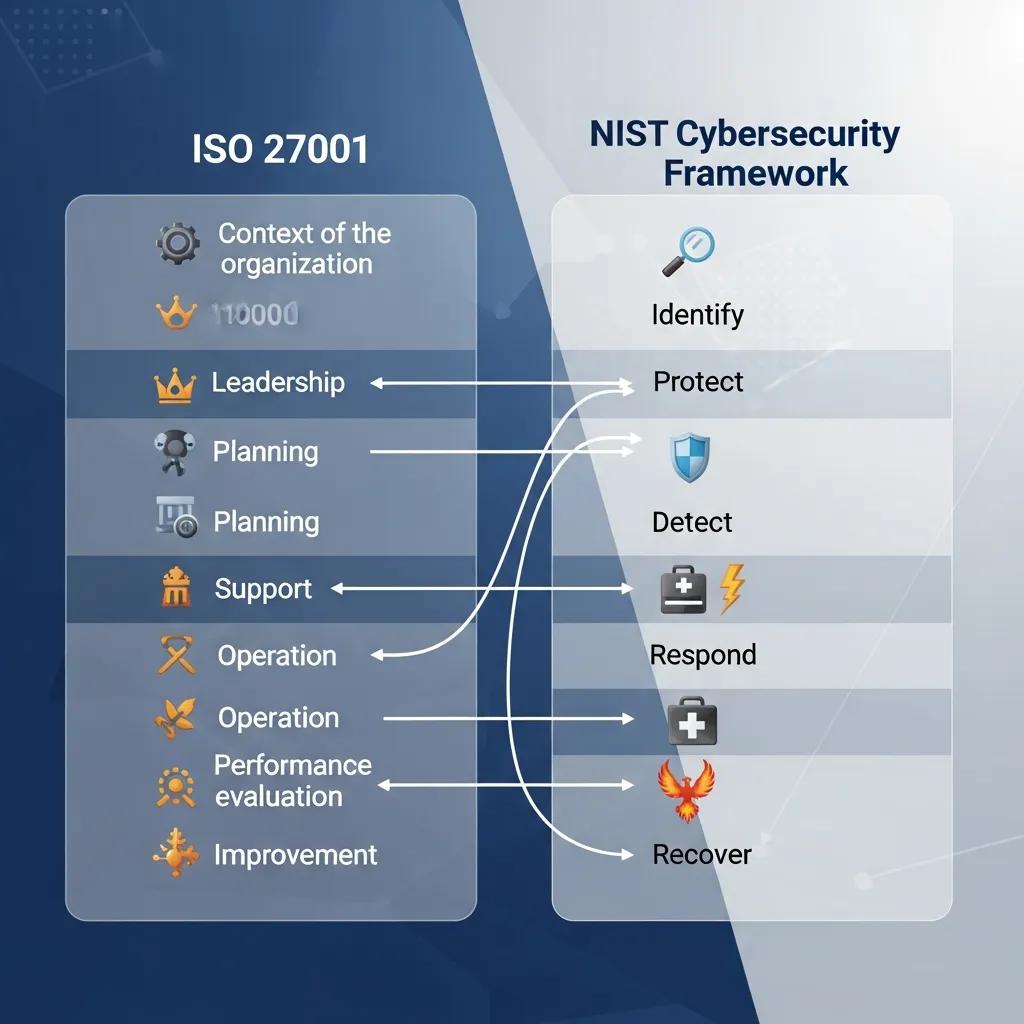
ISO 27001 provides ISMS governance — policies, risk assessment, and continual improvement — while the NIST CSF supplies practical technical functions and controls. The alignment works by mapping NIST functions (Identify, Protect, Detect, Respond, Recover) to ISO control families so you can treat NIST as a technical profile inside ISO governance. That gives you a prioritized set of technical controls aligned to ISO’s risk-based objectives and clearer roadmaps for remediation and investment.
Use the table below to map NIST CSF functions to representative ISO 27001 control families for quick gap analysis reference.
| NIST CSF Function | ISO 27001 Control Family | Value |
|---|---|---|
| Identify | A.5 / A.6 (Leadership, Organization) | Aligns governance, asset inventory, and risk processes |
| Protect | A.9 / A.10 (Access Control, Cryptography) | Implements access controls and data protection measures |
| Detect | A.12 / A.16 (Operations, Incident Management) | Provides logging, monitoring, and detection capabilities |
| Respond | A.16 (Incident Management) | Enables structured incident response and communications |
| Recover | A.17 (Business Continuity) | Supports restoration, continuity, and recovery planning |
This mapping clarifies how NIST profiles add technical priority to ISO implementations. Practical next steps use NIST CSF to add implementation detail while keeping a single ISMS for governance.
What Are the Core Mapping Points Between ISO 27001 Controls and NIST CSF Functions?
Core mapping points include connecting asset and risk inventories (Identify) to ISO risk assessment processes; aligning Protect with Annex A access control and cryptography; and mapping Detect to operational monitoring and logging. These mappings make relationships explicit — for example: asset inventory → risk treatment; access control → user provisioning and encryption; monitoring → SIEM and log review. Treating NIST as a tactical playbook within ISO governance makes remediation and measurement straightforward.
- Identify links to governance and risk assessment workflows.
- Protect maps to access control, encryption, and secure configuration.
- Detect / Respond / Recover map to monitoring, incident handling, and BC/DR controls.
Applying these mappings yields a practical ISO 27001 / NIST CSF checklist that supports prioritized remediation and measurable improvement, which leads into guidance on using NIST to complement an ISMS.
How Can Organizations Use NIST CSF to Complement ISO 27001’s ISMS?
Use NIST CSF to define technical profiles, control baselines, and maturity metrics inside ISO’s governance cycle: run a mapping-based gap analysis, choose NIST subcategories as technical requirements, and fold those into ISO risk treatment plans and objectives. NIST maturity measures can feed ISO performance evaluation and management review processes, giving technical depth to governance decisions.
- Perform a gap analysis between ISO Annex A and NIST subcategories.
- Translate NIST subcategories into actionable controls tied to ISO objectives.
- Use NIST metrics to measure control maturity within ISO monitoring and review.
These steps embed NIST’s tactical guidance into ISO governance, enabling repeatable security improvements and smoother multi-standard certification preparation.
How Can Organizations Achieve SOC 2 Compliance Through ISO 27001 Integration?
ISO 27001 often covers much of SOC 2’s Trust Services Criteria when mapped correctly. The mechanism is converting ISO policies, procedures, and evidence into SOC 2 testing artifacts. The benefit is less duplicated work — you can reuse ISO documentation, risk assessments, and operational evidence for SOC 2 auditors, supplementing only where gaps exist. That lowers the overall effort to achieve both attestations.
Below is a practical crosswalk mapping Trust Services Criteria to ISO Annex A controls with actionable notes for implementers and auditors.
| Trust Area | ISO Annex A Controls | Action Notes |
|---|---|---|
| Security | A.5, A.6, A.9, A.12 | Present ISO policies, access logs, and change-control records as SOC 2 evidence |
| Availability | A.12, A.17 | Tie ISMS continuity plans to availability testing and SLA evidence |
| Confidentiality | A.8, A.10, A.13 | Use classification, encryption, and access-control records |
| Processing Integrity | A.12, A.14 | Document processing controls, change management, and test results |
| Privacy | A.7, A.9, A.18 | Map privacy controls and retention policies to SOC 2 privacy criteria |
This crosswalk shows how ISO artifacts can serve as SOC 2 evidence with clear action notes for mapping. Next, we cover best practices to operationalize that mapping.
What Are the Overlapping Trust Services Criteria and ISO 27001 Controls?
Major overlaps appear where ISO covers governance, access control, logging, and continuity — all of which align with SOC 2 Trust Services Criteria like Security and Availability. For example, ISO’s access control family supports SOC 2 Security through user provisioning and privileged-access documentation, and ISO’s business continuity controls support Availability testing. These overlaps let you present ISO policies, risk assessments, and operations records as SOC 2 evidence with appropriate mapping context.
- Security overlaps through access control and incident management.
- Availability aligns via business continuity and operational controls.
- Confidentiality and Privacy overlap through classification, encryption, and retention policies.
Recognizing these overlaps helps teams prepare integrated evidence packages for auditors and reduces the friction of obtaining multiple attestations.
What Are Best Practices for Mapping SOC 2 Requirements to ISO 27001?
Start with a targeted gap analysis to find SOC 2 subcriteria not fully covered by ISO Annex A, then define remediation tasks and evidence templates. Use consistent naming conventions, a unified evidence repository, and engage auditors early to validate mapping assumptions. Coordinating or combining audits where possible also reduces logistical overhead and maximizes reuse of testing.
- Run a detailed gap analysis between SOC 2 criteria and ISO controls.
- Create standardized evidence templates and a single repository for cross-framework artifacts.
- Coordinate audit schedules or combine audits to minimize duplicate testing.
Following these steps helps transform an ISO 27001 ISMS into a practical foundation for SOC 2 compliance, and leads into how ISO supports privacy regimes like GDPR.
How Does ISO 27001 Support GDPR Compliance and Data Protection?
ISO 27001 supports GDPR by providing control families and processes — such as access control, encryption, retention, and incident response — that address many GDPR obligations around confidentiality, integrity, and availability. The mechanism is embedding data-protection principles into ISMS workflows, using risk assessments and DPIAs to define technical and organizational measures. The outcome is a defensible compliance posture where GDPR requirements are operationalized through ISO risk treatment plans and documented controls.
The table below maps GDPR principles to ISO control areas to guide practical data-protection implementation.
| GDPR Principle | ISO Control Areas | Practical Value |
|---|---|---|
| Lawfulness, fairness, transparency | A.5, A.7 | Policies, roles, and privacy notices aligned with governance |
| Purpose limitation & minimization | A.8, A.9 | Data classification and access control to restrict processing |
| Integrity & confidentiality | A.10, A.12 | Encryption, logging, and secure operations |
| Accountability & record-keeping | A.6, A.18 | Risk assessments, DPIAs, and retention policies documented |
This mapping helps teams translate GDPR obligations into ISO 27001 controls that deliver operational protection and audit evidence. Next, we explain how ISO processes support DPIAs and DSAR handling.
Which ISO 27001 Controls Align with GDPR Data Privacy Principles?
Controls that closely align with GDPR include access control (A.9) for confidentiality, cryptography (A.10) for data protection, and asset management (A.8) to support purpose limitation and minimization. Incident management (A.16) and logging back up breach-notification duties, while documented procedures and records (A.6, A.18) underpin accountability. These mappings let you present ISO artifacts as part of your GDPR compliance evidence.
- Access control supports confidentiality and minimization.
- Cryptography and secure communications protect integrity and confidentiality.
- Incident response and logging enable timely breach detection and notification.
Operationalizing these mappings makes DPIAs and subject-rights handling part of routine ISMS workflows — described next.
How Can ISO 27001 Facilitate Risk Assessments and Data Subject Rights Under GDPR?
ISO 27001’s risk-assessment approach gives a clear structure for Data Protection Impact Assessments (DPIAs): identify processing risks, evaluate likelihood and impact, and document mitigations. Embedding DSAR workflows into incident and records procedures ensures requests are logged, authorized, and fulfilled within statutory timelines. Maintaining documentation of decisions, retention schedules, and access logs gives auditors evidence of GDPR-aligned practice.
- Use ISO risk-assessment templates to structure DPIAs and record mitigations.
- Integrate DSAR intake, authorization, and fulfillment into ISMS incident/records processes.
- Keep retention schedules and access logs as evidence of purpose limitation and accountability.
These steps help you operate a GDPR-aligned ISO 27001 data-protection program that withstands regulatory and auditor scrutiny.
What Is the Synergy Between ISO 27001 and ISO/IEC 42001 for AI Cybersecurity?
ISO/IEC 42001 provides AI lifecycle governance — model validation, data provenance, and explainability — while ISO 27001 delivers core information-security controls like access management, logging, and incident response. The synergy comes when AI-specific processes from ISO/IEC 42001 are folded into the ISMS so model integrity and data governance are managed as part of existing security processes. The combined approach reduces AI-specific threats and enforces responsible AI operations under an established ISMS model.
Key intersecting control areas to plan integration are:
- Data provenance and quality checks mapped to asset management and access controls.
- Model change-control and validation mapped to secure development and change management.
- Monitoring and explainability mapped to logging, incident response, and transparency procedures.
These intersections show how an ISO/IEC 42001 + ISO 27001 governance model turns AI risks into manageable ISMS controls. The next subsection outlines practical policy and control language examples.
How Does ISO/IEC 42001 Complement ISO 27001 in AI Governance and Risk Management?
ISO/IEC 42001 adds lifecycle controls for AI systems — data governance, model validation, bias monitoring, and responsible design — that plug into ISMS processes for access, encryption, and incident handling. Treating AI assets as part of the ISMS inventory lets you apply established controls to protect model confidentiality, integrity, and availability while adding AI-specific checks like explainability and drift monitoring.
- AI lifecycle governance introduces training, validation, and monitoring requirements.
- The ISMS supplies mature security controls (access, encryption, incident response) for AI assets.
- Combined processes ensure model risks follow the same risk treatment and review cycles as other assets.
Those aligned responsibilities make it practical to govern AI systems under the ISO framework and lead into a concise 5-step integration roadmap.
What Are Practical Steps to Build an Integrated AI Cybersecurity Framework?
Start by scoping AI assets and data flows, then map AI-specific risks to ISO controls, add ISO/IEC 42001 guardrails, and set up monitoring and feedback loops. Early steps include cataloguing models and datasets, running joint security-and-AI risk assessments, defining validation and explainability requirements, and embedding those requirements into change management. Ongoing monitoring should capture performance and security telemetry that feeds back into the ISMS for continuous improvement.
- Inventory AI systems, datasets, and related business processes.
- Perform joint risk assessments covering security, privacy, and AI-specific risks.
- Implement model validation, version control, explainability checks, and monitoring within ISMS change and incident processes.
- Define remediation SLAs and reporting metrics tied to ISO objectives.
- Review AI controls during management review and continual improvement cycles.
This roadmap makes AI governance operational within the ISMS and prepares teams to use automated auditing and continuous monitoring — topics we explore next with a focus on Stratlane Certification’s AI-driven auditing.
How Does Stratlane’s AI-Driven Auditing Enhance Integrated Cybersecurity Framework Compliance?
Stratlane Certification combines accredited certification services with AI-driven auditing tools to help organizations implement ISO 27001:2022 and align it with other frameworks more efficiently. We pair experienced auditors with AI-assisted evidence collection, pattern detection, and mapping logic to accelerate gap analysis and reduce manual evidence tasks. The business value is faster readiness, consistent mappings across NIST and SOC 2, and lower operational burden for multi-framework compliance. Stratlane emphasizes accredited certification, professional auditors, and globally recognized certificates while using AI to reduce audit friction.
Practical efficiency and accuracy benefits you can expect when combining an accredited certification pathway with AI-enabled audits include:
- Faster evidence gathering and automated cross-framework mapping.
- Greater consistency in control mappings and sampling decisions.
- Shorter remediation cycles through automated gap identification and reporting.
These capabilities make integrated compliance programs more sustainable and allow security teams to focus on remediation and risk reduction instead of repetitive evidence tasks.
What Are the Efficiency and Accuracy Benefits of AI in Multi-Framework Audits?
AI automates evidence extraction, correlates controls across frameworks, and applies consistent mapping rules to reduce human variability and sampling errors. That leads to quicker gap identification and fewer manual inspection hours during readiness and certification. Industry experience shows measurable reductions in preparation time and more consistent evidence assessment, which helps organizations scale compliance across standards and regions.
- Automated evidence collection lowers manual retrieval effort.
- Consistent mapping logic improves repeatability across NIST, SOC 2, GDPR, and ISO 27001.
- Faster report generation enhances remediation prioritization and tracking.
By improving speed and accuracy, AI-driven auditing reduces the overhead of integrated compliance and produces structured outputs that feed the ISMS for continual improvement, supporting reduced compliance fatigue described next.
How Can AI Tools Reduce Compliance Fatigue and Optimize Resources?
AI reduces compliance fatigue by automating repetitive tasks like log sampling, evidence tagging, and initial gap triage, letting small security teams maintain multiple certifications without proportional headcount increases. Practical recommendations are to schedule periodic automated checks, use dashboards to prioritize high-risk items, and route AI findings into ISMS remediation workflows. This approach frees staff for strategic remediation and shortens the time between detection and resolution.
- Schedule automated evidence and configuration checks to cut manual rework.
- Use AI-driven dashboards to prioritize remediation by risk and business impact.
- Feed automated findings into ISMS workflows for tracking, corrective actions, and management review.
Embedding AI into audit and governance routines creates continuous compliance that lowers audit stress and improves long-term security outcomes while preserving the accreditation path required for recognized certification.
If you’re pursuing ISO 27001:2022 certification and want to ease the burden of multi-framework compliance, Stratlane Certification offers accredited certification services combined with AI-driven audit tools and global auditor coverage to accelerate readiness and manage certificates. Request a quote, book an audit, or inquire about certificate management to start an integrated compliance program with accredited auditors and AI-enabled processes.
Frequently Asked Questions
1. What is the role of AI in enhancing ISO 27001 compliance?
AI helps by automating evidence collection, surfacing gaps, and streamlining audit activities. AI tools can analyze large datasets quickly, improve consistency in control mapping across frameworks, and reduce manual effort. Integrating AI into the compliance workflow lets teams focus on strategic risk management instead of repetitive tasks, which improves readiness and repeatability.
2. How can organizations ensure continuous improvement in their ISMS?
Continuous improvement comes from regular reviews and updates of policies, procedures, and controls driven by performance metrics and audit findings. Build a feedback loop that incorporates audit results, risk assessments, and incident lessons. Foster a security-aware culture and use monitoring tools — including AI where appropriate — to gain real-time insights and adapt the ISMS to new threats and compliance needs.
3. What challenges do organizations face when integrating multiple frameworks?
Common challenges include audit fatigue, inconsistent documentation, and the complexity of mapping controls across standards. Without a unified approach, teams can face duplicated work and fragmented evidence. Address these issues by adopting integrated compliance strategies, centralizing evidence, standardizing naming conventions, and using automation to reduce manual tasks.
4. How does ISO 27001 support risk management in organizations?
ISO 27001 provides a structured, risk-based framework for identifying, assessing, and treating information-security risks. It requires regular risk assessments, documented risk-treatment plans, and alignment of controls with business objectives. Embedding risk management into the ISMS helps organizations proactively address vulnerabilities and strengthen resilience.
5. What are the key steps for achieving SOC 2 compliance through ISO 27001?
Start by mapping ISO controls to SOC 2 Trust Services Criteria to find overlaps and gaps. Leverage ISO documentation and evidence for SOC 2 where applicable, supplement with targeted evidence where needed, and run a gap analysis to identify missing controls. Maintain a unified evidence repository and coordinate audit schedules to streamline the dual-compliance effort.
6. How can organizations effectively manage data subject rights under GDPR using ISO 27001?
Integrate GDPR principles into your ISMS by defining DSAR intake, authorization, and fulfillment processes, and by incorporating DPIAs into your risk-assessment routines. Track requests through the ISMS, keep clear documentation of decisions and retention schedules, and ensure access controls and logs provide the evidence auditors need to confirm compliance.
7. What are the benefits of using a unified evidence repository for compliance?
A unified evidence repository reduces duplication, streamlines audits, and improves documentation consistency. Centralizing evidence gives auditors a single source of truth and makes it easy to reuse artifacts across frameworks. It also improves collaboration across teams and ensures stakeholders access the most current compliance information.
Conclusion
Integrating ISO 27001 with other cybersecurity frameworks gives organizations a practical way to manage risk, cut duplication, and improve compliance efficiency. By using shared controls and centralized evidence repositories, teams can shorten audit cycles and raise overall security posture. That approach also simplifies vendor due diligence and builds market trust through demonstrable governance. To discuss how Stratlane Certification can help you execute an integrated compliance program, request a quote or book an audit today.