
Enhance Cloud Privacy with ISO 27018 for PII Protection

ISO 27018 Certification — Practical PII Protection for Public Clouds, Accelerated with AI
ISO 27018 is the international code of practice for protecting personally identifiable information (PII) in public cloud environments. Certification gives cloud providers and their customers a clear, auditable framework to reduce privacy risk. This guide breaks down ISO 27018:2022 — what it requires, how it builds on ISO 27001 for cloud-specific privacy, and why teams should treat it as a practical risk-management tool. You’ll find the standard’s core principles, the technical and contractual controls auditors expect, and how AI-driven auditing speeds evidence collection, gap analysis, and continuous monitoring. We also map ISO 27018 to GDPR and other global obligations, outline a realistic certification path, and give procurement and security teams straightforward criteria for choosing a certification partner. Throughout, we link controls, processors, subprocessors, and monitoring so policy, tech, and operations align to protect PII in modern multi-tenant clouds.
The first publication of ISO 27018 provided cloud vendors with a focused framework to demonstrate compliance with PII protection requirements.
ISO 27018: PII Protection & Cloud Privacy Compliance
To provide privacy guarantees, a standard, ISO/IEC 27018:2014, has recently been published specifically aimed at enabling cloud service vendors to show compliance with regulations and laws governing the handling of PII. This is just the first in an emerging series of standards providing guidelines on cloud security and privacy, as well as more general PII handling in IT systems.
Privacy, compliance and the cloud, C Mitchell, 2016
What is ISO 27018 and why it matters for public-cloud PII?
ISO 27018 offers targeted guidance for protecting PII when it’s processed by public cloud providers. It layers privacy-focused controls onto the ISMS demanded by ISO 27001, giving auditors and organizations a practical checklist for cloud-specific risks — multi-tenancy, dynamic provisioning, and shared infrastructure. The standard covers transparency, consent handling, subprocessor governance, and breach notification. Treating ISO 27018 as an operational framework helps teams convert legal privacy obligations into technical and contractual controls auditors can test, which speeds contracting and clarifies controller–processor responsibilities. The next section shows exactly how ISO 27018 maps to ISO 27001 and where cloud-specific requirements appear.
Framing cloud providers as PII processors is central to ISO 27018 and guides its operational recommendations.
ISO 27018 Controls for Cloud PII Processors
ISO and IEC published a standard relating to public cloud computing and data protection. The standard provides controls and recommendations for cloud service providers acting as PII processors.
The cloud computing standard ISO/IEC 27018 through the lens of the
EU legislation on data protection, V Papakonstantinou, 2016
How ISO 27018 extends ISO 27001 for cloud privacy
ISO 27018 interprets ISO 27001’s control objectives for cloud processors and adds practical expectations: disclose subprocessors, publish customer-facing transparency notices, and include purpose-limited processing clauses in contracts. Access control principles from ISO 27001 become prescriptive — role-based access, just-in-time privileged provisioning, and tenant separation for multi-tenant services. During assessments auditors map evidence (IAM policies, configuration snapshots, tenancy isolation tests) to both ISO 27001 controls and ISO 27018 guidance. That dual mapping proves a working ISMS and concrete cloud privacy practices — the foundation for the core principles below.
Core principles that drive ISO 27018
ISO 27018 applies familiar privacy principles to cloud processors: lawful processing and consent, transparency, purpose limitation, data minimization, support for individual rights, and accountability. Each principle becomes a control: publish processing details and subprocessor lists for transparency; collect only required attributes for minimization; keep logs of decisions and delegations for accountability. For example, a provider might return pseudonymized IDs by default and only expose additional attributes when explicitly authorized. Auditors expect privacy impact assessments, retention schedules, and documented handling of individual rights requests. These principles shape the controls we cover next, including the 2022 updates on processor and subprocessor duties.
Key requirements and controls in ISO 27018:2022 for cloud PII
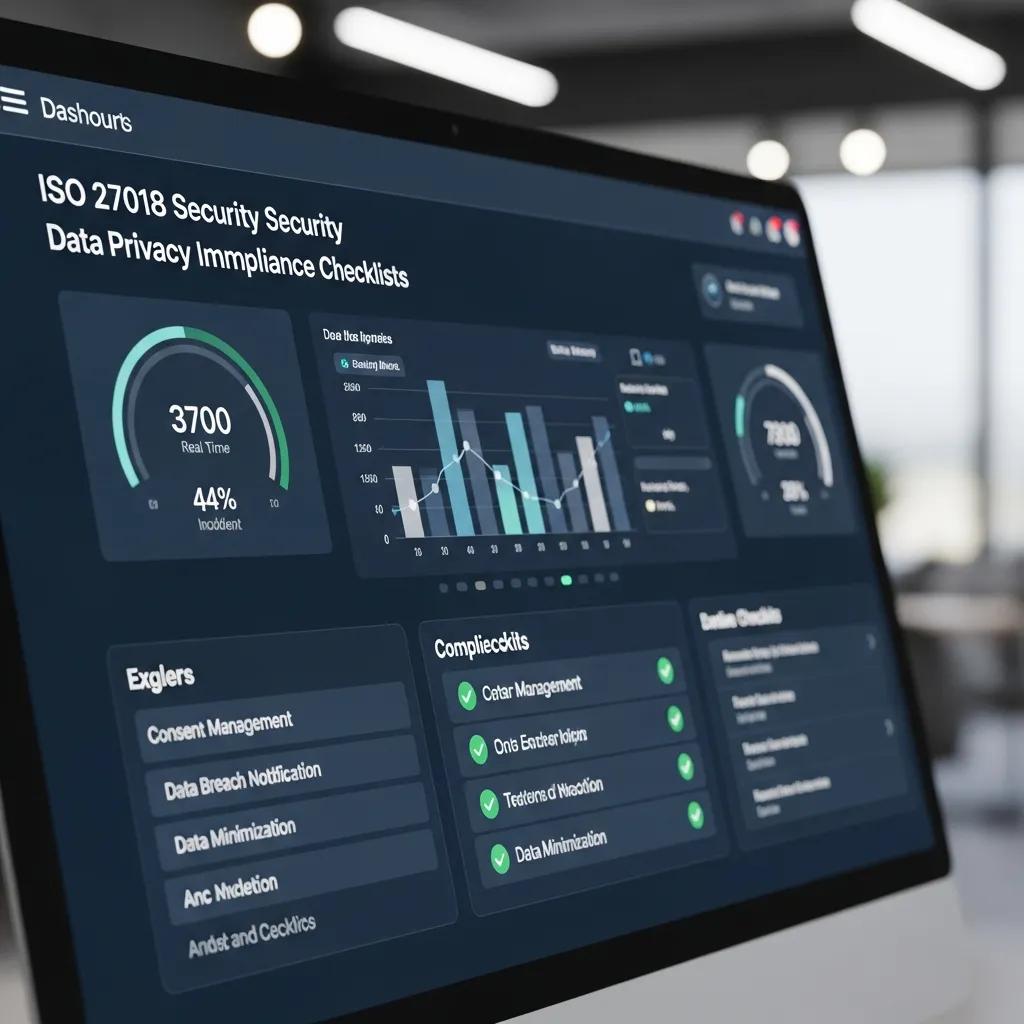
ISO 27018:2022 tightens processor obligations, clarifies subprocessor management, and raises expectations for transparency and breach notification in dynamic cloud environments. Expect auditors to ask for policy-to-control mapping, encryption and key-management records, and a processed-data inventory. Practical implementations focus on minimizing unauthorized access, limiting exposure from configuration drift, and ensuring subprocessors operate under equivalent contractual protections. Below is a concise mapping of common controls, when they apply, and implementation examples auditors accept as evidence.
Introductory table mapping ISO 27018 controls to purpose and example implementations:
| Control | Applicability | Implementation Example |
|---|---|---|
| Encryption (in transit & at rest) | Protects data confidentiality across service boundaries | TLS for APIs; disk-level encryption with audited KMS key rotation |
| Identity & Access Management (IAM) | Prevents unauthorized access and privileged misuse | RBAC, just-in-time privileged access, audited provisioning records |
| Subprocessor Management | Ensures subprocessors meet privacy obligations | Subprocessor registry, contractual flow-down clauses, periodic attestations |
| Logging & Monitoring | Detects misuse and supports breach response | Immutable audit logs, SIEM ingestion, retention policy aligned with privacy needs |
| Breach Notification & Response | Ensures timely communications to controllers and authorities | Incident playbook, mapped notification timelines, post-incident reports |
Which specific controls protect PII in public clouds?
ISO 27018’s technical controls center on encryption, IAM, secure configuration/change control, logging and monitoring, pseudonymization and retention, and secure deletion. Auditors look for encryption policies and key lifecycle procedures that show keys are managed by an automated KMS with role separation. IAM evidence includes inventories of users and service accounts, privileged-access reviews, and enforcement of MFA for admin roles. For logging and monitoring, acceptable evidence includes centralized immutable logs, SIEM alert rules, and retention aligned to privacy needs. Auditors will also validate lifecycle controls — retention, archival, secure deletion — to confirm PII isn’t kept longer than necessary. These layers form a defense in depth. The checklist below highlights common audit evidence items.
Common audit evidence items cloud providers prepare:
- Versioned policies and procedures mapped to each control.
- Technical artifacts: IAM inventories, encryption key records, configuration snapshots.
- Operational evidence: incident reports, subprocessor agreements, access review logs.
Collecting these items ahead of time speeds the audit and supports the transparency auditors expect.
How ISO 27018 clarifies processor and subprocessor responsibilities
ISO 27018:2022 requires explicit contractual commitments, clear subprocessor transparency, and operational supervision of subprocessor activity. Processors should maintain a subprocessor registry, obtain controller consent when needed, and include flow-down clauses requiring equivalent protections. Operational controls include attestation records, audit reports, and timely revocation of access at contract end. Auditors commonly review contract clauses for purpose-limited processing, data segregation guarantees, breach-notification timelines, and audit rights. A practical clause says subprocessors will act only on documented instructions, maintain equivalent security measures, and permit periodic compliance checks. These contractual and operational controls become part of the certification evidence package.
Business value from ISO 27018 certification for providers and buyers
ISO 27018 certification delivers concrete value: it builds customer trust, shortens procurement cycles, aligns processors with GDPR and other regimes, and reduces incident impact through prescriptive controls. For providers, certification differentiates services and simplifies vendor due diligence. For customers, certified providers lower supplier risk, shorten legal reviews, and offer clearer assurances about subprocessors and breach handling. Implementing ISO 27018 also strengthens operations — standardizing evidence collection, clarifying retention rules, and improving incident response — which reduces remediation time and cost. The table below shows benefits and measurable outcomes organizations can use during procurement and audit reviews.
Introductory table comparing benefits and outcomes:
| Benefit | Stakeholder | Business Outcome |
|---|---|---|
| Market differentiation | Cloud service provider | Faster procurement decisions; preference in RFPs |
| Reduced supplier risk | Customers (controllers) | Lower due-diligence time; clearer SLAs |
| Regulatory alignment | Legal & compliance teams | Easier GDPR mapping; reduced legal review cycles |
| Operational resilience | IT/security operations | Faster incident resolution; improved audit readiness |
How certification builds trust and commercial advantage
Certification is an independent signal that privacy controls have been validated — and procurement teams notice. Certified providers can share standardized evidence during RFPs, cutting time spent on bespoke assessments and improving scoring in privacy-sensitive tenders. Internally, certification enforces operational discipline that reduces configuration drift and lowers incident rates, strengthening a provider’s competitive position. The following section connects those certification benefits to GDPR and other global privacy frameworks for compliance teams.
How ISO 27018 supports GDPR and global privacy compliance
ISO 27018 complements GDPR by turning controller and processor obligations into operational controls and evidence on the processor side — especially around breach notification, data minimization, and subprocessor governance. It’s a practical controls framework that maps to GDPR articles on processor duties, security, and cooperation with authorities, though it’s not a substitute for legal advice. For cross-border transfers and residency concerns, ISO 27018 helps show technical and contractual safeguards are in place and can feed into transfer assessments. Treat the standard as a tool in your compliance toolkit, useful for operationalizing legal duties while legal counsel handles jurisdiction-specific rules.
When you’re ready to evaluate certification partners, Stratlane Certification lists ISO services such as ISO 9001, ISO 14001, ISO 27001, and ISO 42001. ISO 27018 is also available in our Quick Quote form. Stratlane differentiates with AI-driven auditing, accredited certification, auditors working across 29+ countries, and certificates recognized by corporations, academia, and SMEs. Our team is based in Amsterdam, Netherlands.
How Stratlane’s AI-driven auditing improves ISO 27018 certification

Stratlane uses NLP, log analytics, and anomaly detection to automate evidence mapping, accelerate gap analysis, and continuously monitor controls — increasing audit speed and coverage. Our tools parse policies and technical artifacts to flag missing clauses or risky configurations, then surface high-risk items for human review. For continuous monitoring, ML models spot unusual access patterns and configuration drift so teams can act before issues escalate. Human auditors validate AI findings, interpret legal and contextual nuance, and make certification decisions — a practical blend of automation and professional judgment. The table below links AI capabilities to audit tasks and measurable gains.
Advanced technologies like AI are reshaping auditing — enabling faster, broader, and more continuous verification.
Quantum AI for Cloud Data Auditing & Privacy
auditing scheme that verifies data integrity and optimizes the auditing process, and by investigating Quantum AI’s security concerns associated with both cloud and blockchain adoption.
Enhancing Data Privacy and Integrity in Cloud With Cutting Edge Through Data Auditing Techniques and Quantum AI Applications in Blockchain Technology, 2025
Introductory EAV table mapping AI capability to audit task and value:
| AI Capability | Audit Task Improved | Benefit / Example |
|---|---|---|
| NLP policy analysis | Rapid mapping of policies to controls | Reduces manual review time; highlights missing clauses |
| Log analytics & ML | Anomaly detection in access patterns | Early detection of suspicious access; fewer false positives |
| Automated evidence collection | Aggregating configuration snapshots | Speeds evidence assembly; reduces on-site time |
| Predictive risk scoring | Prioritizing remediation work | Focuses resources on highest-risk gaps; shortens remediation cycles |
Which AI technologies improve audit efficiency and accuracy?
Key technologies include NLP for policy and contract analysis, ML-based anomaly detection for logs and behaviour analytics, and automated connectors that gather configuration and inventory data. NLP extracts obligations, retention periods, and subprocessor lists into structured control mappings. ML baselines access patterns and flags deviations. Automated connectors collect configuration snapshots and IAM inventories for quick reconciliation. Outputs — prioritized risk lists, annotated policy mappings, and time-series visuals of anomalies — go to auditors for validation, freeing them from repetitive tasks so they can focus on judgement and nuance.
How human oversight preserves audit quality and ethics
We follow a human-in-the-loop model: AI detects, aggregates, and prioritizes; experienced auditors review flagged items, confirm context, and make final certification decisions. Governance routes AI findings to auditors who check provenance, assess false positives, and evaluate legal or contractual subtleties. Auditors remain responsible for judgments, reporting, and ethical considerations, ensuring automated tools augment rather than replace professional accountability. This balance reduces algorithmic risk while keeping audit rigor intact. The next section explains the certification stages and how AI plugs into each one.
Step-by-step ISO 27018 certification with AI integration
The certification journey follows a clear sequence: scope definition, gap analysis, remediation, certification audit, corrective actions, certificate issuance, and ongoing surveillance — with AI accelerating key phases. During scoping, AI-assisted discovery inventories systems and data flows. For gap analysis, automated policy parsing and configuration comparisons produce prioritized findings and remediation roadmaps. At audit time, auditors work from AI-curated evidence packages for efficient validation. After issuance, AI-driven monitoring supports surveillance by surfacing deviations and anomalous trends. Timelines vary with complexity, but AI typically shortens analysis and evidence-collection phases, reducing overall time-to-certification. The list below highlights where AI adds the most value.
- Scoping & Discovery: Define PII boundaries; AI inventories systems and data flows.
- Gap Analysis: Automated policy and config analysis generates prioritized findings.
- Remediation: Teams implement fixes guided by prioritized roadmaps.
- Certification Audit: Auditors validate controls using AI-assembled evidence packages.
- Corrective Actions & Issuance: Address nonconformities; certificate granted.
- Surveillance & Continuous Monitoring: AI monitors controls and flags drift for review.
This sequence clarifies roles and shows where AI shortens specific stages. The next subsection lists typical deliverables and evidence requested at each step.
From gap analysis to surveillance audits — what happens
Gap analysis starts with collecting policies, inventories, and configuration snapshots, then yields a remediation plan that links required changes to control owners. Deliverables include a gap registry, remediation timelines, and an evidence checklist. The certification audit samples evidence and interviews stakeholders, producing an audit report with any nonconformities. Once corrective actions are verified, the certificate is issued and periodic surveillance audits confirm ongoing conformity — often using continuous monitoring outputs as evidence. Typical auditor requests include versioned policies, access-review logs, key-management records, and subprocessor agreements. Clear deliverables and mapped evidence reduce rework and speed issuance.
How AI supports continuous monitoring and anomaly detection
AI monitoring ingests logs, configuration snapshots, IAM events, and change-management records to establish baselines and surface deviations that indicate drift or unauthorized access. ML models prioritize alerts by estimated privacy impact, reducing noise and focusing reviewers on high-risk anomalies. Alerts enter triage workflows where security and privacy teams investigate, document findings, and, when needed, trigger incident response and corrective actions that auditors can later review. Typical inputs include API access logs, privileged-session records, IaC drift reports, and SIEM alerts; AI correlates these sources into contextual incidents. This feedback loop supplies time-series evidence of control effectiveness between formal audits.
After reviewing the process, buyers should evaluate certification bodies on accreditation, auditor cloud-privacy experience, global reach, and tooling. Stratlane Certification lists services including ISO 9001, ISO 14001, ISO 27001, and ISO 42001; ISO 27018 is selectable via our Quick Quote form. We combine AI-driven auditing with accredited processes, auditors in 29+ countries, and certificates recognized by corporations, academia, and SMEs. Our team is located in Amsterdam, Netherlands.
ISO 27018: Protecting PII in Public Clouds with AI-Driven Audits
Pick a certification body based on accreditation, auditors’ cloud-privacy experience, global coverage for multi-jurisdiction audits, transparent methodology, and the ability to support efficient timelines. Traditional providers often rely on manual evidence assembly and extended on-site work. AI-augmented auditors cut on-site time, speed evidence validation, and enable continuous monitoring for surveillance. Ask prospective bodies for accreditation proof, sample methodologies, and geographic coverage. Look for capacity to manage subprocessors across jurisdictions, clear evidence requirements, and scalable surveillance. The next section summarizes Stratlane’s accreditation and geographic reach as available in our materials.
Stratlane Certification — accreditation and global reach
Stratlane Certification is presented as an accredited body with auditors operating in over 29 countries and certificates accepted by corporations, academia, and SMEs. Based in Amsterdam, Netherlands, our network supports assessments across diverse legal and operational contexts, helping multinational providers secure consistent certification. Accreditation confirms our conformity-assessment approach meets recognized standards; our multi-country auditor network pairs local insight with a consistent methodology. Buyers should request accreditation documentation during engagement and confirm auditors’ cloud and privacy experience for ISO 27018 work.
How AI-driven auditing reduces time and cost
AI reduces time and cost by automating evidence collection, speeding policy-to-control mappings, prioritizing remediation, and shrinking on-site audit time through pre-assembled evidence packages. Automation cuts repetitive tasks — manual log reviews, policy cross-referencing, and configuration reconciliation — so auditors can focus on high-risk judgments. Organizations typically see faster gap analyses and more efficient remediation when tools highlight high-impact issues first, though absolute savings depend on complexity and data quality. We always pair automation with human validation to maintain ethical, compliant decisions and audit rigor. When you’re ready, request a scoped assessment or use the Quick Quote to start.
Stratlane Certification offers ISO certification services (examples: ISO 9001, ISO 14001, ISO 27001, ISO 42001); ISO 27018 is available in the Quick Quote form. We emphasize AI-driven auditing, accredited certification, auditors in 29+ countries, and certificates accepted by corporations, academia, and SMEs. Our office is in Amsterdam, Netherlands.
Frequently asked questions
Who benefits from ISO 27018 certification?
Any organization processing PII in public cloud environments benefits — cloud service providers, SaaS vendors, and businesses using cloud storage. Certification proves a measured approach to privacy and security, which helps win customer trust and meet regulatory expectations. Sectors with high privacy stakes — finance, healthcare, education — often gain the most from the standard’s structured approach to managing PII risk.
How does ISO 27018 relate to GDPR and other privacy laws?
ISO 27018 complements GDPR by converting controller and processor duties into operational controls and documented evidence on the processor side. It helps teams implement technical and organizational measures that support legal compliance — for example, around breach notification, minimization, and subprocessor governance. While useful for operationalizing GDPR requirements, ISO 27018 does not replace legal advice or jurisdiction-specific assessments.
What role does AI play in ISO 27018 certification?
AI automates evidence collection, policy analysis, and anomaly detection to reduce the time and resources needed for audits. It identifies gaps, prioritizes remediation, and provides continuous monitoring so teams can address issues earlier. Auditors validate AI findings and make final judgments, so the process remains rigorous while becoming faster and more scalable.
What common challenges do organizations face pursuing ISO 27018?
Organizations often struggle with understanding specific control requirements, integrating ISO 27018 into an existing ISMS, limited personnel or budget, and ensuring subprocessors meet equivalent privacy obligations. Clear scoping, early engagement with a certification partner, and a prioritized remediation plan help overcome these hurdles.
How often are surveillance audits required after certification?
Surveillance audits typically occur at least annually to confirm continued conformity. Frequency and scope depend on your size, complexity, and operational changes. Continuous monitoring can reduce audit effort by providing time-series evidence for surveillance reviews.
How should organizations prepare for ISO 27018 certification?
Start with a gap analysis to identify where controls and documentation fall short. Prepare a remediation plan, implement required controls, and version your policies and procedures. Train staff on privacy principles and recordkeeping. Engaging a certification body early — or using a Quick Quote — helps clarify scope and evidence requirements so you can plan timelines and resources effectively.
Conclusion
ISO 27018 certification strengthens trust, streamlines procurement, and helps cloud providers align with global privacy requirements. It turns privacy obligations into testable controls and operational practices that reduce risk and improve incident readiness. If you want to raise your privacy posture, talk to a certification partner or request a Quick Quote to begin your ISO 27018 journey.