
Enhance Service Delivery Through ISO 9001:2015 Standards

ISO 9001:2015 Certification for Service-Based Businesses: A Practical Guide to Quality Management and Competitive Advantage
ISO 9001:2015 sets out the requirements for a Quality Management System (QMS) that helps organizations reliably deliver services that meet customer and regulatory expectations. For service businesses, the standard means clear processes, measurable outcomes, and a commitment to continual improvement — all of which lift service quality and create a defensible competitive edge. This article walks through how ISO 9001:2015 applies to service environments, the principles that guide implementation, the tangible benefits for customer experience and operations, and a practical certification roadmap for service firms. You’ll also get actionable tips for audit readiness, realistic timelines and cost considerations, how AI-assisted auditing can speed the process, and how to keep your certification current through surveillance and certificate management. Key phrases like service quality, service delivery, customer experience, Quality Management System, and risk-based thinking are used throughout to show how ISO 9001:2015 improves outcomes in IT, healthcare, consulting, and other service sectors.
Achieving ISO 9001:2015 Certification for Service Businesses
ISO 9001:2015 is an international standard for quality management that expects organizations to use a process-based approach, demonstrate leadership commitment, and apply risk-based thinking to deliver consistent results. The standard is implemented via a documented QMS that maps core service processes, assigns responsibilities, and sets measurable objectives to boost customer experience and operational resilience. For service providers, ISO 9001 brings front-line delivery, back-office support, and supplier interactions into a single, predictable system that reduces variability for clients. Turning informal knowledge into documented practices enables training, monitoring, and ongoing improvement — all of which directly influence service quality and client retention.
What Are the Key Principles of ISO 9001:2015 for Service Industries?
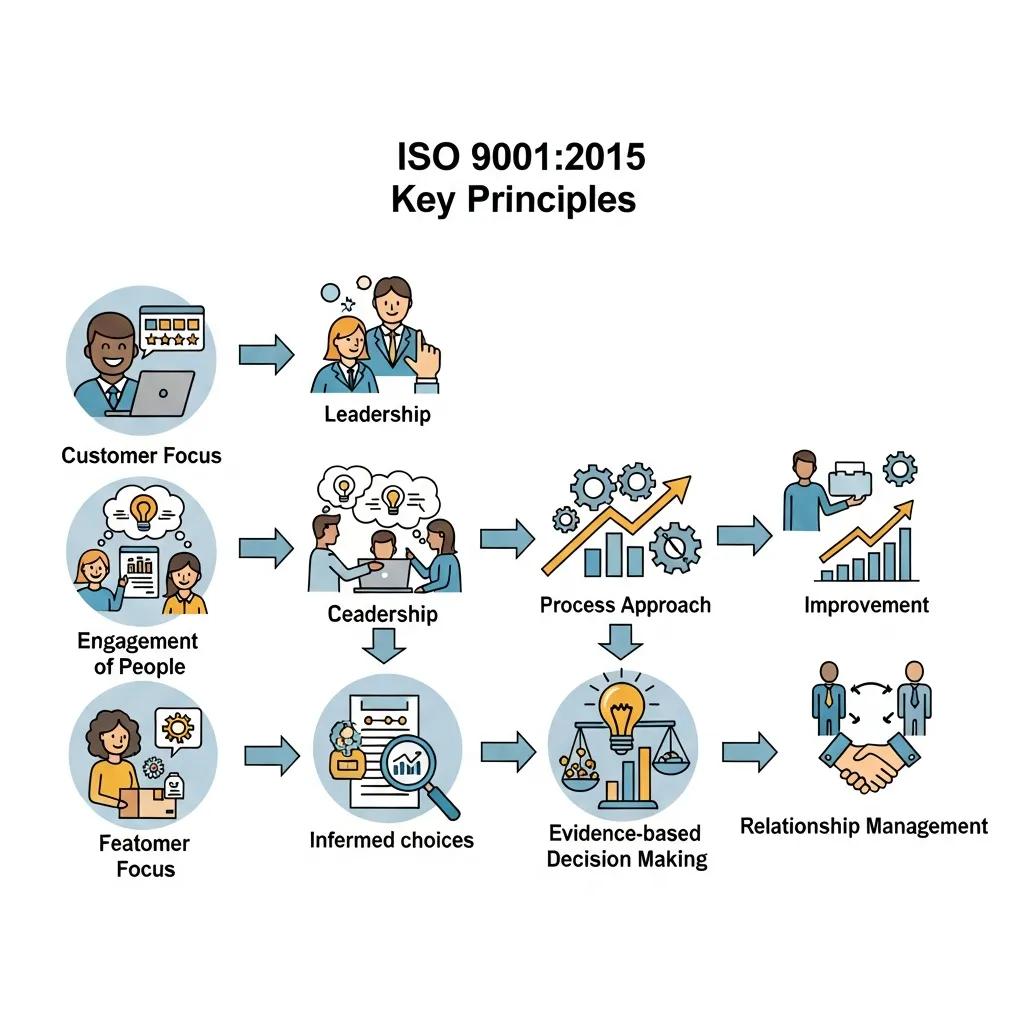
ISO 9001:2015 is built around a set of principles that are especially relevant for services: customer focus, leadership, engagement of people, a process approach, continual improvement, evidence-based decision making, and relationship management. Customer focus means shaping service touchpoints, SLAs, and feedback loops around client needs to lift satisfaction and loyalty. Leadership sets the quality policy and objectives so teams operate with the same priorities. The process approach encourages mapping client intake, service delivery, and follow-up to spot handoffs and reduce failure points. Evidence-based decisions rely on KPIs like NPS, CSAT, and first-contact resolution to guide improvements and resource choices. Relationship management brings suppliers and partners into scope when their performance affects your service outcomes, creating an integrated quality ecosystem.
How Does a Quality Management System Enhance Service Delivery?
A well-built QMS improves service delivery by standardizing how work gets done, clarifying roles, and embedding measurement so results become predictable. Standard processes reduce variability in onboarding, request handling, and escalations — which shortens response times and cuts rework. Dashboards that track SLA compliance, customer satisfaction, and cycle times give you the data needed for corrective actions and performance tuning.
Structured feedback loops — from complaint handling to regular management reviews — turn lessons learned into updated procedures and targeted training. Those mechanisms reduce errors, speed resolution, and make your service more reliable, which strengthens customer experience and retention.
What Are the Benefits of ISO 9001 Certification for Service Companies?
ISO 9001 certification delivers both operational gains and strategic advantages for service organizations. A certified QMS demonstrates consistent performance and governance — a signal of maturity that prospective clients and partners trust. Certification helps teams move from reactive firefighting to systemic improvement through scheduled audits and management reviews. In many service markets, ISO 9001 is a differentiator in bids and RFPs, lowers the long-term cost of quality, and clarifies internal accountability to support scalable growth.
ISO 9001:2015 benefits typically include:
- Improved customer satisfaction: Defined processes and feedback loops increase reliability and perceived value.
- Operational efficiency: Process mapping and data-driven choices reduce rework and lower delivery costs.
- Market and contract access: Certification often meets buyer requirements and strengthens competitive positioning.
- Risk reduction and compliance: Risk-based thinking surfaces threats to service continuity and improves resilience.
These benefits align to measurable KPIs that service leaders can monitor to evaluate impact and ROI.
| Benefit Dimension | Typical KPI | Expected Impact |
|---|---|---|
| Customer Satisfaction | NPS / CSAT | Increase in retention and referrals within 6–12 months |
| Operational Efficiency | First Contact Resolution, Cycle Time | Reduced average handling time and lower rework rates |
| Market Access | Bid win-rate | Improved eligibility for contracts requiring certification |
| Risk Management | Number of nonconformities | Fewer incidents and faster corrective action closure |
This table illustrates how ISO 9001 certification produces both measurable improvements and strategic value across service businesses.
How Does ISO 9001 Improve Customer Satisfaction and Loyalty?
ISO 9001 raises customer satisfaction by establishing clear feedback channels, measurable service standards, and fast corrective mechanisms that respond to client concerns. Providers implement complaint handling, root-cause analysis, and service recovery processes that reduce repeat issues and show responsiveness. Regularly monitoring KPIs like NPS, CSAT, and on-time delivery creates a data-driven improvement loop that reassures clients and builds trust. Over time, steady gains in these metrics translate into higher retention, more referrals, and stronger long-term relationships.
In What Ways Does Certification Drive Operational Efficiency and Cost Reduction?
Certification improves efficiency by requiring documented workflows, removing redundant steps, and measuring outcomes so resources are used where they add the most value. Process mapping exposes bottlenecks and risky handoffs — fixing those reduces cycle times and labor costs. Performance dashboards support focused training and targeted automation that further cut overhead and rework.
The table below maps common implementation phases to the kinds of time and cost improvements service firms frequently see.
| Implementation Phase | Typical Improvement | Estimated Impact |
|---|---|---|
| Process mapping & standardization | Reduced variability | 10–30% decrease in error rates |
| KPI tracking & dashboards | Faster decision-making | 5–20% improvement in throughput |
| Corrective actions & training | Less rework | 8–25% cost reduction on repeat fixes |
These estimates show how QMS work typically delivers measurable, compounding savings as processes mature.
What Is the Step-by-Step ISO 9001 Certification Process for Service Businesses?
The ISO 9001 certification journey for service businesses follows a clear path from scoping and gap analysis through certification and ongoing surveillance. It starts with leadership defining scope and objectives, then a gap analysis compares current practices to ISO requirements. Next you design and document the QMS — procedures, work instructions, and KPIs — then train staff and run internal audits to confirm readiness. A registrar performs a Stage 1 document review and a Stage 2 onsite or remote audit to verify implementation; a successful outcome leads to certification. Afterward, surveillance audits confirm continued compliance and full re-certification typically happens on a multi-year cycle (usually three years).
Use this checklist to plan and communicate milestones across your teams.
- Define scope and objectives: Identify services and processes in scope and set quality goals.
- Conduct gap analysis: Compare existing practices against ISO 9001:2015 requirements.
- Develop QMS documentation: Create procedures, process maps, and performance indicators.
- Implement and train: Roll out processes and educate staff on responsibilities and records.
- Internal audit and management review: Validate readiness and address nonconformities.
- Registrar audit (Stage 1 & Stage 2): External assessment and certification decision.
- Surveillance audits and re-certification: Ongoing verification and continual improvement.
This roadmap simplifies planning and keeps the whole organization aligned on the milestones needed to certify and sustain the QMS.
How to Prepare for an ISO 9001 Audit and Choose a Certification Body?
Audit preparation begins with gathering objective evidence: process maps, work instructions, training records, KPI reports, corrective action logs, and management review minutes. Auditors expect to see consistent application of documented processes, traceable records, and proof that the organization measures and improves performance. When choosing a certification body, check accreditation, sector experience, auditor qualifications, and whether they use modern audit tools that improve efficiency. Pick a registrar whose scope and geographic accreditation fit your market, and assemble a concise audit pack so evidence is easy to find — this reduces audit time and disruption.
What Is the Typical Timeline and Cost for ISO 9001 Certification in the Service Industry?
Timelines and costs depend on company size, service complexity, and whether you engage external consultants, but typical ranges help set expectations. Small service firms with straightforward processes can often complete gap analysis, documentation, and readiness in 3–6 months; medium and large organizations commonly need 6–12 months because of broader stakeholder coordination. Costs include registrar fees, possible consultancy, and internal resource time; registrars usually price by audit days, so larger organizations face higher direct fees. Budget for implementation plus ongoing surveillance and internal maintenance.
| Business Size | Typical Duration | Typical Cost Range |
|---|---|---|
| Small service SME | 3–6 months | Low–moderate registrar fees; modest consultancy if used |
| Medium service company | 6–9 months | Moderate registrar fees; possible consultancy |
| Large/Complex service provider | 9–12+ months | Higher registrar fees due to audit days and complexity |
Size and process complexity are the main drivers of timeline and cost differences for ISO 9001 certification.
How Does AI-Driven Auditing Enhance ISO 9001 Certification for Service Companies?

AI-driven auditing speeds and sharpens ISO 9001 assessments by automating routine tasks, broadening analysis beyond small samples, and surfacing anomalies human reviewers might miss. AI tools can continuously monitor process performance, analyze large record sets for patterns, and flag high-risk areas for auditor focus. That means faster evidence gathering, more consistent findings across audit teams, and earlier detection of emerging compliance risks. AI is an aid to human judgment — governance elements like explainability, data quality checks, and auditor oversight remain essential to keep outputs reliable and actionable.
Key AI advantages at a glance:
- Automation: Reduces manual tasks like document indexing and checklist completion.
- Accuracy: Detects patterns and anomalies across datasets beyond traditional sampling.
- Continuous monitoring: Real-time insights surface trends and risks sooner.
- Efficiency: Shorter audits and standardized reports improve consistency.
What Are the Advantages of AI-Powered Audit Tools in Compliance and Risk Detection?
AI audit tools bring capabilities like predictive analytics, anomaly detection, automated checklists, and natural language processing that change how organizations detect compliance issues and manage risk. Predictive models forecast where nonconformities may occur by linking KPI trends with past incidents, while anomaly detection highlights unusual activity for immediate review. Automated checklists and document parsing speed evidence collection and cut administrative load for both internal teams and auditors. These features extend coverage from small samples to near-complete analysis, increasing the chance of finding issues early and enabling proactive prevention of service disruptions.
| AI Feature | What it does | Benefit / KPI improvement |
|---|---|---|
| Anomaly detection | Scans transactions and logs to flag outliers | Faster detection; reduced incident rate |
| Automated scheduling | Coordinates audit activities and evidence requests | Shorter audit preparation time |
| Full-data analysis | Processes complete datasets rather than samples | Increased coverage; higher confidence in findings |
This table shows how AI capabilities map directly to better audit performance and operational KPIs.
How Is Stratlane Certification Using AI to Improve Audit Efficiency and Accuracy?
At Stratlane Certification, we use AI tools to streamline audit workflows while keeping experienced auditors in control. Automated analysis and anomaly detection reduce manual evidence collection and let auditors focus on judgment-heavy, high-risk areas. That shortens audit time, improves consistency across engagements, and helps clients close nonconformities faster. If you’re exploring certification support, Stratlane Certification offers quotes and audit services that incorporate AI-assisted processes to lower administrative burden and cost while preserving the rigour of ISO 9001:2015 assessments. Prospective clients can request a Get a Quote or contact us to discuss how AI-enhanced audits apply to their service environment.
How Can Service Businesses Manage and Maintain Their ISO 9001 Certification?
Keeping ISO 9001 certification requires disciplined surveillance, ongoing improvement, and strong document and certificate control so the QMS evolves with the business and stays auditable. Surveillance audits confirm the QMS continues to operate as certified, examining recent changes, corrective actions, and performance against objectives. Internally, teams must keep records current, run periodic internal audits, update procedures when processes change, and use management review to steer improvements. Good certificate management — expiry tracking, version control, and accessible audit evidence — lowers the risk of noncompliance and smooths surveillance and re-certification cycles.
Use this concise checklist to sustain compliance and continuous improvement after certification:
- Schedule and prepare for surveillance audits: keep records current and close corrective actions promptly.
- Run regular internal audits: verify process adherence and feed results into improvement plans.
- Maintain document control and records: ensure procedures are current and evidence trails are clear for auditors.
- Use management review to align QMS priorities with business goals and customer feedback.
What Are the Post-Certification Requirements Including Surveillance and Re-Certification?
Post-certification work centers on scheduled surveillance audits — typically annual or as set by your registrar — to confirm ongoing conformity to the QMS and ISO requirements. Auditors review changes since the last audit, check the status of previous nonconformities, and assess performance versus quality objectives. Prepare by keeping KPI trends, corrective action records, internal audit results, and improvement evidence up to date. Re-certification audits take place on a multi-year cycle (usually every three years) and reassess the full QMS; proactive maintenance reduces the burden of these major audits.
How to Use Certificate Management Tools for Continuous Improvement and Compliance?
Certificate management tools help sustain compliance by centralizing certificate downloads, expiry alerts, version control, and audit evidence so teams can act quickly. Valuable features include automatic expiry reminders, a certificate repository with role-based access, document versioning for procedures, and audit report storage linked to corrective actions. When integrated with your QMS, these tools close the loop: audit findings feed into corrective actions and document updates, accelerating improvements and cutting admin overhead. Stratlane Certification also offers certificate management and ongoing support to help with downloads, expiry tracking, and documentation practices that keep certification current and drive continuous improvement.
- Certificate alerts: Automated reminders prevent lapses and support timely re-certification planning.
- Version control: Centralized document history reduces confusion and ensures auditors see the current procedures.
- Audit evidence repository: Storing evidence and corrective-action records simplifies surveillance preparation.
These tools turn certificate administration from a checkbox task into a practical driver of improvement and operational clarity.
Frequently Asked Questions
What types of businesses can benefit from ISO 9001:2015 certification?
ISO 9001:2015 is useful for many service organizations — IT and managed services, healthcare providers, consultancies, educational institutions, and more. Any business that delivers services can tailor a QMS to improve quality, streamline operations, and boost customer satisfaction. The standard’s principles are flexible enough to fit different sectors and processes.
How can small service businesses implement ISO 9001:2015 effectively?
Small service businesses should start by mapping core service processes and clarifying customer needs. Run a gap analysis to prioritize changes, keep QMS documentation simple and practical, and involve staff from the start. Focused training and using digital tools for documentation and tracking will make implementation manageable and sustainable.
What role does employee engagement play in ISO 9001:2015 implementation?
Employee engagement is central to successful ISO 9001 implementation. When people understand their role in the QMS and see how improvements help customers, they’re more likely to adopt processes and contribute ideas. Use training, feedback loops, and recognition to build ownership and a culture of continual improvement.
What are the common challenges faced during the ISO 9001 certification process?
Common challenges include resistance to change, unclear understanding of the standard, and limited resources for implementation. Organizations may struggle to document processes consistently or keep momentum across stakeholders. Clear communication, leadership buy-in, practical training, and targeted support help overcome these hurdles.
How can organizations measure the success of their ISO 9001:2015 implementation?
Measure success with KPIs that reflect service quality, customer experience, and operational efficiency. Track NPS, CSAT, process cycle times, first-contact resolution, and other relevant metrics. Regular internal audits and management reviews also indicate how well the QMS is working. Monitoring these measures over time shows the real impact of your quality efforts.
What is the importance of continuous improvement in ISO 9001:2015?
Continuous improvement is a cornerstone of ISO 9001:2015. Regularly reviewing performance, addressing inefficiencies, and implementing corrective actions keeps your QMS relevant as customer needs and business conditions change. A culture of ongoing improvement helps you maintain compliance, raise service quality, and achieve sustainable results.
Conclusion
ISO 9001:2015 certification gives service businesses a practical framework to improve service quality, operational efficiency, and customer satisfaction through documented processes and continual improvement. Beyond compliance, the standard signals reliability to clients and opens doors to new opportunities. By building a robust QMS and maintaining it with discipline, organizations can manage risk, demonstrate governance, and support sustainable growth. Start your certification journey today — and reach out to learn how our expertise can help you move faster and with confidence.