
Ensure Compliance: Mastering the ISO Recertification Process

The ISO Recertification Process: A Practical Guide to Ongoing Compliance with AI-Assisted Audits
ISO recertification renews your management system certification after the standard three‑year cycle and confirms your processes still meet the standard and deliver results. This guide walks through the recertification steps, the 3‑year audit cycle, and how AI-assisted auditing speeds up surveillance and renewal reviews without sacrificing rigor. You’ll learn what auditors expect for ISO 9001 and ISO 27001, practical readiness steps (gap analysis, internal audits, evidence packs), cost drivers and ROI considerations, and how accredited bodies that use AI can make renewal smoother. We map audit timelines, list the evidence auditors commonly request, and provide concise checklists and comparison tables so you leave the audit with a clear plan for recertification.
What Is the ISO Recertification Process and Why Is It Essential?
Recertification is an external review that verifies your management system still conforms to the relevant ISO standard and to your own documented requirements. It combines periodic surveillance audits during the certification cycle with a full recertification audit in year three. The process produces audit reports, corrective actions, and — if all requirements are met — an updated certificate. Keeping certification current preserves market access, lowers compliance and operational risk, and signals continuous improvement to customers and partners. Organizations that document ongoing improvements and apply risk‑based controls usually face fewer findings at recertification. Knowing the cycle and the evidence auditors expect lets you plan resources and avoid last‑minute compliance gaps.
How Does the 3-Year ISO Certification Cycle Work?
The 3‑year cycle starts with initial certification (year 0), continues with surveillance audits in years 1 and 2, and concludes with a comprehensive recertification audit in year 3. Surveillance audits check continued conformity and progress on corrective actions; the recertification audit evaluates the full scope, processes, records, and performance. Common deliverables across the cycle include surveillance reports, corrective‑action plans with closure proof, updated management‑review minutes, and a recertification report with findings and the certificate decision. Align internal audits and management reviews to audit windows to reduce unresolved nonconformities. Timely closure of corrective actions and visible continual improvement are the outcomes auditors expect at each stage.
What Are the Benefits of Maintaining Continuous ISO Compliance?
Continuous compliance creates operational consistency and embeds risk‑based controls into daily activities, which reduces incidents and improves predictability. Tangible benefits include higher customer confidence, better access to procurement and tenders, and lower regulatory or insurance exposure thanks to documented controls and monitoring. Internally, you’ll see clearer roles, fewer repeat corrective actions, and improved supplier and asset management — all of which avoid costs over time. Regular surveillance and recertification audits also cultivate a culture of continual improvement, keeping systems aligned with new risks and stakeholder expectations. That’s why investing in readiness — internal audits, training, and record upkeep — delivers lasting certification value.
What Are the Key Requirements for ISO 9001 and ISO 27001 Recertification?
Recertification for ISO 9001 (Quality Management) and ISO 27001 (Information Security) hinges on documented evidence that your processes meet the standard clauses, internal audits are effective, management reviews drive decisions, and corrective actions are closed. Both standards require continual improvement and risk‑based thinking, but ISO 27001 demands an up‑to‑date risk assessment, a current Statement of Applicability (SoA), and evidence that controls operate and are monitored. Auditors expect records mapped to clauses, traceable corrective‑action histories, internal audit schedules, and management evidence showing leadership involvement.
The table below compares common recertification expectations for ISO 9001 and ISO 27001, with examples of evidence auditors typically accept.
| Standard | Requirement Area | Expected Evidence / Example |
|---|---|---|
| ISO 9001 | Documented Processes & Records | Process maps, SOPs, production or service records, quality objectives with measurable targets |
| ISO 9001 | Internal Audits & Management Review | Internal audit reports, nonconformity logs, management review minutes and action lists |
| ISO 9001 | Corrective Actions & Continual Improvement | Corrective action records, trend analysis, customer satisfaction data |
| ISO 27001 | Risk Assessment & Statement of Applicability | Updated risk register, risk treatment plans, current SoA mapped to implemented controls |
| ISO 27001 | Incident Response & Monitoring | Incident logs with root cause analysis, monitoring reports, evidence of corrective follow‑up |
| ISO 27001 | Controls Testing & Access Management | Access review records, penetration test summaries, control test evidence |
Use this matrix to align your documentation with what auditors will look for and to create focused evidence pockets for recertification.
What Are the ISO 9001 Recertification Requirements for Quality Management Systems?
ISO 9001 recertification requires verifiable records that processes run as defined, internal audits occur on schedule, management reviews produce measurable outcomes, and corrective actions are implemented and verified. Auditors will expect tracked quality objectives, customer feedback and trend analysis, and documented change impact assessments. Frequent nonconformities include incomplete records, inconsistent internal audit scopes, and weakly evidenced management review decisions. Prepare by ensuring process owners can show records mapped to clauses, closure evidence for past findings, and clear links between improvement initiatives and performance metrics. Doing so shortens auditor verification and demonstrates strong QMS governance.
What Are the ISO 27001 Recertification Steps for Information Security Management?
ISO 27001 recertification centers on a current risk assessment, an accurate Statement of Applicability (SoA), incident handling records, and controls testing to show effectiveness. Refresh the risk register to reflect new assets and threat vectors, align monitoring and logging evidence to SoA controls, and keep incident reports with root cause analyses and remediation records. Watch for outdated SoAs that list unused controls or lack live evidence — map each control to recent testing or monitoring results. Demonstrating continuous monitoring and corrective workflows shows the ISMS is active and managing information risk.
How Does AI-Driven Auditing Transform the ISO Recertification Process?

AI‑assisted auditing complements traditional audits by quickly analyzing large data sets, flagging anomalies, and prioritizing high‑risk areas for human review. Machine‑assisted sampling and pattern detection surface trends manual checks can miss, while automated cross‑referencing speeds evidence verification and reduces clerical errors. The result: fewer hours spent on routine checks, faster report delivery, and more consistent sampling across scopes. AI does not replace auditor judgment — it focuses human expertise where it matters most, helping teams prepare more strategically for recertification.
Research shows that automating management system audits with AI methods can accelerate procedures, reduce labor intensity, and extend audit coverage to more processes.
Automating Management System Audits with AI Methods
The chapter reviews how the COVID‑19 pandemic accelerated changes in management process audits and explores models and methods for automating audits using AI. Automation shortens audit timelines, reduces labor‑intensive tasks, lowers participant risk, and broadens the types of processes that can be audited efficiently.
Automating the Audit Process of Management Systems Through Artificial Intelligence Methods, 2022
Below is a compact EAV‑style table that maps key AI audit capabilities to their audit functions and measurable outcomes.
| AI Feature | Audit Function | Benefit / Measurable Outcome |
|---|---|---|
| Automated data aggregation | Evidence collection & normalization | Reduces manual prep time by consolidating diverse records into one view |
| Anomaly detection | Identifies unusual trends or exceptions | Surfaces issues earlier and lengthens corrective‑action lead time |
| Risk‑based prioritization | Focuses auditor sampling on high‑risk areas | Increases finding relevance and reduces total audit days |
| Pattern recognition | Compares transactions across time | Detects systemic issues that ad‑hoc sampling can miss |
This mapping shows how specific AI features translate into faster readiness and more targeted auditor effort, supporting smoother recertification outcomes.
What Are the Benefits of AI-Driven ISO Auditing for Efficiency and Accuracy?
AI‑enabled auditing accelerates evidence review, enforces consistent sampling, and finds complex patterns or anomalies that would take much longer to detect manually. By automating indexing and cross‑referencing, auditors spend more time on judgment‑heavy work such as control effectiveness and root‑cause analysis. Organizations benefit from clearer repeat‑finding detection and prioritized recommendations tied to business risk. The human+AI model preserves professional skepticism and contextual decisions; track KPIs like audit preparation hours, anomaly detection rates, and corrective‑action closure times to quantify efficiency and accuracy gains.
How Does Stratlane’s AI-Powered Audit Tools Enhance Compliance Assessments?
Stratlane Certification incorporates AI tools into its assessment workflow to speed review and improve audit quality. These capabilities help auditors focus on risk‑prioritized findings and streamline evidence handling so experienced auditors can concentrate on remediation and guidance. Stratlane operates as an accredited certification body and supplements AI‑assisted assessments with certificate management services like a Certificate Database and download options, centralizing records for procurement and compliance checks. If you’re considering an AI‑augmented external audit, request a quote or book an audit to see how these tools fit your recertification workflow.
What Are the Practical Steps to Prepare for ISO Recertification Audits?
Preparing for recertification means running a focused gap analysis, updating documentation, performing internal audits, managing corrective actions, and training staff so evidence is reliable on audit day. Start with a clause‑mapped gap analysis, prioritize fixes by risk and impact, then run internal audits to validate those fixes and collect fresh evidence. Management reviews should document leadership decisions and resource allocations; keep minutes and action follow‑ups handy. Ongoing role‑based training reduces process drift and keeps the system consistent across teams.
Before the external recertification audit, use a short readiness checklist to confirm key items and lock down evidence.
- Map evidence to clauses: Make records retrievable and clearly tied to requirements.
- Close or manage corrective actions: Verify root causes and closure evidence for prior findings.
- Run targeted internal audits: Confirm recent changes and operational effectiveness.
- Hold a management review: Produce minutes that document decisions, objectives, and resource allocation.
Completing this checklist reduces last‑minute findings and shows auditors your management system is active and controlled.
How to Conduct Gap Analysis and Update Documentation Effectively?
Run a gap analysis that defines scope, compares practices to standard clauses, and creates prioritized corrective actions with owners and deadlines tied to evidence. Pick representative processes and records to test conformity, record discrepancies, assign owners, and estimate remediation effort. Use a simple tracker to map each finding to evidence, completion date, and verification steps; include measurable acceptance criteria so internal auditors can confirm closure. Update documentation through a controlled change process that records revision history and notifies owners. Good gap analysis turns observations into verifiable actions and builds an auditable trail for surveillance and recertification auditors.
What Is the ISO Recertification Audit Checklist for Successful Compliance?
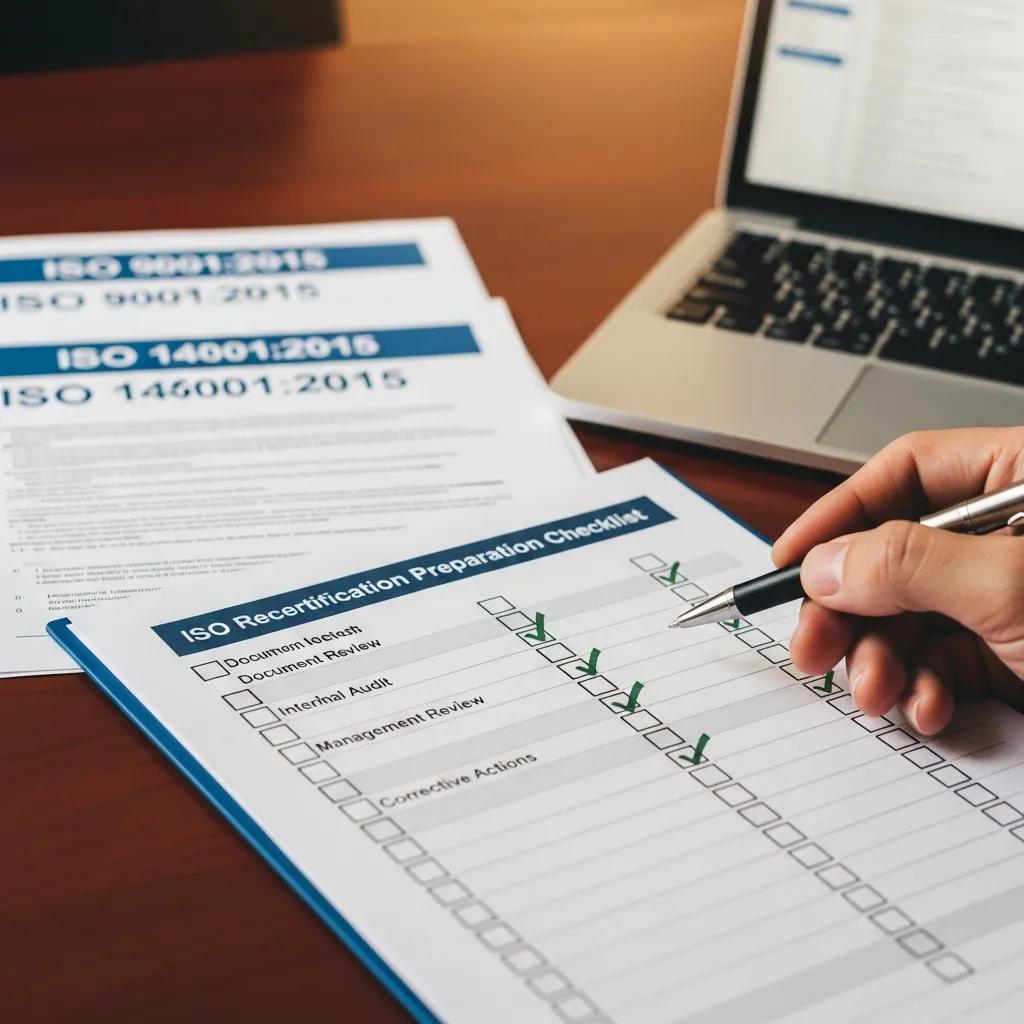
A concise recertification checklist helps teams confirm they have the documents, records, and demonstrated processes auditors will request. Ensure the checklist covers document control, internal audit results, management review outputs, corrective‑action records, performance metrics, and evidence of risk assessments and controls. Organize items by clause or functional area so auditors can cross‑reference quickly and your team can retrieve evidence without delay. Below is a compact checklist of core items auditors commonly examine during recertification.
- Policies and current, controlled documented procedures.
- Internal audit reports and evidence of corrective action closure.
- Management review minutes showing decisions and objectives.
- Current risk assessments (for ISMS) and an up‑to‑date Statement of Applicability.
- Records of monitoring, measurement, and applicable legal/regulatory compliance.
- Evidence of staff competence, role assignments, and training records.
Use this checklist as a final verification step to improve preparation discipline and reduce preventable nonconformities at recertification.
How Much Does ISO Certification Renewal Cost and What Is the ROI?
Renewal cost varies with scope, number of sites, standard complexity, and auditor days required. Evaluate ROI against tangible benefits such as tender eligibility, reduced incident costs, and operational efficiencies. Typical cost drivers are external audit fees, internal time for preparation and remediation, and any consultancy or readiness services. To calculate ROI, estimate incremental revenue or contract wins enabled by certification, quantify avoided costs from fewer incidents or rework, and include risk reduction where possible. The table below breaks down common cost drivers and how they typically affect ROI.
| Cost Driver | Typical Influence | Example Range / Impact on ROI |
|---|---|---|
| Scope & Number of Sites | Directly increases auditor days | Adding sites increases travel, logistics, and fees proportionally |
| Standard Complexity | Specialized standards require expert auditors | More complex scopes often require extra audit time and higher fees |
| Audit Duration / Auditor Days | Main contributor to external fees | Longer audits raise direct costs but reduce the risk of missed findings |
| Preparation Level (nonconformities) | Remediation increases internal costs | High numbers of N/Cs increase prep cost and can delay renewal |
What Factors Influence the Cost of ISO Recertification for Businesses?
Key cost influencers are organizational scope, number of locations, standard complexity, total auditor‑days, and the volume of corrective actions to verify. Multi‑site certifications add audit days and logistical costs; integrated or complex standards need specialist auditors, raising fees. Poor preparation increases internal labor and consultant expenses and can trigger follow‑up audits. Efficient internal audits, current documentation, and the use of automation or AI readiness tools can reduce auditor time and total renewal cost. Investing in readiness usually costs less than responding to multiple late‑cycle nonconformities.
How to Evaluate the Investment Return from Maintaining ISO Certification?
Estimate ROI by listing measurable benefits — tender wins, customer retention, fewer incidents, efficiency gains — and comparing them to full renewal costs, including internal labor and external fees. Start with direct revenue or contract opportunities that require certification and assign conservative revenue estimates. Then quantify avoided costs like incident reduction, less rework, or fewer regulatory penalties using historical or benchmark data. Apply a simple ROI formula: (Total certified benefits − Certification cost) / Certification cost. Track KPIs such as tender success rate, incident frequency, and audit preparation hours across certification cycles to validate the business case and find cost reduction opportunities.
Why Choose an Accredited Certification Body Like Stratlane for ISO Recertification?
Using an accredited certification body ensures certificates are accepted by procurement teams, regulators, and partners and confirms audits follow accreditation rules and impartiality requirements. Accreditation gives independent assurance that assessment processes meet external oversight and helps certificates gain cross‑border recognition. Stratlane Certification is an accredited body that combines AI‑driven audit tools with certificate management services, making it an option for organizations that want an AI‑augmented assessment within accredited processes. When choosing a certification body, consider accreditation scope, auditor expertise, and certificate management features that support long‑term compliance.
What Makes Stratlane’s AI-Driven Auditing Unique in the Certification Industry?
Stratlane’s distinguishing feature is the integration of AI tools into its assessment workflow to accelerate evidence handling and let auditors focus on high‑value findings and remediation. Stratlane pairs these capabilities with professional auditors operating across multiple countries, creating a human+AI approach that increases efficiency while retaining professional judgment. This setup speeds evidence handling and concentrates auditor time on complex compliance issues rather than routine checks. Requesting a recertification quote or audit will show how AI‑assisted assessments can fit your readiness and certificate‑management needs.
How Does Global Accreditation Ensure Trusted and Recognized ISO Certificates?
Accreditation provides independent assurance that a certification body operates under international accreditation standards, increasing confidence that issued certificates are reliable and accepted across jurisdictions. Authorization to issue certificates in multiple countries extends recognition, easing cross‑border trade and procurement eligibility. Stratlane Certification is authorized to issue certificates in over 27 countries, which supports acceptance across diverse markets and reduces friction in international supply chains and academic or corporate validation. Stratlane also offers certificate management and a centralized Certificate Database and download options so organizations can keep records accessible for procurement and compliance checks.
If you’re ready to schedule a recertification audit or request a quote, ask about AI‑assisted assessment options and certificate management features to ensure a streamlined renewal and ongoing access to certified documentation.
Frequently Asked Questions
What is the difference between ISO 9001 and ISO 27001 recertification processes?
ISO 9001 focuses on quality management — customer satisfaction, process control, and continual improvement. ISO 27001 centers on information security — risk management and effective controls. At recertification, ISO 9001 auditors look for quality objectives and customer feedback; ISO 27001 auditors expect updated risk assessments and a current Statement of Applicability. Knowing these differences helps you prepare the right evidence for each standard.
How can organizations effectively manage corrective actions before recertification?
Manage corrective actions with a repeatable process: identify root cause, log actions, assign owners and deadlines, and verify effectiveness. Use a corrective‑action tracker to monitor progress and run internal audits to confirm implementation. Involve management in reviewing actions to ensure accountability and resource allocation before the recertification audit.
What role does staff training play in the ISO recertification process?
Staff training ensures people understand the standard, their responsibilities, and how to follow procedures. Regular, role‑specific training reduces nonconformities and embeds continual improvement. Keep training records as evidence and align refreshers with process changes and internal audits.
How can organizations leverage technology to streamline the recertification process?
Use technology — AI‑assisted audit tools and document management systems — to automate data collection, evidence verification, and reporting. These tools reduce manual effort, highlight anomalies, and prioritize high‑risk areas for auditors. Well‑organized digital records speed auditor reviews and shorten preparation time.
What are common pitfalls organizations face during ISO recertification?
Common pitfalls include poor preparation, incomplete documentation, and unresolved prior nonconformities. Other issues are weak internal audit programs and limited management involvement. Avoid these by following a clear preparation plan, conducting regular internal audits, and ensuring leadership engagement throughout the cycle.
How can organizations measure the success of their ISO recertification efforts?
Measure success with KPIs such as number of nonconformities found, time to close corrective actions, audit outcomes, tender win rates, incident frequency, and operational efficiency metrics. Conduct post‑audit reviews to capture lessons learned and feed improvements into the next certification cycle.
Conclusion
Clear planning and disciplined execution make ISO recertification manageable. AI‑assisted audit tools speed evidence handling and improve focus, while solid internal processes reduce the risk of findings. Prioritize a clause‑mapped gap analysis, reliable internal audits, and management‑level oversight to demonstrate continual improvement for ISO 9001 and ISO 27001. When you’re ready, request a quote or schedule an audit to discuss how our accredited certification services and AI‑assisted assessments can support your recertification journey.