
Ensuring Safety Laws Meet OHS Regulations with ISO 45001

ISO 45001 Certification: How AI Accelerates Workplace Safety Compliance
ISO 45001 is the international standard for occupational health and safety management systems (OHSMS). It helps organizations prevent work‑related injury and illness by bringing a structured, risk‑based approach to leadership, process controls, and worker participation. Workplace incidents still cause major disruption and human cost; ISO 45001 gives teams a repeatable way to reduce that risk. This article explains what the standard requires, why it matters for legal compliance and reputation, and how AI‑driven auditing speeds certification and continuous improvement. You’ll find core clauses, a step‑by‑step implementation roadmap, regional alignment notes for OSHA, the EU and the UK, and practical tips for getting transparent quotes and managing certificates. We also compare traditional audits with AI‑assisted approaches and show how predictive analytics and certificate databases support ongoing compliance and worker protection.
What ISO 45001 Is — and Why It Matters for Workplace Safety
ISO 45001 specifies an occupational health and safety management system that helps organizations identify hazards, assess risks, and put controls in place to prevent harm. The standard follows a Plan‑Do‑Check‑Act (PDCA) cycle and requires visible leadership, worker involvement, documented processes, and performance evaluation to drive continual improvement.
By standardizing how hazards are managed and linking OHS to wider management practices, ISO 45001 reduces variability in safety performance and helps organizations demonstrate compliance with local laws. Grasping these basics makes it easier to map clauses to practical actions and prepare for certification audits.
Published research reinforces that ISO 45001’s framework plays a meaningful role in reducing injuries and meeting legal obligations.
ISO 45001: Preventing Injuries and Supporting Legal Compliance
ISO 45001:2018 emphasizes preventing workplace injuries and illnesses, building a safety culture, and meeting legal requirements—core goals when implementing integrated management systems such as ISO 9001, ISO 14001 and ISO 45001.
Below are ISO 45001’s core objectives and why they matter when you’re improving workplace safety.
- Create a consistent process for hazard identification and risk assessment that targets root causes of incidents.
- Align leadership, resources, and worker participation so safety outcomes are sustained across teams and sites.
- Set measurable performance metrics and a continuous improvement cycle to demonstrate compliance and reduce operational disruption.
These objectives lead naturally into what an OHSMS includes and how ISO 45001 evolved from earlier frameworks such as OHSAS 18001.
How ISO 45001 Defines an Occupational Health and Safety Management System
An OHSMS under ISO 45001 is a coordinated set of policies, processes and procedures that systematically manage workplace health and safety risks. Key elements include an organizational OHS policy, hazard identification and risk assessment, operational controls, training and competence programs, emergency preparedness, and mechanisms for monitoring and corrective action.
The OHSMS links objectives to measurable KPIs—incident rates, near‑miss reporting, corrective action closure times—so teams can track improvement. For example, a manufacturing plant that targets lockout‑tagout procedures through focused risk assessments and training can reduce related incidents by prioritizing controls and follow‑up.
This definition also highlights why ISO 45001 stresses leadership and risk‑based thinking compared with older frameworks.
Key Principles and How ISO 45001 Evolved from OHSAS 18001
ISO 45001 builds on OHSAS 18001 by strengthening top‑management responsibility, embedding risk‑based thinking across processes, and making worker consultation and participation central requirements. Unlike OHSAS 18001, ISO 45001 ties OHS objectives to organizational context and strategic direction, so leaders must demonstrate visible ownership and accountability.
The shift to proactive, risk‑based approaches moves organizations away from checklist compliance toward identifying systemic hazards and controls. That alignment between safety, business goals and regulatory expectations supports performance‑focused audits and continuous improvement.
Understanding these principles explains why implementation roadmaps should prioritize leadership engagement and documented risk management—topics we cover next.
Business Benefits of ISO 45001 Certification

ISO 45001 certification delivers measurable and strategic benefits: fewer incidents, stronger legal alignment, improved reputation, and lower costs tied to workplace injuries. The standard gives you a repeatable way to identify hazards, prioritize controls and measure performance—leading to fewer lost‑time incidents and reduced direct and indirect costs over time. Certification also reassures stakeholders that health and safety are managed systematically, which can influence procurement, supply‑chain relationships and employee retention. Below is a concise list of the top benefits, written for quick clarity.
- Reduced incidents: Systematic risk assessment and controls lower accident and injury rates.
- Regulatory alignment: Clear documentation and monitoring support compliance with OSHA, EU directives or HSE guidance.
- Reputation and trust: Certification signals a real commitment to worker protection and can strengthen commercial relationships.
- Cost savings: Fewer incidents reduce direct claims and indirect costs like downtime and retraining.
- Employee engagement: Worker participation and clear safety communication increase morale and retention.
Empirical studies show ISO 45001 implementation is linked to reduced workplace accidents and improved employee perceptions of safety.
ISO 45001 Impact: Fewer Accidents, Better Safety Perception
Research indicates that adopting ISO 45001 improves OHS performance indicators, reduces workplace accidents, and enhances employees’ perception of safety by reinforcing prevention measures and introducing new controls.
To make benefits actionable, teams often map each benefit to KPIs and expected outcomes; the table below shows common pairings.
| Benefit Type | Metric Improved | Typical Outcome |
|---|---|---|
| Incident Reduction | Lost Time Injury Frequency Rate (LTIFR) | Fewer days lost and lower medical claims |
| Regulatory Compliance | Audit nonconformance count | Reduced legal penalties and inspections |
| Reputation | Supplier/customer confidence indicators | Stronger bids and contract wins |
| Cost Efficiency | Total cost of incidents (direct + indirect) | Lower operating and insurance expenses |
| Employee Morale | Retention and engagement scores | Higher productivity and reduced turnover |
This mapping shows how safety commitments translate to measurable business improvements and leads to questions about the mechanisms behind incident reduction and legal alignment.
How Certification Reduces Incidents and Supports Legal Compliance
Certification reduces incidents by formalizing hazard identification, risk assessment and control verification—creating consistent processes to prevent known risks and spot emerging ones. The OHSMS requires operational controls, training and maintenance programs that close common failure modes, while performance evaluation and internal audits make sure corrective actions stick.
For legal compliance, ISO 45001’s structured documentation and records provide traceability for inspections and reporting. Many organizations find that mapping ISO requirements to local regulators such as OSHA or national HSE bodies simplifies reporting and lowers the risk of fines or enforcement actions.
How ISO 45001 Strengthens Reputation and Employee Morale
ISO 45001 signals a company‑wide commitment to worker protection—external stakeholders like customers, insurers and partners often treat certification as a risk‑mitigation indicator during procurement. Internally, structured worker participation, clear safety communication and visible leadership build trust, increase morale and encourage near‑miss reporting.
These improvements show up as lower turnover, higher engagement scores and better feedback from suppliers and customers. Reputation and morale gains compound incident‑reduction benefits to deliver lasting operational improvements.
Those business outcomes are why many organizations look for structured implementation guidance, which we describe next.
Navigating ISO 45001 Compliance and Implementation
Start by understanding the core clauses—Context, Leadership, Planning, Support, Operation, Performance Evaluation and Improvement—and translate each into concrete actions with owners and deadlines. Best results come from a gap analysis led by a cross‑functional team that includes top management and worker representatives. A phased, risk‑based rollout usually follows: system design, documentation, training, internal audits, corrective actions and the external certification audit. The checklist below is tailored for teams preparing for certification.
Implementation is often guided by practical research and proven frameworks to streamline preparation.
Guidelines for Preparing ISO 45001 Certification
This study examines guidelines for preparing ISO 45001 certification and develops them into a structural model, based on a survey of safety committee representatives from certified industries.
- Run a gap analysis to compare current practices with ISO 45001 clauses.
- Define context, scope and leadership roles; appoint an OHSMS manager and worker representatives.
- Create documented processes for hazard identification, risk assessment, controls and emergency planning.
- Deliver training, communication and recordkeeping systems; perform internal audits and management reviews.
- Fix nonconformities, close corrective actions, and schedule the external certification audit.
This roadmap translates strategy into tactical steps and leads to clause‑level mapping for role assignments and actions.
Below is a clause‑to‑action table that connects ISO 45001 clauses to practical tasks and responsible roles.
| Clause | Requirement | Practical Action |
|---|---|---|
| Context & Scope | Understand internal and external issues | Senior management defines scope and documents key stakeholders |
| Leadership | Top management accountability | Assign roles and review the OHS policy annually |
| Planning | Risk identification and objectives | Conduct risk assessments and set measurable targets |
| Support | Competence and documentation | Deliver training and control document access |
| Operation | Operational controls and emergency planning | Implement procedures, run drills and maintain equipment |
| Performance Evaluation | Monitoring and audits | Schedule internal audits and track KPIs |
| Improvement | Corrective action and continual improvement | Close nonconformities and update controls after reviews |
Mapping clauses to concrete tasks helps teams move from planning to execution and prepares organizations for audits and ongoing evaluation.
Core Clauses and Their Roles in OHS Management
The core clauses are the structural backbone: Context clarifies scope and stakeholders; Leadership assigns top‑level ownership; Planning sets risk‑based objectives; Support covers competence and resources; Operation defines control requirements; Performance Evaluation provides monitoring; and Improvement drives corrective actions and continual enhancement. Each clause produces tangible outputs—procedures, training records and audit reports—that together demonstrate system effectiveness. Assign clause ownership early (executive, OHS manager, supervisors, worker reps) to cut rework during certification.
With clause ownership set, teams can follow a chronological implementation plan to reach certification, described next.
Step‑by‑Step Processes for Effective ISO 45001 Implementation
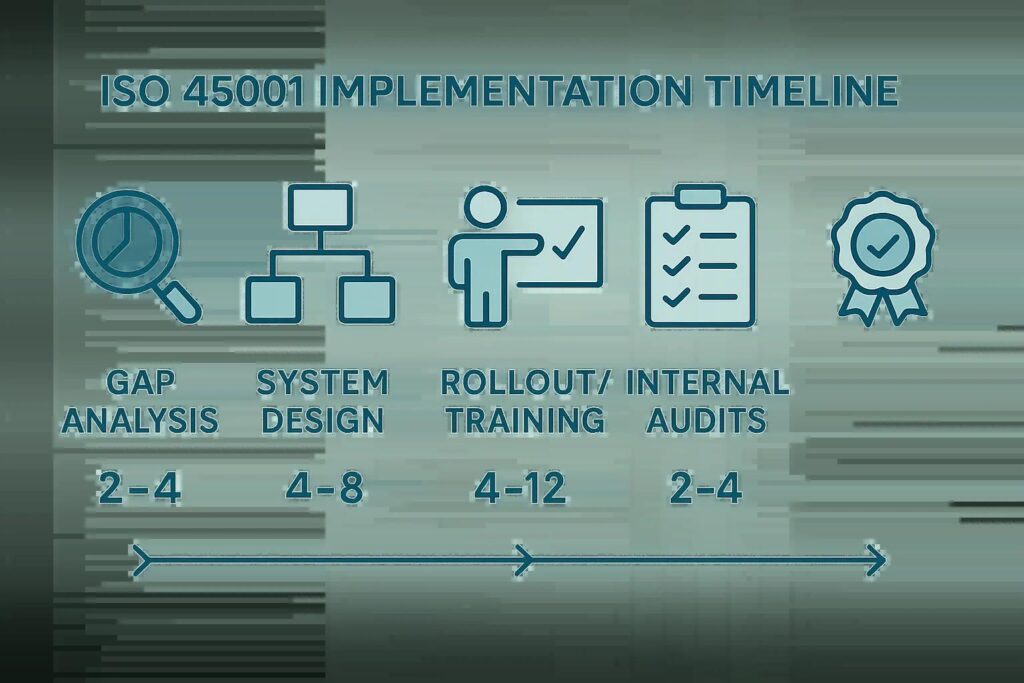
A practical timeline looks like this: gap analysis (2–4 weeks), system design and documentation (4–8 weeks), rollout of training and controls (4–12 weeks), internal audits (2–4 weeks), then the certification audit when readiness is confirmed. Keep clear documentation, evidence of worker involvement and measurable KPIs at every stage. Internal audits and management reviews should surface corrective actions that are closed before external assessment. This iterative timeline supports continual improvement and helps keep certification costs predictable by reducing remediation at audit time.
With a clear roadmap and clause mapping, many organizations now turn to AI‑driven auditing to speed evidence collection and expand audit coverage.
How Stratlane’s AI‑Driven Auditing Improves ISO 45001 Certification

Stratlane applies AI‑driven audit tools to streamline evidence collection, prioritize findings and enable continuous monitoring—cutting audit time while improving risk focus and accuracy. Automated document review and NLP‑based clause extraction save manual effort; predictive analytics flag high‑risk areas so auditors and managers can act sooner. These capabilities refocus human expertise on verification and improvement, speed remediation of nonconformities and shorten certification timelines. The table below contrasts traditional audit phases with AI‑enabled approaches to show concrete efficiency and accuracy gains.
| Audit Component | Traditional Approach | AI‑Driven Approach |
|---|---|---|
| Document Review | Manual sampling and checklists | NLP‑assisted automated extraction and indexing |
| Risk Prioritization | Auditor judgment and experience | Predictive analytics highlight high‑risk processes |
| Evidence Gathering | Onsite checks and manual uploads | Continuous monitoring and automated evidence capture |
| Report Generation | Manual compilation | Automated, structured findings with remediation suggestions |
This comparison shows how automation reduces repetitive tasks and concentrates human review where it adds the most value.
AI Technologies That Transform Safety Audits
Key AI tools include machine learning for anomaly detection in incidents and maintenance records, natural language processing for fast document and policy review, and predictive analytics to forecast hazard likelihood from historical data. Outputs include prioritized findings, alerts on emerging risks and automated summaries of compliance gaps for auditor validation. Turning large volumes of unstructured data into actionable intelligence helps auditors uncover patterns—like recurring near‑miss categories—that routine manual reviews can miss. Those insights drive targeted training and maintenance interventions.
Efficiency and Accuracy Gains from AI‑Driven Auditing
AI cuts routine time spent on document review and evidence collection, often significantly shortening pre‑audit preparation and enabling more frequent internal assessments. Accuracy improves because automated checks reduce human error in data extraction and apply clause mappings consistently across sites. Continuous monitoring detects compliance drift earlier, enabling faster corrective actions and fewer audit surprises. With auditors focused on verification and improvement rather than data gathering, organizations can shorten certification timelines and lower total auditing costs while maintaining—or improving—safety outcomes.
Those gains affect how organizations align ISO 45001 with local regulators and adapt regional compliance strategies, as we explain next.
Regional Workplace Safety Requirements: US, EU and UK
ISO 45001 complements regional occupational safety rules rather than replacing them. In the US, OSHA focuses on reporting, recordkeeping and hazard controls that map to ISO clauses. In the EU, the Framework Directive sets employer duties implemented via national law. In the UK, HSE guidance remains aligned with ISO principles while reflecting local regulatory detail after Brexit. Treat ISO 45001 as a structured, auditable way to show due diligence—map local statutory obligations to your OHSMS and adapt documentation so it satisfies both certification and legal audits.
- Map ISO controls to region‑specific obligations such as OSHA reporting, EU transpositions, or UK HSE guidance so documentation meets audit and legal needs.
- Keep region‑specific records and templates to simplify regulatory reports while preserving ISO evidence trails.
- Use internal audits to confirm legal obligations are covered within the OHSMS and to prepare for inspector queries.
These alignment steps help organizations secure certification and stay defensible under regulatory scrutiny.
How US OSHA Requirements Map to ISO 45001
OSHA emphasizes hazard control, recordkeeping, training and incident reporting—areas that align with ISO 45001’s operational controls, competence requirements and performance evaluation. Practical mapping links OSHA logs and injury records to ISO performance metrics and ensures training content meets OSHA while documenting competence for ISO support clauses. Centralizing OSHA artifacts in the OHSMS simplifies inspections and shows systematic hazard management rather than ad‑hoc compliance.
EU and UK Legal Frameworks That Support Workplace Safety
The EU Framework Directive (89/391/EEC) requires employers to assess risks, prevent hazards and consult workers—duties that map directly to ISO 45001. The UK’s HSE guidance stresses management systems, risk assessment and worker involvement; many principles remain aligned post‑Brexit, though national rules vary. For multi‑site operators, adapt ISO processes to each jurisdiction’s transposition of EU directives or UK statutory instruments and document local requirements inside a centralized OHSMS to reduce duplication and maintain consistent compliance.
Getting a Transparent ISO 45001 Quote and Managing Certificates
Certification cost depends on size, number of sites, operational complexity, geographic spread and readiness. Auditors estimate scope, audit days and remediation needs to produce a transparent quote. To get an accurate estimate, prepare documentation showing current OHS processes, incident history, number of employees/sites and previous audit reports. Many certification providers also offer certificate management systems to centralize issued certificates, track renewals and store audit findings—features that reduce post‑certification admin. The list below covers the main cost drivers and steps to speed up quoting.
- Organization size and total headcount included in the scope.
- Number and distribution of sites and the travel/logistics involved.
- Operational complexity and the extent of remediation needed to meet ISO clauses.
Providing clear scope and well‑organized documentation shortens quote lead time and reduces scope‑change surprises during audits.
What Influences ISO 45001 Certification Costs?
Cost drivers include the number of sites and employees in scope, operational complexity (for example hazardous processes), geographic spread and your readiness level—higher remediation needs increase auditor days and cost. Auditor travel, sampling depth and reporting requirements also affect price. Organizations that complete gap analyses, run internal audits and show closed corrective actions before external assessment usually receive more accurate—and often lower—quotes because less auditor time is needed for remediation. Transparency on scope and documentation helps control certification expenses.
How Stratlane Supports Certificate Management and Ongoing Compliance
Stratlane combines AI‑driven audit tooling with a certificate database and a network of professional auditors across 29+ countries to support multi‑jurisdictional programs. Our platform evaluates scope and readiness to produce transparent quotes and centralizes issued certificates and renewal tracking to cut administrative effort. Accredited to issue certificates in 27+ countries, we pair technology‑enabled audits with local auditor expertise to streamline certification and ongoing monitoring—so organizations can request a quote and use certificate management to sustain compliance over time.
This approach shows how AI tools and certificate services complement ISO 45001 implementation and long‑term improvement.
Frequently Asked Questions
What’s the difference between ISO 45001 and OHSAS 18001?
ISO 45001 replaces OHSAS 18001 and takes a more integrated, strategic approach. OHSAS focused on procedural compliance; ISO 45001 adds leadership accountability, risk‑based thinking and worker participation. It also requires organizations to consider context and stakeholders, making the system more adaptable to different operational environments.
How can organizations ensure continuous improvement after certification?
Continuous improvement is driven by regular internal audits, management reviews and performance evaluations. Establish KPIs to monitor safety performance, involve employees in safety discussions and near‑miss reporting, and use data (including AI‑driven analysis) to spot trends and focus improvements. These practices keep safety systems responsive to changing conditions and emerging risks.
What role does employee training play in ISO 45001 compliance?
Training is essential. It ensures people understand hazards, risk controls and emergency procedures and that they can perform their safety responsibilities. Training should be role‑specific, repeated as needed and documented as part of competence records. Well‑designed training builds capability and a culture where safety is part of daily work.
Does ISO 45001 certification affect insurance costs?
Yes—certification can lower insurance costs by demonstrating a systematic approach to risk management. Insurers may view certified organizations as lower risk, which can lead to better premiums or terms. The combination of fewer incidents and documented controls supports negotiations with insurers.
What common challenges do organizations face during implementation?
Typical challenges include resistance to change, weak management commitment and low employee engagement. Aligning existing processes with ISO requirements and resourcing documentation and training can also be hurdles. Overcome these by securing top‑management buy‑in, involving workers early and dedicating the resources needed for a structured rollout.
How can technology improve compliance with ISO 45001?
Technology automates documentation, training, incident reporting and evidence collection. AI tools streamline audits, surface insights from data and support continuous monitoring. Digital platforms make hazard reporting, corrective action tracking and communication easier—reducing human error and keeping the OHSMS proactive.
Conclusion
ISO 45001 gives organizations a practical framework to improve workplace safety, reduce incidents and demonstrate legal compliance. When leaders commit and workers participate, the result is a stronger safety culture that protects people and supports business resilience. AI‑driven auditing tools make the certification process faster and more focused, helping teams stay compliant and proactive. Ready to take the next step? Explore our certification services to see how we can help you achieve and sustain ISO 45001 certification.