

ISO 37001 sets an international baseline for Anti‑Bribery Management Systems (ABMS). It helps organizations identify bribery risk, put in proportionate controls, and show they can detect and respond when issues arise. This guide breaks down how the standard works, the core requirements you’ll need to meet, and the measurable value certification delivers for compliance, corporate integrity, and a broader ethics program within the organization. With regulatory scrutiny rising and third‑party networks getting more complex, a formal ABMS isn’t just advisory — it’s business risk management. We map the standard’s core functions, show how AI‑assisted auditing speeds and sharpens assessments, offer a step‑by‑step implementation roadmap, and explain integration with systems like ISO 9001 and ISO 27001. Throughout, you’ll find practical checklists, clear tables linking requirements to outcomes, and actionable next steps for teams planning certification.
What is ISO 37001 and How Does It Improve Anti‑Bribery Management?
ISO 37001 defines an Anti‑Bribery Management System: a structured, auditable framework of policies, controls and oversight designed to manage bribery risk across activities and relationships. The standard uses a risk‑based approach — identify risks, apply proportionate controls (policy, due diligence, monitoring), and embed continual improvement — so you reduce incidents and can demonstrate due diligence. Implementing ISO 37001 delivers concrete business benefits: lower legal exposure, stronger procurement positioning, and improved confidence from investors and customers. The sections below clarify an ABMS’s scope and the main requirements that make the standard operational and certifiable.
Defining ISO 37001 and the Anti‑Bribery Management System
First published in 2016 and updated through 2021, ISO 37001 sets requirements for establishing, implementing, maintaining and improving an Anti‑Bribery Management System proportionate to the bribery risks you face. An ABMS typically covers leadership and governance, key business processes, third‑party relationships and any activities that present bribery exposure. Unlike an internal policy, the standard requires auditable systems and documented evidence of controls and ongoing improvement. Many organizations use ISO 37001 to signal formal anti‑corruption commitment and to show they manage bribery risk with repeatable, verifiable controls.
Key Principles and Requirements of ISO 37001
ISO 37001 is built on interlocking requirements that make an ABMS workable and verifiable. Leadership commitment and a clear policy set tone from the top. A risk‑based approach targets controls where exposure is greatest. Third‑party due diligence, monitoring and reporting, protected whistleblowing channels, and role‑based training create detection and response capability. The system also needs performance measurement, internal audit and continual improvement to stay effective and defensible.
The table below translates those requirements into practical actions you can audit against.
| Requirement Area | What the Standard Requires | Practical Example |
|---|---|---|
| Leadership commitment | Board or senior‑management oversight, resourcing and accountability for the ABMS | Board‑approved anti‑bribery mandate with periodic reporting to the board |
| Anti‑bribery policy | A clear, communicated policy that prohibits bribery in all forms | Company‑wide policy with concrete examples and escalation steps |
| Due diligence | Risk‑based checks on third parties and significant transactions | Standardized third‑party questionnaire plus approval gates for high risk |
| Monitoring & reporting | Mechanisms to detect, report and respond to suspected bribery | Confidential whistleblower channel and an incident response log |
| Training & awareness | Role‑specific training and demonstrated competence | Mandatory annual training with attendance and assessment records |
This table shows how requirements become operational tasks and evidence points for audits. With these elements in place, your team can run targeted controls and assemble the records auditors expect.
What Are the Benefits of ISO 37001 Certification for Corporate Anti‑Corruption Compliance?

ISO 37001 certification ties anti‑corruption controls to business and governance outcomes. Certification formalizes prevention and detection, reduces legal and financial risk, and strengthens trust with customers, regulators and investors. It also helps streamline due diligence, eliminate duplicate controls, and improve procurement eligibility. Below are the primary benefits and the practical value each delivers.
- Risk Reduction: Shows active management of bribery risk, reducing the chance of fines and enforcement action.
- Procurement Advantage: Signals reliability to buyers and increases competitiveness in tenders.
- Reputational Protection: Builds stakeholder and investor confidence through independent validation of controls.
- Operational Efficiency: Consolidates due diligence and monitoring to lower admin burden and speed responses.
- Regulatory Evidence: Creates documented processes and records that demonstrate due diligence to regulators.
These benefits map to measurable KPIs; the table below links outcomes to indicators you can track.
| Benefit | Key Performance Indicator | Expected Business Impact |
|---|---|---|
| Risk reduction | Number of bribery incidents detected or prevented | Lower fines and legal exposure |
| Procurement advantage | Tender success rate where ABMS is requested | More contract wins |
| Reputational protection | Stakeholder trust measures / ESG ratings | Improved investor and customer sentiment |
| Operational efficiency | Time and cost to complete due diligence | Reduced administrative expenses |
| Regulatory readiness | Completeness and accessibility of evidence packages | Faster, more favorable regulator interactions |
This practical mapping helps decision‑makers quantify the case for ABMS investment and set targets tied to business results.
Reducing Legal and Financial Risks through Certification
Certification reduces exposure by showing you’ve applied proportionate controls, performed due diligence, and maintained credible monitoring and enforcement. Regulators and enforcement bodies frequently consider documented preventive measures when deciding penalties, so ISO 37001 evidence can influence outcomes. Standardizing third‑party screening, transaction controls and whistleblower handling reduces incident probability and impact. Keep clear records of investigations, remediation and corrective actions to build an auditable trail for both internal governance and external review.
Building Corporate Integrity and Strengthening Stakeholder Trust
Beyond reducing legal risk, ISO 37001 embeds ethical expectations into governance, procurement and supplier relationships. Certification signals to customers and investors that anti‑corruption is a formal, managed business risk — not a box‑ticking exercise. That assurance supports market access, improves supplier behaviour and boosts employee confidence. Measurable results include better tender outcomes, higher supplier compliance rates and a stronger culture of integrity that protects long‑term value.
How Does Stratlane’s AI‑Driven Auditing Improve ISO 37001 Compliance?
AI‑driven auditing enhances traditional assessments by automating evidence collection, spotting anomalies and optimizing sampling so audits are faster and more precise. Machine learning can scan large document sets — contracts, invoices, emails — to surface patterns manual review may miss, enabling targeted testing of high‑risk transactions. Automation also standardizes sampling and scoring, improving consistency and reducing reviewer bias. These capabilities shorten pre‑audit work, reduce on‑site time and produce repeatable evidence packages that support confident certification decisions.
- Anomaly detection: Flags unusual payments or behavioral patterns for focused review.
- Document analysis: Extracts clauses and supporting evidence from contracts and policies to confirm controls.
- Sampling optimization: Uses risk scores to prioritize transactions most likely to show issues.
Stratlane Certification combines AI tools with expert auditors to deliver efficient, rigorous management system assessments. We offer ISO certification and certificate management, and currently highlight ISO 9001, ISO 14001, ISO 27001 and ISO 42001 on our site. For this guide, our primary service focus is ISO 37001 ABMS certification supported by AI‑driven auditing.
These AI capabilities cut manual review time, sharpen risk detection, and reduce overall certification cost and timeline—without compromising audit quality. For organizations with heavy document loads or wide third‑party networks, AI‑assisted audits surface prioritized remediation and feed targeted improvements back into the ABMS cycle.
Efficiency and Accuracy in Anti‑Bribery Assessments
AI accelerates routine tasks—document classification, keyword detection in agreements, and transaction reconciliation—that once consumed auditors’ hours. That frees auditors to focus on control design and effectiveness testing. The outcome is time saved plus better detection of subtle bribery indicators, such as related‑party anomalies or repetitive low‑value payments. Consistent scoring and reproducible sampling also improve year‑to‑year comparability and support data‑driven decisions on where to strengthen controls.
Cost‑Effectiveness and a Streamlined Certification Journey
Compared with fully manual audits, AI‑enabled workflows shorten preparation, cut on‑site time and reduce administrative overhead by assembling standardized evidence packages. That translates to lower audit fees and faster certification for many organizations—especially those with distributed operations or large supplier estates. A sensible next step is to pilot AI‑assisted assessments in a high‑risk unit to measure time and cost savings, then scale the approach across your ABMS.
How to Implement ISO 37001: A Step‑by‑Step Compliance Roadmap
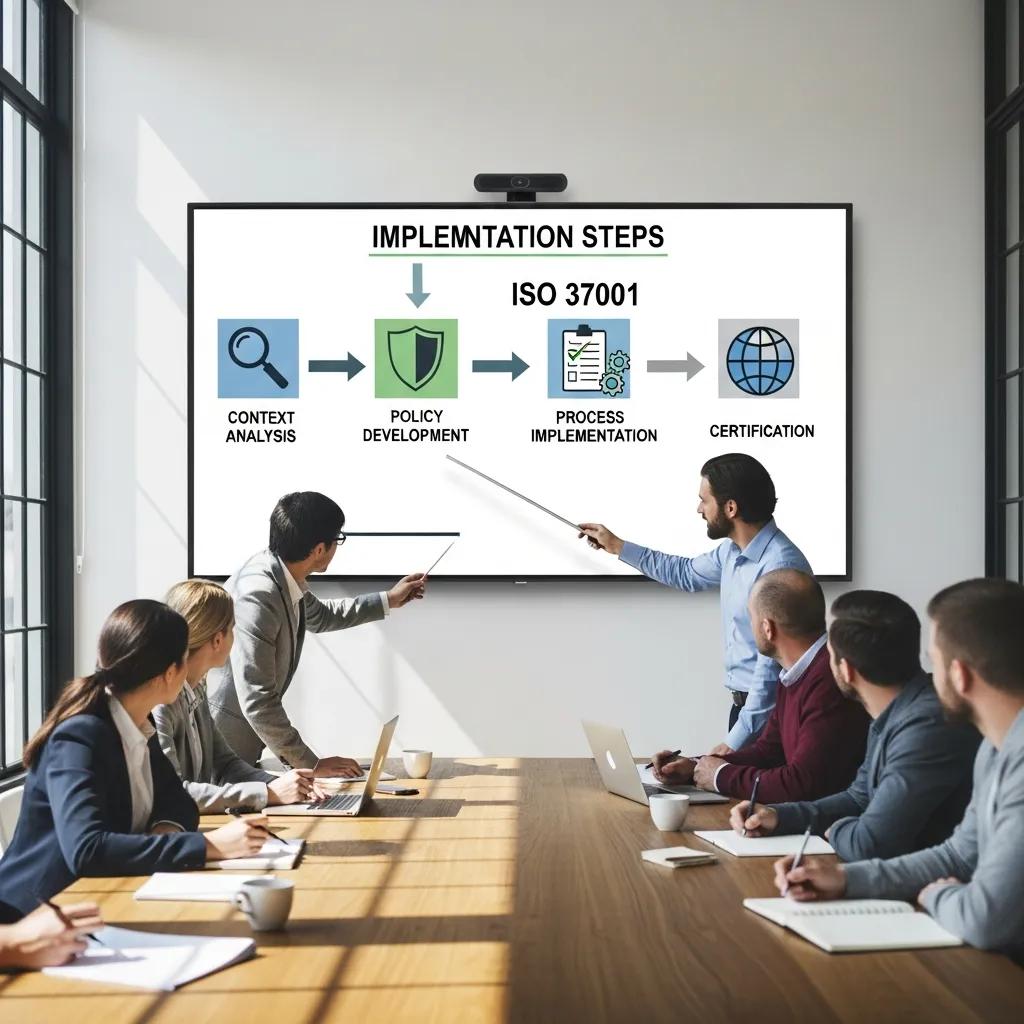
A clear roadmap reduces complexity and makes certification achievable. Start with scoping and a bribery risk assessment to prioritize controls. Then establish policy, assign leadership responsibilities, and design due diligence and monitoring processes. Finish with training, whistleblower arrangements, recordkeeping and internal audit before management review and external assessment. The six steps below offer a practical path to align people, timelines and evidence for certification readiness.
- Scope & risk assessment: Map activities, geographies and third parties that carry bribery exposure and rank risks.
- Policy & governance: Publish an anti‑bribery policy, clarify roles and secure leadership buy‑in.
- Due diligence: Deploy third‑party screening, transaction controls and approval gates for high risk.
- Controls & monitoring: Implement monitoring, whistleblower channels and incident response procedures.
- Training & communication: Deliver role‑based training and ensure policy awareness across the organisation.
- Internal audit & management review: Conduct internal audits, close corrective actions and prepare evidence for external certification.
Following these steps sets your organisation up for a successful certification audit and creates a foundation for continual improvement. After initial certification, plan periodic reviews, refreshed training and updated risk assessments as business conditions change.
Stratlane Certification combines AI‑enabled audit tools with experienced assessors to deliver practical, effective management system assessments. We provide ISO certification services and certificate management, and currently feature ISO 9001, ISO 14001, ISO 27001 and ISO 42001 on our site. The focus here is ISO 37001 ABMS certification supported by AI‑driven auditing.
Conducting Bribery Risk Assessment and Due Diligence
A bribery risk assessment blends process mapping, stakeholder interviews and data analysis to pinpoint where bribery is most likely and most damaging. Typical techniques include scoring risk by geography, business line, transaction type and third‑party exposure, then assigning mitigations to reduce residual risk. Due diligence should be tiered: basic checks for low‑risk suppliers and enhanced reviews for agents or intermediaries judged high risk, with documented thresholds and approval authorities. Practical tools include standard third‑party questionnaires, risk‑scoring templates and contract clauses that preserve audit rights.
Establishing Policies, Training and Monitoring Controls
Policies should be concise, role‑specific and supported by procedures that define acceptable gifts and hospitality, approval matrices and escalation routes. Training must be recurring, scenario‑based and matched to role risk; attendance and assessment records form core audit evidence. Monitoring controls include analytics of transactions, reconciliations, confidential whistleblower channels and periodic self‑assessments. An evidence checklist — policy copies, training logs, due diligence records and incident files — ensures the documentation auditors will request is available.
How Can ISO 37001 Integrate with Existing Management Systems?
ISO 37001 is compatible with other ISO management standards, letting organisations consolidate governance, risk registers and audit functions for efficiency. Shared elements such as leadership commitment, risk‑based thinking, document control and internal audit create natural integration points with ISO 9001 (quality), ISO 27001 (information security), ISO 14001 (environment) and ISO 42001 (AI governance). Integration reduces duplication, centralises evidence and supports consolidated management reviews that treat bribery risk alongside other enterprise risks. The table below shows practical integration points.
| Entity | ISO Standard | Integration Point / Example |
|---|---|---|
| Documented processes | ISO 9001 | Shared document control and versioning for policies and procedures |
| Risk registers | ISO 27001 | A unified risk register covering information and bribery risks |
| Supplier management | ISO 14001 | Combined supplier due diligence covering environmental and bribery risks |
A unified approach lets organisations draw on existing audit schedules and evidence repositories, making certification more efficient and less resource‑intensive.
Synergies with ISO 9001, ISO 14001, ISO 27001 and ISO 42001
Clause‑level overlaps mean ABMS controls often mirror requirements in other ISO standards — leadership, performance evaluation and continual improvement recur across frameworks. For example, document control and competence tracking in ISO 9001 can house anti‑bribery policies and training records; supplier evaluation under ISO 14001 can include bribery due diligence; and ISO 27001 controls can protect investigative records and whistleblower data. These synergies reduce audit duplication and streamline compliance governance.
Benefits of a Unified Compliance and Governance Framework
A unified governance model delivers consolidated reporting, fewer audits and streamlined corrective action management across standards, cutting overhead and improving senior management visibility. Consolidation creates a single source of truth for risk treatment plans and evidence, speeds responses to regulatory inquiries and sharpens board oversight of enterprise risk. Organisations that adopt integrated management systems typically see faster certification for additional standards and clearer accountability for risk owners.
Who Should Pursue ISO 37001 Certification and Why?
ISO 37001 applies across industries and sizes wherever bribery risk exists: finance, construction, energy, healthcare and the public sector. SMEs can scale the ABMS to fit resources and risk exposure, while large corporations benefit from standardized global controls and consolidated oversight. Organisations operating cross‑border, managing complex procurement, or heavily reliant on third parties often gain clear commercial and regulatory advantages from certification. The audience list below helps leaders identify where certification delivers most value.
- Large corporations: Benefit from consistent global controls and improved procurement competitiveness.
- SMEs: Build procurement credibility and clearer risk management without disproportionate overhead.
- Public sector & regulated entities: Meet higher transparency and accountability expectations.
- Organisations with complex supply chains: Strengthen third‑party governance and reduce downstream exposure.
Practical early actions include preparing documentation, running focused pilot audits and embedding controls in the highest‑risk units.
Stratlane Certification pairs AI‑enhanced audit tools with experienced assessors to provide efficient, reliable management system certification and certificate management. We currently highlight ISO 9001, ISO 14001, ISO 27001 and ISO 42001; here our primary offering is ISO 37001 ABMS certification backed by AI‑driven auditing.
Applicability Across Industries and Organisation Sizes
Sectors under heavy procurement scrutiny — construction, energy and government contracting — can gain immediate advantage from ISO 37001 by demonstrating controlled procurement and third‑party oversight. Financial services and multinationals use ABMS certification to support anti‑corruption compliance across jurisdictions. SMEs can adopt a scaled ABMS focused on their most material risks to balance cost and benefit. Practical next steps include scoping exercises, pilot implementations in high‑risk units and simple, well‑documented procedures that meet the standard.
Meeting Regulatory Expectations and Turning Certification into Advantage
Certification provides documented due diligence that can influence regulator discretion and improve procurement outcomes, especially where tenders require anti‑corruption assurances. Using ISO 37001 in bids signals a proactive compliance posture and reduces supplier vetting friction. To convert certification into commercial advantage, include relevant controls in tender documentation, describe governance and incident response capabilities, and where appropriate offer recent audit summaries or control performance metrics.
- Document due diligence: Include standard third‑party screening templates in tender submissions.
- Highlight governance: Describe leadership oversight and incident response arrangements.
- Offer evidence: Provide recent audit summaries and relevant control metrics when appropriate.
These steps help organisations turn certification into procurement and reputational gains while preserving ABMS integrity.
Frequently Asked Questions
1. How long does it take to achieve ISO 37001 certification?
Timeframes vary by organisation size, complexity and existing controls. Typical journeys range from a few months to more than a year. Key timing drivers include the depth of the initial bribery risk assessment, how quickly policies and controls are implemented, and the readiness of documentation for audit. Organisations that invest early in training and internal audits often move faster to certification.
2. What are the costs associated with ISO 37001 certification?
Costs differ based on organisation scale, operational complexity and the chosen certification body. Expect fees for the certification audit, implementation costs for controls and training, and ongoing monitoring expenses. Internal preparation—consultants or staff time to document processes—also adds cost. A detailed cost‑benefit analysis helps justify the investment against reduced legal and commercial risk.
3. Can ISO 37001 certification be integrated with other compliance frameworks?
Yes. ISO 37001 integrates well with frameworks such as ISO 9001, ISO 27001 and ISO 14001. Aligning policies, procedures and audit functions reduces duplication and improves efficiency. A unified compliance strategy lets you address multiple regulatory requirements while keeping focus on anti‑bribery measures.
4. What role does training play in ISO 37001 compliance?
Training is essential. It ensures employees understand policies, procedures and their roles in preventing bribery. Role‑specific and scenario‑based training helps staff identify risks and respond appropriately. Records of attendance and assessment results are primary audit evidence showing competence and awareness.
5. How does ISO 37001 help in managing third‑party relationships?
ISO 37001 requires risk‑based due diligence on partners, suppliers and contractors, including review of their anti‑bribery controls and risk profiles. Standardized screening and ongoing monitoring reduce third‑party risk and encourage transparency and accountability in supplier relationships.
6. What are the common challenges organisations face when implementing ISO 37001?
Common challenges include resistance to change, limited awareness of anti‑bribery practices and insufficient resources for training and compliance. Integrating ISO 37001 with existing systems can be complex. Overcome these by securing leadership commitment, communicating clearly with staff, allocating resources for training and using a phased implementation approach.
7. How can organisations measure the effectiveness of their ISO 37001 compliance efforts?
Measure effectiveness with KPIs such as number of bribery incidents detected, success rate of third‑party due diligence, and stakeholder trust metrics. Regular internal audits, control testing and feedback from employees and suppliers provide insight into ABMS performance and guide continuous improvement.
Displaying the Stratlane Certification Mark After Audit
Once an organization completes ISO 37001 certification, it may display the Stratlane Certification mark, also known as the Stratlane ISO Certification Logo, to show that its anti-bribery management system has been independently audited and certified by Stratlane Certification, Corp. The mark denotes system-level certification and must be used as issued: it should not be resized in a way that distorts the design, altered graphically, or applied to an individual product label in a way that implies product-level certification.
Correct use of the mark protects the credibility of the certification and the organization’s standing with regulators, customers and partners. Any question about proper display, sizing or placement should be directed to Stratlane Certification BV, which oversees usage of the mark across certified organizations and can confirm the right asset for a given application before it is published on a website, report or marketing material.
Conclusion
ISO 37001 certification gives organisations a practical, auditable way to manage bribery risk, strengthen compliance and build stakeholder trust. The standard reduces legal exposure, streamlines processes and supports better procurement outcomes. Prioritising an ABMS shows a clear commitment to ethical practice and can create a competitive edge. If you’re ready to explore certification, our AI‑driven auditing services can help speed readiness and focus remediation efforts — reach out to discuss next steps.