

“Beyond ISO 27001” means taking the standard’s management‑system foundation and turning it into an operational, telemetry‑driven security program that keeps pace with today’s threats. This guide explains how to layer practical controls — from enterprise cyber hygiene and zero trust to AI‑assisted audits — on top of an ISO‑aligned ISMS to reduce risk and speed remediation. You’ll find hands‑on hygiene steps, data‑protection patterns, a clear view of how AI changes audit workflows, and strategic frameworks that protect security investments over time. We map actions to regulatory expectations and 2025 trends so security leaders can prioritize the highest‑impact next steps for resilience and reliable evidence collection. Throughout, we use pragmatic comparisons (entity relationships and EAV formats) to help decision‑makers evaluate controls and build continuous‑improvement workflows. These recommendations are written for CISOs, IT managers, compliance officers and audit teams who need actionable ways to harden posture while keeping systems auditable and business continuity intact.
Why extend ISO 27001 with additional security measures?
ISO 27001 gives you the governance and ISMS framework—but it’s deliberately high level and doesn’t spell out every technical control for fast‑moving threats. To cover real‑time risks like cloud misconfiguration, AI‑enabled phishing and supply‑chain compromise, organisations must supplement ISO with adaptive controls, telemetry‑driven monitoring and playbooks that work under pressure. Those layers speed detection, shorten attacker dwell time and let the ISMS evolve with the threat landscape rather than rely only on periodic manual reviews. Below we list concrete reasons to extend ISO 27001 and practical principles for prioritising investments.
The standard’s structure supports continual improvement, but gaps often appear around cloud, automation and AI risk surfaces. Organisations that stop at baseline certification can still be exposed to modern attack patterns — which is why targeted technical controls matter. Expanding beyond ISO 27001 boosts operational resilience while keeping the governance discipline certification provides.
We recommend a pragmatic mix of policy, automation and threat‑informed controls that turn ISO intent into measurable security outcomes. Prioritise high‑impact changes — stronger access controls, continuous monitoring and validated incident playbooks — because they deliver direct risk reduction. That foundation leads into specific ISO limitations and how continuous improvement fills them.
What limitations does ISO 27001 have against emerging cyber threats?
ISO 27001 prescribes processes and control objectives but doesn’t mandate detailed technical controls for rapidly evolving technologies, leaving blind spots against AI‑driven attacks and cloud‑native risks. For example, the standard asks for access‑control policies but does not require modern identity proofs (FIDO2) or continuous device posture checks that reduce credential compromise. Likewise, documented procedures don’t guarantee telemetry capable of catching living‑off‑the‑land activity or supply‑chain abuse in third‑party CI/CD pipelines. Organisations should map ISO control objectives to concrete technical measures — CSPM for cloud posture, DLP for exfiltration risk and ML‑tuned SIEM/XDR for anomaly detection — to close those gaps.
A practical step is to extend the ISMS with control profiles that define minimum technology and telemetry requirements per asset class. That turns high‑level ISO intent into repeatable operational controls that can be validated continuously, supporting the Plan‑Do‑Check‑Act cycle and paving the way for ongoing control tuning.
How does continuous improvement reinforce security after ISO 27001?
Continuous improvement applies Plan‑Do‑Check‑Act to operations: ingest telemetry, add threat intelligence and iteratively tune controls to drive residual risk down. In practice that looks like continuous monitoring (SIEM/XDR), regular red‑ and purple‑team exercises, threat‑feed integration into detection rules and feeding incident outcomes back into the risk register and control baselines. This closed‑loop ensures control effectiveness is measured and adjusted, which makes compliance evidence collection more agile and reduces audit friction. Useful KPIs include mean time to detect, mean time to respond, percentage of controls continuously verified and number of high‑risk findings remediated within SLA.
Operationalising continuous improvement requires automation and role‑based workflows that link technical telemetry to ISMS evidence artifacts. With telemetry feeding the ISMS, you can automate repetitive audit tasks and let people focus on strategic remediation — a transition that also lowers baseline exposure through better cyber hygiene and MFA.
Core cyber‑hygiene practices that strengthen security beyond ISO 27001
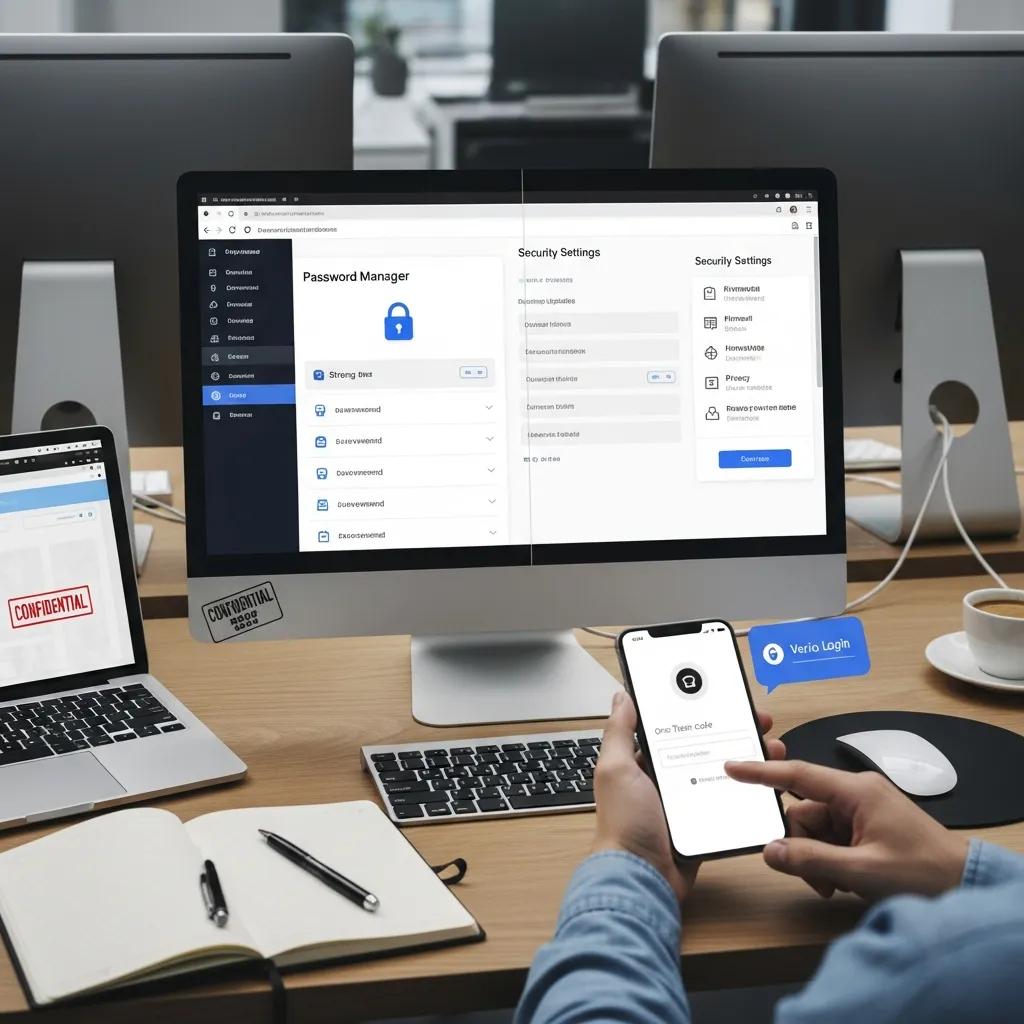
Good cyber hygiene shrinks the common attack surface and delivers measurable reductions in baseline risk that complement ISO controls. Essentials are strong credential policies, broad multi‑factor authentication, asset and patch management, least‑privilege access and targeted security awareness training based on observed phishing trends. When foundations are in place, higher‑level approaches like Zero Trust and IR work far better because routine risks are already controlled. The list below summarises practical hygiene steps and why each matters.
Core cyber‑hygiene practices to implement enterprise‑wide:
- Enforce strong credential hygiene: Use password managers, enforce rotation and ban reused credentials to reduce credential‑stuffing and account compromise.
- Deploy MFA widely: Require multi‑factor authentication for remote access and high‑privilege accounts to cut account‑takeover risk.
- Automate patching and vulnerability management: Prioritise CVEs by asset criticality and exploit availability; automate deployment where safe to shrink exploitable exposure.
- Run security awareness training with phishing simulations: Improve detection and reporting rates so incidents are caught and contained more quickly.
Consistent application of these basics reduces incidents that escalate into major breaches and simplifies audit evidence collection. The sections that follow compare MFA methods and outline patch‑management best practices that operationalise these hygiene controls.
Which multi‑factor authentication methods provide the best protection?
MFA adds a critical layer beyond passwords and, when chosen with a risk‑based approach, dramatically reduces compromises. Options vary by security and usability: SMS OTP is convenient but vulnerable to SIM swap; TOTP apps are stronger with modest user effort; FIDO2/WebAuthn and hardware tokens provide the highest phishing resistance. Require stronger factors for administrators and third‑party access while phasing stronger options across the user population.
Before rollout, run a user‑impact assessment, pilot FIDO2 where device support exists and define fallback procedures for lost devices or accessibility needs. The EAV comparison below helps decision‑makers weigh security level against implementation complexity and align choices with regulatory and operational priorities.
| MFA Method | Security Level | Implementation Complexity |
|---|---|---|
| SMS OTP | Medium‑Low | Low — easy to deploy, higher SIM‑swap risk |
| TOTP (authenticator apps) | Medium | Medium — user education and provisioning needed |
| FIDO2 / WebAuthn | High | Medium‑High — requires device support and lifecycle management |
| Hardware tokens (PKI‑based) | Very High | High — procurement and token lifecycle management required |
Trade‑offs are clear: use FIDO2 or hardware tokens for high‑risk contexts, TOTP for broad adoption, and phase out SMS OTP where possible. These decisions flow naturally into patch and vulnerability management practices that keep systems resilient.
How do timely updates and patch management reduce exploitable risk?
Prompt patching narrows the exposure window for known vulnerabilities and prevents common exploits. Adopt a risk‑based patch cadence that classifies fixes by CVE severity, exploit presence and asset criticality, and automate deployments through endpoint management and orchestration tooling where safe. For cloud‑native apps, bake patching into CI/CD with dependency scanning, canary releases and rollback plans so updates don’t harm availability.
Coordinate patching with change management and ISMS documentation to preserve auditability and avoid configuration drift. Clear SLAs and dashboards for patch coverage create accountability and supply evidence auditors expect when assessing control maturity during certification or surveillance audits.
How advanced data‑protection strategies complement ISO 27001
Advanced data protection maps technical controls to ISO objectives for confidentiality, integrity and availability while addressing privacy and regulatory needs. Key measures include strong encryption and key management, enterprise DLP across endpoints and cloud, access governance and retention policies that limit sensitive‑data exposure. Linking those controls back to ISMS clauses makes protection auditable and traceable during reviews. Below we provide comparative EAV guidance on encryption/DLP and a cloud data‑security checklist to put these strategies into practice.
Data protection must be part of data‑lifecycle and access‑workflow design so sensitive information is defended at rest, in transit and in use. A layered approach of encryption, DLP and access governance reduces exfiltration risk and simplifies privacy compliance. For teams looking for practical data protection tips, the options that follow show how to operationalise those layers.
Which encryption and DLP techniques are most effective?
Encryption and DLP work together: encryption secures stored and transmitted data, while DLP detects and blocks unsafe transfers or misuse. Pick algorithms and key‑management architectures that balance performance and protection — for example, AES‑256 for at‑rest encryption with a hardware or cloud KMS for key lifecycle. Deploy DLP at endpoints, network egress and inside cloud SaaS connectors to detect risky transfers or misclassifications.
The compact EAV table below compares common encryption approaches and typical use cases to help map choices to ISMS controls and regulatory needs.
| Encryption Approach | Strength | Typical Use Case |
|---|---|---|
| AES‑256 (symmetric) | High | At‑rest encryption for databases and file stores |
| TLS 1.3 (transport) | High | In‑transit encryption for APIs and web services |
| Asymmetric (RSA/ECC) | Medium‑High | Key exchange, digital signatures and PKI |
| Envelope encryption + KMS | High | Cloud‑native workloads with centralised key rotation |
Choosing the right mix — and operationalising key rotation, access logs and split‑key models — improves auditability and maps cleanly to ISO 27001 evidence requirements. The next section explains how cloud responsibility models affect these choices.
How does cloud data security fit into modern protection frameworks?
Cloud security depends on a clear shared‑responsibility model so you know which controls the provider manages and which remain yours. Use CSPM, CASB and IAM policies to automate discovery, configuration checks and data‑access governance aligned to your ISMS objectives. A practical checklist: enforce encryption, verify least privilege, monitor storage permissions and scan for exposed secrets or misconfigured buckets.
Align cloud configuration checks with audit schedules and keep evidence of remediation steps and timelines. Treat cloud risks within the ISMS scope so control validation and compliance remain continuous and auditable.
How AI‑driven auditing improves ISO 27001 certification and ongoing assurance
AI‑driven auditing automates repetitive evidence collection, accelerates control testing and surfaces anomalies human review can miss — increasing audit coverage and consistency. By using pattern recognition, automated mapping of artifacts to control objectives and prioritising high‑risk exceptions, AI reduces time‑to‑audit and improves assessment accuracy. The list below summarises how AI boosts audits, followed by a practical EAV mapping of audit tasks to AI capabilities.
- Faster evidence collection: Automated connectors and snapshots cut manual effort.
- Broader control coverage: AI can validate technical controls across thousands of assets quickly.
- Greater accuracy: Pattern analysis reduces missed exceptions and strengthens traceability of findings.
Those gains make audits more efficient and help organisations close gaps faster. Below we map AI features to measurable audit impacts.
What measurable benefits does AI bring to audit efficiency and accuracy?
AI capabilities directly support audit tasks and deliver measurable outcomes: fewer audit hours, higher control coverage and more reliable evidence trails. The EAV table shows common audit tasks, AI features that assist them and expected time or accuracy improvements to help justify automation investments.
| Audit Task | AI Capability | Time / Accuracy Benefit |
|---|---|---|
| Evidence collection | Automated connectors & parsing | Reduces manual hours by 40–70% |
| Control testing | Rule‑based checks plus ML validation | Increases coverage and lowers false negatives |
| Anomaly detection | Behavioural ML models | Faster detection of deviations and fewer missed issues |
Beyond time savings, AI improves repeatability by applying validation logic consistently and keeping an auditable trail of what was checked. For organisations looking to combine certification with AI‑assisted auditing, Stratlane Certification offers ISO 9001, ISO 14001, ISO 27001 and ISO 45001 services. Our ISO 27001 offering pairs accredited auditors with AI tooling, operating across Europe and the UK with professional auditors in over 29 countries. We also provide a streamlined client journey — from quote requests and audit scheduling to certificate management (database and downloads) — demonstrating how AI‑assisted audits can shorten certification cycles and improve evidence quality. Once an organisation’s management system has been audited and approved, Stratlane Certification BV issues the Stratlane Certification mark, displayed as the Stratlane ISO Certification Logo, as formal proof of certified status.
How does AI‑powered threat detection support proactive security?
AI‑powered detection ingests telemetry from endpoints, network and cloud into SIEM/XDR pipelines to spot anomalous patterns and emerging campaigns faster than static rules alone. ML models reduce false positives through contextual tuning and behavioural baselines, and detections can trigger playbooks that limit exposure while analysts investigate. Crucially, detections should feed back into the ISMS risk register so incident learnings inform preventive controls and strengthen audit evidence.
A practical sequence is: telemetry → AI detection → triage and automated containment → incident playbook → ISMS update and control retune. Embedding that feedback loop makes controls adaptive, measurable and better defended against repeat events.
Strategic frameworks that future‑proof security beyond ISO 27001
Frameworks such as Zero Trust, thorough incident‑response planning and formal third‑party risk management create a security posture that endures technology shifts and new threat vectors. Zero Trust enforces least privilege and continuous verification; incident‑response and resilience planning ensure rapid recovery and evidence preservation. Folding supplier assessments and contractual controls into the ISMS reduces supply‑chain risk and links external dependencies to governance obligations. The sections below describe Zero Trust components and incident‑response best practices with practical KPIs.
Adopting these frameworks benefits from phased roadmaps that balance risk, cost and operational impact: start with identity and access modernisation, then move to segmentation and device posture enforcement. A staged rollout reduces disruption and produces measurable control gains auditors can verify.
How does Zero Trust limit insider and external threats?
Zero Trust replaces implicit trust with continuous verification, micro‑segmentation and least‑privilege controls. Core elements include strong IAM, adaptive MFA, device posture checks and policy enforcement at the application or workload level rather than relying only on the network perimeter. Start by consolidating identity, add conditional access and then segment networks and workloads to limit lateral movement.
A phased roadmap — pilot on critical applications, extend to privileged access, then apply to cloud workloads — minimises operational risk and creates clear audit evidence that access controls are enforced and monitored. Effective Zero Trust deployments tie directly to incident logging and response, improving both prevention and post‑incident forensics.
What are best practices for incident response and resilience planning?
A resilient incident‑response programme documents the lifecycle: preparation, detection, containment, eradication, recovery and post‑incident review, with runbooks for common incident types. Tabletop exercises and purple‑team engagements validate playbooks; post‑incident reviews must feed concrete corrective actions into the ISMS risk register and control updates. Readiness KPIs should include time‑to‑detect, time‑to‑contain and time‑to‑recover, plus exercise cadence and percentage of playbook steps automated.
Organisations that prefer managed support can align Stratlane Certification’s audit and certificate‑management services with resilience planning so post‑incident improvements are properly captured as audit evidence. Our streamlined client journey — from quote requests and audit scheduling to certificate management — helps teams keep artifacts current and demonstrate corrective actions in future certification cycles. This integration supports both operational readiness and demonstrable compliance.
Navigating regulatory compliance and emerging cybersecurity trends
Regulatory alignment means mapping ISO 27001 controls and technical measures to regional obligations such as GDPR, NIS2 and DORA while preparing for AI‑enabled threats and cloud expansion. Conduct a regulatory impact assessment, map applicable clauses to ISMS controls and prioritise controls that satisfy multiple obligations for efficiency. The comparison below summarises key requirements and how ISO mappings can address them, followed by a 2025 planning checklist.
A crosswalk between regulations and ISO clauses makes compliance manageable and highlights where extra technical controls — for example DLP for GDPR or enhanced logging for NIS2 — are required. Use those mappings to build prioritized remediation roadmaps and evidence plans.
What are the core security requirements in GDPR, NIS2 and DORA?
| Regulation | Key Security Requirements | ISO 27001 Mapping |
|---|---|---|
| GDPR | Data protection by design, DPIAs, breach notification | A.8, A.9, A.18 (asset management, access control, legal & privacy considerations) |
| NIS2 | Timely incident reporting, security measures for essential services | A.12, A.16 (operations, communications and incident management) |
| DORA | ICT risk management, operational resilience, third‑party oversight | A.6, A.15 (organisational security and supplier relationships) |
Mapping regulations to ISO clauses makes compliance tasks clearer and shows where extra technical measures are required. Use these crosswalks to prioritise remediation and streamline evidence collection for regulators and auditors.
How should organisations prepare for 2025 cybersecurity trends and AI threats?
Preparing for 2025 means a prioritized roadmap that balances quick wins with strategic investments. Immediate steps: strengthen MFA, automate patching and detection, and verify backup and recovery procedures. Medium‑term: adopt Zero Trust, integrate CSPM/CASB tooling and expand AI‑assisted detection and audit automation. Long‑term: invest in supply‑chain risk management, continuous compliance and internal AI governance for detection models.
Maintain readiness with regular tabletop exercises and threat‑hunting cadence, and use AI‑assisted tooling to shorten audit cycles and improve proactive detection. For organisations that want certification combined with advanced audit tooling, Stratlane Certification provides ISO 27001 services paired with AI‑driven auditing and a complete client journey — from quote requests and audit scheduling to certificate management (database and downloads) — helping teams align compliance and operational resilience efficiently.
When you’re ready to act, fold these steps into the ISMS and engage partners that combine certification expertise with AI tooling to move from baseline compliance to proactive, measurable security outcomes.
Frequently Asked Questions
1. How does ISO 27001 differ from other information‑security frameworks?
ISO 27001 focuses on creating an ISMS and governing security risk; it defines objectives and management processes rather than prescribing every technical control. Frameworks such as the NIST CSF or CIS Controls provide more detailed, actionable controls and implementation guidance. In practice, organisations use ISO 27001 for governance and pair it with operational frameworks to meet technical requirements — the approaches are complementary.
2. How can organisations assess their cybersecurity posture beyond ISO 27001?
Carry out a comprehensive risk assessment that evaluates existing controls, uncovers gaps and benchmarks against industry practices. Use penetration testing, vulnerability scanning and security audits for technical insight, and add threat modelling and scenario planning to understand attack paths and prepare defences. Combine those outputs with a prioritised roadmap tied to business risk.
3. What role does employee training play in improving security?
Employee training builds a security‑aware culture and reduces human error — a leading factor in breaches. Regular, targeted training on phishing, secure password practices and incident reporting raises detection and reporting rates. Effective programmes are measured, tailored to organisational risks and reinforced with phishing simulations and role‑specific guidance.
4. How should organisations integrate AI into cybersecurity strategies?
Start by using AI/ML where it scales detection, triage and repetitive audit work: behavioural analytics in SIEM/XDR, automated evidence collection for audits and supervised models to reduce false positives. Ensure models are monitored, validated and governed so they remain effective and explainable. Treat AI as an assistive layer that augments human expertise rather than replacing it.
5. What are best practices for managing third‑party security risk?
Do thorough due diligence before onboarding: evaluate vendor security posture, validate certifications and require contractual security obligations. Maintain continuous monitoring via supplier assessments, audit rights and integration of third‑party telemetry where possible. Treat suppliers as part of the ISMS scope and include remediation timelines and evidence requirements in contracts.
6. How can organisations stay compliant with changing rules like GDPR and NIS2?
Build a compliance framework that includes regular audits, risk assessments and policy updates. Map ISO 27001 controls to specific regulatory obligations to identify gaps and prioritise actions. Keep legal and compliance teams involved in change management and monitor regulatory developments so you can adapt policies and controls proactively.
7. What advantages does a Zero Trust Architecture deliver?
Zero Trust reduces both insider and external risk by enforcing continuous verification, least privilege and micro‑segmentation. It limits lateral movement, strengthens access control and aligns well with modern cloud‑first environments. Implemented incrementally, Zero Trust improves security posture while providing demonstrable controls for auditors and regulators.
Conclusion
Extending ISO 27001 with AI‑driven auditing, continuous improvement and solid cyber hygiene materially raises organisational resilience against modern threats. These approaches deliver measurable security outcomes, streamline audits and help maintain compliance as threats and regulations evolve. If you’re ready to move from baseline certification to proactive defence, consider integrating these steps into your ISMS and working with partners who combine certification expertise with AI‑enabled tooling to make progress predictable and auditable.