
Integrated Management System: Streamlining Your Processes

Why an Integrated Management System (IMS) Pays Off — Benefits, AI‑Driven Auditing, and Business Impact
An Integrated Management System (IMS) brings multiple management systems into one practical framework, aligning processes, controls and objectives across quality, environmental, information security and emerging AI governance. This guide explains why an IMS matters today, how it removes duplication and speeds decisions, and how AI‑driven auditing multiplies those gains. Many organizations struggle with repeated processes, scattered compliance evidence and slow decision cycles — an IMS eliminates redundant controls, combines risk registers and delivers consistent metrics leaders can trust. You’ll learn core IMS benefits, how AI improves audit efficiency and accuracy, how ISO 9001/14001/27001/42001 fit together, practical risk and compliance improvements, and the ROI case for adoption. We reference Stratlane Certification as a real‑world example of an accredited, AI‑enabled certification body that blends tooling and auditor expertise to accelerate certification without sacrificing accreditation rigor.
What Are the Core Benefits of an Integrated Management System for Businesses?
An IMS gives you consolidated governance by bringing quality, environmental, information‑security and AI governance controls into one operating model. That harmonization reduces duplication and clarifies who owns what. By standardizing processes and documents, an IMS cuts administrative overhead and creates a single source of truth for compliance evidence — improving audit readiness and operational visibility. The result: steadier reporting, consistent certification and aligned KPIs that help leadership make faster, more confident decisions. Below we unpack how process streamlining, audit reduction and measurable outcomes typically appear after implementing an IMS.
Core IMS benefits can be summarized as follows:
- Streamlined processes: Consolidated procedures remove repeated steps and speed execution.
- Reduced audit burden: One integrated audit evaluates shared controls across standards.
- Improved operational efficiency: Unified metrics cut handoffs and shorten decision cycles.
- Cost reduction: Fewer audits and less duplication lower both external and internal spend.
- Stronger stakeholder trust: Consistent certification and clear controls boost reputation.
The list above highlights the main outcomes organizations see; the table that follows pairs benefit areas with typical business results and representative metrics.
The following table compares IMS benefit areas, what improves, and typical business outcomes observed after integration.
| Benefit area | What improves | Typical business outcome |
|---|---|---|
| Streamlined processes | Single documentation & unified procedures | 20–40% time saved on routine tasks |
| Audit efficiency | Consolidated evidence and controls | 30–50% shorter audit windows |
| Operational visibility | Centralized KPIs and dashboards | Faster decision cycles; fewer escalations |
| Compliance costs | Reduced duplication of effort | Lower external and internal audit spend |
| Reputation & trust | Consistent certification evidence | Improved partner and customer confidence |
This snapshot shows how aligned controls cut wasted effort and compress compliance timelines into measurable gains. Understanding the process‑level mechanics makes it clear how those benefits show up day‑to‑day and sets the scene for AI‑enabled audit improvements.
How Does an IMS Streamline Processes and Improve Operational Efficiency?
An IMS streamlines work by standardizing procedures, consolidating documentation and aligning control ownership so teams operate on the same cadence instead of running parallel processes. Shared templates, combined work instructions and one document control system reduce duplicate effort, speed onboarding and prevent version conflicts. For example, when procurement, IT and operations use a single supplier‑assurance workflow, lead times fall and corrective actions decline because evidence is collected once and reused across standards. Those efficiencies shorten cycle times and reduce internal escalations — and they also cut the work needed to prepare for audits.
In What Ways Does an IMS Reduce Audit Burden and Lower Costs?
An IMS reduces audit burden by converting multiple separate audits into a coordinated integrated audit that evaluates common controls across ISO 9001, ISO 14001, ISO 27001 and related frameworks in a single engagement. Auditors reuse mapped evidence and assess cross‑standard controls together, which cuts redundancy and preparation time. Organizations often report fewer nonconformances after integration because responsibilities are clearer and corrective actions target root causes rather than symptoms. Fewer audit days and smarter sampling also reduce travel and admin costs, strengthening the business case for an IMS — and AI‑driven auditing can multiply those savings further.
How Does AI-Driven Auditing Enhance the Advantages of an Integrated Management System?

AI‑driven auditing complements an IMS by automating evidence collection, spotting patterns in large datasets and surfacing predictive risk signals that focus auditor time where it matters most. When AI reviews logs, document repositories and performance metrics, it finds anomalies and correlations faster than manual review, increasing audit throughput and consistency. In an IMS context, AI handles repetitive checks so human auditors can concentrate on judgment calls — improving the effectiveness of integrated audits. Stratlane Certification is an example of an accredited certification body using AI‑driven tools alongside experienced auditors to speed integrated assessments while preserving accreditation standards.
The industry increasingly recognizes how AI is reshaping traditional auditing practices.
AI’s Transformative Impact on Auditing & Risk Assessment
The rapid rise of Artificial Intelligence is changing auditing and risk assessment. Traditional audits — often manual and resource‑intensive — struggle to scale with growing data complexity. AI techniques like machine learning and predictive analytics create new opportunities to boost efficiency, improve accuracy and support strategic decision‑making in audit workflows.
ASSESSING THE IMPACT OF ARTIFICIAL INTELLIGENCE ON FINANCIAL AUDITING AND RISK ASSESSMENT, N Riana, 2024
Key AI‑driven auditing benefits include:
- Efficiency: Automated data parsing shortens pre‑audit preparation and speeds evidence triage.
- Accuracy: Pattern detection reduces human error and improves consistency of findings.
- Predictive risk: Algorithms flag anomalies and help prioritize audit scope based on real risk exposure.
The table below contrasts traditional audit approaches with AI‑driven methods to show measurable differences in time and consistency.
| Audit approach | Time | Accuracy / consistency |
|---|---|---|
| Traditional audit | Longer on-site and manual prep | Variable; depends on auditor experience |
| AI-driven audit | Faster pre-audit triage and remote sampling | Higher consistency; repeatable evidence scoring |
| Hybrid (AI + human) | Shortest total engagement time | Best balance of context-aware judgment and data rigor |
That comparison shows AI and hybrid audits materially reduce elapsed time and increase repeatability. The sections that follow quantify efficiency and cost impacts and explain how AI reshapes specific audit workflows.
What Are the Efficiency and Accuracy Benefits of AI in ISO Auditing?
AI speeds audits by automating document classification, log analysis and evidence correlation, compressing pre‑audit cycles and lowering the manual sampling auditors must run. Accuracy improves because automated checks apply consistent rules, reducing subjective variation between auditors and making trend detection more reliable. Continuous monitoring use cases help spot control drift early, lowering the chance of major nonconformances at scheduled audits. Overall, AI lets auditors focus on context and judgment while machines handle repetitive verification — producing faster, more reliable integrated audit outcomes.
How Does AI Reduce Audit Time and Improve Cost-Effectiveness?
AI reduces audit time by validating bulk data and collecting evidence remotely, which shortens on‑site visits and lets interviews focus on exceptions instead of routine checks. Risk‑driven sampling lowers total auditor hours as well as travel and administrative costs, directly cutting the price of integrated audits. For IMS holders, AI‑powered pre‑audit triage combined with a consolidated scope multiplies savings because automated evidence often serves multiple standards at once. Next, we map how specific ISO standards fit into an IMS and how each contributes to those combined gains.
Which ISO Standards Are Integrated Within an IMS and How Do They Contribute to Business Advantages?
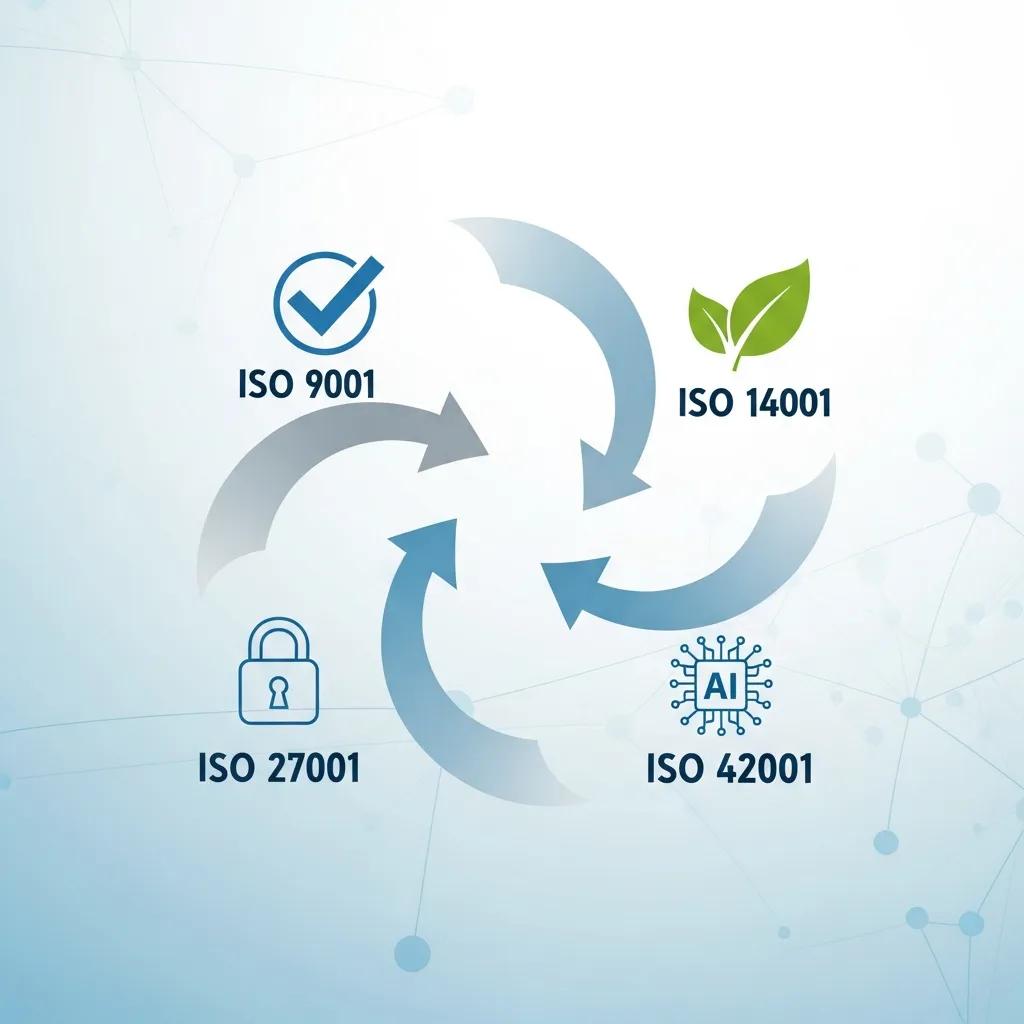
A practical IMS commonly combines ISO 9001, ISO 14001, ISO 27001 and emerging standards such as ISO 42001 for AI management into one governance layer that aligns objectives, controls and audit evidence. Each standard brings targeted controls — quality for consistent outcomes, environmental for regulatory and reputational risk, information security for data protection, and AI management for responsible AI use — and an IMS harmonizes overlaps so organizations avoid duplicated controls and streamline reporting. Below is a short mapping that makes those relationships easy to scan and reuse.
The following mapping shows each ISO standard and the primary advantage it contributes to an IMS:
- ISO 9001 → Process and product consistency, improving customer outcomes and reducing defects.
- ISO 14001 → Environmental risk control, lowering regulatory exposure and resource waste.
- ISO 27001 → Data protection and trust, safeguarding information assets and building third‑party confidence.
- ISO 42001 → AI governance and ethics, ensuring responsible AI deployment and aligning with future regulation.
Integrating these standards lets teams reuse shared processes and controls; the next section summarizes how 9001, 14001 and 27001 interlock inside an IMS.
What Roles Do ISO 9001, ISO 14001, and ISO 27001 Play in an IMS?
ISO 9001 provides the quality management backbone — standardizing processes and measurement that an IMS uses for operational controls and continuous improvement. ISO 14001 folds environmental aspects into those same process flows so risk assessments and objectives reflect environmental impact alongside quality metrics. ISO 27001 adds information security controls that protect data used across quality and environmental processes, creating shared responsibility and common evidence. By aligning objectives and control ownership, an IMS reduces conflicting procedures and makes audit evidence collection smoother.
How Does ISO 42001 Integration Future-Proof AI Management Systems?
ISO 42001 sets governance and ethical guardrails for AI — controls for transparency, risk assessment and human oversight that regulators and stakeholders increasingly expect. Integrating ISO 42001 into an IMS prevents AI governance from becoming a separate silo by aligning AI controls with existing risk and security processes, reducing duplicate reviews and clarifying accountability. That alignment helps organizations respond faster to evolving AI rules and clearly demonstrate responsible AI practices during audits, strengthening stakeholder trust and complementing other ISO standards in a single governance model.
How Does an Integrated Management System Improve Risk Management and Compliance?
An IMS sharpens risk management by centralizing risk identification in a unified register and mapping cross‑standard controls to single mitigation actions. That approach avoids fragmented ownership and duplicated controls. Centralized evidence and consolidated reporting simplify regulator interactions because auditors can review aligned documentation instead of multiple systems. A unified model shortens incident response times and improves scenario planning since risks are assessed against the same appetite and thresholds across the organization. The sections below describe unified risk mitigation and how an IMS eases cross‑standard compliance.
What Are the IMS Benefits for Unified Risk Mitigation?
An IMS creates a single source of truth for risk by combining risk registers, control libraries and process ownership across quality, environmental, security and AI governance domains. Cross‑functional controls — supplier assurance, access control and change management — are mapped once and applied consistently, reducing gaps that occur when functions manage related risks separately. Scenario planning improves because impact and likelihood use the same criteria, allowing clearer mitigation prioritization. These outcomes reduce regulatory noncompliance risk and give leaders consolidated dashboards for better strategic planning.
Research supports the idea that integrated management systems deliver a more coherent approach to business risk.
Integrated Management Systems for Coherent Risk Management
Studies show that integrating management systems produces a more coherent, consistent and harmonized approach to managing business risk.
The integration of standardized management systems: managing business risk, R Silva, 2017
How Does IMS Simplify Regulatory Compliance Across Standards?
An IMS simplifies compliance by consolidating evidence and aligning reporting so the same artifacts satisfy multiple regulatory or accreditation needs, reducing duplicate submissions. Standardized processes and a single document control mechanism make audits more predictable for internal teams and external assessors, shortening prep cycles and minimizing disruption. Consolidated compliance also makes multi‑jurisdiction coordination easier by keeping consistent controls and traceable records stakeholders can reuse. Those efficiencies lead to faster regulator responses and clearer compliance decisions across business units.
What Are the Financial and Strategic Advantages of Implementing an IMS?
An IMS delivers financial upside through direct cost reductions — fewer audit days, less internal prep and lower administrative overhead — and strategic benefits such as faster decision‑making and stronger external credibility. Cost savings come from avoiding duplicated controls and from process improvements surfaced by unified metrics, while strategic gains include quicker leadership response enabled by consistent KPIs and improved market positioning from consolidated certification. After outlining ROI drivers below, we offer a short practical note on pursuing certification and certificate management with accredited partners that combine AI tools and experienced auditors to realize these gains.
The following numbered list highlights ROI drivers you can expect after implementing an IMS:
- Fewer audit hours: Reduced external and internal audit time lowers professional fees and staff distraction.
- Lower administrative costs: One document control system and unified workflows cut routine overhead.
- Reduced corrective actions: Clearer controls lead to fewer repeat nonconformances and lower remediation spend.
- Faster decisions: Aligned KPIs shorten time to act on operational issues and prevent revenue leakage.
These drivers show both direct savings and strategic uplift; the table below summarizes investment areas, cost impact and strategic benefits.
| Investment area | Cost impact | Strategic benefit |
|---|---|---|
| Audit consolidation | Lower audit fees and travel | Faster compliance cycles |
| Document control tools | Reduced admin and versioning errors | Consistent evidence and faster onboarding |
| Risk and KPI dashboards | Lower incident response costs | Improved executive decision speed |
| AI audit tooling (hybrid) | Reduced auditor hours | Focused high-value audit work |
This ROI snapshot ties investment choices to bottom‑line and strategic outcomes, showing why an IMS is a business‑enabling investment. Organizations that want to quantify projected savings and pursue accredited certification can work with providers that blend AI‑driven audit tools and experienced auditors for fast, rigorous assessments and streamlined certificate management. Stratlane Certification, for example, operates as an accredited certification body using AI tooling alongside professional auditors to support integrated certification and certificate management across multiple standards.
How Does IMS Drive Cost Savings and Return on Investment?
IMS savings come from eliminating duplicate audits and harmonizing controls so the same evidence supports multiple standards — reducing external audit fees and internal prep time. Additional savings come from fewer corrective actions and less rework, since root‑cause analysis targets systemic problems rather than isolated symptoms. A simple ROI check compares annual audit and compliance spend before and after integration, accounting for one‑time implementation costs to estimate payback; many organizations see payback within a few audit cycles. Providers that offer AI‑enabled audit workflows and certificate management can accelerate payback by shortening audit windows and lowering ongoing admin costs.
In What Ways Does IMS Enhance Decision-Making and Stakeholder Confidence?
An IMS improves decision‑making by delivering unified KPIs and dashboards that combine quality, environmental, security and AI‑governance metrics into actionable insights executives can trust. With consistent cross‑standard metrics, choices about suppliers, capital allocation and compliance priorities happen faster and with less debate. Externally, consolidated certification signals reliability to partners, customers and research partners, strengthening credibility and easing collaboration. Those effects build long‑term stakeholder confidence and a more resilient governance posture that supports growth and regulatory readiness.
Frequently Asked Questions
What types of organizations can benefit from implementing an Integrated Management System?
Organizations of all sizes and sectors can benefit from an IMS — manufacturing, healthcare, finance, services and more. Any business that wants to streamline operations, improve compliance and manage risk more consistently will find value. An IMS reduces redundancy, raises efficiency and supports a culture of continuous improvement, making it adaptable to many operational contexts.
How long does it typically take to implement an Integrated Management System?
Implementation timelines vary based on size, complexity and how mature your existing systems are. Expect anywhere from a few months to a year or more for full integration. Key factors include required training, process re‑engineering and how much of your current documentation can be reused. A phased plan with clear milestones shortens time to value and helps ensure smooth adoption.
What challenges might organizations face when transitioning to an IMS?
Common challenges include resistance to change, the complexity of aligning multiple standards, and the need for thorough training. Aligning legacy processes can demand time and resources. To overcome these hurdles, involve stakeholders early, run targeted training, and communicate clear benefits so teams understand how the IMS will make day‑to‑day work simpler and more predictable.
How does an IMS support continuous improvement within an organization?
An IMS supports continuous improvement by providing a structured way to monitor performance across quality, environmental and security domains. Unified metrics and KPIs make it easier to spot improvement opportunities and guide corrective actions. Built‑in feedback loops and regular, integrated audits keep processes under review so the system evolves with the organization.
Can an IMS be customized to fit specific industry needs?
Absolutely. While an IMS rests on common principles, it can be tailored to industry‑specific regulations, operational realities and stakeholder expectations. Customization might include adding sector standards, adjusting processes or designing focused training so the IMS supports your unique goals and compliance needs.
What role does employee training play in the success of an IMS?
Employee training is essential. Clear, role‑based training ensures staff understand new processes, their responsibilities and why compliance matters. Well‑designed training boosts adoption, helps teams spot improvement opportunities and maintains momentum as the IMS matures. Ongoing refresher training keeps skills up to date as the organization and standards evolve.
Conclusion
An Integrated Management System delivers tangible benefits: streamlined processes, a lower audit burden and improved operational efficiency. By aligning multiple standards under one governance model, organizations strengthen compliance and foster continuous improvement. If you’re ready to explore how an IMS could transform your operations, consider partnering with accredited certification providers like Stratlane Certification to guide implementation, certification and ongoing certificate management. Start the journey toward a simpler, more reliable management framework today.