
ISO 27001:2022 Explained - ISMS Principles & Data Protection

ISO 27001:2022 — A practical guide to the standard and certification
ISO 27001:2022 defines the requirements for an Information Security Management System (ISMS). Updated in 2022, the standard reflects modern threats, cloud-first architectures, and hybrid working. This guide breaks down the standard’s structure, highlights what changed since 2013, and explains ISMS fundamentals like the CIA triad and the risk-based approach. You’ll find practical steps to implement controls, update your Statement of Applicability (SoA), and prepare for certification — including how AI-assisted auditing can speed evidence collection while keeping human auditors in control. We also map realistic timelines and transition options so organizations can plan remediation, audits, and certification before the October 2025 deadline.
What changed in ISO 27001:2022 versus the 2013 edition?
The 2022 revision modernizes Annex A by consolidating overlapping controls and grouping them around organizational, people, physical, and technical themes. The number of controls was reduced from 114 to 93, and new topics — such as cloud security, threat intelligence, and remote work — were added. The update reinforces a risk-based lifecycle: controls should be selected and maintained according to business context and measurable outcomes. As a result, organizations must revisit their SoA and control mappings to reflect new control identifiers and any newly applicable requirements.
Key differences at a glance:
- Controls consolidated from 114 to 93 to remove redundancy and improve clarity.
- Controls reorganized into thematic groups that reflect function and risk domains.
- New or updated control topics: cloud security, supply chain risk, and threat intelligence.
These changes make it important to review how Annex A maps to your existing controls and SoA.
How did Annex A controls change in 2022?
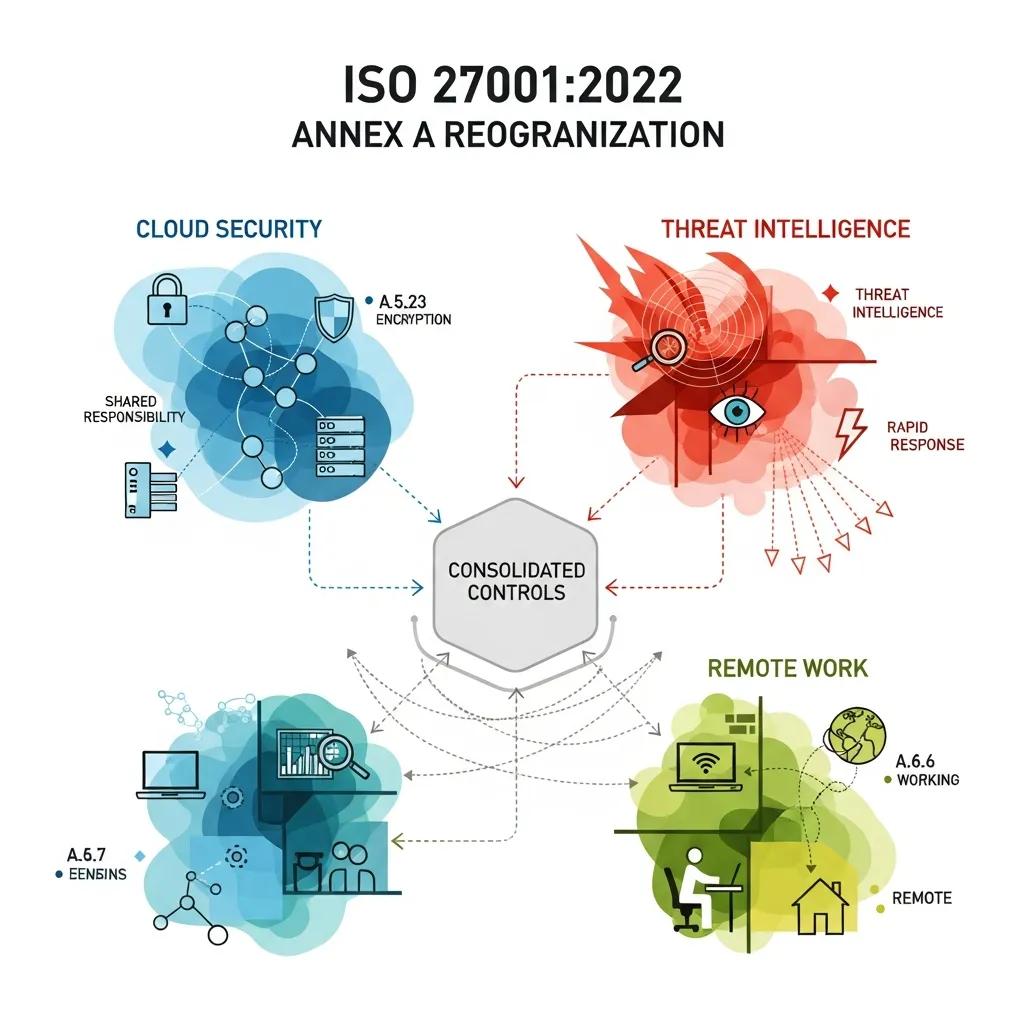
Annex A now groups related requirements, merges similar controls, and removes legacy overlaps that previously caused duplication. The revision introduces controls tailored to digital operations — for example, clearer guidance on cloud service security, integration of threat intelligence, and measures supporting remote collaboration. Organizations should run a control-mapping exercise to translate old control IDs to the 2022 structure and to identify any additional controls that should appear on the updated SoA.
Independent analyses show Annex A’s consolidation to 93 controls requires careful remapping so organizations can confirm compliance with the updated requirements.
ISO 27001:2022 — Annex A control updates
The key change in Annex A for ISO/IEC 27001:2022 is the reduction to 93 controls, including several newly articulated items. A mapped view helps organizations pinpoint implemented controls and those still needing action to meet the new standard’s expectations.
Information security management: a fuzzy DEMATEL analysis of the new ISO/IEC 27001: 2022 controls, LG Zanon, 2022
To make the comparison actionable, the table below pairs representative control topics with the type of change and the practical 2013→2022 mapping.
Annex A mapping highlights:
| Clause / Control Topic | Change Type | 2013 → 2022 Mapping |
|---|---|---|
| Access control and identity | Reorganized | Access-related items consolidated into clearer identity and authorization controls |
| Asset management | Renamed/merged | Asset management joined with classification and handling practices |
| Cryptography | Clarified | Guidance refreshed for cloud environments and modern key management |
| Remote work and communications | New/expanded | Explicit controls added for remote access and collaboration tools |
| Threat intelligence | New | Introduced to support proactive detection and monitoring |
Why does the October 2025 transition deadline matter?
The October 2025 transition deadline (September 30, 2025) is the final date for organizations to migrate certificates issued against ISO 27001:2013 to the 2022 standard. Missing this deadline risks certificate invalidation and can affect supply-chain status or procurement eligibility. To avoid gaps, plan a gap analysis, update your SoA and risk treatment plan, and schedule audits well ahead of the cutoff. Engaging auditors early and prioritizing high‑risk control gaps helps ensure a smooth transition.
Short action checklist before the deadline:
- Run a control mapping gap analysis between 2013 and 2022.
- Update the Statement of Applicability and the risk treatment plan.
- Schedule internal and certification audits with time for remediation.
Following this sequence reduces last-minute remediation and ensures audit-ready evidence before the deadline.
What is the ISMS framework in ISO 27001:2022?
An Information Security Management System (ISMS) under ISO 27001:2022 is a structured set of policies, processes, procedures, and resources that manage information security risks and protect assets across confidentiality, integrity, and availability. The ISMS is built around clauses 4–10, covering context, leadership, planning, support, operation, performance evaluation, and improvement. Risk-based thinking and the Plan-Do-Check-Act cycle remain core: planning and evaluation feed continual improvement so the ISMS stays aligned with evolving threats and business goals. The framework ties together asset inventories, risk assessments, the SoA, and monitoring to create auditable evidence of control effectiveness.
Put simply: ISO 27001:2022’s risk-based ISMS remains the baseline practice for organizations looking to manage cybersecurity and legal risks in a structured way.
Risk-based ISMS: ISO 27001:2022
ISO 27001:2022 emphasizes a risk-based approach that helps organizations establish scalable, auditable cybersecurity practices. This alignment strengthens information security while helping address legal and regulatory exposure (see Clause 6.1). The standard pairs well with companion guidance like ISO 27002 and ISO 27005.
INTEGRATION OF ISO 27001: 2022
WITH OTHER INFORMATION SECURITY STANDARDS, O Starkova, 2022
Core ISMS components include defining scope and context, securing leadership buy‑in, documenting policies, allocating resources, operating controls, monitoring performance, and running continual improvement cycles. Each element should map back to management responsibilities and audit evidence that demonstrate how security objectives are met.
What are the ISMS core principles (the CIA triad)?
The ISMS centers on the CIA triad: Confidentiality — information is only accessible to authorized users; Integrity — information is accurate and protected from unauthorized change; Availability — systems and data are available when needed. Typical controls that support these principles include access management and encryption for confidentiality, change control and integrity monitoring for integrity, and backups, redundancy, and incident response for availability. These principles guide control selection during a risk assessment and are documented in the SoA with justification tied to business impact.
Examples: encrypting data-in-transit supports confidentiality, file integrity monitoring supports integrity, and tested recovery procedures support availability. Mapping these controls back to business objectives makes risk‑based prioritization straightforward.
How does a risk-based approach improve security?
ISO 27001:2022’s risk-based approach asks organizations to identify assets, threats, and vulnerabilities, assess likelihood and impact, and select controls that reduce risk to acceptable levels while documenting residual risk and treatment. This ensures resources target the highest business risks instead of applying generic controls everywhere, improving both security and cost efficiency. A common risk assessment workflow includes asset inventory, threat and vulnerability identification, risk scoring, control selection, treatment planning, and continuous monitoring of residual risk.
Practical steps:
- Identify assets, owners, and classify information sensitivity.
- List threats and vulnerabilities, then score likelihood and impact.
- Select controls, record them in the SoA, and monitor their effectiveness.
This cycle aligns controls to measurable business outcomes and supports targeted remediation.
What benefits does ISO 27001:2022 certification deliver?

ISO 27001:2022 certification brings concrete technical and business benefits: stronger data protection, clearer regulatory alignment (for example, GDPR), higher trust with customers and partners, and lower incident costs through mature risk treatment and response. Certification demonstrates a managed, auditable ISMS — which can unlock procurement opportunities, improve insurance discussions, and simplify regulatory audits with documented artifacts like the SoA and risk treatment plans. Together, these outcomes strengthen digital trust and reduce the likelihood and impact of security events.
A well-implemented ISMS mapped to the 93 controls in ISO 27001:2022 is a practical way to measure and improve an organization’s security posture.
ISO 27001:2022 — Compliance frameworks and benefits
This research outlines a controls-based framework for achieving ISO 27001:2022 compliance and improving information security practices. The framework catalogs the 93 controls and supports gap analysis to help organizations evaluate adherence and plan remediation.
Enhancing Information Security Management System using ISO controls-based framework, 2022
Benefits mapped to outcomes:
| Benefit | Impact Area | Business Outcome |
|---|---|---|
| Data protection and compliance | Regulatory alignment | Smoother GDPR and privacy audits |
| Market trust and procurement | Client assurance | Easier inclusion in RFPs and vendor lists |
| Incident reduction | Operational resilience | Lower recovery costs and reduced downtime |
| Insurance negotiations | Risk visibility | Potentially better cyber insurance terms |
When you’re ready to act, Stratlane Certification pairs AI-driven audit tooling with accredited certification services and experienced auditors to manage issuance and ongoing certificate handling. We combine automated evidence organization with professional validation to streamline readiness and post-certification maintenance. Contact Stratlane Certification for a demo or a tailored quote to discuss certificate management and audit options.
How does certification strengthen data protection and compliance?
Certification formalizes processes — access control, encryption, logging, and incident response — and produces the documented evidence regulators expect. ISO 27001 controls align well with legal obligations like data minimization, purpose limitation, and breach notification under GDPR. Auditable artifacts such as the SoA, risk treatment plans, and incident records create a transparent trail for regulators and clients, reducing time spent during compliance checks and enforcement reviews.
For example, strong authentication and access controls support data minimization and integrity obligations, while logging and monitoring make timely breach detection and notification more reliable. Demonstrating continual improvement shows regulators you manage compliance proactively.
What competitive advantages and risk reductions come with ISO 27001:2022?
Certification gives third‑party validation that an organization manages information security risks — a decisive factor in RFPs and vendor assessments. It reduces operational risk by enabling structured incident response, which lowers recovery costs and business disruption. In many sectors, certified status helps secure partnerships with larger enterprises and can improve negotiating positions with insurers.
Typical business outcomes include faster contract close times, reduced recovery windows after incidents, and clearer risk communication to stakeholders. That’s why many organizations treat ISO 27001 as both a risk-management tool and a market differentiator.
How does Stratlane’s AI-driven auditing streamline certification?
Stratlane Certification’s AI-driven approach automates routine audit tasks like evidence discovery and organization, generates compliance matrices from documentation, and supports continuous monitoring while keeping auditors in the loop for interpretation and judgment. By combining automation with experienced auditors, we cut hours spent on evidence compilation, increase consistency across audits, and speed SoA updates. AI prioritizes anomalies, maps controls to evidence, and produces structured audit outputs that auditors validate — shortening audit cycles while preserving the professional assurance required for accredited certification.
Main AI benefits:
- Automated evidence collection to speed audit readiness.
- Compliance matrix generation to simplify SoA updates.
- Continuous monitoring to surface drift and support remediation.
These capabilities reduce manual auditing load and support ongoing compliance between formal audits.
| AI Function | Audit Task Automated | Efficiency / Accuracy Improvement |
|---|---|---|
| NLP document extraction | Extracts evidence from policies and logs | Faster indexing and less manual review time |
| Automated control mapping | Generates compliance matrices for the SoA | More consistent mappings and fewer missed controls |
| Anomaly detection | Flags unusual activity in logs and metrics | Earlier detection and higher precision for auditor review |
Which AI technologies improve audit accuracy and speed?
We use natural language processing (NLP) to extract and classify control-relevant text from policies, procedures, and logs; machine learning to detect anomalous patterns in telemetry; and automation to assemble compliance matrices and draft audit outputs. NLP speeds identification of relevant evidence, ML surfaces deviations that merit human review, and automation standardizes outputs auditors use to verify conformance. The result is a repeatable, auditable workflow where AI handles repetitive work and auditors focus on judgment and stakeholder engagement.
This approach enables more frequent, lightweight compliance checks between formal audits and supports continuous compliance at lower operating cost.
How does AI lower costs and support continuous compliance?
AI reduces audit effort by cutting hours spent on document review, evidence sorting, and initial mapping — freeing auditors for substantive verification and advisory work. Continuous monitoring uses automated feeds, anomaly alerts, and dashboards to surface compliance drift early, shortening detection-to-remediation cycles and lowering total cost of ownership for ISMS upkeep.
Common cost-saving mechanisms include automated evidence indexing, fewer SoA rework cycles, and reduced billable auditor hours for evidence collection. Regular compliance health indicators also help organizations stay audit-ready and avoid major corrective actions during certification audits.
What are the essential steps to implement and certify to ISO 27001:2022?
Certification follows a clear roadmap: scope and gap analysis, risk assessment, control implementation, internal audit, management review, and certification audits. A recommended six-step timeline helps teams plan resources and align remediation with audit schedules. The certification process produces documented outputs — the SoA, risk treatment plan, internal audit reports, and corrective action records — which auditors review during Stage 1 (readiness) and Stage 2 (evidence validation). Sequencing these steps correctly reduces rework and ensures complete audit evidence.
Typical stepwise process and timing:
- Define scope and run an initial gap analysis (2–4 weeks).
- Perform risk assessment and prepare the Statement of Applicability (2–6 weeks).
- Implement prioritized controls and remediate gaps (1–6 months, by scope).
- Conduct internal audits and management review to confirm readiness (2–4 weeks).
- Engage a certification body for Stage 1 readiness review (1–2 weeks).
- Complete Stage 2 certification audit and close any corrective actions (2–6 weeks).
Depending on maturity and scope, certification commonly takes 3–12 months. The timeline below helps you prepare for risk assessments and audit readiness.
How should you prepare for risk assessment and control rollout?
Begin by compiling an asset register, defining risk criteria (likelihood and impact), identifying threats and vulnerabilities, and involving stakeholders who can validate assumptions. Set scoring thresholds and acceptance criteria so evaluations are consistent and treatment decisions are transparent. Use practical templates — asset registers, risk matrices, and control selection checklists — to speed assessments and prioritize work. Engaging cross-functional owners reduces blind spots and ensures controls are implementable in day-to-day operations.
Checklist essentials: asset classification, threat catalog, scoring methodology, stakeholder assignments, and templates for the SoA and treatment plans. With these in place, remediation is focused and internal audits can produce solid evidence.
What does the typical certification timeline and audit preparation look like?
Certification usually takes three to twelve months, depending on scope and readiness. Stage 1 covers documentation and readiness: auditors review ISMS scope, policies, and the SoA. Stage 2 validates implementation and operational effectiveness through evidence sampling and interviews. Prepare an evidence checklist that includes policies, procedures, logs, monitoring outputs, training records, and corrective action evidence so auditors can verify controls efficiently.
Pre-audit checklist essentials:
- Current SoA and risk treatment records.
- Documented procedures and proof of implementation.
- Internal audit reports and management review minutes.
- Incident records and corrective action tracking.
Thorough preparation reduces certification risk and increases predictability of audit outcomes.
How do organizations transition smoothly from ISO 27001:2013 to 2022?
Start with a focused gap analysis to identify changed, merged, or new controls and assess their impact on the SoA and risk treatment plans. Use control-remapping templates and prioritize remediation of high-risk gaps so you can maintain certification continuity. Engage certification partners early to align surveillance or recertification audits with the September 2025 deadline. Phased remediation and automation tools help contain resource strain while preserving evidence quality and audit readiness.
Effective transition steps: scope the mapping effort, prioritize high-impact controls, schedule internal testing of remapped controls, and book certification audits well in advance of the deadline. These actions lower the risk of certificate lapses and keep your organization ready for the updated standard.
What challenges arise during transition — and how to solve them?
Typical challenges include complex mapping from legacy controls to the new structure, limited internal resources for remediation, and tight timelines driven by the September 2025 deadline. Practical solutions are to adopt control-mapping templates and tooling, run phased remediation that targets high-risk items first, and engage external experts for tasks like evidence collection or internal audit facilitation. Standardized templates and automation reduce errors and speed SoA updates, while phased approaches align work to budget and staffing constraints.
Mitigation examples: prioritize controls tied to regulatory obligations, and use interim compensating controls to maintain protection while permanent solutions are implemented. These pragmatic steps keep the transition manageable and focused on business-critical risk.
How does Stratlane help clients meet the 2025 compliance deadline?
Stratlane Certification offers AI-enabled gap analysis, prioritized remediation roadmaps, and expedited audit scheduling to help organizations meet the September 30, 2025 compliance deadline. Our tools speed evidence mapping and control identification so clients receive an actionable remediation plan immediately, while our auditors provide validation and advisory services to close gaps. Beyond audit delivery, we offer certificate management across multiple countries to support issuance and ongoing maintenance after certification.
Contact Stratlane Certification to request an AI audit demo or a tailored quote that outlines timelines, remediation estimates, and audit scheduling options to help you meet the deadline.
Frequently Asked Questions
What is the role of the Statement of Applicability (SoA) in ISO 27001:2022?
The SoA lists which Annex A controls apply to your ISMS and explains why each control is included or excluded. It connects the risk assessment to control implementation and serves as a central audit artifact. Keep the SoA current — it should reflect changes in risk, new controls, and evidence of control effectiveness.
How can organizations ensure continuous compliance after certification?
Continuous compliance depends on a robust monitoring and review cycle: regular internal audits, management reviews, ongoing risk assessments, and automated evidence collection where possible. Use continuous monitoring and dashboards to spot drift early, and invest in staff training and security awareness so controls stay effective between formal audits.
What common pitfalls occur during ISO 27001:2022 implementation?
Common pitfalls include unclear scope, weak stakeholder engagement, and controls that aren’t aligned with business objectives. Remapping controls from 2013 to 2022 can also be tricky. Avoid these issues by planning thoroughly, involving cross-functional teams, and using templates and tools to keep documentation consistent.
How does ISO 27001:2022 align with other cybersecurity frameworks?
ISO 27001:2022 shares principles with frameworks like the NIST Cybersecurity Framework and CIS Controls — particularly around risk management and asset protection. Many controls can be mapped across frameworks, letting organizations leverage existing investments and simplify multi-framework audits.
What resources are available for organizations transitioning to ISO 27001:2022?
Resources include official ISO publications, online training, guidance from certification bodies, and consulting services offering gap analysis, mapping templates, and implementation roadmaps. Professional communities and forums also provide practical tips from peers who’ve completed the transition.
Why is risk assessment important in ISO 27001:2022?
Risk assessment is the foundation of the standard: it identifies what’s important, scores potential impacts, and drives which controls you implement. A well-documented risk assessment supports the SoA and underpins continuous monitoring and improvement of the ISMS.
ISO 27001:2022 Implementation and Certification Roadmap
ISO 27001:2022 provides a practical, risk-based framework for protecting information, meeting regulatory expectations, and building stakeholder trust. Updating controls and aligning the ISMS to business outcomes lets organizations reduce risk and improve resilience. Partnering with an experienced certification provider like Stratlane can smooth your transition and help you realize the full value of certification. When you’re ready, explore our tailored certification and audit solutions to begin your compliance journey.