
ISO 45001:2018 and Your Guide to Workplace Safety Compliance

ISO 45001:2018 — The Practical Guide to Occupational Health & Safety, AI‑Assisted Audits, and Ongoing Compliance
ISO 45001:2018 sets the international benchmark for occupational health and safety management systems (OHSMS). It helps organizations systematically prevent workplace injuries and illness while improving safety performance. This guide walks you through what the standard requires, how its system elements reduce risk, and why certification creates real value for employees, regulators, and customers. You’ll find clear explanations of the core clauses, practical implementation steps, how AI changes audit evidence and monitoring, and a straight‑forward route to certification and measurable safety gains. Many organizations struggle with fragmented safety practices and reactive compliance; ISO 45001 replaces that with a risk‑based, leadership‑led framework that embeds prevention, worker participation, and continual improvement. Topics covered include system structure, key requirements, AI‑enhanced audits, certification steps with a partner, sector guidance, OHSAS 18001 comparison, and post‑certification practices for sustained performance.
What is ISO 45001:2018 and Why is it Essential for Workplace Safety?
ISO 45001:2018 is a management system standard that defines how to establish, implement, maintain and continually improve an occupational health and safety management system. It asks organizations to understand their context and stakeholders, identify hazards and risks, set controls, and involve workers so prevention is planned—not accidental. The outcome is fewer incidents, stronger legal compliance, and greater resilience because hazards are managed proactively. Below are three key benefits to keep in mind before we unpack the system elements that deliver those results.
ISO 45001 delivers three primary advantages for workplace safety:
- Risk reduction and prevention: Systematic hazard identification and controls reduce the number and severity of incidents.
- Legal and contractual assurance: A demonstrable OHSMS supports compliance with regulators and client requirements.
- Worker engagement and wellbeing: Structured consultation and participation strengthen safety culture and morale.
These benefits clarify how the OHSMS elements—policy, planning, support, operation, evaluation, and improvement—work together to protect people and the business.
What defines the ISO 45001 Occupational Health and Safety Management System?
An ISO 45001 OHSMS is a set of linked elements: leadership and policy, context analysis, hazard identification and risk assessment, operational controls, competence and communication (support), performance evaluation, and continual improvement. It starts with top management setting a safety policy and providing resources, then moves to planning where risks and legal obligations are identified and prioritized. Support functions make sure people have the right training and information, while operational controls turn plans into safe daily work practices and emergency readiness. The system follows a Plan‑Do‑Check‑Act cycle so monitoring and internal audits feed improvements and keep the system responsive to new hazards.
How does ISO 45001 improve workplace safety and reduce risks?
ISO 45001 reduces risk through structured hazard identification, preventive controls, and measurement of outcomes. Organizations use risk‑based thinking to prioritize controls, adopt safer processes, and track both leading indicators (near‑misses, observations) and lagging indicators (injuries, lost time). Visible leadership commitment secures resources, and worker participation brings practical insights into hazards and effective controls. For example, when risk scoring prioritizes interventions, high‑risk activities are mitigated sooner—shortening the time from hazard recognition to risk reduction. In short, ISO 45001 shifts the organization from reacting to preventing.
Research supports that proactive OHS management also delivers measurable operational and financial benefits.
ISO 45001:2018 Benefits — Productivity & Cost Reduction
Evidence shows ISO 45001 implementation can improve productivity and lower costs related to stoppages and production losses, alongside safety gains.
Mapping occupational health and safety management systems in Portugal: outlook for ISO 45001: 2018 adoption, FJG Silva, 2018
What are the Key Requirements and Benefits of ISO 45001 Certification?
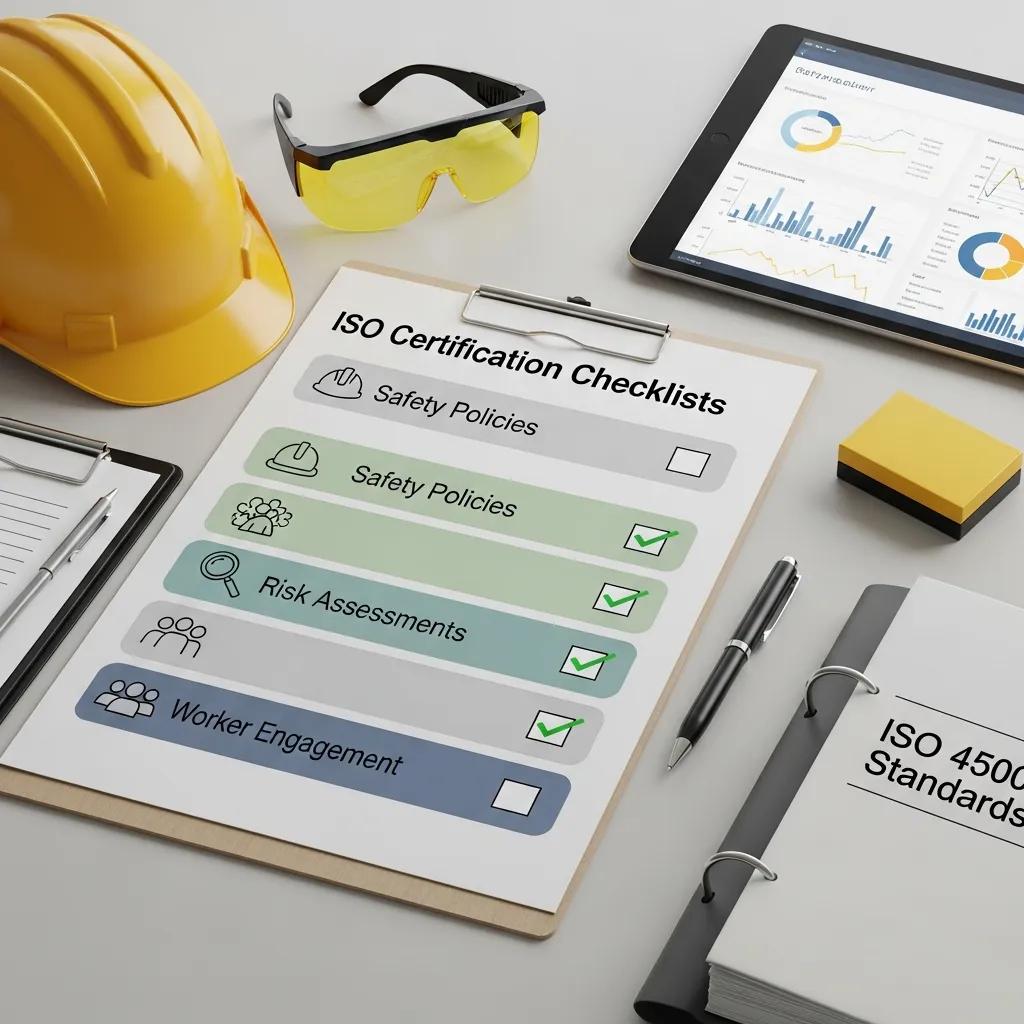
ISO 45001 groups requirements across clauses covering context, leadership, planning, support, operation, performance evaluation, and improvement. Certification means an accredited third party has audited your OHSMS and confirmed it meets the standard—providing independent assurance to customers, regulators, and insurers. The table below links core clauses to practical business outcomes so implementation teams can see where to focus effort for legal compliance, risk reduction, and employee wellbeing.
| Clause / Area | Requirement / Attribute | Practical Impact / Value |
|---|---|---|
| Context & Interested Parties | Identify internal/external issues and stakeholders | Aligns OHS priorities with business drivers and regulatory obligations |
| Leadership & Policy | Top management commitment and safety policy | Ensures resources and accountability for safety outcomes |
| Planning | Hazard identification, risk assessment, objectives | Prioritizes controls and allocates budget to highest risks |
| Support | Competence, communication, documented information | Reduces errors and ensures consistent execution of controls |
| Operation | Operational controls, emergency preparedness | Prevents incidents through standardized safe work practices |
| Performance Evaluation | Monitoring, audits, incident investigation | Enables data‑driven decisions and demonstrates continual improvement |
| Improvement | Corrective actions, preventive measures | Reduces recurrence and drives ongoing OHS performance gains |
That mapping shows how each clause leads to measurable benefits: clearer legal responsibility, fewer incidents, less downtime, and better staff morale. Next we break down the core requirements and the typical records auditors expect to see.
What are the core requirements of ISO 45001:2018?
At a practical level organizations are asked to:
- determine context and interested parties
- secure leadership commitment and define an OHS policy
- plan by identifying hazards and legal obligations
- provide resources, competence and communication
- implement operational controls and emergency preparedness
- monitor and evaluate performance
- pursue continual improvement
In practice this means documenting scope and policy, keeping a risk register and control plans, maintaining training records, procedure manuals, and an audit schedule. Auditors will also look for evidence of management review and corrective action cycles to confirm the system is active and improving. These records form the basis for verifying conformity and effectiveness.
How does ISO 45001 certification benefit businesses and employees?
Certification offers measurable and qualitative returns across financial, operational, reputational, and people‑centric areas. Financially, fewer incidents lower direct costs (compensation, repairs) and indirect costs (downtime, lost productivity). Operationally, clearer procedures and responsibilities reduce variability and improve reliability. For employees, a certified OHSMS improves wellbeing through systematic risk control, clearer participation channels, and targeted training—boosting morale and retention.
Further studies highlight how ISO 45001 adoption can positively influence overall business performance and employee welfare.
ISO 45001 Implementation — Business Performance & Employee Benefits
Analysis shows integrated management systems that include ISO 45001 can improve company performance, increase employee awareness, enhance reputation, and open access to new customers and markets.
The effect of implementation integrated management system ISO 9001, ISO 14001, ISO 22000 and ISO 45001 on
Indonesian food industries performance, P Agus, 2020
How Does Stratlane’s AI-Driven Audit Enhance ISO 45001 Certification?

AI‑assisted auditing speeds evidence collection, improves risk scoring, and delivers prioritized, actionable insights so auditors focus where it matters most. By analyzing operational records, documents, and incident patterns, AI helps discover anomalies and trends faster than manual review—boosting both speed and accuracy. Stratlane Certification, an accredited body operating in the US, EU, and UK, combines AI tools with traditional auditing to increase efficiency while preserving rigorous conformity assessment. The table below maps common AI capabilities to concrete audit benefits so you can see how technology translates into time and cost savings.
| AI Capability | Attribute (What it does) | Benefit (Time / Cost / Accuracy) |
|---|---|---|
| Automated Data Ingestion | Collects and normalizes documents and records | Reduces manual evidence preparation time and clerical errors |
| Predictive Analytics | Prioritizes high‑risk processes based on patterns | Focuses auditor attention on likely nonconformities, saving audit days |
| Anomaly Detection | Flags deviations in incident or KPI trends | Improves early detection and intervention accuracy |
| Continuous Monitoring | Streams relevant operational indicators | Lowers surveillance audit burden through real‑time oversight |
| Automated Reporting | Generates draft findings and dashboards | Shortens reporting cycles and clarifies corrective actions |
These capabilities reduce repetitive work, surface higher‑value findings, and let auditors spend more time on judgment‑based activities. Below we explain how AI specifically changes evidence collection and reporting workflows.
How does AI transform the ISO 45001 audit process?
AI automates routine evidence collection, indexes documents, and uses natural language processing to extract compliance‑relevant facts from policies, procedures, and incident reports. Automated risk scoring, driven by historical incidents and operational indicators, helps allocate auditor effort toward the highest‑risk activities for more focused audits. During on‑site or remote verification, AI dashboards highlight trends and outliers that auditors validate through interviews and observations—reducing time spent on manual cross‑checking. The combined AI‑and‑auditor approach increases sampling objectivity and produces earlier, richer insights for corrective action planning, speeding certification readiness.
What role does continuous AI monitoring play in maintaining compliance?
Continuous AI monitoring complements scheduled surveillance audits by continuously evaluating selected operational indicators, near‑miss reports, and compliance data and alerting when deviations occur. This shortens the feedback loop from detection to mitigation, enabling faster corrective actions and clearer trend analysis for management review. Compared with calendar‑only surveillance, continuous monitoring helps detect emerging risks and track remediation between formal audits. When alerts are triaged and resolved promptly, organizations face fewer surprises during surveillance and better demonstrate continual improvement.
What is the ISO 45001 Certification Process with Stratlane?
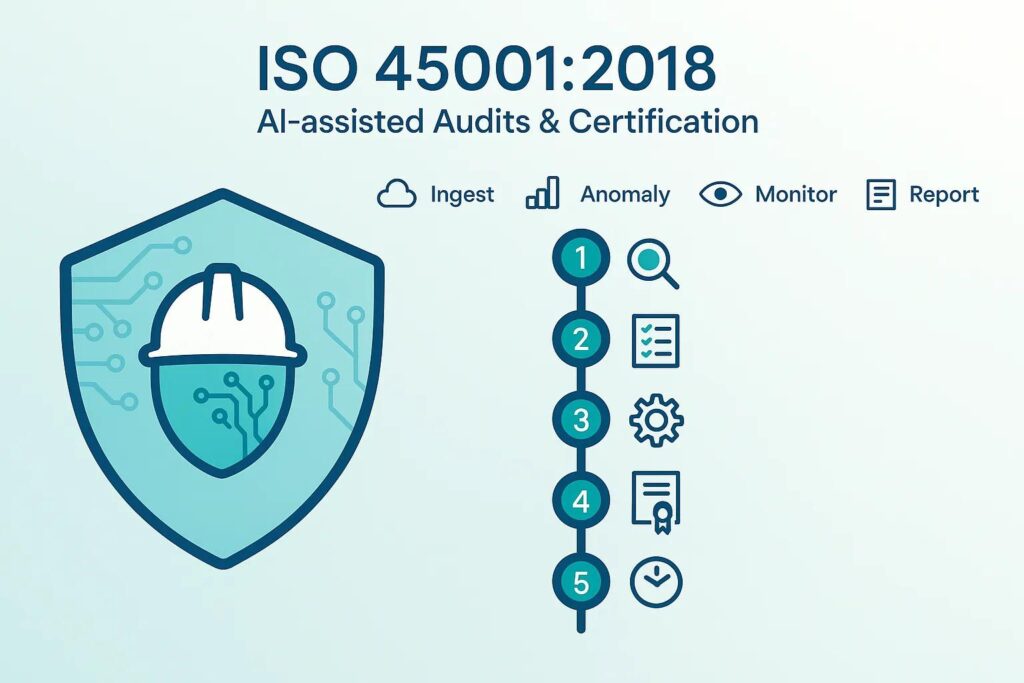
Certification with an accredited body follows a clear sequence from scoping to certificate issuance and ongoing surveillance—each step confirms your OHSMS is effective and sustained. Using Stratlane Certification as an example, the typical flow is: request a quote and provide scope details, complete audit planning and optional pre‑assessment, undergo Stage 1 documentation review and Stage 2 implementation verification, receive the certificate after a positive decision, and then follow surveillance and recertification cycles. The numbered list below summarizes these stages and the timelines you can expect while preparing for certification.
Follow these steps to achieve certification:
- Request a personalized quote: Share scope, number of sites, and workforce size so we can propose a tailored plan.
- Pre‑assessment / Audit planning: Remote or on‑site prep to identify gaps and schedule resources.
- Stage 1 — Documentation review: Auditors confirm required documented information and scope are in place.
- Stage 2 — Implementation & verification: On‑site or remote checks confirm controls are effective in practice.
- Certification decision and issuance: Accredited reviewers confirm conformity and the certificate is issued.
- Surveillance and recertification: Regular surveillance audits maintain validity and support continual improvement.
This sequence clarifies the path from initial inquiry to ongoing certificate management and helps set expectations for time and resources. The next section explains what to prepare when requesting a quote.
How to get a personalized quote and start your ISO 45001 certification?
To get an accurate quote, have these inputs ready: the intended OHSMS scope, number of sites and locations, approximate employee counts by site, and whether you accept remote auditing. Sharing key documents—safety policy, scope statement, and a high‑level org chart—speeds the pre‑assessment and improves quote accuracy. Accredited bodies typically respond within a few business days to two weeks depending on complexity; a clear scope shortens that timeline. For organizations in the US, EU, or UK seeking a balance of efficiency and rigor, Stratlane Certification offers AI‑assisted audits and can provide tailored proposals and demo sessions on request.
What are the stages of the ISO 45001 audit journey?
The audit journey includes several stages with distinct goals: pre‑assessment to check readiness, Stage 1 documentation review to confirm system design, Stage 2 verification to confirm implementation and effectiveness, and routine surveillance to ensure continued conformity. Pre‑assessment is often remote and focuses on gaps, Stage 1 reviews documented intent and scope, and Stage 2 uses sampling and on‑site checks to evaluate controls in operation. Surveillance audits commonly occur annually with full recertification every three years, while AI‑assisted monitoring can shift some assurance activities to continuous evidence streams. Knowing these stages helps you allocate internal resources—training, document updates, and corrective actions—so audits verify what actually happens on the ground rather than uncover surprises.
Who Should Pursue ISO 45001 Certification and How Does It Compare to OHSAS 18001?
ISO 45001 fits organizations of any size with measurable OHS risks that want systematic prevention across operations. It’s especially useful for manufacturing, construction, healthcare, and multi‑site operations where worker safety is critical to continuity and reputation. SMEs can adopt a scaled‑down OHSMS focused on core hazards to see major safety gains without unnecessary paperwork. The list below highlights sectors where ISO 45001 typically delivers fast returns.
Sectors that particularly benefit include:
- Manufacturing: Fewer machine‑related incidents and stronger maintenance controls.
- Construction: Better control of transient hazards and clearer subcontractor management.
- Healthcare: Improved infection control and safer patient‑handling practices.
- Multi‑site organizations: Harmonized practices across locations and supply chains.
These examples show where ISO 45001’s structured approach pays off quickly. Below we summarize how ISO 45001 differs from the older OHSAS 18001 and what to expect when transitioning.
Which organizations benefit most from ISO 45001 certification?
Organizations with meaningful operational hazards, regulatory exposure, or contractual requirements for third‑party assurance benefit most. Manufacturers cut downtime and liability through standardized safety controls, construction firms protect mobile workforces with consistent risk controls, and healthcare providers strengthen clinical and non‑clinical safety. SMEs that apply proportionate systems often see quick ROI through fewer incidents and improved insurer perception. Multi‑site and international organizations gain a common OHSMS vocabulary and audit approach that supports cross‑border operations and supplier alignment.
What are the differences between ISO 45001 and OHSAS 18001?
ISO 45001 replaces OHSAS 18001 and places stronger emphasis on leadership, context, and risk‑based thinking. It aligns with other ISO management standards through a common structure and increases the focus on worker participation. Key practical differences include explicit top management accountability, more detailed planning for risks and opportunities, and broader stakeholder identification. Transitioning typically requires updating scope and policy, strengthening leadership evidence, aligning risk assessments to business context, and ensuring documented information meets ISO 45001 expectations. Overall, ISO 45001 ties occupational health and safety into strategic business objectives rather than treating it as a standalone activity.
How to Maintain and Maximize ISO 45001 Certification Benefits?
Keeping the benefits after certification requires a deliberate program of surveillance, corrective‑action management, KPI tracking, and integration with other management systems where appropriate. Regular surveillance audits, internal audits, and management reviews sustain improvement. Integrating OHS objectives with quality and environmental systems (ISO 9001, ISO 14001) reduces duplication and increases efficiency. The list below suggests practical post‑certification activities and cadences to help capture long‑term value from certification.
Recommended post‑certification practices:
- Quarterly internal reviews and KPI dashboards: Track leading and lagging indicators and progress on corrective actions.
- Annual management review: Evaluate system performance, resource needs, and strategic alignment.
- Surveillance audits and corrective action closure: Address findings quickly and verify remediation.
- Integration projects: Combine OHS, quality, and environmental processes to streamline monitoring and reduce audit fatigue.
Following these practices makes continual improvement part of daily operations and turns surveillance audits into routine health checks rather than emergencies. The next section covers recommended KPIs, cadences, and how AI can reduce administrative effort.
What post-certification support and continuous improvement practices are recommended?
An effective post‑certification program mixes scheduled audits, KPI‑driven reviews, and a formal corrective action process with clear owners and deadlines. Useful KPIs include incident frequency rates, near‑miss reporting rates, corrective action closure times, training compliance, and internal audit results. Quarterly operational reviews and an annual management review provide governance rhythm, while monthly safety meetings keep frontline engagement active. AI‑enabled monitoring and automated reporting cut manual consolidation work and free safety teams to analyze trends and close actions faster.
How does ISO 45001 address psychosocial risks and worker participation?
ISO 45001 recognizes psychosocial hazards—workload, shift patterns, bullying, and mental health—as legitimate risks that must be considered in hazard identification and risk assessment. Worker consultation and participation are central: organizations must create channels for involvement in risk identification, control selection, and incident investigation. Practical actions include anonymous surveys, focus groups, manager mental‑health training, and documented action plans with measurable outcomes. Using guidance from related standards on psychosocial risk management helps operationalize these requirements and strengthen both physical and psychological safety.
- Psychosocial hazard identification: Include mental‑health indicators in risk assessments and incident investigations.
- Participation mechanisms: Maintain regular consultation and feedback loops to capture worker input on controls.
- Targeted interventions: Use training, workload reviews, and support programs driven by data and worker feedback.
These steps ensure psychosocial risks receive systematic attention and that worker participation becomes a constant source of improvement—not a one‑off exercise.
This guide has outlined ISO 45001:2018 from system fundamentals to AI‑enhanced auditing and long‑term sustainability. Organizations pursuing certification should align leadership, adopt risk‑based planning, engage workers meaningfully, and consider accredited, AI‑enabled certification partners to streamline audits while keeping focus on continuous improvement.
Frequently Asked Questions
What types of organizations should consider ISO 45001 certification?
Any organization that manages occupational health and safety risks should consider ISO 45001. It’s especially relevant for sectors like manufacturing, construction, healthcare, and multi‑site operations, but SMEs can also adopt scaled systems to achieve significant safety improvements without heavy administrative overhead. In short: if you want structured prevention and independent assurance, ISO 45001 is worth evaluating.
How does ISO 45001 address mental health and psychosocial risks?
ISO 45001 treats psychosocial hazards as workplace risks to be identified, assessed, and controlled. The standard requires worker involvement in those processes and encourages measures such as anonymous surveys, manager training, and action plans informed by employee feedback. This ensures both physical and psychological safety are addressed in a systematic way.
What are the key differences between ISO 45001 and OHSAS 18001?
ISO 45001 replaces OHSAS 18001 and adds stronger focus on leadership, context, and risk‑based thinking. It integrates more naturally with other ISO management standards and demands clearer top‑management accountability and broader stakeholder engagement. Transitioning means updating policies, strengthening leadership evidence, and aligning risk assessments with business context.
How can organizations maintain ISO 45001 certification benefits over time?
Sustain benefits by running regular surveillance audits, managing corrective actions rigorously, and tracking KPIs. Internal reviews and management evaluations keep the system aligned to strategy. Integrating OHS with quality and environmental systems reduces duplication and increases efficiency—turning certification from a one‑time achievement into an ongoing performance advantage.
What role does leadership play in the success of ISO 45001 implementation?
Leadership is decisive. Top management must set the safety policy, provide resources, and visibly support safety initiatives. That commitment creates accountability, encourages worker engagement, and ensures safety gets the investments it needs. Without leadership buy‑in, systems struggle to deliver lasting results.
How does AI enhance the ISO 45001 audit process?
AI speeds up evidence collection, analyzes operational data for trends and anomalies, and helps prioritize high‑risk areas for auditors. Continuous monitoring provides near‑real‑time insight into compliance and performance, reducing the load of periodic audits and helping teams act faster on emerging issues.
What are the common challenges organizations face when transitioning to ISO 45001?
Typical challenges include resistance to change, gaps in understanding the new requirements, and the workload of documentation and training. Overcoming these hurdles requires leadership support, clear communication, and time invested in training and adapting risk‑based processes. With those elements in place, transitions are smoother and more effective.
Conclusion
ISO 45001:2018 gives organizations a practical, business‑aligned framework to improve workplace safety, reduce risk, and build a culture of continual improvement. When leadership commits, workers are engaged, and the system is managed with data and discipline, the benefits are measurable—in compliance, employee wellbeing, and operational efficiency. Accredited, AI‑enabled certification partners can make the path to certification more efficient without compromising rigor. Ready to take the next step toward a safer workplace? Explore our certification services to learn how we can help.