
Master Waste Reduction: Effective Strategies for Businesses

Driving Waste Reduction with ISO 14001 and AI-Powered Audits
Effective waste management means cutting waste at the source, keeping materials in use longer, and meeting regulatory obligations — all while lowering costs and protecting brand value. This guide shows how ISO 14001 and AI-enhanced waste audits work together as practical tools to drive measurable reduction, operational efficiency, and better environmental performance. You’ll get the business case for structured waste programs, a clear mapping of ISO 14001 to operational controls, where AI boosts audit accuracy and cadence, and a set of tactics that deliver quick wins and longer-term circularity. We cover market and regulatory drivers, step-by-step audit and source-reduction workflows, examples of recycling and employee engagement, and enterprise-level circular models. Throughout, the emphasis is on steps your team can implement — including how an accredited certification partner and AI auditing validate results and accelerate continuous improvement. Keywords such as waste reduction, circular economy, ISO 14001, waste audit, and AI-driven auditing are integrated into practical guidance so teams can prioritize projects and measure outcomes.
Why Are Effective Waste Management Strategies Crucial for Businesses Today?
Effective waste management is a coordinated set of practices that cuts material loss, lowers disposal costs, and keeps you compliant. It targets waste streams at their source and closes loops through reuse and recycling. Combining operational controls, supplier engagement, and data-driven monitoring delivers financial savings, reduces regulatory risk, and strengthens reputation. When businesses treat waste management as an operational KPI, disposal cost centers become opportunities for resource efficiency and supplier collaboration. With market expectations rising and regulations tightening, proactive waste strategies are now a strategic priority for organisations of every size.
- Primary drivers for investing in waste management are cost savings, regulatory compliance, and protecting brand value.
- Regulators in major markets are increasing pressure with extended producer responsibility and stricter e-waste rules.
- Digital tools and AI allow faster audits and more granular performance tracking.
These forces explain why waste reduction programs deserve board-level attention and operational resources, and they lead directly to the concrete benefits businesses can capture through focused reduction and recycling initiatives.
What Are the Key Benefits of Implementing Waste Reduction and Recycling Programs?
Targeted waste reduction and recycling programs deliver measurable cost savings by cutting disposal volumes and lowering procurement through reuse and efficiency. Operationally, they simplify handling, reduce downtime linked to waste processes, and create predictable waste flows that vendors can manage more cost-effectively. Environmentally, these programs cut greenhouse gas emissions and reliance on landfill, supporting corporate sustainability targets and supply-chain expectations. From a reputation standpoint, proven waste-management performance strengthens relationships with customers, investors, and regulators and provides a competitive edge in procurement and tender processes.
- Direct cost savings from lower disposal and material purchase expenses.
- Operational gains through standardized segregation and handling procedures.
- Stronger reputation and lower regulatory exposure that ease market access.
Those benefits justify baseline audits and performance targets, which then feed ISO-aligned management systems and technology-enabled audit programs.
How Do Market Trends and Regulations Impact Business Waste Management?
Shifts such as a growing circular-economy focus, consumer demand for sustainable packaging, and investor ESG expectations are pushing companies to rethink material stewardship and product life cycles. Regulatory tightening in regions like the US, EU, and UK — including single-use-plastic restrictions and tougher e-waste collection rules — raises the cost of non-compliance. Meanwhile, technology adoption (IoT sensors, AI analytics) enables more frequent, granular monitoring and faster corrective action. Together, these trends make proactive waste management an operational imperative rather than a discretionary sustainability program.
- Regulatory changes raise the compliance baseline and add new reporting obligations.
- Market demand for circular products shifts procurement and design decisions upstream.
- Technology speeds up identification of waste hotspots and supports data-driven continuous improvement.
Understanding these dynamics helps organisations prioritise interventions that reduce risk and unlock operational savings, which naturally leads into how formal systems like ISO 14001 support those outcomes.
How Does ISO 14001 Certification Support Sustainable Waste Management?
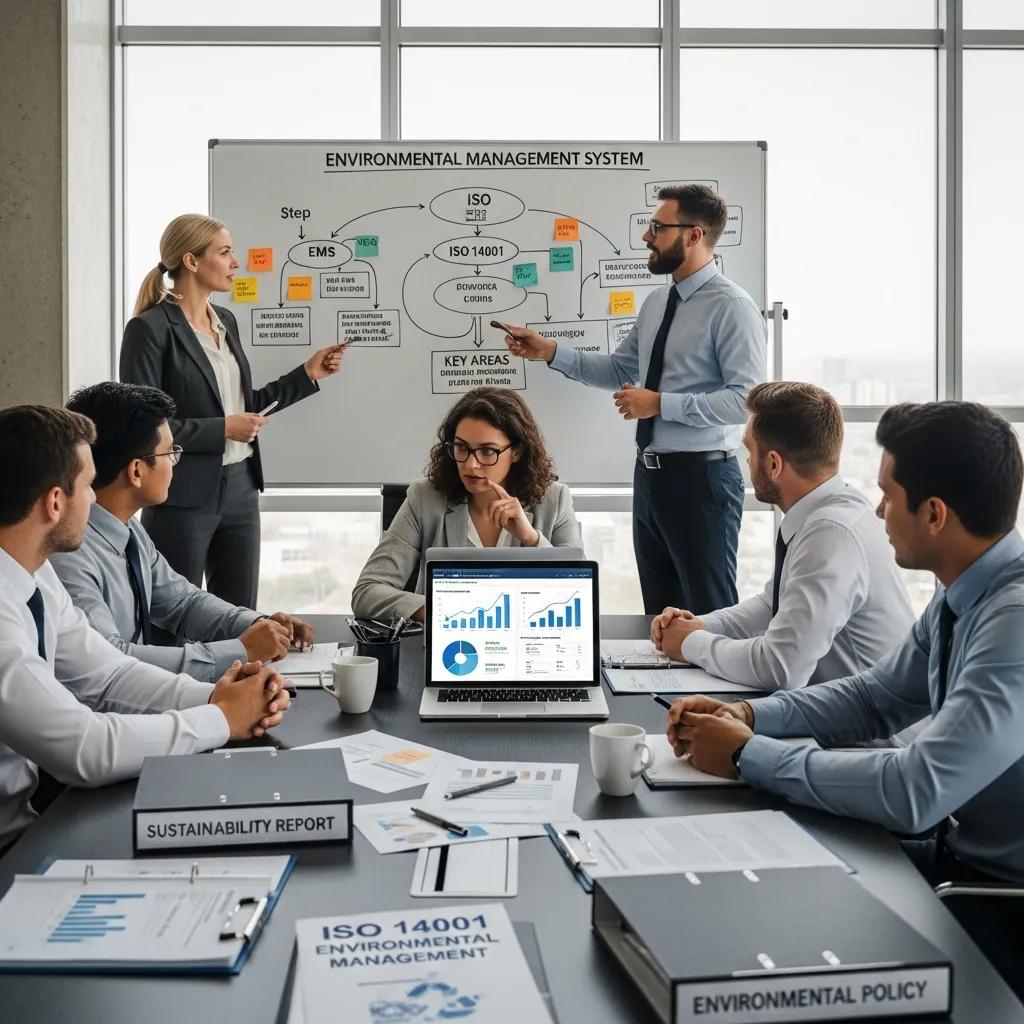
ISO 14001 provides a structured Plan-Do-Check-Act framework to set environmental policy, define objectives, implement controls, and drive continuous improvement. For waste management, that means embedding waste targets, monitoring, and operational controls into everyday processes. The standard requires organisations to identify environmental aspects, meet legal obligations, and use performance indicators — creating a repeatable system to reduce waste and improve resource efficiency. The outcome is documented evidence of systematic waste reductions that can be audited and improved, strengthening compliance and stakeholder confidence.
| ISO 14001 Requirement | Practical Implementation | Example Waste-Management Action |
|---|---|---|
| Environmental Policy & Objectives | Set measurable waste targets and demonstrate leadership commitment | Target a 20% reduction in hazardous waste this fiscal year |
| Operational Control | Standardise segregation, storage, and handling procedures | Introduce color-coded bins and storage protocols for organics and e-waste |
| Monitoring & Measurement | Use KPIs and periodic audits to track waste streams | Monthly weight-based KPIs and contamination-rate reporting |
| Compliance & Legal Evaluation | Map applicable waste regulations and reporting timelines | Maintain a register of extended producer responsibility obligations |
This mapping shows how ISO 14001 clauses translate into operational steps that reduce waste and prepare organisations for certification and ongoing improvement through documented controls and measurable outcomes.
What Are the Core Components of ISO 14001 Environmental Management Systems?
The core EMS components are leadership and policy; planning (identifying aspects and legal requirements); implementation and operation (controls and competence); performance evaluation (monitoring and internal audit); and improvement (corrective actions and management review). Each element ties strategic objectives to practical procedures, assigns roles for waste handling, and mandates measurement and corrective loops. For example, planning highlights high-volume waste streams and legal drivers; implementation sets segregation and handling rules; evaluation uses audit findings to refine targets. These linked elements ensure waste reduction becomes an auditable part of operations rather than an ad hoc effort.
- Policy & leadership: secure top-level commitment to waste objectives.
- Planning: identify significant waste aspects and set measurable targets.
- Implementation & evaluation: embed controls and use audits to close gaps.
Together, these components create the management infrastructure businesses need to scale waste-reduction programs and show results to stakeholders and certifiers.
How Does ISO 14001 Drive Waste Reduction and Circular Economy Practices?
ISO 14001 promotes life-cycle thinking, supplier engagement, and product stewardship — all central to circular-economy strategies. By requiring life-cycle consideration, the standard pushes design, procurement, and supplier choices toward reusable, recyclable, or lower-impact materials. Operational controls and supplier-communication requirements encourage take-back schemes, remanufacturing, and reduced packaging. The standard’s PDCA cycles enable iterative pilots (take-back schemes, packaging redesigns, remanufacturing trials) that progressively increase material circularity and resource efficiency.
- Life-cycle thinking drives upstream design changes that reduce end-of-life waste.
- Supplier engagement creates pathways for material reuse and closed-loop sourcing.
- PDCA cycles enable pilots to scale into repeatable circular projects.
These mechanisms align internal processes with circular outcomes and set the stage for tech-enabled measurement — including AI audits — to validate progress. Working with an accredited partner can streamline the path to ISO 14001 recognition while ensuring internationally accepted audit evidence.
What Role Does AI-Driven Waste Auditing Play in Enhancing Business Waste Management?

AI-driven waste auditing applies image recognition, sensors, and analytics to classify materials, quantify streams, and spot contamination faster and with greater consistency than manual methods. That reduces human error and speeds insight generation. With richer, repeatable datasets, organisations can run audits more often, prioritise interventions, and strengthen ISO 14001 evidence. The net result: quicker identification of waste hotspots, clearer guidance for source-reduction projects, and scalable audit programs across multiple sites.
| Audit Type | Accuracy / Time | Typical Cost Impact |
|---|---|---|
| Manual Audit | Moderate accuracy; several hours per site | Baseline cost; higher labour and sampling variability |
| AI-Supported Audit | High accuracy; minutes to hours per site | Lower labour costs; faster ROI through targeted actions |
| Hybrid Audit (Manual + AI) | Very high accuracy; optimised time | Balanced cost with rapid adoption and high repeatability |
The comparison highlights how AI-supported audits shorten cycles and improve data quality, enabling more effective waste reduction programs and stronger compliance records for certification.
How Can AI Improve Waste Audit Accuracy and Efficiency?
AI increases accuracy by applying consistent classification rules to images and sensor inputs, reducing misclassification and auditor variability. Efficiency comes from automated capture and processing, compressing audit cycles from days to hours and powering near-real-time dashboards for facilities managers. AI can flag anomalies and forecast trends, enabling preventive actions — changes to procurement or on-site handling — before issues escalate. These capabilities make AI a strong complement to ISO 14001 monitoring and reporting.
- Automated classification lowers manual sorting time and improves repeatability.
- Faster processing allows more frequent audits and timely corrective actions.
- Predictive analytics help prioritise high-impact source-reduction projects.
By improving speed and consistency, AI makes audits more actionable — which is why many organisations pair AI auditing with formal EMS frameworks to close the loop on continuous improvement.
What Are the Cost and Compliance Benefits of AI-Powered Waste Auditing?
AI-powered audits typically cut audit labour hours and sampling costs, delivering operational savings and speeding discovery of high-impact reduction opportunities. Compliance benefits include timestamped, standardised datasets that strengthen audit trails for ISO 14001 and regulatory reviews. Scalability is another advantage: AI methods can be applied consistently across sites and jurisdictions, supporting centralised performance management and multi-site certification. Together, these cost and compliance gains improve ROI on waste programs and lower the risk of non-compliance penalties.
- Reduced audit time directly lowers labour costs and enables higher audit frequency.
- Higher-quality documentation supports certification audits and regulatory inspections.
- Scalable methods make multi-site rollouts more consistent and auditable.
Organisations accelerate these benefits by integrating AI auditing into their EMS and aligning KPIs with reduction targets, turning audit insights into prioritised action plans and measurable results.
Which Practical Strategies Can Businesses Implement for Effective Waste Management?
Start with a baseline audit, set measurable reduction targets, and roll out prioritized source-reduction projects that deliver quick wins while building capacity for longer-term circular initiatives. The approach pairs data-driven audits with operational changes — packaging redesign, process tweaks, and supplier collaboration — and tracks outcomes with KPIs aligned to ISO 14001. Combining tactical projects with strategic investments yields immediate cost reductions and builds the systems needed for sustained improvement, tying day-to-day operations to management review and certification needs.
Below are priority strategies businesses can implement now, with short benefit statements:
- Run baseline waste audits to identify major streams and hotspots so you can target effort where it matters.
- Pursue source-reduction actions like packaging redesign to cut material costs and waste volumes.
- Build robust recycling and segregation programs to recover value and reduce landfill fees.
- Engage suppliers on take-back and remanufacturing partnerships to close material loops.
These steps form a roadmap from diagnosis to steady improvement, and many organisations speed implementation by blending in-house effort with external audit and certification support.
Introductory table: common waste streams, typical generation, reduction tactics, and expected outcomes.
| Waste Stream | Typical Generation | Reduction Tactics | Expected Cost/Benefit Outcome |
|---|---|---|---|
| Paper & Cardboard | Moderate | Source reduction, compacting, vendor take-back | Lower purchasing and disposal costs |
| Plastic Packaging | High | Design for reduction, reusable packaging pilots | Reduced procurement spend; landfill savings |
| Organic/Food Waste | Variable | On-site composting, donation programs | Lower waste fees; potential compost revenue |
| E-waste | Low volume, high value | Asset tracking, refurbishment, certified recycling | Recover value; compliance risk reduction |
This table helps teams prioritise interventions by stream size and value, showing where immediate savings or compliance benefits are most likely.
How to Conduct Waste Audits and Source Reduction Initiatives?
Begin by scoping facility boundaries, identifying primary waste streams, and selecting representative sampling periods to capture operational variation. Good scoping makes audit results actionable. Data collection should combine weigh-scale sampling, visual classification, and increasingly, AI-assisted image capture for repeatable metrics. Analysis translates tonnages and contamination rates into prioritised projects — for example, switching packaging suppliers, adjusting production runs, or adding segregation points. Finally, set KPIs (weight per unit, diversion rate, contamination rate) and review them regularly to iterate improvements and meet ISO 14001 measurement requirements.
- Scope and plan audits to reflect representative operations and key waste streams.
- Pair manual weighing with AI-enabled classification for accuracy and frequency.
- Turn findings into prioritised source-reduction projects with measurable KPIs.
These steps connect audit evidence to operational change and management review, producing a continuous improvement loop that supports certification and cost reduction.
What Are Best Practices for Corporate Recycling Programs and Employee Engagement?
Design recycling programs around the right infrastructure (bins, signage, vendor contracts) and clear segregation rules with contamination monitoring; good design lowers sorting costs and raises recovery rates. Employee engagement is essential: training, simple communications, and incentive mechanics increase participation and sustain behaviour change. Define contamination thresholds and track them as KPIs under your ISO 14001 performance evaluation, using feedback loops to refine processes. Choose haulers and processors that prioritise traceability and commodity quality so recovered materials are actually recycled.
- Provide clear infrastructure, signage, and vendor standards to reduce contamination.
- Use training and incentives to sustain employee participation and ownership.
- Monitor recovery and contamination rates and iterate based on audit feedback.
These practices convert employee behaviour into measurable program performance and lower lifecycle costs while advancing environmental objectives. For teams seeking external help, Stratlane Certification offers managed audit and certification services to operationalise these practices and handle ongoing certificate management.
How Can Businesses Embrace Circular Economy Models to Minimise Waste?
Circular models reduce waste by designing it out, keeping products and materials in use, and regenerating natural systems. Tactics include product redesign, service-based models, and reverse-logistics to reclaim end-of-life value. Businesses adopt circularity by assessing lifecycle impacts, piloting take-back or remanufacturing schemes, and embedding circular criteria in procurement and design. The result is lower material dependency, reduced disposal costs, and potential new revenue from refurbished or service offerings.
- Design for durability and repair to extend product life and cut replacement rates.
- Implement take-back and remanufacturing to recapture product and material value.
- Shift to product-as-a-service models where feasible to retain ownership and incentivise longevity.
These approaches move the business model from linear disposal to continuous value capture, requiring cross-functional changes in operations, logistics, and supplier contracts that strong EMS documentation and measurement can support.
What Are Circular Economy Principles Relevant to Business Waste Reduction?
Core circular principles are reduce (minimise material use), reuse (extend product life), recycle (recover materials), and redesign (create longer‑lasting, repairable products). Each principle maps to specific actions: reduce via packaging and process changes; reuse via refurbishment or modular design; recycle via improved collection and recovery systems; redesign via material substitution and design-for-disassembly. Applying these principles together reduces material throughput and aligns commercial incentives with environmental outcomes.
- Reduce: remove unnecessary material through design and process changes.
- Reuse: adopt take-back and remanufacturing to extend asset life.
- Recycle & Redesign: prioritise recoverable materials and design for disassembly.
Embedding these principles into procurement and product development builds long-term resilience and reduces exposure to material price volatility.
How Do Circular Business Models Drive Resource Efficiency and Sustainability?
Circular models — product-as-a-service, take-back schemes, remanufacturing — turn one-way material flows into managed value chains with multiple product lives. These models can reduce procurement spend and disposal costs while opening revenue or margin opportunities from refurbished goods or subscriptions. Operationally, they require reverse logistics, asset tracking, and supplier partnerships that enable remanufacturing or recovery. Certification and documented EMS practices help substantiate circular claims and provide auditable evidence of resource-efficiency gains.
- Product-as-a-service aligns incentives for durability and maintenance, reducing replacement waste.
- Take-back schemes recapture materials and reduce landfill inputs.
- Remanufacturing converts end-of-life products into revenue while lowering material purchases.
Paired with strong measurement and certification, circular models let businesses demonstrate verifiable improvements in resource efficiency and sustainability to stakeholders.
Why Choose Stratlane Certification for ISO 14001 and AI Waste Auditing Solutions?
Stratlane Certification combines accredited ISO 14001 services with AI-driven auditing to give businesses a pragmatic route to implement, measure, and certify sustainable waste systems. Our accreditation across multiple countries and network of professional auditors deliver consistent certification practice and recognised evidence for global stakeholders. We pair EMS certification with AI tools to raise audit quality and speed, shortening the path from baseline assessment to verified improvement. For organisations seeking end-to-end support, Stratlane offers certification, managed audits, and certificate management to sustain compliance and continuous improvement.
- Accredited certification in 27+ countries, providing international recognition and consistency.
- Professional auditors in 29+ countries to support multi-site and cross-border certification programs.
- AI-driven audit tools that improve data quality, accelerate audits, and support ISO 14001 evidence requirements.
These advantages help businesses scale EMS adoption, document performance for regulators and customers, and maintain certificates as part of an ongoing compliance program. Getting started usually involves requesting a quote, scoping the audit approach, preparing documentation, and scheduling the audit — steps Stratlane supports through managed onboarding and certificate management.
What Unique Advantages Does Stratlane Offer in Certification and Support?
Stratlane blends accredited certification with AI-enhanced auditing to deliver higher-quality, more efficient assessments that reflect both international standards and operational realities. Our AI tools deliver consistent classification and faster data capture, while our global auditor footprint supports multi-jurisdictional certification under uniform criteria. Beyond certification, we provide training and certificate-management services to help organisations maintain compliance and show continual improvement. These capabilities reduce administrative burden and speed the delivery of waste reduction outcomes across sites and regulatory environments.
- AI-enhanced audits for faster, more consistent data that supports better decision-making.
- Accredited certification in multiple countries for recognised credentials.
- End-to-end services including training and certificate management to sustain compliance.
These strengths make Stratlane a practical partner for organisations that need both technical audit capability and a clear certification pathway to validate environmental performance.
How Can Businesses Get Started with Stratlane’s Certification and Audit Services?
Onboarding follows a clear sequence to define scope, choose audit modalities, and prepare evidence efficiently. First, request a quote or consultation to confirm scope and objectives. Next, decide on AI, manual, or hybrid audit methods and finalise audit scope. Then prepare documentation and operational evidence mapped to ISO 14001 clauses. Finally, schedule and complete the audit and use our certificate-management services to maintain compliance. Stratlane emphasises measurable KPIs and practical implementation so audit findings translate into source‑reduction projects and continuous improvement.
- Request a quote or consultation to define certification scope and objectives.
- Scope the audit and choose AI, manual, or hybrid methods tailored to site needs.
- Prepare evidence, schedule the audit, and use certificate-management services to maintain compliance.
Following these steps moves organisations from assessment to certified performance while preserving the data and systems needed for ongoing waste reduction and circularity.
Frequently Asked Questions
What types of businesses can benefit from ISO 14001 certification?
ISO 14001 suits a wide range of organisations — from manufacturing and retail to healthcare and professional services. Any company that wants to improve environmental management, tighten waste controls, and show regulatory compliance can benefit. Certification supports sustainability targets, operational efficiency, and brand reputation with customers and stakeholders who prioritise environmental performance.
How can businesses measure the success of their waste management initiatives?
Measure success with clear KPIs: diversion rate, reduction in waste generation per unit, and cost savings from lower disposal fees. Regular audits supply quantitative data on stream composition and recycling rates. Employee engagement and participation metrics also indicate program effectiveness. Align targets with ISO 14001 requirements and review them regularly to drive continuous improvement.
What role do employees play in effective waste management strategies?
Employees are essential. Their day-to-day choices determine segregation quality and contamination levels. Training, clear signage, and incentives make participation routine. Involving staff in program design often produces practical ideas and greater buy-in. Recognising contributions reinforces behaviour change and helps sustain results.
What are some common challenges businesses face in waste management?
Typical challenges include low employee engagement, inadequate recycling infrastructure, and inconsistent waste tracking. Contamination in recycling streams raises costs and lowers recovery. Keeping pace with changing regulations is also a frequent pain point. Overcoming these issues requires a structured approach: training, clear processes, reliable vendor partnerships, and robust monitoring.
How can technology enhance waste management practices?
Technology improves data collection, analysis, and monitoring. AI-driven audits increase classification accuracy and audit frequency. IoT sensors reveal generation patterns in real time so you can intervene faster. Digital platforms support training and communication. Together, these tools enable data-driven decisions that boost diversion rates and reduce costs.
What are the long-term benefits of adopting a circular economy model?
Circular models lower material costs, reduce disposal fees, and improve resource efficiency. Designing for longevity and reusability reduces raw-material dependency and exposure to price swings. Circular approaches can also unlock revenue from refurbished products or service models. Over time, these benefits strengthen brand loyalty and create a competitive advantage for organisations that embed circularity into their operations.
Conclusion
Effective waste management reduces cost, improves operations, and strengthens brand trust. Using ISO 14001 together with AI-driven auditing provides a clear, auditable path to measurable waste reduction and ongoing improvement. These insights let organisations take practical steps toward a circular economy while meeting compliance obligations. Start your journey to better waste outcomes today — explore our certification and auditing services to see how we can help.