
Strategic Advantages of ISO Certification for Large Corporations

ISO Certification: Efficiency, Risk Reduction & Competitive Edge
ISO certification confirms that a company’s management systems meet internationally recognised standards, creating consistent quality, information security, environmental stewardship and emerging AI governance across global operations. This article describes how enterprise ISO programmes — including ISO 9001, ISO 14001, ISO 27001 and the emerging ISO/IEC 42001 — convert into measurable efficiency gains, lower risk and sustained market access for multinational firms. Large organisations contend with complex regulation, distributed supply chains and heightened reputational exposure; ISO frameworks supply structured controls and auditable evidence that address these challenges while embedding continuous improvement. You’ll find the principal strategic benefits of certification, which standards matter for global compliance, how AI-driven auditing changes certification economics, example ROI metrics, and practical next steps to fold certification into risk and procurement strategies. The following section lists the core benefits enterprises capture from certification and shows how they cascade into operational and commercial outcomes.
What are the key benefits of ISO certification for large businesses?
ISO certification gives enterprises an auditable, repeatable framework to standardise processes, strengthen controls and sustain customer confidence across multiple geographies. At scale, certification aligns disparate business units around shared metrics, reduces operational variation and creates a single source of truth for compliance that suppliers and customers can rely on. The management-system approach encourages continuous improvement cycles that turn policy into measurable KPIs and predictable results. These outcomes support enterprise priorities such as procurement eligibility, lower incident costs and faster integrations during M&A or market expansion. For clarity, the list below highlights the principal strategic gains large organisations typically realise from certification.
ISO certification delivers distinct strategic advantages for large companies:
- Enhanced corporate credibility and customer trust: independent certification validates governance and processes against recognised standards.
- Operational efficiency and process standardisation: uniform processes reduce variation, rework and cost across locations.
- Risk mitigation and improved information security: ISMS frameworks lower breach frequency and limit impact through defined controls.
- Market access and regulatory compliance: certificates are often required in tenders and global supply chains.
- Continuous improvement and scalability: documented systems enable faster scale-up and smoother integration during growth.
These five benefits form the core value proposition for enterprise ISO programmes. The next subsection explains how certification produces tangible improvements in operational efficiency and quality management.
How does ISO certification enhance operational efficiency and quality management?
Certification drives operational efficiency by enforcing standard process controls, clear KPIs and documented procedures that cut variation and waste across large operations. ISO 9001, for example, requires processes to be measured, analysed and optimised, producing more consistent products and services and fewer defects and rework events. At the enterprise level, gains come from centralised process mapping, performance dashboards and cross-functional governance that bring manufacturing, supply chain and service delivery into alignment. Typical outcomes include shorter cycle times and higher first-pass yield — improvements that compound as standardised processes roll out across sites. These operational levers also strengthen enterprise risk management and information security, making certification a complementary asset for digitally enabled organisations.
In what ways does ISO certification improve corporate risk management and security?
Standards such as ISO 27001 formalise risk assessment, control selection and incident response so large organisations can quantify and reduce exposure across complex IT and operational environments. The Information Security Management System (ISMS) model requires risk identification, prioritised controls, ongoing monitoring and documented treatment plans, which together reduce both the frequency and impact of incidents. Enterprises gain integrated incident response playbooks, clearer lines of accountability and auditable evidence to present to regulators and partners. Faster containment and lower breach costs translate into financial resilience and stronger stakeholder confidence. Because these controls tie into business continuity and quality systems, certification becomes a practical bridge between operational reliability and regulatory readiness.
Which ISO standards are most relevant for large corporations' global compliance?
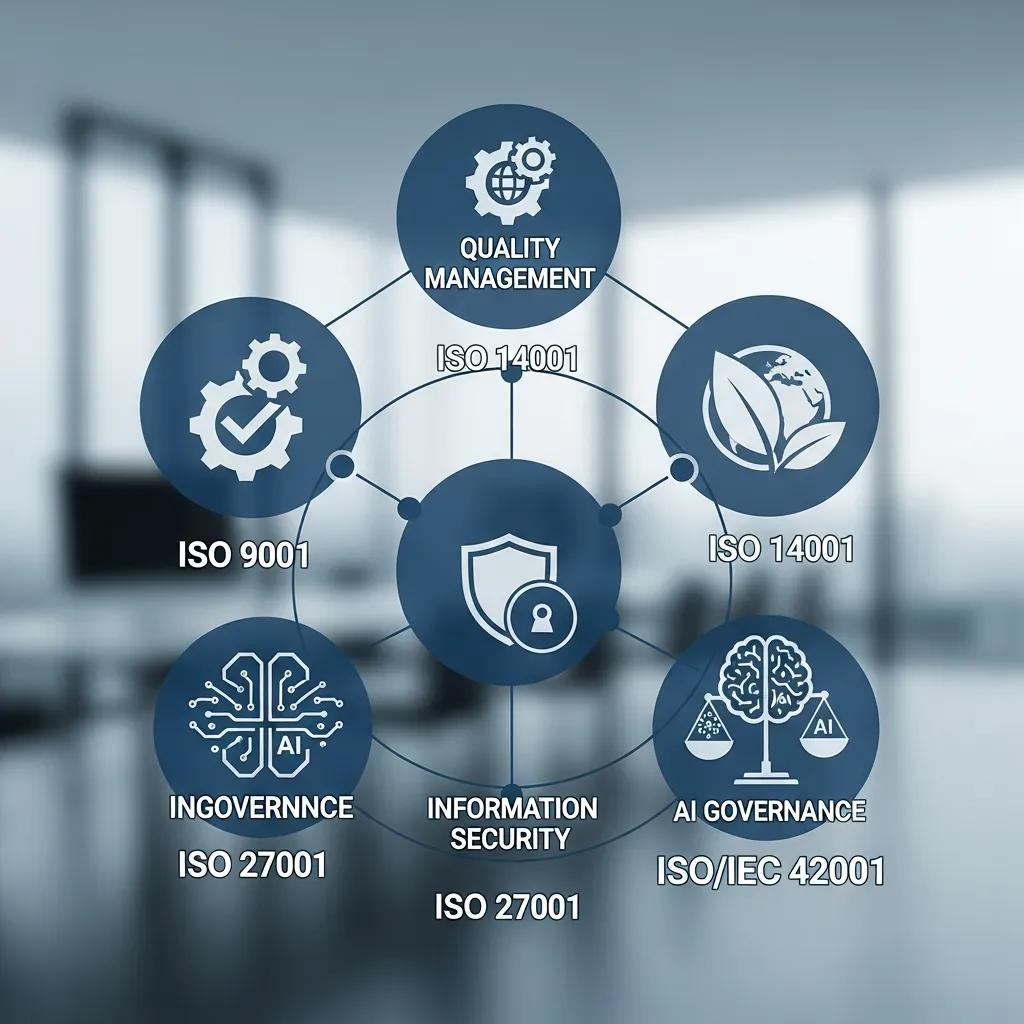
Large corporations typically prioritise a set of ISO standards that together cover quality, environment, information security and emerging AI governance. ISO 9001, ISO 14001, ISO 27001 and ISO/IEC 42001 address complementary enterprise risks — quality, environmental impact, information security and AI management — helping organisations satisfy tender requirements, regulator due diligence and supply-chain expectations. The table below summarises each standard in enterprise terms to help decision-makers sequence implementation and plan integration.
| Standard | Primary Focus | Strategic Benefit for Large Corporations |
|---|---|---|
| ISO 9001 | Quality Management Systems | Reduces variation, improves customer satisfaction, enables standardised KPIs across global sites |
| ISO 14001 | Environmental Management Systems | Demonstrates sustainability commitments, reduces regulatory risk and supports ESG reporting |
| ISO 27001 | Information Security Management Systems | Protects data assets, lowers breach costs and supports data-protection compliance |
| ISO/IEC 42001 | AI Management Systems | Provides governance for responsible AI deployment, managing model risk and ethical oversight |
This view helps enterprises map standards to strategic objectives and decide whether to pursue single-standard certification or an integrated management-system approach. The following subsections unpack the enterprise advantages of ISO 9001 and ISO 14001 and then explain how ISO 27001 and ISO/IEC 42001 address security and AI governance.
What strategic advantages do ISO 9001 and ISO 14001 offer enterprises?
ISO 9001 and ISO 14001 work together: one raises operational performance, the other improves environmental stewardship — and together they create commercial differentiation in regulated and sustainability-focused markets. ISO 9001 enforces process control, supplier quality expectations and measurable KPIs that drive down warranty claims and improve on-time delivery, often reducing unit costs. ISO 14001 provides a structured way to identify environmental aspects, cut emissions or waste and align sustainability targets with regulatory obligations and investor expectations. Impacts differ by sector: manufacturers typically see less scrap and higher throughput, while service firms benefit from steadier contract retention due to predictable delivery. These complementary gains support integrated management systems that lower overhead and improve procurement outcomes.
How do ISO 27001 and ISO/IEC 42001 support information security and AI governance?
ISO 27001 reduces security incidents by establishing an ISMS with risk-based controls, encryption expectations and access governance across distributed systems, which decreases breach likelihood and recovery costs. ISO/IEC 42001 — an emerging AI-management framework — sets governance for model development, data provenance, explainability and ethical risk assessment, which organisations need when deploying AI at scale. Together, these standards help enterprises manage technical and ethical risks, meet regulator expectations and preserve stakeholder trust in automated decision systems. Practical controls include asset inventories, continuous monitoring and documented model validation — steps that reduce operational surprises and support procurement reviews that demand demonstrable AI governance.
How does AI-driven auditing transform the ISO certification process for enterprises?

AI-driven auditing automates evidence collection, broadens coverage across digital systems and speeds analytic synthesis, making enterprise-scale audits faster and more reliable. Machine learning and pattern recognition help auditors spot anomalies, detect nonconformities in large datasets and flag the highest-risk findings for human review — shortening audit cycles and improving accuracy. Continuous monitoring connects to existing telemetry (logs, change records, configuration management) to deliver near-real-time assurance, shifting organisations from point-in-time checks to an ongoing compliance posture. These capabilities scale across geographies and complex IT estates, reducing travel-heavy audit models and enabling broader scope with less manual sampling. The table below maps AI audit capabilities to concrete advantages and impact.
| AI Capability | Audit Advantage | Efficiency / Accuracy / Cost Impact |
|---|---|---|
| Automated evidence parsing | Faster aggregation of evidence across systems | Reduces manual sampling time by 40–60% |
| Anomaly detection | Early identification of control failures | Increases nonconformance detection coverage |
| Continuous monitoring | Ongoing compliance visibility | Shortens time-to-issue resolution and reduces audit frequency |
| Natural language analysis | Efficient review of policies and records | Improves report consistency and reduces review labour |
These AI features change how enterprises prepare for certification by enabling wider evidence coverage and faster remediation cycles, which shortens time-to-certification and lowers audit expense. The following subsection examines specific efficiency and accuracy benefits AI brings to ISO audits.
Stratlane Certification is an accredited certification body delivering ISO services to organisations across Europe and the UK. We combine AI-enabled audit tools with professional auditors who have industry experience, offer certification for ISO 9001, ISO 14001, ISO 27001 and ISO/IEC 42001, hold accreditation in over 27 countries and provide certificate-management features for validity checks and downloads.
What efficiency and accuracy benefits does AI bring to ISO audits?
AI delivers concrete efficiencies by automating routine data collection, widening evidence coverage and speeding report generation so audit teams can focus on risk-based analysis and remediation. Automated parsing of logs and records supports broader sampling across systems instead of limited manual spot checks, strengthening statistical confidence in findings. Pattern recognition reduces false positives and surfaces recurring control failures, while NLP-based policy review accelerates compliance checks. These automation gains typically lead to shorter audit windows, earlier recommendations and less client-side preparation time. With these improvements, organisations can move from reactive annual audits to proactive assurance models that feed continuous improvement.
How does Stratlane's AI-powered auditing provide a competitive advantage?
Stratlane Certification combines accredited auditors with AI-enabled tooling to shorten certification timelines: we automate evidence collection, run parallel analyses across business units and deliver centralised reporting for enterprise governance. Accreditation across multiple jurisdictions increases credibility when presenting certificates to international customers and regulators, while certificate-management features simplify validity checks across complex supply chains. Enterprises gain an edge through faster time-to-certification, consolidated audit reporting for procurement teams and demonstrable controls mapped to regulatory expectations. For teams ready to act, the usual path is: request a quote, schedule an AI-enabled audit and then manage issued certificates through an integrated database that supports downloads and validity checks.
What is the return on investment of ISO certification for large corporations?
ROI from ISO certification blends direct cost savings from process improvements and fewer incidents with indirect upside such as more contract wins and higher customer retention. Cost savings come from fewer defects, less rework and lower breach-related expenses when controls are effective; revenue gains arise from eligibility for tenders and improved procurement scores. Measuring ROI requires tracking metrics like cost-per-incident, defect rates, procurement success rate and customer-satisfaction scores before and after certification. The table below summarises typical enterprise ROI metrics and example values organisations use to evaluate impact.
| Benefit / Metric | How It’s Measured | Example / Impact |
|---|---|---|
| Process cost reduction | % decrease in rework or scrap | 10–20% lower production costs |
| Security incident reduction | % fewer reportable breaches | 30–50% reduction in incident frequency |
| Procurement eligibility | Number of tenders qualified for | Access to higher-value contracts |
| Customer satisfaction | NPS or CSAT change | 5–10 point NPS improvement |
This ROI framework helps finance and compliance leaders quantify certification benefits. The next sections describe how certification lowers costs and improves customer outcomes, followed by illustrative vignettes.
Stratlane Certification is an accredited certification body delivering ISO services to organisations across Europe and the UK. We combine AI-enabled audit tools with professional auditors who have industry experience, offer certification for ISO 9001, ISO 14001, ISO 27001 and ISO/IEC 42001, hold accreditation in over 27 countries and provide certificate-management features for validity checks and downloads.
How does ISO certification reduce costs and increase customer satisfaction?
Certification reduces operational costs by codifying process controls that lower defect rates, cut warranty claims and streamline supplier quality management, which typically reduces variable costs across production and service delivery. In information security, an ISMS aligned with ISO 27001 lowers breach probability and impact, reducing remediation costs and potential fines. Customer satisfaction improves because certified processes produce consistent outcomes and transparent escalation paths, which boost retention and create upsell opportunities. Tracking before-and-after KPIs such as defects per million, mean time to recovery and CSAT allows organisations to quantify gains and link them to certification investments.
What case studies demonstrate measurable ROI from ISO certification?
Enterprises often report measurable ROI in manufacturing, technology and services when certification is paired with disciplined change management and continuous monitoring. For example, a manufacturing division implementing ISO 9001 achieved double-digit scrap reduction and better on-time delivery; a technology firm adopting ISO 27001 cut incident-response costs and regained eligibility for major procurements; and a services company saw higher renewal rates and improved CSAT after standardising delivery. These anonymised vignettes show common patterns — process control reduces variable costs, security controls limit breach exposure and certification credibility opens commercial doors — which is why many organisations treat certification as both risk management and revenue enablement.
How does ISO certification facilitate global market access and regulatory compliance?
ISO certification acts as a universal signal of governance and controls recognised by many international tenders, customers and partners, reducing administrative friction when entering new markets or negotiating with global suppliers. A certificate provides auditable evidence of standardised practices, simplifying due diligence and supplier assessments and shortening the time to qualify for regulated contracts. For multinationals, certification supports harmonised compliance across jurisdictions by mapping standard controls to local regulatory requirements, enabling central oversight with local implementation. This bridge between global standards and regional regulation helps enterprises scale into new markets with lower legal and procurement friction.
Stratlane Certification is an accredited certification body delivering ISO services to organisations across Europe and the UK. We combine AI-enabled audit tools with professional auditors who have industry experience, offer certification for ISO 9001, ISO 14001, ISO 27001 and ISO/IEC 42001, hold accreditation in over 27 countries and provide certificate-management features for validity checks and downloads.
What role does ISO play in navigating international corporate regulations?
ISO standards provide auditable controls that often align directly with regulatory expectations, enabling enterprises to demonstrate compliance in areas such as data protection, environmental reporting and product safety. Mapping standard clauses to local regulations creates a compliance matrix legal and compliance teams can use to show regulators and contracting authorities that requirements are covered by existing controls. This harmonisation reduces duplicated effort across countries and lowers the cost of multi-jurisdiction compliance programmes. With those efficiencies, certification becomes a practical tool for meeting cross-border regulatory demands while preserving central governance and visibility.
How does certification enhance corporate credibility and customer trust?
Certification is a recognised trust signal in procurement and stakeholder interactions because it shows an independent body has audited the organisation’s processes and controls against established standards. This external validation improves supplier scorecards, buyer assessments and investor due diligence, often strengthening negotiation leverage and shortening procurement timelines. Certified organisations can present validated evidence during audits and tenders, increasing transparency and reducing perceived vendor risk. Those credibility gains convert to measurable advantages such as higher contract win rates and stronger partner relationships.
What are the future trends and innovations in ISO certification for large enterprises?
Future trends include broader adoption of ISO/IEC 42001 for AI governance, wider use of AI and digital tools for continuous auditing and a move toward integrated management systems that combine quality, environment, security and AI governance into unified enterprise programmes. Digital transformation will enable more remote and continuous evidence collection, creating efficiency gains and supporting risk-based, near-real-time assurance for leadership. Enterprises should prepare by investing in data governance, traceability and automated evidence pipelines that feed audit and compliance platforms. These developments define how organisations will stay certification-ready and manage controls across increasingly automated operations.
How is ISO/IEC 42001 shaping AI management systems in corporations?
ISO/IEC 42001 shapes AI management systems by defining governance for model lifecycle management, risk assessment, transparency and accountability — elements critical for responsible enterprise AI. Preparing for ISO/IEC 42001 typically involves a gap analysis against current AI practices, ethical risk-assessment frameworks, strong data-provenance controls and model-validation procedures that show reliability and fairness. Organisations can phase implementation by piloting governance around high-impact models and scaling controls across the AI portfolio. Adopting ISO/IEC 42001 aligns AI practices with stakeholder expectations and regulatory trends, encouraging predictable, auditable AI behaviour across business units.
What is the future impact of digital transformation on ISO compliance and auditing?
Digital transformation will embed compliance into workflows through continuous monitoring, automated evidence capture and integrated compliance dashboards that reduce manual audit effort and speed remediation. Continuous auditing helps organisations spot control drift earlier and stay audit-ready between formal reviews. To reap these benefits, enterprises must strengthen data governance, ensure traceability for key transactions and feed compliance signals into existing IT and operational telemetry. The result is a more resilient compliance posture that supports faster certification cycles and more effective enterprise risk management.
Stratlane Certification is an accredited certification body delivering ISO services to organisations across Europe and the UK. We combine AI-enabled audit tools with professional auditors who have industry experience, offer certification for ISO 9001, ISO 14001, ISO 27001 and ISO/IEC 42001, hold accreditation in over 27 countries and provide certificate-management features for validity checks and downloads.
- Request a quote: begin with a tailored scoping and pricing estimate.
- Schedule an AI-enabled audit: use automated evidence collection and auditor expertise for an efficient assessment.
- Certificate issuance and management: receive accredited certification and manage certificates via tools for validity checks and downloads.
These steps map strategy to delivery: quote → audit → certificate management, supporting enterprise procurement and compliance workflows and making the path to global compliance operationally clear.
Frequently asked questions
What is the process for obtaining ISO certification for large corporations?
Obtaining ISO certification typically follows a few key stages. First, assess current practices against the chosen ISO standard. Next, close gaps by implementing required processes and controls. An accredited certification body then performs an audit to verify conformity; if successful, the organisation receives certification. Ongoing monitoring and periodic surveillance audits are required to maintain certification and drive continuous improvement.
How can ISO certification impact a corporation's supply chain management?
ISO certification improves supply-chain management by standardising processes, clarifying supplier expectations and improving collaboration. Certified organisations can demonstrate commitment to quality and compliance, which strengthens supplier relationships and can improve negotiation outcomes. Many ISO standards also embed risk-management practices that help identify and mitigate potential disruptions, increasing reliability and reducing total supply-chain cost.
What role does employee training play in achieving ISO certification?
Employee training is essential: it ensures staff understand the processes, controls and expectations required for certification. Training should cover the relevant ISO standards, operational procedures and the role each team plays in compliance and continuous improvement. Well-trained teams are likelier to follow procedures, spot improvement opportunities and sustain certification benefits.
How does ISO certification influence customer satisfaction and retention?
ISO certification signals consistent, repeatable delivery — which customers notice. Standardised processes reduce defects and improve predictability, boosting satisfaction and retention. Certification also makes it easier to provide evidence of compliance during tenders or audits, strengthening customer trust and often supporting higher renewal and upsell rates.
What are the costs associated with obtaining and maintaining ISO certification?
Costs vary by organisation size, operational complexity and the standards pursued. Upfront costs can include gap analysis, consultancy, training and audit fees. Ongoing costs cover surveillance audits, refresher training and process updates. Many organisations find the long-term savings and increased market access outweigh initial investments, but a clear ROI assessment is recommended.
How can organizations measure the success of their ISO certification efforts?
Measure success with KPIs tied to certification goals: reductions in defect rates, improvements in customer-satisfaction scores, decreases in operational costs, number of tenders won and frequency of nonconformities. Regularly review these metrics to validate continuous improvement and demonstrate the certification’s business impact.
What future trends should corporations be aware of regarding ISO certification?
Look for growing use of AI and digital tools in auditing, wider adoption of ISO 14001 for sustainability and the rise of ISO/IEC 42001 for AI governance. Organisations should monitor these trends and adapt compliance strategies to leverage continuous auditing, stronger data governance and integrated management systems.
Conclusion
ISO certification gives large corporations a structured, auditable framework that improves operational efficiency, reduces risk and strengthens trust in global markets. Aligning with recognised standards helps organisations streamline processes, meet regulatory expectations and unlock commercial opportunities. If you’re ready to move forward, explore our tailored services and book an AI-enabled audit to see how certification can support your strategic goals.