
Streamline HR Process Improvement through ISO Standards

Improving HR Processes with ISO Certification: Benefits, Standards, and AI-Driven Auditing
HR teams still struggle with disconnected workflows, inconsistent metrics and weak data governance — problems that make workforce planning and people management harder than they need to be. ISO certification, paired with AI-assisted auditing, gives you a repeatable route to align HR with internationally recognised management-system standards, measure process improvements and strengthen human‑capital reporting. This guide walks through the ISO standards that matter to HR (notably ISO 30414 and ISO 30415), shows how core standards like ISO 9001 and ISO 27001 support quality and data protection, and explains how AI shortens audits and eases evidence collection. You’ll get practical gap‑analysis checklists, KPI examples tied to certification benefits, and a clear certification roadmap from assessment to surveillance — all framed around people metrics, HR analytics and ethical AI governance to help HR leaders prioritise the highest‑impact work.
What Are the Key ISO HR Standards for Enhancing Human Resource Management?
ISO standards give HR a structured, auditable way to make people processes measurable. ISO 30414 sets the framework for human‑capital reporting by naming core metric categories; ISO 30415 provides governance and implementation guidance for diversity and inclusion; and supporting standards such as ISO 9001 and ISO 27001 embed quality‑management and information‑security controls into HR operations. Together these standards form a practical suite—ISO 30414 and ISO 30415 address HR specifics while ISO 9001 and ISO 27001 provide system‑level controls—enabling stronger workforce planning, better employee management and compliant reporting for investors and regulators. Below is a compact comparison to clarify where each standard applies before we dive into metrics and D&I guidance.
The table below summarises how standards map to HR priorities:
| Standard | Primary Focus | Typical HR Metrics | Applicability for HR |
|---|---|---|---|
| ISO 30414 | Human capital reporting | Workforce composition, turnover rates, productivity metrics | External reporting, investor transparency, strategic workforce planning |
| ISO 30415 | Diversity & inclusion guidance | Demographic representation, inclusion indices, pay equity | Policy design, talent attraction, equitable practices |
| ISO 9001 | Quality management systems | Process cycle times, error rates, time-to-hire | Standardising HR processes like onboarding and recruitment |
| ISO 27001 | Information security management | Access incidents, data retention compliance, audit trails | Protecting HR data and maintaining confidentiality controls |
In short: ISO 30414 and ISO 30415 deliver HR‑specific guidance while ISO 9001 and ISO 27001 give you the controls that turn those requirements into measurable, repeatable processes. The sections that follow unpack human‑capital metrics and practical D&I principles you can action today.
How Does ISO 30414 Define Human Capital Reporting Metrics?
ISO 30414 organises human‑capital metrics into clear categories — workforce composition, capability and performance, productivity and retention — and standardises their definitions so organisations can report comparable, decision‑ready data. High‑value metrics include turnover rate (voluntary separations as a percentage over a period), time‑to‑proficiency (how long new hires take to reach the target performance), employee productivity (output per employee or revenue per FTE) and training investment per employee. Those measures expose talent bottlenecks, skill gaps and where retention or development spending will move the needle.
This standardised approach to human‑capital metrics aligns with academic research highlighting ISO 30414’s role in improving HR transparency and decision‑making.
ISO 30414 & Human Capital Reporting for HRM Effectiveness
The study adopts a conceptual and analytical approach, relying on an extensive review of contemporary academic literature and international standards for human capital reporting, including ISO 30414:2018. The authors synthesize findings from empirical and theoretical studies on HRM performance, high-commitment work systems, sustainable HRM, and human capital risk management
Standardised definitions also make cross‑functional conversations with finance and operations cleaner and speed dashboarding for continuous improvement. Once you’re aligned on ISO 30414 categories, ISO 30415 helps you layer in equitable representation and inclusion metrics.
What Are the Principles of ISO 30415 for Diversity and Inclusion?
ISO 30415 frames diversity and inclusion around policy alignment, governance, culture and measurable outcomes. The standard asks organisations to embed D&I across recruitment, development, supplier relationships and governance: assign roles and responsibilities, set measurable D&I KPIs (for example, representation by level, pay‑equity ratios, inclusion survey scores), and create feedback loops that connect D&I outcomes to performance and talent strategies. Practical steps include running anonymised demographic baselines, writing inclusive job specs, training hiring managers on bias mitigation and setting short‑cycle targets for representation in critical roles.
Suggested KPIs that map back to ISO 30415 include representation by gender and ethnicity at each level, pay‑equity gap, internal mobility rates for underrepresented groups and inclusion survey scores. Consistent measurement enables transparent reporting and continuous improvement, and these indicators slot directly into the human‑capital model described under ISO 30414.
How Does ISO Certification Optimize HR Processes and Workforce Management?
ISO certification makes HR processes repeatable and measurable by clarifying roles, documenting procedures and embedding PDCA (Plan‑Do‑Check‑Act). The result: less variation, faster hiring and smoother onboarding, stronger performance‑review quality and clearer evidence for stakeholders. ISO 9001 brings the quality framework that standardises workflow and metrics; ISO 27001 ensures personnel records and candidate data are handled securely. Together they reduce friction, limit privacy risk and strengthen trust with employees and regulators.
ISO certification optimises HR through several mechanisms:
- Standardisation of HR processes reduces variation and accelerates consistent decision‑making.
- Measurable metrics align HR actions to business outcomes and support workforce planning.
- Information security controls protect sensitive HR data and ensure regulatory compliance.
- Continual improvement cycles drive incremental operational gains and reduce rework.
Those mechanisms map directly to HR KPIs and set the stage for applying ISO 9001 and ISO 27001 to specific HR activities, as shown in the next sections.
What Benefits Does ISO 9001 Bring to HR Quality Management?
ISO 9001 adds a process lens to HR: documented procedures, defined inputs and outputs, and measurable indicators that enable continual improvement. Using PDCA, HR teams can iterate on recruitment, onboarding and appraisal workflows to cut errors (missing paperwork, inconsistent checks) and shorten cycle times like time‑to‑hire. Relevant KPIs include time‑to‑fill, onboarding completion rate, HR process error rate and candidate satisfaction; mapping these to ISO 9001 controls helps prioritise improvements and demonstrate process capability.
A practical ISO 9001 checklist for HR might include agreed role descriptions, standard interview guides, onboarding milestones and post‑onboarding reviews to capture lessons learned. Applying quality management naturally leads to ensuring those processes also protect people data under ISO 27001.
How Does ISO 27001 Enhance HR Information Security and Compliance?
ISO 27001 secures HR data by requiring an information‑security management system (ISMS) built on risk assessment, access control, data classification and incident management tailored to personnel information. Controls relevant to HR include role‑based access to personnel files, encryption for stored candidate data, documented retention and disposal policies, and procedures for background checks and privileged access. These measures reduce breach risk, support data‑protection obligations and provide clear audit evidence — all of which are essential when HR runs analytics or reports on human capital.
Simple implementations include role‑based system access, audit logs for employee record changes, and periodic vendor reviews. These security controls underpin reliable HR analytics and make AI‑enabled auditing safer and more effective, as we explore next.
In What Ways Does AI-Driven Auditing Revolutionize HR ISO Compliance?
AI‑driven auditing changes the compliance equation by automating evidence discovery, normalising unstructured HR data and surfacing anomalies for human review. Techniques such as natural‑language processing to match policies with evidence, pattern detection for procedural deviations and anomaly detection for payroll or hiring outliers expand audit coverage, shorten timelines and reduce evidence‑collection burden. That said, model governance and validation are essential to manage bias and privacy — AI should amplify human judgement, not replace it.
The table below compares audit modalities:
| Audit Modality | Time to Complete | Accuracy / Coverage | Bias Risk | Typical Cost Impact |
|---|---|---|---|---|
| manual audit | Weeks to months | Variable, limited sampling | Lower algorithmic bias, higher human oversight bias | Higher person-hour cost |
| AI-assisted audit | Days to weeks | Broader coverage, higher detection of anomalies | Model bias risk if not governed | Lower marginal cost per audit after setup |
| Hybrid (AI + human) | Days to weeks | High accuracy with human validation | Managed via human-in-loop checks | Optimal cost-effectiveness for scale |
That comparison explains why many organisations favour hybrid approaches that combine AI’s speed with human oversight. The sections that follow highlight the AI techniques that deliver the most value in HR audits.
How Does AI Improve Efficiency and Accuracy in HR Audits?

AI raises audit efficiency through methods like natural‑language processing for policy‑to‑evidence mapping, named‑entity recognition to extract personnel attributes, and anomaly detection to identify outliers in payroll or hiring datasets. These automations handle repetitive evidence‑collection tasks — scanning contracts, matching signatures, linking policies to actions — and output structured results auditors can validate quickly, reducing cycle time and false negatives. Trackable KPIs for AI impact include audit cycle time, percentage of evidence auto‑collected and reduction in false positives; these metrics make the value case concrete.
AI‑assisted audits let you check a wider evidence set more often, enabling continuous compliance rather than infrequent, resource‑heavy reviews. That leads to an important follow‑on: how to deploy AI responsibly in HR contexts.
What Ethical Considerations Are Essential in AI-Powered HR Auditing?
Ethical AI in HR auditing must address bias, privacy, transparency and governance. Biased training data can unfairly target groups; low explainability erodes trust; and weak data governance risks privacy violations. Mitigations include validating models on representative datasets, adding explainability layers for flagged results, enforcing strict access controls for sensitive inputs and keeping documented human‑in‑loop review processes to adjudicate algorithmic findings. Governance should also require periodic model audits, bias impact assessments and clear accountability for corrective actions.
When these safeguards are in place, AI strengthens human judgement and helps build trust with employees and regulators. Some providers pair AI audits with certificate management workflows to simplify delivery and administration.
Stratlane Certification combines AI‑enabled audit tooling with practical certification services, offering assessments for ISO 30414 and ISO 30415 alongside core management standards such as ISO 9001 and ISO 27001. That combination can shorten time‑to‑compliance while preserving governance controls.
What Are the Strategic Benefits of ISO Certification for HR Departments?
ISO certification converts informal HR practices into auditable, measurable systems — delivering benefits across employee management, engagement, operational efficiency and risk mitigation. Standards set expectations; certification provides independent verification that processes meet them. The result: stronger stakeholder confidence, clearer alignment between HR metrics and organisational strategy, and better support for ESG and investor reporting. Documented controls and surveillance cycles also reduce legal and operational risk.
The EAV table below maps strategic benefits to measurable HR KPIs and typical time-to-value to help HR leaders prioritise certification work.
| Benefit | Measurable HR KPI | Typical Time-to-Value |
|---|---|---|
| Improved employee management | Onboarding completion rate, time-to-proficiency | 3–6 months |
| Increased engagement & retention | Engagement score, voluntary turnover rate | 6–12 months |
| Operational efficiency | Time-to-hire, HR process error rate | 3–9 months |
| Risk mitigation & compliance | Number of incidents, audit findings closed | Immediate to 6 months |
Use this mapping to focus early effort on KPIs with fast time‑to‑value while planning longer workstreams for strategic outcomes like sustained engagement gains.
How Does ISO Certification Enhance Employee Management and Engagement?
Certification improves employee management by making expectations explicit, standardising development pathways and using transparent performance measures that build trust. With consistent onboarding, clear career paths and measurable learning programmes, HR can increase engagement and reduce churn. For example, linking time‑to‑proficiency and training spend per employee to development plans creates a measurable feedback loop that shows how investment changes performance.
Track KPIs such as engagement scores, internal mobility rate, retention of high performers and training ROI. Those indicators support targeted interventions — mentorship, role redesign or focused training — and feed the continual improvement cycles that sustain certification benefits.
How Does ISO Support Streamlined HR Operations and Risk Management?
ISO frameworks streamline HR operations by assigning clear process ownership, documenting procedures and requiring routine monitoring — steps that reduce rework and sharpen accountability. Risk management benefits include an auditable register for HR exposures (for example, access control lapses or missed background checks) and a regular cadence for internal audits and corrective actions. A practical HR risk checklist includes periodic access reviews, retention schedules, incident response plans for HR data breaches and a timetable for internal audits with tracked corrective‑action closure.
Embedding these controls reduces operational friction and prepares organisations for external audits. The next section lays out a pragmatic certification journey you can follow.
What Is the ISO Certification Journey for Improving HR Processes?
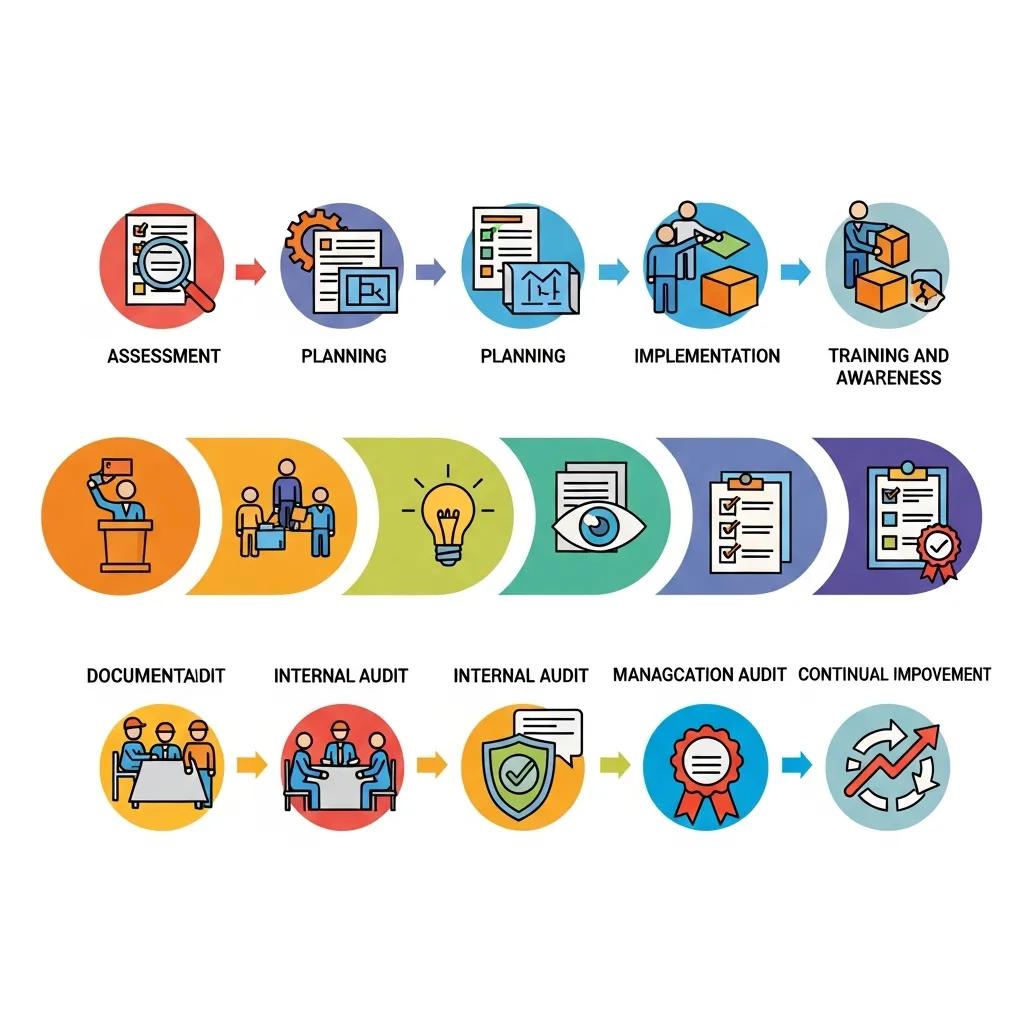
The certification journey for HR typically follows assessment, implementation, internal audit, certification audit and continual improvement. Start with a gap analysis to see where HR processes fall short of the standard, prioritise remediation and documentation, run internal audits to validate readiness and then complete the external certification audit. Timelines depend on scope: focused HR modules can take a few months; enterprise‑wide change will take longer.
Below is a numbered checklist that captures the standard certification sequence for HR teams preparing for ISO alignment.
- Conduct a gap analysis to map existing HR processes to standard requirements.
- Prioritise remediation actions, document procedures, and implement controls.
- Run internal audits and corrective-action cycles to validate readiness.
- Schedule and complete the external certification audit.
- Maintain certification through surveillance audits and continual improvement.
This concise path leads into practical steps for gap analysis and ongoing maintenance described in the following subsections.
What Are the Steps for Gap Analysis and ISO Implementation in HR?
A gap‑analysis workflow starts with scoping (which HR processes are in scope), evidence mapping (what records prove compliance), risk assessment and prioritisation by impact and effort. Useful evidence items include job descriptions, recruitment logs, onboarding checklists, training records, access‑control logs and policy documents — each mapped to specific standard clauses. Prioritise using a simple matrix: tackle high‑impact/low‑effort items first, then schedule high‑impact/high‑effort work into sprints; typical remediation sprints run 2–4 weeks per cluster.
Collecting standardised evidence and sequencing fixes creates momentum for internal audits and makes the external audit phase smoother. The next subsection explains how to keep certification active through continuous improvement.
How Can Organizations Maintain Certification and Drive Continuous Improvement?
Maintaining certification requires scheduled surveillance audits, regular internal audits and embedding PDCA cycles into HR governance so metrics are regularly reviewed and corrective actions are closed. Recommended cadences include quarterly internal reviews of human‑capital KPIs, an annual management review and surveillance audits as required by your certification scheme. Dashboards should show turnover trends, onboarding completion and open corrective actions to demonstrate ongoing compliance. Use audit findings to prioritise iterative updates and link HR metrics to business outcomes to justify investment.
These maintenance practices close the loop from certification back to operational improvement. Organisations that want an integrated delivery model often choose services that combine AI‑driven audits with certificate management to shorten timelines and simplify administration.
For organisations seeking an applied delivery model, Stratlane Certification provides a service portal and AI‑enabled audit methodology that guides clients from quote request to audit scheduling and certificate issuance, including certificate‑management features to streamline renewals and surveillance. Request a quote / Book an audit to see how an AI‑accelerated certification pathway fits your HR priorities.
Stratlane Certification is an innovative certification body that uses AI‑assisted audit tools and offers certification for ISO 9001, ISO 14001, ISO 27001, ISO 42001 and HR‑specific standards such as ISO 30414 and ISO 30415. We hold accreditation across multiple jurisdictions and operate with a global team able to support cross‑border certificate issuance. This positioning shows how technical audit capability and practical certificate management combine to help HR teams optimise processes.
Request a quote / Book an audit with Stratlane Certification to start a structured HR certification programme that pairs AI‑assisted evidence collection with managed certificate issuance and renewal workflows.
- Request a quote: Start with a scoped quote that clarifies standards and HR processes in scope.
- Schedule an AI-enabled audit: Use automated evidence collection to shorten audit timelines and increase coverage.
- Manage certificates: Use a service portal for issuance, storage and renewal tracking to maintain continuous compliance.
This conversion path gives HR teams a low‑friction route from assessment to certified practice while preserving the practical guidance in this guide.
Frequently Asked Questions
What is the role of AI in enhancing HR compliance with ISO standards?
AI speeds and broadens audits by automating evidence collection, normalising unstructured data and highlighting anomalies that may indicate compliance gaps. Natural‑language processing and machine learning help process large volumes of HR records so teams can focus on remediation and strategy. The net result is faster, more accurate compliance checks and lower audit overhead when models are governed responsibly.
How can organizations measure the impact of ISO certification on HR performance?
Measure before and after certification using KPIs aligned to your goals: turnover rates, time‑to‑hire, onboarding completion and engagement scores are common. Tracking these metrics over time demonstrates operational improvements, changes in employee experience and the business value of standardising HR processes.
What challenges might organizations face during the ISO certification journey?
Common challenges include resistance to change, limited understanding of ISO requirements and constrained implementation resources. Aligning existing HR activity with standard clauses requires documentation and training, and success needs visible leadership support. Address challenges with clear communication, structured training and a phased, prioritized remediation plan.
How does ISO certification support diversity and inclusion initiatives in HR?
Standards like ISO 30415 give you a framework for measurable D&I goals and accountability. Embedding D&I KPIs into recruitment, development and supplier management lets organisations track progress, spot gaps and ensure equitable practices. The structure improves transparency and helps build a genuinely inclusive workplace.
What are the long-term benefits of maintaining ISO certification for HR departments?
Maintaining certification yields sustained operational efficiency, improved employee engagement and lower compliance risk. Continuous adherence to standards fosters a culture of quality and accountability, strengthens decision‑making and keeps HR practices aligned with changing regulations. Over time, this builds reputation and stakeholder trust while supporting sustainable growth.
How can organizations ensure ethical AI use in HR auditing?
Adopt robust AI governance: validate models on representative data, document decision logic, enforce strict access controls and retain human oversight for critical decisions. Regular model audits and bias impact assessments ensure AI systems remain fair, transparent and compliant. Prioritising ethics builds confidence among employees and regulators while delivering audit efficiency.
Conclusion
ISO certification strengthens HR by standardising processes, tightening compliance and embedding continuous improvement. Applying frameworks such as ISO 30414 and ISO 30415 helps organisations measure human capital and advance diversity and inclusion, while AI‑driven auditing streamlines evidence collection and speeds certification. Ready to begin? Explore our services and request a quote to start your certification journey.