
Understanding IAF Accreditation and Its Global Impact

IAF and ISO Explained: Why Accreditation, the Certification Journey, and AI Matter
The International Accreditation Forum (IAF) and ISO standards form the backbone of credible, internationally recognized management system certification. This guide walks through what IAF accreditation is, the ISO certification lifecycle, and why accreditation gives certificates real weight in cross-border trade and procurement. We also look at how AI-driven auditing changes the picture—speeding evidence collection, improving the quality of findings, and enabling near‑continuous compliance monitoring. You’ll find a clear checklist of certification stages, practical benefits of global recognition, and a side‑by‑side view of traditional versus AI-assisted audits. We close with the main cost drivers for ISO 9001, how certification creates operational value, and why modern certificate management cuts long‑term admin work. Throughout, we reference terms like iaf accreditation, global recognition, ISO certification process, AI-driven auditing, and certificate management so practitioners and decision-makers can quickly find relevant answers.
What is IAF Accreditation and Why Does It Matter?
IAF accreditation means an accreditation body has been evaluated against international criteria to assess and approve certification bodies. That chain of oversight ensures certificates issued by accredited certification bodies are reliable and broadly accepted. The system rests on peer evaluations, mutual recognition through the IAF Multilateral Recognition Arrangement (MLA), and ongoing oversight that aligns national practices with global norms. The practical payoff is trust: buyers and regulators can accept an IAF‑backed certificate without repeating audits, which reduces friction in trade and procurement. The section below explains the specific mechanisms the IAF uses to preserve that trust at scale.
How Does the IAF Ensure Global Certification Integrity?
IAF preserves certification integrity through structured peer evaluations, scheduled reassessments of accreditation bodies, and the MLA that commits signatories to shared assessment standards. Peer evaluations review policies, technical competence, and decision consistency, identifying gaps and driving corrective action so practices stay aligned across borders. The MLA promotes mutual acceptance of certificates among signatories, supporting cross‑border recognition for contracts and regulatory reliance. These oversight layers limit certificate variability and create a predictable conformity‑assessment environment—exactly the kind of assurance buyers and regulators need. Mapping those IAF activities shows how governance delivers practical confidence for certificate users.
| IAF Function | Mechanism | Outcome |
|---|---|---|
| Governance | Peer evaluation of accreditation bodies | Consistent application of standards |
| MLA Recognition | Mutual acceptance framework among signatories | Cross‑border acceptance of certificates |
| Assurance | Oversight and periodic reassessment | Reduced risk of unreliable certifications |
This layout connects IAF activities to outcomes that matter to buyers, regulators, and certified organizations. That assurance is the foundation for the commercial benefits we cover next.
What Are the Benefits of IAF Accreditation for Businesses?
IAF accreditation delivers measurable advantages: it builds trust, opens international markets, and simplifies procurement acceptance. For buyers, an IAF‑backed certificate signals that a certification body met international criteria, reducing the need for duplicate checks and speeding supplier onboarding. For sellers, accredited certification often unlocks tenders, regulatory approvals, and supply‑chain opportunities that require formal compliance evidence. That credibility lowers perceived vendor risk and shortens commercial negotiations—saving time and money as organizations scale. The next section explains the ISO certification process so you can see where accreditation and certification intersect.
How Does the ISO Certification Process Work?
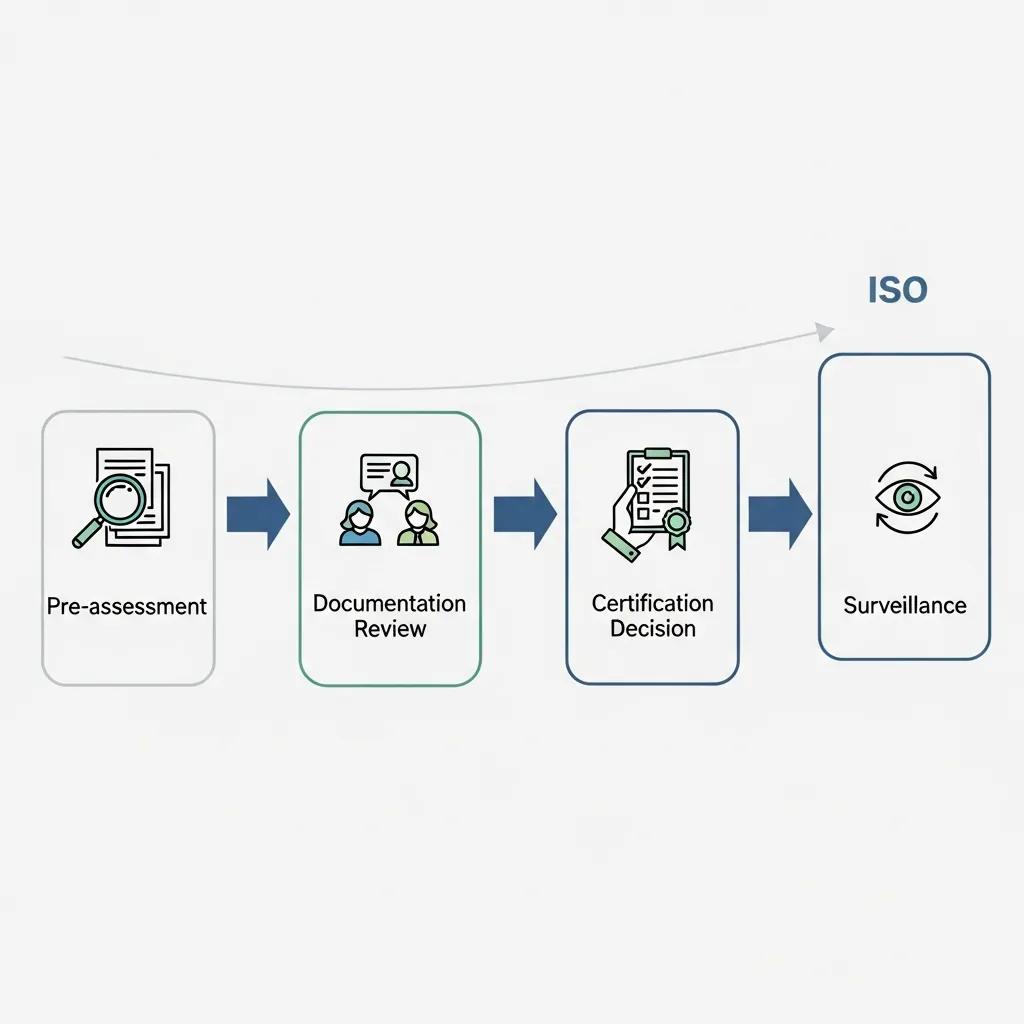
The ISO certification lifecycle moves from readiness checks through formal audits to ongoing surveillance. Most organizations begin with a pre‑assessment or gap analysis to surface deficiencies and prioritize fixes before a Stage 1 documentation review and a Stage 2 conformity audit. After auditors verify conformity against the selected ISO standard and evidence, the certification body makes a decision and, if successful, issues the certificate. Surveillance audits—typically annual—and full recertification cycles—commonly every three years—keep the system working. The process balances document review, operational verification, and corrective‑action closure so certification reflects sustained system performance, not a one‑time checklist. Knowing these stages helps plan resources and timelines for a smooth certification run.
- Pre‑assessment and gap analysis: Compare your current system against the ISO standard and identify corrective priorities.
- Stage 1 – Documentation review: Confirm management system scope, policies, and readiness for a full audit.
- Stage 2 – Conformity audit: On‑site or remote verification of processes, evidence, and effectiveness.
- Certification decision and issuance: Independent review leads to grant or denial of certification.
- Surveillance and recertification: Regular audits sustain conformity and drive continuous improvement.
These steps form a practical roadmap for organizations preparing for ISO certification and set the context for where AI tools can boost efficiency and evidence quality.
What Are the Key Steps in Obtaining ISO Certification?
Getting ISO certified requires disciplined preparation, objective auditing, and timely corrective‑action management. Start with internal audits and a gap analysis to define scope and align processes with the standard—this reduces surprises in Stage 1. During Stage 1, the certification body reviews documentation and readiness, which shapes the Stage 2 audit plan where auditors confirm operational implementation and collect objective evidence. If nonconformities appear, implement corrective actions with root‑cause analysis and have auditors verify closure before the certification decision. These sequential actions ensure certification reflects effective system operation, not superficial compliance, and prepare the organization for ongoing surveillance audits.
How Does Stratlane’s AI-Driven Auditing Enhance the Certification Process?

Stratlane integrates AI‑driven audit tools into the ISO workflow to speed evidence collection, surface anomalies, and provide continuous compliance visibility—helping certification decisions happen faster and with higher confidence. Our AI automates routine checks, structures audit evidence into usable reports, and highlights risk patterns that traditional sampling can miss so auditors can focus on technical judgments and systemic issues. Stratlane provides accredited ISO certification services across multiple standards and operates with auditors in 29+ countries and service coverage in over 27 countries. You can request a quote or book an audit with Stratlane to see how AI assistance shortens timelines and improves audit accuracy. These tools augment traditional audit stages while preserving the impartiality required by accreditation bodies.
With accredited certification and AI audit features, Stratlane helps organizations turn readiness into certified compliance more efficiently—without compromising integrity. Next, we outline the strategic advantages of global ISO recognition for market access and reputation.
What Are the Advantages of Global ISO Recognition?
Global ISO recognition benefits exporters, suppliers, and multinational firms by creating a shared language of compliance that buyers, regulators, and partners trust. A recognized ISO certificate simplifies cross‑border procurement because buyers can assess supplier capability against a global standard rather than bespoke local checks. Certification also strengthens brand reputation by proving consistent management practices, helping organizations stand out in crowded markets. In regulated industries and complex supply chains, ISO recognition reduces friction in approvals and speeds supplier onboarding—making certification a strategic asset when expanding internationally. Below are practical advantages to consider.
- ISO recognition builds trust with international partners and regulators.
- Many tenders and large contracts prefer or require ISO certification.
- Certification improves supplier positioning in global supply chains.
These advantages translate into concrete opportunities for organizations ready to use certification as a market‑access tool.
How Does ISO Certification Facilitate International Market Access?
ISO certification eases market access by aligning your management system with internationally accepted practices that buyers and regulators recognize as evidence of competence and control. For exporters, certified suppliers reduce buyer due diligence and are more likely to meet regulatory or contractual prerequisites quickly, shortening negotiation cycles. Certification can also act as a baseline where local requirements map to ISO standards, smoothing entry into markets like the EU, UK, and North America. Operational considerations include confirming your certificate scope covers the exported product or service and keeping up with surveillance audits to preserve recognition. These realities explain why certification credibility affects SMEs and large corporations differently.
Why Is Certification Credibility Important for SMEs and Corporations?
Certification credibility directly influences procurement access, risk perception, and supply‑chain confidence. SMEs often rely on accredited certificates to qualify for tenders and gain initial market entry; for them, accreditation is a trust signal that levels the playing field. Larger corporations use accredited certificates across suppliers to reduce audit duplication, streamline assurance programs, and strengthen supply‑chain resilience. Practical steps include scoping certification to customer requirements for SMEs and integrating certificate checks into procurement workflows for larger organizations. That naturally leads to how AI‑enabled auditing supports credible, efficient compliance at scale.
How Does AI-Driven Auditing Improve ISO Compliance?
AI‑driven auditing improves ISO compliance by automating evidence aggregation, detecting patterns and anomalies in operational data, and powering near‑real‑time dashboards that support continuous monitoring and faster corrective‑action cycles. In practice, AI ingests structured and unstructured sources—logs, records, process metrics—and correlates them against audit checklists, risk models, and historical findings to highlight where auditors should focus. The results are faster audit cycles, better detection of subtle nonconformities, and stronger capacity to maintain compliance between scheduled audits. These capabilities shift the model from periodic inspection to ongoing assurance and risk‑based auditing. The subsection below maps key AI audit features to their benefits.
Research further explains how AI approaches speed audits and improve consistency in compliance findings.
AI-Driven Compliance Audits: Faster, Consistent Findings
AI‑based compliance auditing combines machine learning, natural language processing, and automation to identify regulatory gaps, extract evidentiary material, and deliver audit findings faster and more consistently. The paper outlines a hybrid model using transformer‑based NLP for interpreting contracts and regulations, supervised anomaly detection on transaction streams, and an explainability layer that maps model outputs back to regulatory clauses and audit trails.
AI‑
Driven Compliance Audits: Enhancing Regulatory Adherence in Financial and Legal Sectors, ST Gandhi, 2023
What Are the Features of AI-Driven Auditing in ISO Certification?
AI‑driven auditing commonly includes automated data ingestion, anomaly and pattern detection, risk scoring, and automated reporting that turns raw evidence into auditor‑ready findings. Automated evidence collection pulls records from multiple systems, reducing manual sampling and freeing auditors to focus on interpretation and systemic risk. Pattern detection and risk scoring surface trends and outliers across process data so audits target material risks rather than exhaustive checklists. Real‑time dashboards and templated reports speed audit closeout and give stakeholders clearer visibility into corrective‑action progress. The table below pairs features with typical improvements.
| Feature | Attribute | Improvement |
|---|---|---|
| Automated evidence collection | Data integration from multiple sources | Lower manual workload; faster audit preparation |
| Anomaly detection | Statistical pattern recognition | Higher chance of finding subtle nonconformities |
| Continuous monitoring | Event‑driven alerts and dashboards | Faster remediation and reduced operational risk |
This feature→benefit mapping shows how AI attributes convert into measurable audit improvements. The next section quantifies efficiency and accuracy gains and outlines readiness steps to adopt AI audits.
How Does AI Increase Audit Efficiency and Accuracy?
AI raises audit efficiency by automating repetitive verification tasks, cutting the time spent on evidence gathering, and producing structured outputs auditors can review quickly. Accuracy improves because machine learning correlates diverse datasets to surface inconsistent patterns and potential nonconformities that random sampling can miss—yielding more consistent, repeatable assessments. Illustrative metrics (for guidance) suggest automated processes can reduce preparatory time by 30–60% and accelerate root‑cause identification; organizations should validate these gains in their own context. To realize benefits, ensure good data quality, define process interfaces, and train auditors to interpret AI outputs so professional judgment remains central. These readiness steps help organizations adopt AI‑driven audits while meeting accreditation and certification standards.
What Are the Costs and Value of ISO 9001 Certification?
ISO 9001 cost depends on drivers such as company size, certification scope, system maturity, number of sites, and chosen certification services—each affects audit effort, travel, and surveillance fees. While specific prices vary, you can estimate cost drivers to budget and target improvements that shorten time‑to‑certification and lower long‑term costs. The value from ISO 9001 typically includes operational efficiency gains, improved customer satisfaction, and access to contracts requiring quality management certification—delivering measurable ROI over time. Modern certificate management also lowers admin burden by centralizing certificates for validity checks and downloads, cutting the cost of managing many supplier certificates. Below we break down key cost drivers and offer tips to control spending.
| Cost Driver | Impact | Estimated Range |
|---|---|---|
| Company size and headcount | More processes and audit time | Small: low; Medium: moderate; Large: higher |
| Scope complexity (products/services) | Number of audit days and specialists required | Low–High depending on complexity |
| Readiness level | Pre‑audit preparation and corrective actions | Low readiness increases consulting/audit time |
| Multiple sites | Travel and duplicate audit effort | Adds proportional audit days and cost |
This table clarifies how structural factors translate into effort and expense, helping teams budget and schedule certification projects more accurately.
What Factors Influence ISO 9001 Certification Costs?
Key cost influences include organization size, scope breadth, system maturity, geographic footprint, and whether you use external consultants or pre‑assessment services. Larger or multi‑site organizations need more audit days and technical expertise, which raises costs; a broad scope covering many products or services also increases complexity. Organizations with mature systems and active internal audit programs can reduce certification effort by resolving nonconformities before the formal audit. Travel and logistics for on‑site audits affect pricing, especially for remote locations or when multiple auditors are needed. Practical cost controls include narrowing the initial scope strategically, investing in internal readiness, and using centralized certificate management to cut downstream admin costs.
How Does Certification Deliver ROI and Operational Benefits?
ISO 9001 delivers ROI through better process consistency, fewer quality incidents, and higher customer satisfaction—reducing rework and improving contract win rates. Standardized processes clarify responsibilities, lower variability, and improve throughput, often producing savings that offset certification costs within a few reporting cycles. Certified organizations also report stronger supplier and customer relationships because accredited certificates simplify evidence exchange and reduce duplicated audits. Digital certificate management and a centralized certificate database for validity checks and downloads further reduce administrative overhead and speed procurement. Quantify expected efficiency gains in areas like defect reduction and order‑to‑invoice times to build a business case that supports strategic goals.
For tailored cost estimates or to explore how AI‑enabled auditing and certificate management can lower total cost of ownership, request a quote or an audit engagement with an accredited provider that combines automated audit processes and certificate database services.
- Identify scope and locations: Define exactly what you need certified to target audit effort effectively.
- Assess readiness internally: Close obvious gaps before formal audits to reduce audit days.
- Consider AI‑assisted auditing and certificate management: Use automation to lower ongoing costs and improve visibility.
These steps help translate certification into lasting operational value while keeping upfront and recurring costs under control.
Frequently Asked Questions
What is the role of AI in enhancing the ISO certification process?
AI speeds up and sharpens the certification process by automating data collection, improving the consistency of evidence, and supporting continuous compliance monitoring. Machine learning analyzes large volumes of operational data to spot patterns and anomalies that could indicate nonconformities, letting auditors focus on higher‑value judgements. The result is a faster, more accurate audit experience that preserves rigorous standards while reducing manual effort.
How can organizations prepare for ISO certification effectively?
Prepare by running internal audits and a gap analysis to identify and prioritize improvements. Set a clear certification scope, align processes to the standard, and resolve obvious issues before the formal audit. Pre‑assessment services can provide an external check on readiness and help streamline the formal audit, reducing the chance of major nonconformities.
What are the common challenges faced during the ISO certification process?
Common challenges include incomplete documentation, low employee engagement, and misunderstanding standard requirements. Aligning existing processes to the standard can take time, and managing corrective actions requires resources and discipline. Address these issues with targeted training, clear ownership of tasks, and tools that simplify documentation and evidence management.
How does ISO certification impact supplier relationships?
ISO certification creates a shared framework of quality and compliance that builds trust between buyers and suppliers. Certified suppliers are often seen as more reliable, which can open new business opportunities and reduce procurement risk. Accredited certificates also streamline supplier onboarding—buyers accept certified vendors with less extra verification—strengthening partnerships and improving supply‑chain efficiency.
What is the significance of ongoing surveillance audits after certification?
Surveillance audits ensure organizations keep meeting the standard over time. They catch deviations early, create opportunities for continuous improvement, and protect the value of the certificate. Regular reassessment reinforces commitment to quality and helps maintain stakeholder confidence and competitive advantage.
How can organizations leverage AI to reduce ISO certification costs?
AI reduces costs by automating routine audit tasks—cutting time for evidence collection and analysis—and by offering continuous monitoring that lowers the risk of expensive corrective actions. Automated report templates and prioritized findings let auditors close audits faster and focus on material issues, delivering ongoing savings in audit effort and admin overhead.
What are the long-term benefits of achieving ISO certification?
Long‑term benefits include improved operational efficiency, higher customer satisfaction, and stronger market competitiveness. Certified organizations see fewer quality incidents and less rework, which drives cost savings. Certification also opens doors to new contracts where clients prefer or require certified suppliers. Over time, the credibility of certification strengthens brand reputation and supports sustainable growth.
Conclusion
IAF accreditation and the ISO certification process deliver clear commercial and operational advantages: they build trust, streamline procurement, and open market access. AI‑driven auditing further enhances these benefits by speeding evidence collection, improving detection, and enabling continuous visibility into compliance. Use these insights to shape a certification approach that supports your business objectives. Explore our accredited certification services to see how we can help you achieve and sustain compliance efficiently.