
Achieve Sustainability Compliance with ISO 14001 Strategies

ISO 14001 Certification — Practical steps to meet environmental requirements
ISO 14001 is the global standard for Environmental Management Systems (EMS). This guide explains how ISO 14001:2015 works as a compliance framework, reduces regulatory complexity, and delivers measurable environmental improvements that keep pace with changing laws and green standards. You’ll get a clear view of the core requirements, how the Plan-Do-Check-Act cycle enforces continuous compliance, and practical steps to prepare for certification. We also compare regulatory priorities in the US, EU, and UK, outline measurable benefits like cost savings and reputational gains, and show how AI-assisted auditing can shorten certification timelines. Finally, follow a step‑by‑step path from gap analysis to surveillance audits so your team can pursue certification with confidence while staying aligned with regulators.
What is ISO 14001 and how it supports environmental compliance
ISO 14001 sets out the requirements for an EMS so organizations can identify and control environmental aspects, meet legal obligations, and pursue continual improvement. The standard asks organizations to map environmental aspects and applicable laws, set objectives, implement controls, monitor performance, and review results through management cycles. Those documented processes and records form the evidence regulators commonly expect and help demonstrate due diligence. Recent updates through 2023 emphasize lifecycle thinking and climate-related factors, aligning EMS practice with current environmental regulation and green standards.
Stratlane is an accredited certification body that offers ISO certification services worldwide and can certify an EMS once it meets audit criteria. We combine accredited third‑party assessments with AI-enabled tools to streamline evidence collection and sharpen audit focus, reducing time on site without compromising rigor. Naming an accredited provider early makes the connection between the ISO framework and practical, third‑party verification — the framework defines expectations; certified auditors and modern audit techniques make conformity assessment faster and more effective.
What defines the ISO 14001 Environmental Management System?
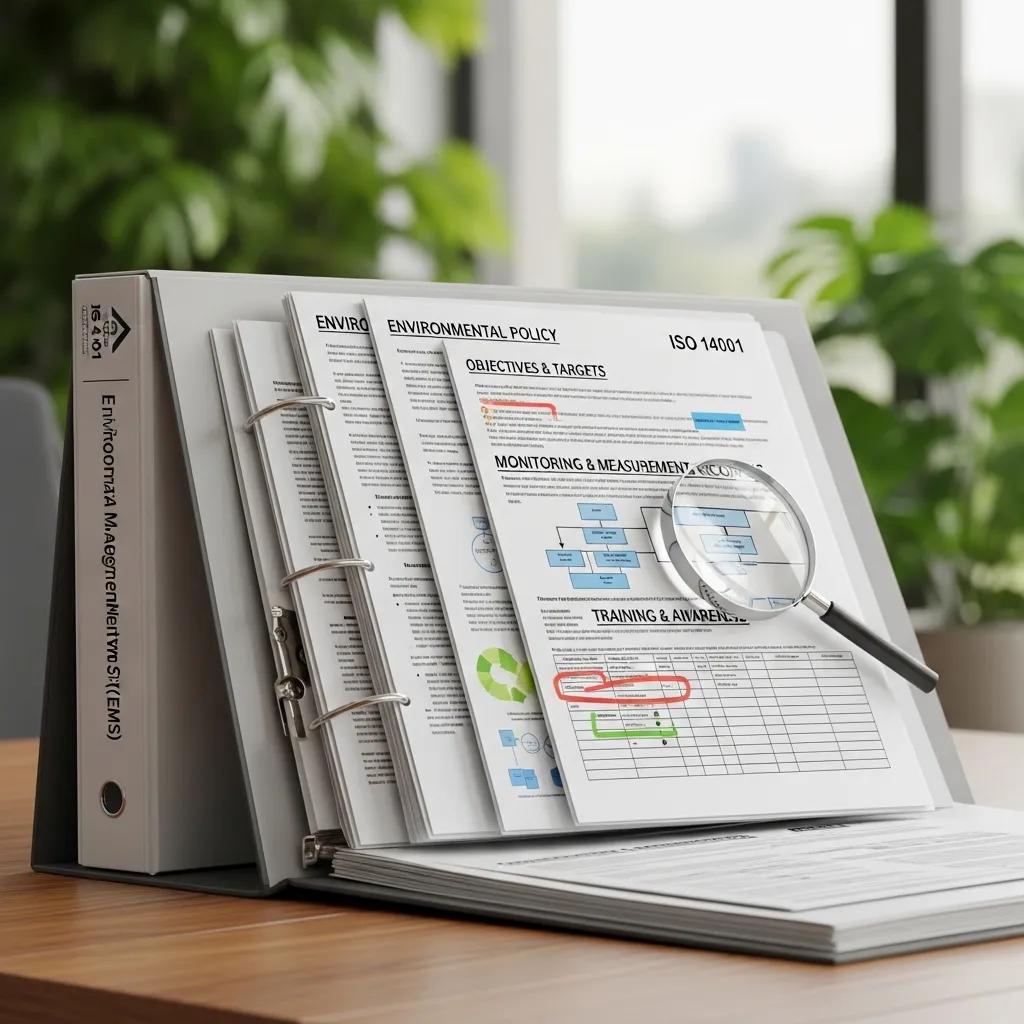
An ISO 14001 EMS is built from linked elements: an environmental policy, planning (aspects and obligations), operational controls, monitoring and measurement, internal audit, and continual improvement. The policy expresses leadership commitment. Planning identifies environmental aspects, legal and regulatory obligations, and sets measurable objectives. Operational controls turn the policy into procedures and work instructions for significant areas like emissions, waste, and resource use. Monitoring and internal audits generate the records needed for management review and corrective actions that drive ongoing improvement and sustained compliance.
How ISO 14001 aligns with global environmental regulations
ISO 14001 helps organizations translate legal obligations into auditable EMS processes. Regulatory mapping — cataloguing applicable laws, building compliance checklists, and embedding permit limits into operational controls — ensures permits, reporting, and controls become part of everyday practice. Agencies such as the US EPA, the European Environment Agency, and the UK Environment Agency expect documentary evidence of monitoring, incident response, and training — all elements ISO 14001 requires. For multinational operations, a single EMS framework enables consistent governance across jurisdictions while meeting local requirements.
Key requirements for achieving ISO 14001 certification
To achieve ISO 14001 certification organizations must demonstrate a systematic approach across the standard’s clauses: context, leadership, planning, support, operation, performance evaluation, and improvement. Auditors typically look for documented processes, monitoring records, a legal register, training and competence evidence, internal audit reports, and management review outputs. Typical preparation steps include a gap analysis, implementation of controls, internal audits, corrective actions, and a formal management review to confirm readiness. The standard’s focus on continual improvement makes compliance an ongoing, measurable process rather than a one‑off task.
Note: the table below maps ISO clauses to practical actions and the types of evidence auditors commonly request. Use it to prepare concrete, audit‑ready documentation for each clause.
| Clause or Area | What to do | Typical evidence / Example |
|---|---|---|
| Context & Stakeholders | Document internal/external issues and stakeholder expectations | Scope statement, stakeholder register, risk and opportunity log |
| Leadership & Policy | Secure top management commitment and a written environmental policy | Signed policy, aligned objectives, roles and responsibilities |
| Planning (Aspects & Compliance) | Identify environmental aspects, legal requirements, objectives and targets | Aspects register, legal register, SMART objectives and KPIs |
| Support (Resources & Competence) | Provide resources, training, and documented procedures | Training records, competence matrix, documented procedures |
| Operations & Controls | Apply operational controls where aspects are significant | Work instructions, permits, maintenance and inspection records |
| Performance Evaluation | Monitor, measure and audit environmental performance | Monitoring logs, internal and external audit reports, management review minutes |
| Improvement | Manage nonconformities and pursue continual improvement | Corrective action records, improvement project notes, trend analysis |
Which clauses and steps organizations must follow for ISO 14001
Certification audits assess conformity with ISO 14001:2015 core clauses — documented context, a clear policy, planned actions for significant aspects, and records that demonstrate support and operational control. Practical steps include performing a gap analysis against clause requirements, updating the legal register, implementing operational controls for significant aspects, and setting KPIs for objectives. Internal or mock audits reveal nonconformities and supply corrective action evidence for auditors. Leadership involvement in management review and objective setting closes the loop between planning and improvement — a key audit focus.
How the Plan‑Do‑Check‑Act cycle facilitates compliance
Plan‑Do‑Check‑Act (PDCA) is the engine of ISO 14001: Plan by identifying aspects, obligations, and objectives; Do by implementing controls and procedures; Check by monitoring, measuring, and auditing; Act by reviewing results and making improvements. PDCA ties regulatory requirements to tangible activities that produce auditable records — monitoring logs, corrective actions, and management review minutes. Regular PDCA cycles help organizations convert regulatory changes into updated plans and controls, lowering compliance risk through documented, repeatable steps.
Benefits of ISO 14001 certification for environmental compliance
ISO 14001 certification delivers practical benefits: lower regulatory risk, operational efficiencies from better resource management, and improved market access through verified environmental performance. A certified EMS provides the documentation regulators and customers expect, strengthening trust and procurement eligibility. Organizations often report cost reductions from less waste, energy savings, and fewer incidents, while certification supports stronger ESG reporting and stakeholder confidence. In short, ISO 14001 turns environmental obligations into measurable business value.
Research underlines ISO 14001’s strategic value, its growing adoption, and the practical trade‑offs organizations weigh when implementing an EMS.
ISO 14001:2015 — benefits, costs and strategic value
Over the past decade ISO 14001 has become a strategic tool for many organizations. While adoption has grown steadily, some organizations pursue certification mainly for advantages like permit simplifications or finance incentives, which can risk superficial compliance or image‑focused “greenwashing.” When implemented with genuine operational change, however, an EMS can deliver measurable benefits across compliance, cost control, and reputation. The balance between investment and value depends on clear objectives, leadership commitment, and robust implementation.
| Benefit type | Quantified impact | Example / Illustration |
|---|---|---|
| Regulatory risk reduction | Fewer compliance incidents and penalties | A maintained legal register reduces permit noncompliance risks |
| Operational efficiency | Resource savings (energy, materials) | Energy monitoring can yield 5–15% utility cost reductions |
| Cost avoidance | Lower incident and remediation costs | Fewer spills cut remediation expenses and downtime |
| Market & reputational gain | Higher procurement eligibility | Certified suppliers win bids that require environmental credentials |
How ISO 14001 improves environmental performance and sustainability
ISO 14001 drives performance by requiring measurable objectives, KPI tracking, and root‑cause analysis for nonconformities. Metrics like energy intensity or waste per unit create targets and trend data that management reviews assess. The EMS encourages lifecycle thinking and aligns operational controls with broader sustainability goals, supporting ESG reporting and stakeholder transparency. In practice, ISO 14001 converts sustainability ambitions into operational metrics and corrective actions that deliver measurable environmental improvements.
What cost savings and competitive advantages certification can bring
Certification often produces direct cost savings through efficiency projects identified via monitoring and audits — for example lower energy use or reduced waste disposal fees. Certified organizations commonly qualify for contracts with environmental prequalification, opening new business opportunities. Risk reduction lowers the chance and cost of environmental incidents, while verified performance can strengthen brand value. Examples include multi‑thousand‑dollar annual savings from resource reduction projects and procurement wins tied to documented environmental performance.
How Stratlane’s AI‑driven auditing improves the certification process

Stratlane pairs accredited third‑party auditing with AI tools to speed and focus ISO 14001 assessments while preserving auditor judgement. Our AI aggregates documents, flags anomalies, and prioritizes high‑risk areas so auditors concentrate on substantive compliance issues instead of routine evidence gathering. That reduces time spent on manual review and cuts non‑value work, improving efficiency and lowering indirect costs from business disruption. Stratlane’s global accreditation and distributed auditor network — certificates in 27+ countries and auditors in 29+ countries — support multinational clients that need consistent certification across jurisdictions.
- Faster evidence processing: Automated document aggregation shortens preparation time and speeds audit readiness.
- Targeted audit focus: Risk scoring highlights priority compliance areas, improving audit precision.
- Lower administrative burden: Automated checklists and anomaly detection reduce manual review and rework.
These AI‑enabled gains translate to shorter audit windows, fewer on‑site days, and clearer, more actionable findings. For organizations that want to accelerate certification without sacrificing rigor, combining an accredited provider with AI tools streamlines the route to a successful assessment.
What role does AI play in audit efficiency and accuracy?
AI helps by rapidly aggregating evidence, spotting patterns or outliers, and flagging items that need human attention. Pattern detection speeds trend analysis in monitoring data and highlights deviations that may signal noncompliance. Automated checklists ensure consistent coverage of clause requirements and reduce human error in routine verification. That said, human auditor judgement remains crucial for contextual interpretation, complex legal assessments, and interviews that verify implementation beyond documents.
How AI‑driven auditing reduces certification costs and time
AI shortens certification timelines by cutting the volume of manual evidence reviews and directing auditor effort where it matters most. This can reduce on‑site audit days and compress the overall certification cycle. Indirect costs — staff time spent supporting audits and operational downtime during assessments — fall when AI handles repetitive evidence tasks. Fewer unclear findings and a more focused audit scope also speed closure of nonconformities and certificate issuance, improving cost efficiency across the certification lifecycle.
How ISO 14001 helps navigate regional environmental regulations
ISO 14001 lets organizations embed legal registers, permit obligations, and reporting requirements into a single EMS. That approach supports consistent controls across jurisdictions while allowing local procedures to address specific laws. An EMS provides structured documentation, monitoring records, and incident response procedures that simplify inspections and reporting to different agencies. Using ISO 14001 as a common framework reduces duplication, clarifies governance, and harmonizes compliance activities across regions.
| Region | Regulatory focus | How ISO 14001 maps to requirement |
|---|---|---|
| US | EPA permits, emissions reporting, hazardous waste management | Legal register, operational controls, spill response procedures |
| EU | Directives, lifecycle/ecodesign, circular economy initiatives | Lifecycle thinking in planning, aspect controls, supply‑chain considerations |
| UK | Domestic permitting, reporting, environmental governance | Permit integration in controls, robust monitoring, management review evidence |
What are the compliance requirements in the US, EU, and UK?
In the US, compliance typically centers on meeting EPA permit limits, emissions inventories, and hazardous waste rules — all of which require documented controls and monitoring data. The EU emphasizes directives, product lifecycle considerations, and circular economy policy, encouraging lifecycle thinking and supplier controls. In the UK, permitting and reporting demand clear evidence of monitoring, incident control, and governance. Across regions, ISO 14001’s documentation and performance evaluation requirements create the auditable records regulators expect and make multi‑jurisdictional compliance easier to manage.
How ISO 14001 supports adherence to green standards and sustainability laws
ISO 14001 underpins sustainability claims and ESG disclosures by delivering verified operational controls and documented performance metrics. EMS records — objective trends, emissions data, and corrective action logs — feed sustainability reporting and third‑party verification. The standard’s lifecycle perspective aligns with eco‑design and circular economy rules, helping organizations demonstrate compliance with evolving green regulations. Treating environmental performance as a managed, measurable system gives legal and market‑ready evidence of sustainability commitments.
Step‑by‑step process for ISO 14001 certification with Stratlane
Working with an accredited provider like Stratlane follows a clear path from initial inquiry to certificate issuance and ongoing surveillance, with AI tools to streamline evidence submission and audit focus. The typical steps are: request a quote or preliminary assessment, perform a gap analysis, implement the EMS, run internal audits, then undergo the certification audit. After the audit, organizations receive any nonconformity reports, complete corrective actions, and, once verified, the certification body issues the certificate. Regular surveillance audits then maintain certification and support continual improvement.
- Scope and site details: Define the facilities, operations, and processes included in the EMS scope.
- Existing documentation: Gather policies, the legal register, monitoring records, and internal audit reports.
- Key personnel and roles: Identify a management representative and operational contacts for the audit.
Providing these items upfront shortens the quoting phase and ensures the audit scope is accurate, reducing surprises and allowing targeted use of AI for document aggregation and pre‑audit checks.
How to request a quote and prepare for the audit
When requesting a quote, share a clear EMS scope, a list of sites or activities, and an overview of existing documentation so your certification body can estimate audit effort and logistics. Prepare by completing a gap analysis, updating the legal register, conducting at least one internal audit, and ensuring staff understand roles and procedures. AI tools that collate documents and monitoring data speed pre‑audit evidence assembly and pinpoint remaining gaps. Typical preparation timelines run 2–6 weeks for planning, internal verification, and final readiness checks so auditors can assess implementation effectively.
What are the final steps to obtain and maintain certification?
After the certification audit, auditors issue a report listing any nonconformities that require corrective action. Organizations must resolve these within agreed timelines and provide evidence of correction. Once corrective actions are verified, the certification body issues the ISO 14001 certificate and sets the surveillance audit schedule, typically annual, to confirm continued conformity. Certificate management includes documenting changes, retaining monitoring and audit records, and preparing for re‑certification cycles that reaffirm EMS effectiveness. Stratlane can support certificate lifecycle management by coordinating surveillance audits and using AI tools to keep a clear evidence trail for ongoing compliance.
- Request quote and define scope: Provide site, activity and documentation details for accurate quoting.
- Implement EMS and conduct internal audit: Remedy gaps and validate implementation internally.
- Certification audit and corrective actions: Undergo assessment, resolve findings, and receive certification.
- Surveillance and re‑certification: Participate in scheduled surveillance audits and periodic re‑certification.
These sequential steps create a clear path from initial engagement to sustained certification, helping organizations meet regulatory obligations and maintain continual improvement.
What are the final steps to obtain and maintain certification?
Once audit findings are closed, the organization provides corrective action evidence for auditor review to confirm effective resolution. The certification body then issues the certificate and notifies the organization of surveillance audit dates that preserve accreditation status. Maintaining the certificate requires regular monitoring, internal audits, and management reviews to show the EMS continues to meet ISO 14001 requirements. For multinational clients, centralized certificate management and coordinated surveillance scheduling reduce administrative burden and support consistent compliance across jurisdictions.
Frequently asked questions
What is the difference between ISO 14001 and other environmental standards?
ISO 14001 focuses on establishing an Environmental Management System (EMS) to manage environmental responsibilities systematically. Other standards target different areas — for example, ISO 50001 focuses on energy management, while ISO 9001 covers quality. ISO 14001 is versatile across industries because it emphasizes legal compliance, continual improvement, and stakeholder engagement, making it straightforward to integrate environmental considerations into overall management systems.
How can organizations ensure continuous improvement after certification?
Continuous improvement relies on regular monitoring, internal audits, and management reviews. Set clear KPIs to track environmental performance and use audit results to drive corrective actions and projects. Engage employees through training and awareness programs and use the PDCA cycle to adapt the EMS to changing regulations and stakeholder expectations. Those routines keep improvement active, measurable, and demonstrable.
What role do employees play in achieving ISO 14001 compliance?
Employees are central to ISO 14001 success because they implement procedures and controls daily. Training and awareness ensure staff understand their responsibilities and the importance of environmental management. Encouraging participation in improvement initiatives builds ownership and helps embed the EMS into everyday operations, improving overall performance.
How does ISO 14001 certification impact an organization's reputation?
ISO 14001 certification signals a formal commitment to environmental responsibility. It reassures customers, regulators, and stakeholders that the organization manages environmental risks and performance systematically. That credibility can strengthen customer relationships, open procurement opportunities, and enhance brand value — especially where environmental credentials are part of supplier selection.
What are the common challenges organizations face during the certification process?
Common challenges include resistance to change, limited resources, and insufficient employee engagement. Aligning existing practices to ISO requirements can be complex, especially for multi‑site organizations or those operating across jurisdictions. Address these challenges by securing leadership support, allocating resources for training and implementation, and using internal audits to surface and fix gaps early.
How can technology assist in maintaining ISO 14001 compliance?
Technology automates data collection, monitoring, and reporting, reducing manual effort and improving accuracy. Software platforms can centralize environmental data, simplify internal audits, and track KPIs. AI tools enhance audits by finding anomalies and prioritizing high‑risk areas. The right technology reduces administrative load and helps teams respond quickly to compliance needs.
What are the costs associated with obtaining and maintaining ISO 14001 certification?
Costs vary based on organization size, complexity, and current systems. Initial expenses may include training, consultancy, and implementation work to meet ISO requirements. Ongoing costs cover internal audits, surveillance audits, and continuous improvement activities. Many organizations find that long‑term savings from improved resource efficiency and reduced regulatory risk offset the initial investment.
Conclusion
ISO 14001 certification gives organizations a practical, auditable way to manage environmental responsibilities and stay aligned with global regulations. The standard reduces operational risk, drives continual improvement, and converts environmental commitments into measurable business results. Partnering with an accredited provider like Stratlane — and leveraging AI‑assisted auditing where appropriate — can streamline the certification journey and improve efficiency. If you’re ready to strengthen compliance and environmental performance, explore our certification services to get started.