
Driving QMS Improvement Through Effective Corrective Actions

Driving Continual Improvement with ISO 9001:2015 — Practical PDCA Guidance for Better Quality
Continual improvement under ISO 9001:2015 is the ongoing, intentional work to make your quality management system (QMS) perform better — from product quality to delivery and customer outcomes. It runs on iterative learning: Plan-Do-Check-Act cycles driven by performance data, corrective actions and management review, in line with Clause 10. Organizations that make continual improvement part of their day-to-day reduce defects, improve delivery predictability, and boost customer satisfaction while lowering operational risk. This guide walks through Clause 10’s intent, a step-by-step PDCA approach, corrective-action lifecycle and root-cause methods, plus practical KPIs and QMS tactics. You’ll also see how AI-powered auditing and predictive analytics speed each stage, and what emerging ISO 9001-2025 trends mean for your QMS in practice.
What is the ISO 9001 Continual Improvement Process and Why It Matters
Under ISO 9001:2015, continual improvement is a formal expectation: you must steadily improve the suitability, adequacy and effectiveness of your QMS. That happens when teams use performance data, corrective actions and management reviews to spot opportunities and apply PDCA-style changes that deliver measurable results. The practical payoff is clearer compliance with customer and regulatory requirements, fewer nonconformities, and stronger market credibility. With this foundation, you can design governance, metrics and evidence collection that sustain real improvement over time.
How ISO 9001 Clause 10 Frames Continual Improvement
Clause 10 requires organizations to identify and act on improvement opportunities so they meet customer requirements and raise performance. It expects evidence-based decisions, an effective corrective-action process for nonconformities, and verification that changes actually worked. In practice, that means keeping records, watching trends and proving that corrective and improvement actions achieved their goals. Treating Clause 10 as a management responsibility builds routines — trend analysis, verification checks and documented follow-through — that keep improvement moving forward.
What Benefits Come from a Working Continual Improvement Process?
When continual improvement is active, improvements show up in both operations and the bottom line. You can expect fewer defects, higher yield, faster responses to customer feedback and stronger regulatory performance — all of which lower costs and build trust. Typical metrics that improve include reduced NCRs per month, better first-pass yield and higher customer satisfaction scores. As those metrics improve, they reveal more targeted opportunities, creating a reinforcing cycle of higher-value improvement.
These practical gains are supported by studies of organizations certified under ISO 9001.
Applying CI Methodologies in ISO 9001:2015 Certified Organizations
A comparative study of continuous improvement practices in ISO 9001:2015 versus ISO 9001:2008 certified organizations highlights how structured CI methods — such as Kaizen — strengthen operational performance and value-stream improvements.
The best of both worlds? Use of Kaizen and other continuous improvement methodologies within Portuguese ISO 9001 certified organizations, LM Fonseca, 2015
- Lower Defect Rates
: Targeted root-cause work reduces recurring nonconformities.
- Faster Corrective Action Closure
: Clear workflows shorten time-to-resolution.
- Improved Customer Satisfaction
: Process improvements raise on-time delivery and product quality.
Those outcomes explain why organizations embed PDCA and corrective-action governance into their QMS.
How to Apply the PDCA Cycle for ISO 9001 Continual Improvement
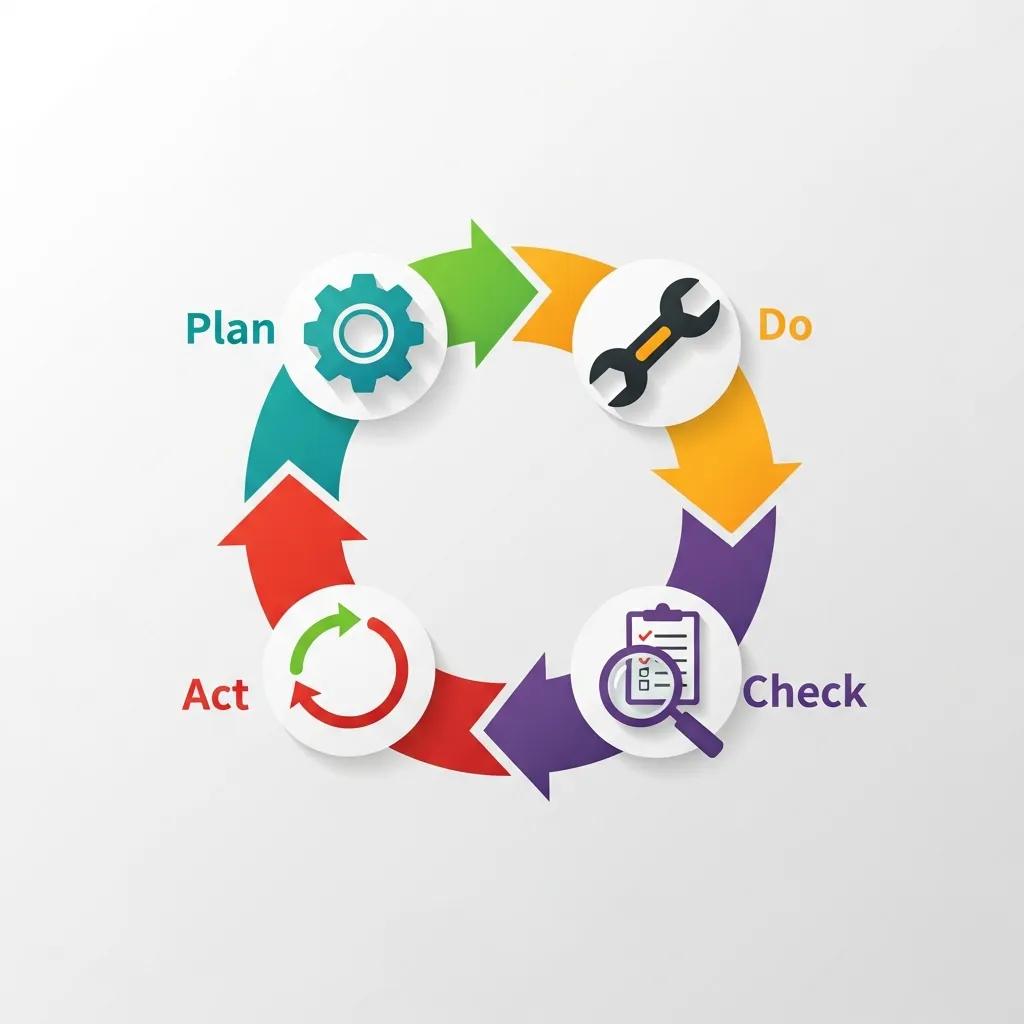
PDCA is the operational backbone for continual improvement: Plan sets goals and identifies risks; Do puts changes into practice; Check measures results through monitoring and audits; Act standardizes successful changes or restarts the cycle for further refinement. Applying PDCA across processes makes improvement evidence-driven and auditable, which directly supports Clause 10’s requirement to verify effectiveness.
The central role of PDCA in ISO management systems is reinforced by recent research.
PDCA Cycle: Foundation for ISO Management Systems
The Plan–Do–Check–Act cycle underpins the process approach in ISO management standards. Recent analysis adapts PDCA concepts to modern management-system requirements, including AI-related controls in newer standards.
Research and Application of The PDCA Cycle in Artificial Intelligence Management Systems, T Gueorguiev, 2024
The Four PDCA Phases — What to Do at Each Step
PDCA breaks improvement into clear tasks, owners and outputs so teams can act and demonstrate results. Plan requires objectives, risk-based process mapping and measurement plans; Do covers implementation, training and documented procedures; Check focuses on monitoring, internal audits and performance metrics; Act uses corrective actions, updates to documented information and management-review outputs to embed learning. Assign owners and KPIs for each phase to avoid drift and ensure initiatives close the loop. The next section shows how AI can speed those phases.
- Plan
: Define objectives, map processes and set measurable indicators.
- Do
: Implement changes, train people and capture baseline evidence.
- Check
: Monitor performance, run audits and compare outcomes to targets.
- Act
: Apply corrective actions, update procedures and scale what works.
This phase breakdown gives teams a practical checklist for verifiable, auditable improvements.
Before we compare AI approaches, here’s a concise look at where traditional PDCA practices differ from AI-augmented ones.
The table below highlights where automation and analytics add the most value across PDCA activities.
| Phase | Traditional Practice | AI-Augmented Practice |
|---|---|---|
| Plan | Manual trend reviews and spreadsheet risk logs | Predictive analytics that flag risk hotspots and priority objectives |
| Do | Manual checklists and paper evidence | Digital checklists and API-based evidence capture |
| Check | Periodic audits and batch reporting | Continuous monitoring with anomaly detection and live dashboards |
| Act | Manual prioritization and follow-up | Automated corrective-action triage and verification workflows |
AI mainly speeds detection, prioritization and evidence capture — letting PDCA cycles run more often and with sharper focus. Next, we review specific AI capabilities for each PDCA stage.
How AI Strengthens Each Stage of PDCA for QMS Improvement
AI turns scattered data into prioritized, actionable insights that shrink cycle time and improve decisions. In Plan, predictive models reveal trends and forecast process risk to focus objectives; in Do, automated workflows and digital evidence capture reduce human error during implementation; in Check, anomaly detection and natural-language audit summaries speed root-cause work; in Act, AI helps prioritize and track verification so corrective actions close properly. These capabilities improve audit efficiency, accuracy of trend detection and time-to-resolution for corrective actions. The next section focuses on corrective actions and how AI tightens their lifecycle.
Integration example: Stratlane Certification uses AI-assisted audit tools to improve audit efficiency and evidence capture. Their ISO 9001:2015 certification services pair accredited audit practices with predictive analytics to help teams implement PDCA faster — and to provide options for getting a quote or booking an audit with tailored audit automation support.
The Role of Corrective Actions in ISO 9001:2015 Continual Improvement
Corrective actions turn identified nonconformities into lasting improvements and are central to Clause 10 compliance. The corrective-action lifecycle — identify, analyze, act, verify — ensures root causes are addressed, changes are made and effectiveness is confirmed. Strong governance here prevents recurrence, creates audit evidence and supplies management review with validated results that feed strategic decisions. The section below outlines practical root-cause analysis techniques.
How to Identify and Analyze Root Causes of Nonconformities
Root-cause analysis (RCA) uses structured methods to move from symptom to systemic cause so corrective actions fix the real problem. Common approaches include 5 Whys, fishbone diagrams and fault-tree analysis, supported by data such as process logs, inspection records and customer complaints. A solid RCA gathers objective evidence, tests hypotheses with targeted data and records assumptions and findings for the audit trail. Good RCA is critical — it determines whether corrective actions deliver lasting improvement instead of temporary fixes.
Practical RCA techniques include:
- 5 Whys
: Repeatedly ask “why” to trace the chain of cause-and-effect back to the root.
- Fishbone Diagram
: Organize potential causes across people, process, material and equipment categories.
- Data-Driven Validation
: Use process and inspection data to confirm or refute suspected root causes.
These tools help teams move from identifying issues to implementing verified solutions that feed continual improvement.
Below is a simple mapping of corrective-action steps to expected outcomes and AI features that accelerate each stage.
| Step | Expected Outcome | AI Capability |
|---|---|---|
| Identify | Timely, accurate detection of nonconformities | Pattern recognition across audits and operational data |
| Analyze | Verified attribution of root causes | Correlation analysis and clustering of similar incidents |
| Act | Implemented corrective measures | Automated task assignment and workflow orchestration |
| Verify | Confirmed effectiveness and formal closure | Automated follow-up sampling and statistical checks |
This mapping shows how AI improves speed and precision across the corrective-action lifecycle, producing verifiable outcomes for management review and continual improvement.
How AI-Driven Auditing Improves Corrective-Action Processes

AI-driven auditing surfaces patterns humans can miss, prioritizes high-risk issues and automates verification — shortening closure times and improving reliability. Pattern recognition can link related nonconformities across sites or products so teams apply systemic fixes instead of isolated patches. Automated dashboards and certificate management provide clear evidence trails for auditors and leadership, simplifying verification and reporting. The result is less manual tracking and a higher likelihood that corrective actions produce measurable improvement.
Stratlane Certification’s AI-enabled auditing tools demonstrate how audit automation and predictive analytics speed corrective-action tracking and certificate management. Features like certificate databases and certificate downloads help organizations keep clear proof of compliance and evidence of corrected issues after certification.
QMS Improvement Strategies That Fit ISO 9001 Continual Improvement
To align improvement with ISO 9001, use measurable objectives, clear governance and data-driven review rhythms that feed Clause 10 processes. Consistently effective strategies include setting SMART quality objectives, embedding improvement into daily work, using management review as a strategic control point, and applying analytics to detect systemic issues. These approaches let incremental gains compound into meaningful performance improvement.
How to Set and Measure Quality Objectives That Drive Improvement
Quality objectives should be SMART — specific, measurable, achievable, relevant and time-bound — and tied to business outcomes like customer satisfaction, delivery performance and first-pass yield. Choose KPIs that reflect process behavior and can be measured reliably, for example NCR rate, on-time delivery percentage and mean time to close corrective actions. Measure with a mix of SPC charts, audit results and AI-driven analytics for predictive trending. Regular review cadences (monthly operations reviews, quarterly management reviews) keep objectives relevant and actionable.
| Objective Area | KPI | Measurement/Tool |
|---|---|---|
| Customer Satisfaction | NPS or CSAT score | Survey platforms with sentiment analysis |
| Process Efficiency | First-pass yield | SPC charts and process telemetry |
| Nonconformity Reduction | NCRs per period | Automated tracking dashboards |
Practical steps to make objectives operational include:
- Align KPIs to customer outcomes so metrics reflect delivered value.
- Use mixed measurement tools — SPC, audit data and AI analytics — for fuller insight.
- Set review cadences so operational and strategic reviews keep objectives current.
These actions turn objectives from targets into levers for continual improvement.
How Management Review Guides Strategic QMS Evolution
Management review turns audit and performance data into strategic decisions — resource allocation, reprioritizing objectives and sponsoring systemic improvement projects. Typical inputs include audit results, corrective-action status, process performance and customer feedback; outputs are decisions to change objectives, allocate resources or initiate improvement work. When reviews rely on validated evidence and trend analysis, leadership becomes proactive instead of reactive. Documenting inputs and outputs creates an auditable trail that demonstrates Clause 10 compliance and ties tactical activity to strategic direction.
A practical management-review checklist includes recent audit findings, corrective-action closure rates, KPI trends and risk assessments so leaders can convert operational signals into targeted improvement investments. This structured approach closes the loop between frontline performance and organizational strategy, enabling sustained QMS evolution.
Emerging Trends and ISO 9001 Changes That Affect Continual Improvement
Emerging trends shaping continual improvement include stronger emphasis on digital evidence, data integrity, AI governance and resilient process controls — signs that future ISO 9001 updates will formalize digital and AI-aware expectations. Teams should improve data quality, pilot continuous monitoring and establish governance for algorithmic decision-making. Continual improvement will increasingly rely on near-real-time data and predictive insights rather than only periodic sampling.
How the Expected ISO 9001:2025 Revision May Change Practices
The anticipated ISO 9001:2025 revision is likely to highlight digitalization, data integrity and responsible use of AI in audits and monitoring. Practically, expect greater scrutiny of digital records, higher expectations for demonstrable data governance and a need to document AI-assisted decision logic. Teams should inventory digital evidence sources, validate data pipelines and record AI decision criteria so improvement activities remain transparent and auditable.
Short-term preparation steps include mapping current digital evidence flows, identifying data quality gaps and piloting continuous monitoring to show reliable governance ahead of standard changes. These measures smooth compliance and speed PDCA cycles.
The Role of Digital Transformation and AI in Future ISO 9001 Standards
Digital transformation and AI will push continual improvement from periodic checks toward continuous assurance: monitoring, anomaly detection and automated reporting become standard practices. AI-driven auditing can continuously synthesize operational signals, freeing auditors to interpret strategic risk and systemic issues. That shift requires governance — data lineage, model explainability and ethical-use policies — to ensure automated findings are trustworthy and defensible in audits. Organizations that combine modern tools with strong governance will gain faster, more reliable improvement cycles.
Key governance priorities for AI and digital transformation include:
- Data integrity controls
: Ensure sources are reliable and traceable.
- Model transparency
: Explain how algorithms generate flags or recommendations.
- Ethical oversight
: Define acceptable use and guardrails for automated actions.
Addressing these areas ensures AI supports continual improvement without undermining confidence in evidence or decisions.
Stratlane Certification pairs accredited processes with AI-driven auditing to help organizations adapt to these trends. Their ISO 9001:2015 certification services combine predictive analytics and audit automation. If your team needs validation and faster PDCA cycles, Stratlane offers ways to request a quote or book an audit and provides post-certification support like a certificate database and certificate downloads to manage evidence and demonstrate ongoing compliance.
For teams ready to move from planning to execution, working with an accredited provider that blends quality-management expertise with AI-assisted audit tools can shorten the path to measurable improvement and deliver stronger documentation for continual improvement cycles. Consider requesting a quote or booking an audit to integrate these capabilities into your QMS and simplify certificate management and evidence handling.
Frequently Asked Questions
What are the main challenges when implementing continual improvement under ISO 9001?
Common challenges include resistance to change, uneven management commitment and gaps in training on quality principles. Teams also struggle with consistent data collection and analysis, which are essential for informed decisions. Without a clear understanding of PDCA and regular routines, improvement efforts can stall. Overcoming these challenges requires visible leadership, clear communication and a culture that rewards learning and adaptation.
How can organizations make sure quality objectives match customer needs?
Align objectives to customer needs by talking to customers regularly and using feedback channels like surveys, interviews and support data. Translate that feedback into SMART objectives tied to outcomes customers care about — for example, delivery reliability or defect reduction. Validate objectives with measurable KPIs and review them at regular cadences so they stay relevant and drive real value.
What role does employee training play in continual improvement?
Training is essential: it gives staff the skills to follow QMS processes, run PDCA cycles and perform root-cause analysis. Regular workshops and practical coaching build capability, encourage problem-solving and embed quality thinking into daily work. Well-trained teams act faster and make better, evidence-based improvement decisions.
How can organizations measure whether their continual improvement efforts are working?
Measure effectiveness with KPIs that reflect operations and customer outcomes — defect rates, on-time delivery and customer feedback scores are common examples. Combine KPI tracking with regular audits and management reviews to evaluate impact. Also use feedback loops from employees and customers to refine actions based on real-world outcomes.
Why are management reviews important in the continual improvement process?
Management reviews provide a formal moment for leadership to convert operational data into strategic action — reallocating resources, reprioritizing objectives and authorizing improvement projects. Documenting inputs and outputs ensures decisions are auditable and shows how operational performance links to strategic goals, which is a core expectation of Clause 10.
How can AI improve continual improvement under ISO 9001?
AI improves continual improvement by automating data analysis, surfacing trends and delivering actionable recommendations. It enables continuous monitoring, faster root-cause work and more efficient corrective-action workflows. By reducing manual effort and sharpening insights, AI helps teams make better decisions faster and accelerate improvement cycles — provided governance and explainability are in place.
Leveraging the PDCA Cycle for ISO 9001 Continual Improvement
Putting continual improvement into practice under ISO 9001:2015 strengthens your QMS, reduces defects and improves customer outcomes. Using PDCA as a routine, and applying AI where it adds validated value, helps teams achieve measurable results that align with strategy. Working with accredited providers can streamline certification and evidence management. When you’re ready to move forward, explore our certification services to see how we can help you accelerate improvement and simplify ongoing compliance.