
Implementing ISO Standards for Remote and Hybrid Teams
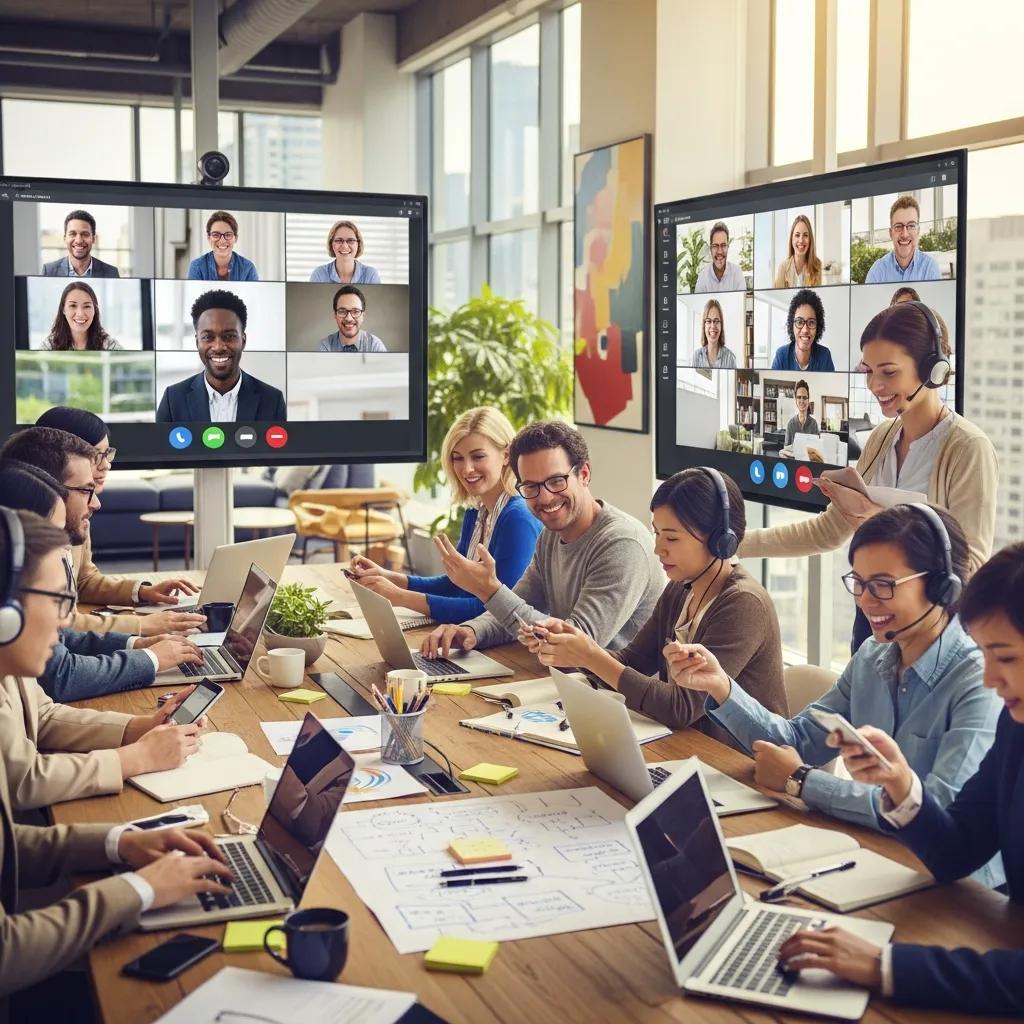
Adapting ISO Standards for Remote and Hybrid Work: Compliance and Efficiency with AI-Powered Auditing
Remote and hybrid work have reshaped how organizations design processes, assess risk, and prove compliance. That shift creates practical gaps between traditional, site-based ISO expectations and today’s distributed operations. This guide shows how core ISO management system standards still apply when adapted for virtual offices, and how AI-assisted auditing and continuous monitoring can cut the friction of evidence collection while raising audit quality. You’ll learn which standards matter most for flexible work arrangements, how to interpret clauses such as ISO 9001 Clause 7 and ISO 27001 Annex A 6.7 in a remote context, and practical steps to adapt processes, gather remote evidence, and run remote audits that stand up to external scrutiny. The article lays out an implementation path, weighs benefits and trade-offs of remote audits, and explains how AI-enabled auditing and certificate management simplify certification for organizations operating across the US, EU, and UK. Throughout, we stress risk-focused controls, device management, and human-in-the-loop reviews to keep compliance measurable and operationally sustainable.
For a closer look at how organizations are changing operational management to support these work patterns, recent research offers useful perspective.
Adapting Operational Management for Hybrid & Remote Work
Advances in technology and evolving work patterns have led many organizations to adopt hybrid and remote models. Adapting operational management—covering HR, communications, performance measurement, and digital tooling—is central to keeping teams effective and productive. With a pragmatic, flexible approach, companies can maintain collaboration, preserve culture, and meet business goals while operating remotely.
Adaptation of Operational Management to Hybrid and Remote Work Trends, 2025
What Are the Key ISO Standards for Remote and Hybrid Work Compliance?
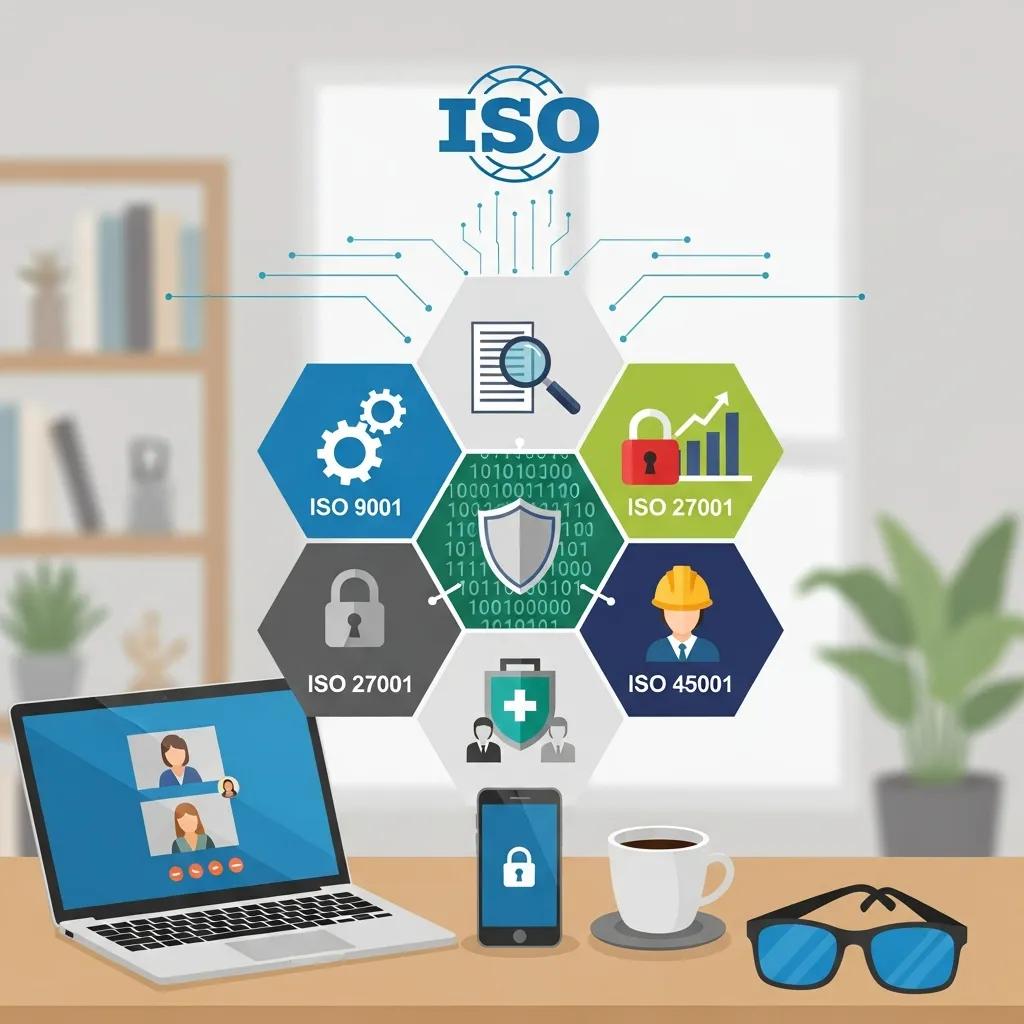
For remote and hybrid setups, a small set of ISO management system standards forms the backbone of compliance: ISO 9001 (quality), ISO 27001 (information security), ISO 45001 (occupational health and safety), and ISO 42001 (AI governance where applicable). These standards provide outcome-focused frameworks that teams can interpret for distributed operations—mapping clauses and Annex controls to artifacts like logs, screenshots, telemetry, and documented remote procedures. The short list below gives each standard’s core relevance to help prioritize adaptations.
Key remote/hybrid-relevant ISO standards and one-line relevance:
- ISO 9001: Quality management for virtual offices—requires documented remote processes and controls over infrastructure.
- ISO 27001: Information security for hybrid work—focuses on access control, encryption, and Annex A 6.7 remote-working safeguards.
- ISO 45001: Health and safety for remote teams—covers ergonomics, risk assessments, and psychosocial protections.
- ISO 42001: AI governance where AI impacts decisions or monitoring in remote work (development expected in 2024).
The table below links each standard to representative clauses or controls and suggests practical remote adaptations to make planning concrete.
| Standard | Relevant Clause/Control | Remote/Hybrid Adaptation |
|---|---|---|
| ISO 9001 | Clause 7 (Support: Infrastructure) & Clause 7.4 (Communication) | Document cloud SLAs, keep versioned SOPs, and define remote communication protocols with traceable records |
| ISO 27001 | Annex A controls & Annex A 6.7 (Mobile/Remote Working) | Require MFA, VPN or zero‑trust access, MDM enrollment, encrypted collaboration, and retained remote access logs |
| ISO 45001 | Clause on Hazard Identification and Risk Assessment | Run remote ergonomic checks, document psychosocial risk controls, and keep home‑office assessment records |
| ISO 42001 | Governance clauses for AI management systems | Ensure transparency, model governance, and audit trails for AI used in HR, monitoring, or decision support |
That mapping helps teams decide where to start. Once clauses are mapped, move to clause-level adaptations and an evidence strategy that satisfies external auditors while supporting distributed operations.
How Does ISO 9001 Support Quality Management for Distributed Teams?
ISO 9001 requires documented processes, clear ownership of infrastructure, and demonstrable communication controls—requirements that translate directly to remote environments. In practice, clause expectations (infrastructure, competence, communication) become things like cloud platform SLAs, change-control records for digital assets, and traceable meeting minutes that show consistent decision‑making. Auditors commonly accept versioned SOPs in a controlled repository, ticketing and incident logs that show process adherence, and monitoring telemetry that corroborates service levels. Pair these artifacts with role-based competence records and scheduled remote internal audits to keep continual improvement on track. Those quality controls naturally lead into information security measures to protect remote infrastructure and data integrity.
What Information Security Measures Does ISO 27001 Recommend for Remote Workforces?
ISO 27001 emphasizes access control, endpoint security, secure communications, and explicit management of mobile and remote working risks (Annex A 6.7). Practical steps include multi-factor authentication (MFA), VPN or zero‑trust network access, endpoint management (MDM), collaboration tools with controlled sharing, and hardened baseline configurations for remote devices. Auditors typically review remote access logs, configuration baselines, incident response records, and staff training records on secure remote practices. Combining technical controls with policies, awareness, and monitoring reduces risk—and aligns with continuous monitoring and AI-assisted anomaly detection discussed later.
Adapting ISO Standards for Remote Work with AI Auditing
Adapting ISO clauses for remote settings follows a simple, structured approach: assess which clauses apply, adapt processes to remote evidence types, assign responsibilities, and put monitoring in place that feeds continual improvement. ISO clauses are outcome-oriented, not location‑prescriptive, so organizations can meet objectives using remote‑compatible controls and auditable artifacts. Begin by mapping clauses to remote workflows and defining the expected evidence for each clause so auditors can verify compliance without unnecessary on‑site visits. The checklist below turns clause requirements into operational tasks to accelerate remote audit readiness.
This checklist translates clause adaptations into immediate action items:
- Assess: Identify applicable clauses and gaps in remote evidence for infrastructure, communication, competence, and security.
- Adapt: Write remote procedures, capture cloud vendor SLAs, and assign role‑based responsibilities aligned to each clause.
- Collect: Define and gather evidentiary artifacts (logs, recordings, SOPs) and store them in a controlled repository.
- Train: Deliver focused remote training and keep attendance and competency records.
- Monitor: Run periodic remote checks and continuous monitoring to surface deviations and drive corrective actions.
Following these steps creates a repeatable workflow for clause adaptation and leads naturally into technical measures for infrastructure and Annex‑based security controls.
What Are Best Practices for Implementing ISO 9001 Clauses on Infrastructure and Communication Remotely?
Applying ISO 9001’s infrastructure and communication clauses remotely requires named owners, documented vendor agreements, and auditable communication records that show controlled processes across distributed teams. Best practices include assigning infrastructure owners for cloud and collaboration platforms, negotiating SLAs that cover availability and backups, and using version control for SOPs and product documentation. Communication controls should require meeting agendas, recorded decisions or minutes, and traceable issue tickets to prove consistent execution. Acceptable remote audit evidence includes archived chat logs with timestamps, change‑control records for deployments, and monitoring dashboards that demonstrate quality metrics.
These practices close the gap between operational control and auditability and prepare organizations for Annex‑level security work.
How Does ISO 27001 Annex A 6.7 Address Remote Working Security Challenges?
Annex A 6.7 targets the security risks introduced by mobile and remote working and asks organizations to match policies, awareness, technical controls, and monitoring to their identified risks. To operationalize Annex A 6.7, create a remote working policy that sets acceptable device use, secure access methods, and responsibilities for patching and configuration. Deploy technical controls such as MFA, endpoint hardening, device encryption, and MDM enrollment. Auditors will look for remote access logs, baseline configuration snapshots, incident tickets tied to remote access, and training records showing staff awareness. Mitigations like pre‑deployment baseline checks, scheduled remote configuration audits, and a documented exception process for nonstandard access both satisfy Annex A 6.7 and reduce the attack surface for distributed environments.
What Role Does AI-Driven Auditing Play in Remote ISO Certification?
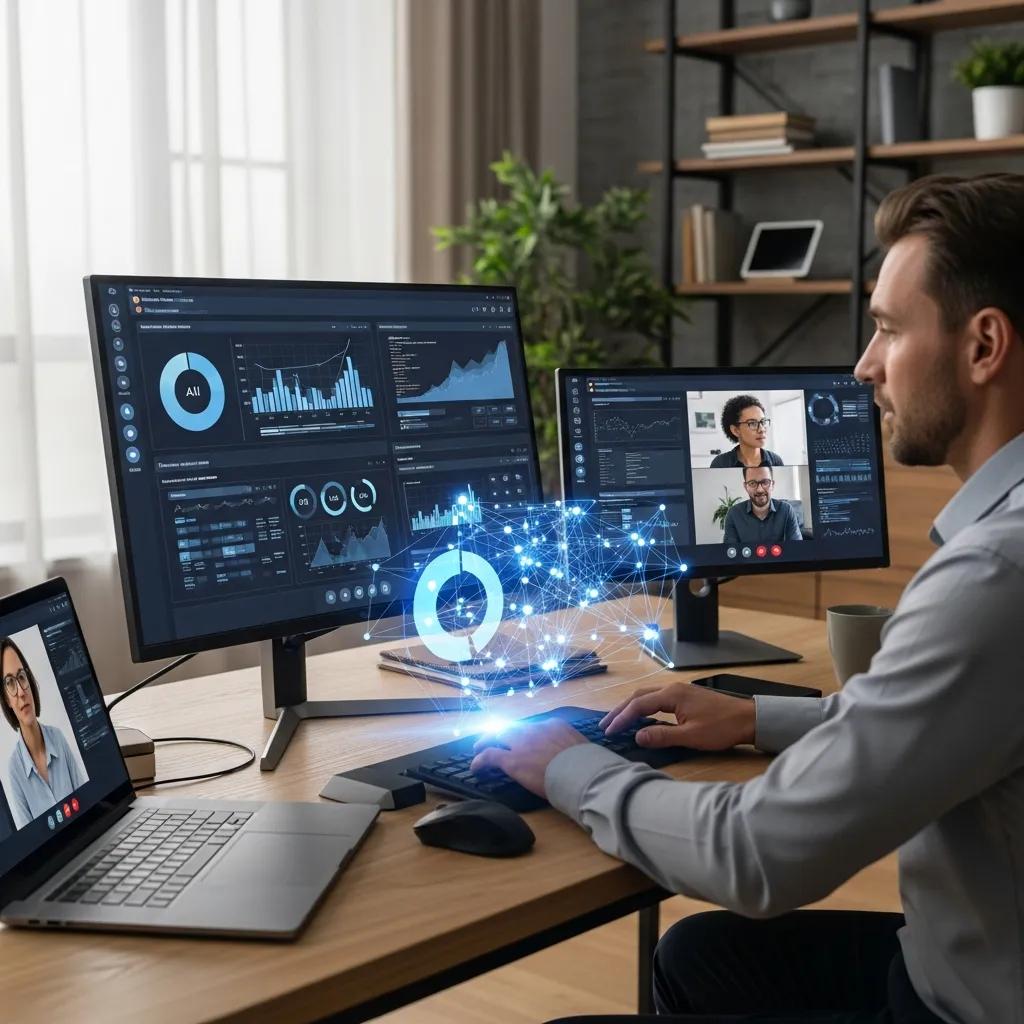
AI‑driven auditing augments remote ISO certification by automating evidence aggregation, enabling continuous monitoring, and surfacing anomalies that human reviewers might miss—improving both efficiency and the depth of assurance. AI systems ingest telemetry, logs, document metadata, and configuration snapshots, then apply pattern detection and rule‑based mapping to align evidence with clause requirements. The outcome is broader sample coverage, more consistent evidence matching, and earlier detection of control drift—reducing audit cycle time while increasing confidence in remote attestations. The table below matches core AI audit capabilities to their attributes and concrete benefits so you can see how features translate to audit outcomes.
Research into AI for compliance auditing is advancing quickly, highlighting its potential to streamline evidence collection and rule‑based checks.
AI-Driven Compliance Audits for Faster, Consistent Findings
AI-based compliance auditing uses machine learning, natural language processing, and automation to surface regulatory issues, extract relevant evidence, and produce findings more quickly and consistently. A hybrid compliance‑audit model pairs transformer‑based NLP for contract and regulation interpretation with supervised anomaly detection over transaction and reporting streams, plus explainability layers that map model outputs back to clauses and audit trails.
AI-Driven Compliance Audits: Enhancing Regulatory Adherence in Financial and Legal Sectors, ST Gandhi, 2023
Intro: The table below shows how specific AI audit capabilities align with audit attributes and the measurable outcomes they enable for remote certification.
| Audit Capability | Attribute | Value / Benefit |
|---|---|---|
| Continuous Monitoring | Always-on evidence collection | Faster detection of deviations and richer audit trails |
| Anomaly Detection | Pattern recognition across telemetry | Early flagging of suspicious behavior and reduced sampling bias |
| Evidence Aggregation | Automated correlation of logs and documents | Less manual evidence collection time and improved traceability |
By shifting audits from episodic sampling to near‑continuous assurance, AI tooling lets auditors focus on judgment and remediation rather than manual evidence gathering. The next section explains how these capabilities improve audit KPIs and why human oversight remains essential.
After describing capabilities at a product‑agnostic level, it’s helpful to show how accredited providers combine AI with expert auditors. Stratlane Certification pairs AI‑driven tools for evidence collation and preliminary checks with experienced human auditors working across regions. That combination shortens audit cycles by automating log collection and initial checks, increases sample coverage through continuous monitoring, and preserves audit validity with human‑in‑the‑loop reviews. Organizations pursuing remote certification gain from Stratlane’s accredited remote audit capabilities and certificate management services designed for cross‑border acceptance in the US, EU, and UK.
How Does AI Enhance Efficiency and Accuracy in Remote ISO Audits?
AI speeds remote audits by automating repetitive work—evidence matching, log parsing, and compliance mapping—reducing manual hours and accelerating time‑to‑findings without sacrificing depth. AI can process large volumes of telemetry, correlate events to clause requirements, and expand sample sizes beyond manual limits, improving statistical confidence in conclusions. Accuracy benefits because AI consistently applies matching rules and highlights outliers for human review, lowering the chance of missed nonconformities. Strong privacy and ethical guardrails are vital: AI outputs should be treated as investigatory inputs that require human validation to avoid false positives and to add context. Those guardrails protect audit integrity while amplifying auditors’ capacity.
What Are the Benefits of Combining Human Expertise with AI in Auditing Processes?
Combining human expertise with AI creates a complementary workflow: AI handles scale tasks like continuous monitoring and pattern detection, while auditors apply professional judgment, legal or contractual interpretation, and remediation planning. Typical workflow: AI triages and flags anomalies, auditors validate and contextualize those flags, then auditors issue findings and remediation guidance—ensuring ethical oversight and accountability. Human reviewers address nuance (legal, cultural, contractual) that AI cannot reliably infer, and auditors record dispositions that become part of the audit trail. This hybrid approach produces higher‑quality, cost‑effective, and defensible remote certifications.
What Are the Benefits and Challenges of Remote and Hybrid ISO Audits?
Remote and hybrid ISO audits offer greater accessibility, lower travel costs, and access to a wider auditor pool, but they also present challenges around evidence sufficiency, privacy, and engagement that organizations must manage. The main upside is the ability to scale assurance across distributed teams with less travel and faster scheduling, enabling more frequent checks and quicker corrective loops. Key challenges include proving authenticity and completeness of remote evidence, handling cross‑border data privacy requirements, and keeping stakeholders engaged during virtual assessments. The table below balances common aspects with benefits and mitigations to support readiness planning.
The logistics and limitations of remote audits—seen from auditors’ and auditees’ viewpoints—have been examined in focused studies.
Remote QMS Audits: Challenges & Auditor Perspectives
The pandemic accelerated changes in how organizations assess quality management systems, making remote audits a practical necessity. This research presents findings on difficulties encountered by auditors and auditees when conducting remote internal audits and highlights lessons learned for improving remote assessment practices.
Remote Quality Management System Audit. Auditors’ and Auditees’ Perspective and Lessons Learned, MZ Wiśniewska, 2015
Intro: The table below summarizes primary aspects of remote audits, pairing benefits with common challenges and recommended mitigations.
| Aspect | Benefit (Remote audit) | Challenge / Mitigation |
|---|---|---|
| Accessibility | Faster scheduling and easier participation across time zones | Timezone coordination / use staggered sessions and regional auditors |
| Cost | Lower travel and accommodation expenses | Extra prep work / provide pre‑audit evidence packs |
| Evidence Coverage | Larger digital sample sizes via telemetry | Authenticity concerns / use signed logs and time‑stamped screenshots |
| Data Privacy | Ability to review data locally without physical transfer | Cross‑border rules / apply regional handling and data minimization |
This balanced view helps organizations prioritize mitigations that preserve audit rigor while realizing remote audit efficiencies. The lists below unpack the most tangible benefits and readiness actions.
Intro to list: Practical benefits organizations gain from remote audits and how those advantages translate into operational outcomes.
- Faster Scheduling: Remote audits remove travel barriers, enabling audits to happen on shorter notice.
- Broader Auditor Pool: Access specialized auditors across regions without relocation.
- Lower Travel Costs: Reduce travel and lodging spend, freeing budget for remediation and improvement.
Summary: These efficiencies shorten certification timelines and support more frequent assurance activities, provided organizations adopt robust evidence practices and engagement plans for virtual assessments.
How Do Remote Audits Improve Accessibility and Cost-Effectiveness?
Remote audits let distributed teams join without geographic constraints and cut travel‑related costs and logistics. That flexibility allows organizations to involve subject‑matter experts regardless of location and to combine cross‑site checks into consolidated virtual sessions. Operationally, these gains shorten certification cycles and enable more affordable interim assessments, supporting continual improvement. To capture these benefits, prepare pre‑audit evidence packs, verify connectivity and access rights beforehand, and coordinate stakeholder windows to maximize auditor time—practices that keep remote audits effective and economical.
What Challenges Must Be Overcome for Successful Remote ISO Certification?
Successful remote certification depends on addressing evidence authenticity, connection reliability, data privacy, and virtual engagement fatigue through clear mitigations and governance. Ensure remote evidence—logs, screenshots, recordings—are time‑stamped, stored in a controlled repository, and traceable to responsible owners to counter authenticity concerns. Reduce connectivity risk with pre‑audit checks and fallback plans. Meet privacy obligations through evidence minimization and regional handling. Maintain engagement with focused agendas, clear roles, and pre‑briefed participants so virtual sessions stay productive. Applied consistently, these measures keep remote audits valid and defensible.
How Does Stratlane Certification Facilitate Seamless ISO Certification for Remote Work Models?
Stratlane Certification combines accredited remote audit capabilities, a global auditor network, AI‑enabled tooling, and certificate management services to remove friction for organizations seeking ISO certification for remote and hybrid operations. Our multi‑jurisdiction accreditation and international auditor presence support regional acceptance and flexible scheduling, while AI tools automate evidence collation and preliminary checks to shorten audit cycles. Certificate management covers issuance, secure storage, and retrieval to aid cross‑border recognition in the US, EU, and UK—useful for organizations working with corporate and academic partners. Together, these services address the main barriers to remote certification: evidence collection, audit scalability, and cross‑region certificate acceptance.
Intro to list: Stratlane’s core differentiators for remote and hybrid certification, framed as product‑level benefits rather than a sales menu.
- Accredited Global Coverage: Presence across multiple countries that supports regional acceptance and inbound audit requests.
- AI-Driven Audit Tools: Automated evidence collation and continuous monitoring reduce client preparation time.
- Certificate Management: Centralized issuance and retrieval simplify post‑audit certificate handling across jurisdictions.
Summary: These capabilities lower the operational burden of remote certification while preserving audit integrity through experienced auditors and recognized accreditation.
What Unique Advantages Do Stratlane’s AI-Driven Audit Tools Provide?
Stratlane’s AI tools automate routine checks, enable continuous monitoring, and collate evidence to speed pre‑audit and audit phases—without replacing expert auditors. The tools aggregate logs, map events to clause requirements, and surface anomalies for human review, increasing sample coverage and reducing time spent assembling evidence. Expected outcomes include fewer administrative nonconformities, shorter audit cycles, and clearer, more actionable findings. Critically, Stratlane keeps humans in the loop: AI outputs are reviewed by accredited auditors so final decisions and accountability remain with qualified professionals.
How Does Stratlane Support Certificate Management Across US, EU, and UK Regions?
Stratlane handles certificate issuance, secure storage, and retrieval with workflows designed for cross‑border recognition, helping clients prove compliance to partners and institutions in the US, EU, and UK. Typical steps include verified issuance after audit closure, centralized storage for authorized downloads, and documented processes for re‑issue or updates—governed by accreditation and regional acceptance practices. This reduces administrative overhead for organizations managing certificates across jurisdictions and helps ensure artifacts meet stakeholder expectations. Aligning certificate workflows with regional norms helps maintain trust and continuity in multi‑jurisdiction operations.
How Can Businesses Get Started with Remote ISO Certification?
Begin remote ISO certification with a clear sequence: define scope, request a remote audit quote, prepare pre‑audit evidence, schedule the audit, and implement findings after the audit. This sequence aligns organizational readiness with auditor needs and leverages remote channels for evidence submission and interviews. Assemble scoping details—standards sought, virtual teams or locations in scope, critical processes, and existing documentation—before requesting a quote so you get an accurate estimate and timeline. The numbered steps below map the operational path from inquiry to audit scheduling and post‑audit actions.
Intro to numbered list: Follow these operational steps to request a quote and schedule an AI‑assisted remote audit, with realistic expectations for timelines and information required.
- Define Scope: Document the management system standard(s), processes and remote sites in scope, and any regulatory considerations.
- Request a Quote: Submit scope, standards, and remote model details to receive a tailored quote and timeline for audit preparation and execution.
- Prepare Evidence Pack: Collect SOPs, access logs, configuration baselines, training records, and other digital artifacts in a controlled repository.
- Schedule Audit: Coordinate stakeholder availability, run connectivity tests, and agree session windows with time‑zone accommodations.
- Post-Audit Actions: Remediate findings, provide corrective evidence, and complete certificate issuance and management steps.
Summary: Clear scoping and evidence preparation reduce surprises during remote audits and speed certification timelines. For organizations seeking an accredited partner, Stratlane Certification provides remote audit capabilities, AI‑assisted evidence aggregation, and certificate management to support cross‑border recognition and efficient certification workflows.
What Are the Steps to Request a Quote and Schedule an AI-Driven Audit?
To get an accurate quote and schedule, prepare a concise package with the intended standard(s), scope (processes and remote teams), number of remote locations or user groups, and any preferred timelines or regional constraints. Typical timelines include an initial scoping call, a prompt quote, and a scheduling window that allows pre‑audit evidence collection and connectivity tests. After quote acceptance, share pre‑audit evidence packs and complete any readiness checks to minimize delays during the audit. Clear scope and evidence readiness make timelines predictable and smooth the AI‑assisted audit experience.
Where Can Organizations Find Case Studies of Successful Remote ISO Implementations?
Look for case studies that match your industry, size, and remote complexity—particularly those where distributed teams, cross‑border operations, or AI tooling were central. The most useful case studies spell out the problem statement, actions taken (technical and organizational), measurable outcomes (shorter audit time, fewer findings), and lessons learned. If direct case studies are scarce, request anonymized summaries or scenario-based examples that mirror your environment to assess likely results. Reviewing detailed cases and metrics helps set realistic expectations for timelines, evidence needs, and the impact of AI‑driven audits on certification velocity.
This article outlines a standards‑focused roadmap for adapting ISO requirements to remote and hybrid work models and shows how AI‑driven auditing and accredited services tackle the operational challenges of distributed compliance. Organizations that follow the sequence—assess, adapt, collect evidence, train, and monitor—can meet ISO outcomes through remote‑compatible controls and modern auditing practices that combine algorithmic scale with professional oversight.
Frequently Asked Questions
What are the main challenges organizations face when adapting ISO standards for remote work?
Common challenges include proving the authenticity and completeness of remote evidence, meeting data privacy requirements, and keeping distributed teams aligned and engaged. The absence of physical oversight can complicate verification of on‑process behaviors. To address these issues, implement controlled evidence collection practices, apply secure data handling technologies, and establish clear communication protocols so teams understand expectations throughout the audit cycle.
How can organizations ensure effective training for remote teams regarding ISO compliance?
Deliver structured online training, interactive workshops, and regular updates that focus on the ISO standards relevant to your remote environment. Use e‑learning platforms for flexible access, require assessments to verify competency, and keep attendance and completion records. Encourage questions and feedback during sessions to boost retention, and link training outcomes to role‑based responsibilities so compliance becomes part of day‑to‑day work.
What role does continuous monitoring play in maintaining ISO compliance for remote teams?
Continuous monitoring is a core control for remote compliance: it detects deviations in near real‑time, verifies control effectiveness, and supplies richer audit trails. Automated monitoring tools track compliance metrics and surface trends that inform management decisions and corrective actions. Regular review of monitoring outputs enables proactive risk management and supports ongoing improvement aligned with ISO expectations.
How can organizations effectively manage data privacy during remote ISO audits?
Manage privacy by minimizing personal data in evidence packs, enforcing secure storage and access controls, and following applicable regulations like GDPR or CCPA. Conduct privacy impact assessments for remote evidence handling, document processing activities, and train staff on data protection practices. When possible, keep reviews regional to limit transfers and apply data‑minimization techniques to reduce exposure.
What strategies can organizations use to enhance stakeholder engagement during remote audits?
Improve engagement through clear briefing materials, concise agendas, and interactive sessions. Share pre‑audit packs that outline the audit process, expectations, and roles. Use collaborative tools for real‑time feedback, schedule regular checkpoints, and keep sessions focused to avoid fatigue. Promptly address questions and concerns so stakeholders feel informed and invested in the audit outcomes.
How can organizations leverage AI to improve their remote ISO auditing processes?
Use AI to automate evidence collection, speed data analysis, and enable continuous monitoring. AI tools can aggregate and analyze large datasets to spot patterns and anomalies that need human attention, reducing manual effort and improving finding accuracy. Integrate AI outputs into audit workflows with human validation and explainability so insights are actionable, defensible, and privacy‑aware.
Conclusion
Adapting ISO standards for remote and hybrid work makes compliance more practical and improves operational resilience. AI‑driven auditing streamlines evidence work and strengthens assurance when paired with professional oversight. By adopting outcome‑focused controls, robust evidence practices, and continuous monitoring, teams can meet ISO requirements while supporting modern, distributed ways of working. Begin your remote certification journey with a partner who blends accredited auditing, AI tooling, and practical certificate management to simplify the path to compliance.