
Identify Compliance Gaps with Effective ISO Gap Analysis

Accelerating Certification Readiness with AI-Driven Gap Analysis
An ISO gap analysis is a focused readiness check that compares your current management system against a specific ISO standard to surface compliance gaps, prioritize fixes, and estimate time-to-certification. This guide walks through how gap analysis works, why it’s essential for certification readiness, and how AI-augmented audit techniques speed accuracy while cutting cost. You’ll get practical guidance on clause-to-process mapping, targeted checklists for ISO 9001, ISO 27001 and ISO 42001, and a clear workflow that blends automated analysis with human validation. We also cover cost drivers, ROI for automated gap analysis, typical timelines, and how to request a quote — plus checklists and remediation templates you can apply immediately.
What an ISO Gap Analysis Is—and Why It Matters for Certification
A gap analysis is a diagnostic review that maps your documented processes, evidence and controls to the clauses and intent of an ISO standard, revealing where you fall short. By identifying specific nonconformities and weak controls, the assessment produces a prioritized remediation list that guides resource allocation, risk-based planning and certification timelines. Running a gap analysis lowers the chance of major nonconformities during the certification audit and reduces auditor rework — both of which shorten time-to-certification and reduce total project cost. Teams that complete a thorough gap assessment gain clarity on required documentation, control operation and evidence sampling, which makes certification audits smoother and ongoing compliance easier to sustain. Common, tangible benefits typically include the following.
This diagnostic benefit leads into the mechanics of how gaps are detected and recorded during a structured assessment.
Key benefits of a gap analysis:
- Prioritized corrective actions based on risk and audit impact.
- Fewer audit surprises through targeted remediation and evidence collection.
- Faster certification by addressing critical weaknesses before the external audit.
These outcomes make an initial gap analysis a high-value step in any certification readiness program and set the stage for how organizations detect and address gaps in practice.
How an ISO Gap Analysis Finds Compliance Shortfalls
Gap analysis combines document review, clause-to-process mapping, interviews with process owners and evidence sampling to validate claims. Auditors review policies, procedures, records and measurable objectives, then map those artifacts to specific ISO clauses to reveal missing controls or weak implementation. Sampling and interviews expose practice-versus-policy gaps, and risk assessments rank issues by severity and business impact. Automated tools can speed document parsing and initial clause mapping, but human validation remains essential to capture context, nuance and operational controls. The outcome is a categorized gap register — critical, major and minor findings — with corrective actions and timelines that drive remediation and resource planning.
Specialized tools further strengthen gap analysis by turning identified requirement gaps into practical, process-level improvements.
Gap Analysis Tools for Compliance Readiness
A gap analysis tool can translate identified requirement gaps into a process view. Built on a process map derived from the Process Assessment Model (PAM), the tool correlates requirements with process activities and complements related PAM assessments. A proof-of-concept validates this design and shows potential application in IT service management, including integration with existing frameworks like TIPA.
Measuring readiness for compliance: A gap analysis tool to complete the TIPA process assessment framework, M Picard, 2016
That explanation of detection methods naturally leads into why performing a gap analysis before certification materially improves outcomes.
Why You Should Run a Gap Analysis Before Certification
A gap analysis reduces audit risk by surfacing weaknesses that commonly cause major nonconformities, so teams can fix issues before external assessors arrive. It also supports realistic project planning — defining scope, assigning owners, estimating timelines and budgeting for remediation — so certification efforts become predictable and measurable. Turning findings into prioritized action plans cuts costly rework and repeated surveillance failures, increasing the chance of successful first-time certification. For standards in transition, a gap analysis highlights migration tasks that can’t be delayed. In short: a structured readiness assessment shortens the certification journey and strengthens long-term compliance.
This rationale sets up the next section on how AI-driven auditing can enhance gap analysis.
How Stratlane’s AI-Enhanced Approach Improves Gap Analysis

At Stratlane Certification we pair automated analysis with professional auditor validation to accelerate gap analysis without sacrificing audit quality or regulatory rigor. AI capabilities — automated document ingestion, clause mapping, risk scoring and pattern detection — speed the first pass at identifying gaps and surface anomalies across large document sets or multiple sites. Our hybrid model hands aggregated evidence from the machine to experienced auditors who validate findings, prioritize remediation and craft practical action plans. The result: fewer manual review hours, more consistent assessments, and scalable coverage for multi-standard or multi-site programs — all while preserving accredited certification pathways and global certificate issuance.
Research shows that automating parts of the audit process can significantly improve efficiency and reduce the burden of manual checks.
Automating ISO Compliance Audits for Efficiency
Traditional compliance audits are often manual, labor-intensive and error-prone. As regulations and digital product representations increase, automating parts of the audit process becomes prudent. An automated compliance audit framework can be integrated into product lifecycle compliance management; key components include machine-readable legal knowledge, executable audit models, support for human input and simulation interfaces.
Automating conventional compliance audit processes, J Dimyadi, 2017
The table below highlights specific AI features, the assessment tasks they help, and measurable impacts on time or accuracy.
Overview: This table compares AI capabilities to the assessment tasks they improve and shows typical measurable gains for gap analysis.
| AI Feature | Assessment Task | Measurable Impact |
|---|---|---|
| Automated document parsing | Rapid ingestion and indexing of policies/records | 40–60% reduction in manual review time |
| Clause-to-process mapping (NLP) | Mapping documents to ISO clauses | 30–50% improvement in mapping consistency |
| Risk scoring & anomaly detection | Prioritizing high-risk findings | Faster prioritization; earlier remediation focus |
| Continuous monitoring | Ongoing evidence collection and alerts | Sustained compliance visibility between audits |
These capabilities show how AI complements human judgment to deliver faster, more consistent gap assessments while keeping the auditor’s interpretive role central.
Benefits of AI-Driven ISO Auditing in Gap Analysis
AI-driven auditing expands coverage, improves clause mapping consistency and surfaces predictive insights that reveal hidden or systemic weaknesses. Automated parsing cuts the time auditors spend on manual indexing, freeing them to focus on contextual validation, interviews and remediation strategy. Consistency gains reduce reviewer variance and produce more comparable reports across locations and standards. Predictive analytics help identify patterns and root causes rather than isolated issues. For organizations with multiple standards or global sites, these benefits scale, delivering cost-effective assessments and clearer remediation priorities that shorten certification timelines.
Next we explain the specific mechanisms by which AI improves both accuracy and efficiency.
How AI Raises Accuracy and Efficiency in Gap Assessments
AI improves accuracy with NLP-driven clause matching and pattern recognition that detect semantic links between policies and standard requirements, reducing missed mappings and human oversight. Efficiency comes from automated triage — classifying findings by risk and grouping similar issues — so auditors validate high-impact gaps first and cut total audit hours. For example, automated mapping of a security policy to ISO 27001 controls can surface scope gaps that manual review might miss. Combining algorithmic detection with professional judgment lowers false negatives and speeds remediation cycles, improving the ROI of readiness assessments.
This technical overview leads to a practical, step-by-step workflow that integrates AI into gap analysis.
Step-by-Step: Conducting an ISO Gap Analysis with AI
An AI-augmented gap analysis follows a clear workflow: scoping and document collection, automated analysis and mapping, human validation and interviews, prioritized reporting, and remediation with re-assessment cycles. This sequence lets automated tools handle volume and pattern detection while auditors provide context, risk judgment and corrective guidance. Accurate scoping up front — standards, sites and processes in scope — enables efficient ingestion and targeted evidence sampling. The combined output is a gap register with severity ratings, recommended actions, assigned owners and timelines that form a certification readiness plan.
Below is a concise summary of each step for quick reference.
Concise step summary for automated ISO gap analysis:
- Scoping and document collection: Define scope, stakeholders and required artifacts.
- Automated ingestion and clause mapping: Use AI to parse documents and map to ISO clauses.
- Human validation and interviews: Auditors verify AI findings, interview owners and sample evidence.
- Reporting and prioritization: Produce a categorized gap register and remediation roadmap.
- Remediation and re-assessment: Implement fixes, then re-run focused analysis to confirm readiness.
This stepwise outline prepares you to see where AI adds value and how to read reports and action plans.
Where AI Fits in Stratlane’s Gap Analysis Workflow
AI is most effective during document ingestion, clause mapping, risk scoring and continuous monitoring — stages where volume and pattern detection matter most. During ingestion, automated parsing extracts metadata and indexes records for fast retrieval. Clause mapping uses NLP to link statements and controls to ISO clauses, while risk scoring ranks findings by likely business impact. Continuous monitoring alerts teams to changes that affect readiness between assessments. Human auditors validate AI outputs through interviews, observations and sampling to ensure context and convert findings into practical remediation steps.
Knowing where AI fits helps you interpret AI-augmented outputs and next steps.
How to Read a Gap Analysis Report and Build Action Plans
Start by understanding how findings are categorized — critical, major or minor — and the rationale for assigned risk scores. Convert each finding into a corrective action with a named owner, measurable success criteria and a target completion date. A simple remediation template includes: action item, owner, required evidence, target date and status. Schedule follow-up validations and re-assessments to confirm controls are effective before the certification audit. Regular progress reviews and evidence updates close the loop between reporting and demonstrable readiness.
With process and interpretation covered, next we show how to tailor gap analyses for key ISO standards.
Tailoring Gap Analyses for Key ISO Standards
Tailored gap analyses apply the same core methodology — mapping, sampling and prioritization — but focus on standard-specific domains: quality management for ISO 9001, information security for ISO 27001, and AI governance for ISO 42001. Each standard calls for different evidence and evaluation criteria: ISO 9001 stresses documented processes and performance metrics; ISO 27001 emphasizes control implementation and risk treatment; ISO 42001 focuses on governance, ethics and model lifecycle controls. AI tools speed locating relevant passages and flagging missing evidence for process owners.
Below is a matrix that maps standards to focal assessment areas and sample checklist items with notes on AI assistance.
| ISO Standard | Focus Area | Checklist Items / AI Role |
|---|---|---|
| ISO 9001 | Quality management & performance | Context, leadership, objectives, process maps; AI verifies document coverage |
| ISO 27001 | Information security controls | Risk assessment, control implementation, evidence of control operation; AI maps controls and flags missing evidence |
| ISO 42001 | AI governance & ethics | Model documentation, validation logs, transparency practices; AI inspects model logs and metadata for evidence |
| ISO 14001 | Environmental management | Environmental aspects, compliance obligations, monitoring; AI aggregates records for trend detection |
This mapping helps teams reuse the same framework while addressing the nuances each standard requires.
Next: a concrete checklist example for ISO 9001.
ISO 9001 Gap Analysis Checklist — What to Verify
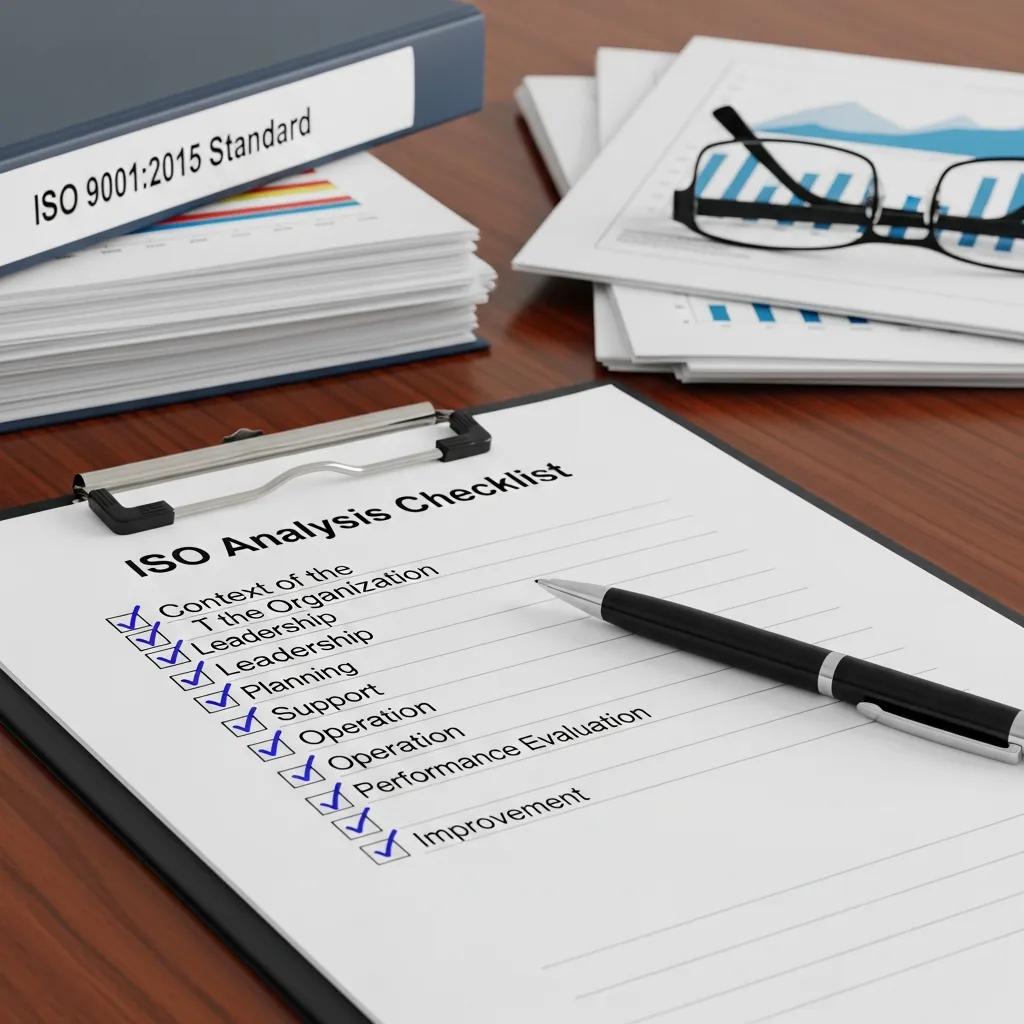
An ISO 9001 checklist targets core QMS requirements: organizational context and interested parties, leadership commitment, risk-based thinking, process maps, performance evaluation and documented information. Verify documented process flows, evidence of management reviews, defined quality objectives with measurable KPIs and records showing corrective action effectiveness. AI-assisted checks can quickly confirm whether documents reference required clauses and whether records show consistent measurement data over time. The checklist validates both artifact presence and operational effectiveness, turning findings into prioritized actions for certification readiness.
This QMS example leads into how we adapt methodology for the ISO 27001:2022 transition.
Adapting ISO 27001 Gap Analysis for the 2022 Transition
ISO 27001:2022 requires remapping existing controls to the new structure and confirming that risk assessments align with updated control objectives. Gap analysis therefore emphasizes control remapping, revalidation of control operation and documentation updates to match revised control descriptions. AI tools speed that work by comparing existing controls to the new taxonomy and surfacing areas where evidence no longer lines up. Assessors must also ensure risk treatment plans reflect the reorganized control sets and that implementation evidence demonstrates ongoing effectiveness under the new structure.
That transition focus brings us to why ISO 42001 gap analysis matters for AI systems.
Why ISO 42001 Gap Analysis Matters for AI Systems
ISO 42001 gap analysis centers on AI governance: accountability, transparency, ethical risk mitigation, model validation and data quality controls — areas that differ from traditional management systems. Assessors must locate model documentation, validation reports, bias test results and lifecycle controls for model updates, then evaluate whether governance structures provide adequate oversight and mitigation. AI-assisted meta-assessment tools can inspect model logs, validation artifacts and data lineage to surface evidence gaps faster than manual review alone. Given the technical complexity, a tailored gap analysis ensures AI systems meet governance expectations before certification.
With tailored approaches explained, the next section covers cost, ROI and commercial considerations for AI-driven gap analysis services.
Cost and ROI of an AI-Driven ISO Gap Analysis by Stratlane
Cost depends on scope, number of standards, locations and depth of evidence sampling, but AI-driven techniques typically cut labor, travel and reporting time compared with fully manual assessments. Stratlane’s accredited model pairs automated analysis with professional auditors to reduce time-on-task, enabling more frequent readiness checks and faster remediation cycles that shorten time-to-certification. Savings come from fewer onsite days, quicker report delivery and earlier detection of systemic issues, which together lower total certification costs. For organizations managing multiple standards or sites, efficiency gains compound and deliver measurable ROI through reduced audit rework and stronger operational resilience.
Overview: The table below compares traditional cost drivers with the AI-driven impact on cost and ROI.
| Cost Driver | Traditional Cost Impact | AI-driven Cost / ROI Impact |
|---|---|---|
| Manual document review hours | High labor hours, variable consistency | Automated parsing reduces review hours by 40–60% |
| Onsite audit travel | Travel and logistics for auditors | Remote analysis lowers travel-related costs significantly |
| Reporting time | Longer turnaround for consolidated reports | Automated drafts accelerate reporting and reduce rework |
| Rework from nonconformities | Extended remediation cycles increase cost | Early detection and prioritization shorten remediation cycles |
This comparison highlights where automated gap analysis reduces readiness costs while improving report quality and overall preparedness.
How AI-Driven Auditing Lowers Gap Analysis Costs
AI reduces costs by automating bulk tasks — document parsing, initial clause mapping and preliminary risk scoring — which lowers billed auditor hours. Remote analysis reduces travel and onsite time, while automated report templates shrink the gap between assessment and actionable findings. Organizations often complete remediation faster because high-risk items surface earlier, limiting prolonged nonconformity resolution. Together, these efficiencies reduce total cost of ownership for certification readiness while preserving the professional audit judgment required for accredited outcomes.
Those optimizations feed into long-term strategic benefits for sustained certification readiness, described next.
Long-Term Benefits of Regular Gap Analysis
Regular gap analysis supports sustained compliance, fewer nonconformities over time, faster certification for new standards and stronger stakeholder confidence in management systems. Ongoing assessments feed continual improvement by turning findings into organizational learning, increasing control maturity and reducing audit surprises. Over time, mature remediation processes and evidence management — often paired with certificate management tools — simplify surveillance audits and cut administrative load for maintaining certification across jurisdictions. These strategic benefits compound as organizations scale standards coverage and use audit outputs in daily operations.
Next: practical answers to common questions about timelines and next steps.
Frequently Asked Questions
Which organizations benefit most from an ISO gap analysis?
All sizes and sectors benefit, especially organizations pursuing ISO certification for the first time or transitioning to new standards. Manufacturing, healthcare, IT and finance often see strong value in identifying compliance gaps to boost operational efficiency and risk management. Organizations with complex processes or multiple locations can use gap analysis to standardize practices and ensure consistent compliance across sites, improving certification readiness.
How often should an organization run a gap analysis?
Run a gap analysis at least annually or whenever processes, regulations or standards change significantly. Regular checks keep compliance current and spot emerging risks early. It’s also wise to run a gap analysis before any scheduled certification audit to confirm controls are in place and working effectively.
What role do employees play in the gap analysis?
Employees are essential: their day-to-day knowledge helps identify gaps and operational weaknesses. Engaging process owners and staff during interviews and evidence sampling gives auditors practical context and improves analysis accuracy. Early involvement also builds ownership for corrective actions and supports sustained improvement.
Can a gap analysis be done remotely?
Yes. With AI tools, remote gap analysis is effective: auditors can access documents, run automated checks and conduct interviews remotely, reducing onsite visits. Remote assessments save time and travel costs, but require good document access and clear communication channels to be thorough.
What are common challenges during a gap analysis?
Common challenges include incomplete or outdated documentation, staff resistance and difficulty accessing evidence. Aligning processes with ISO requirements can be hard for organizations new to the standards, and managing multiple standards or sites adds complexity. Overcome these by preparing documentation, engaging employees early and using AI to streamline data collection and analysis.
How can organizations ensure an effective gap analysis?
Set clear objectives and scope up front. Work with experienced auditors and use AI tools to boost accuracy and efficiency. Encourage open collaboration among staff to get honest input. After the assessment, prioritize findings, create actionable remediation plans and schedule follow-ups to confirm actions were implemented and effective.
Gap Analysis vs. Internal Audit — What’s the Difference?
A gap analysis is a readiness-focused diagnostic that benchmarks current practices against ISO requirements to identify what needs fixing before certification. An internal audit is a recurring check within the management system cycle that verifies conformity and effectiveness. Gap analysis usually happens early in a certification project to shape scope and remediation; internal audits are periodic checks that confirm corrective actions and support continual improvement. Both are complementary: gap analysis tells you what to fix for readiness, internal audits confirm fixes are working over time.
Understanding this difference helps set realistic timelines for readiness — addressed next.
How Long Does an ISO Gap Analysis Take?
Duration depends on scope: a single-site, single-standard assessment can take a few days up to two weeks for full analysis and reporting; multi-site or multi-standard programs typically take several weeks. Timelines stretch when evidence is scattered, environments are complex or documentation is incomplete; they shorten with strong scoping and centralized document access. AI-driven gap analysis shortens upper bounds by automating ingestion and clause mapping, enabling faster turnarounds and quicker remediation cycles.
Next: how to request a quote for an AI-powered gap analysis and what to prepare.
How to Request a Quote for Stratlane’s AI-Powered Gap Analysis
When requesting a quote, have these project details ready: standards in scope, number and location of sites, estimated document volume and any system complexities (for example, AI systems or legacy IT). That information lets us scope the work accurately and return a precise quote faster. Stratlane pairs AI-assisted analysis with accredited auditing and can include certificate management across countries where certificates are issued. Expect a scheduling proposal and quote based on scope and evidence collection complexity.
Prepare scope, standard list, site count and document access details to request a tailored quote and schedule an assessment with Stratlane Certification. That starts your AI-augmented readiness pathway and certificate management support across accredited jurisdictions.
Conclusion
An ISO gap analysis enhanced with AI-driven auditing improves certification readiness by uncovering compliance gaps and streamlining remediation. This approach accelerates timelines and increases consistency and accuracy, raising the odds of a smooth certification outcome. By combining advanced tools with professional audit judgment, organizations can get audit-ready faster and keep compliance sustainable. Ready to move forward? Explore our tailored gap analysis services to start your readiness plan.