
Demystifying ISO: Key Terms in Our Standard Glossary

ISO Terms Made Clear: A Practical Guide to ISO Certification and Standards
ISO is a set of international standards that define consistent requirements and recommended practices for products, services, and management systems. Knowing the right ISO vocabulary matters: precise terms make compliance repeatable, audits reliable, and conversations with vendors or regulators unambiguous. This guide walks through the essential ISO terms, highlights differences between management systems like ISO 9001, ISO 14001, ISO 27001, and ISO 42001, and explains how clear definitions reduce risk and speed market access. You’ll get core definitions, common audit language, the certification vs. accreditation distinction, and emerging terms tied to AI-enabled auditing and ISO 42001. The article is organized into six focused sections—what ISO is and why terminology matters; core management system definitions with comparisons; the certification and accreditation pathway; audit-specific vocabulary and nonconformity handling; AI’s influence on auditing; and dependable resources plus rollout best practices—paired with practical examples and curated checklists to make ISO language actionable for compliance teams, auditors, and business leaders.
What is ISO and Why is Understanding Its Terminology Important?
ISO is the International Organization for Standardization’s collection of voluntary consensus standards that help organizations achieve interoperability, quality, safety, and regulatory alignment across borders. Shared terminology reduces misinterpretation, speeds procurement decisions, and makes audit findings comparable between organizations. When teams use the same terms, scopes and objectives are clear, controls are measurable, and auditors and stakeholders can assess results consistently—improving certification outcomes and supplier selection. For practitioners, a solid grip on ISO language shortens readiness timelines, clarifies cross-functional responsibilities, and cuts rework during audits. Consistent terminology also supports cross-border recognition of conformity assessments and helps suppliers meet client requirements without repeated back-and-forths. The next section explains what ISO stands for and how the global standards process shapes the documents organizations follow.
Stratlane Certification is an accredited certification body that combines AI-assisted auditing with experienced industry auditors. We cover major management-system standards and guide clients from quotes to certification and ongoing certificate management. If you need a readiness assessment or help managing certificates, request a quote to start the conversation.
What Does ISO Stand For and What Is Its Role in Global Standards?
ISO stands for the International Organization for Standardization. It’s a non-governmental network that develops and publishes international standards through consensus among national member bodies. ISO’s role is to create common technical and management-system specifications that facilitate trade and promote safety, efficiency, and best practice. Standards usually move through proposal, committee draft, public review, and publication stages, so many stakeholders contribute and the result applies globally. For businesses, that lifecycle means standards are reviewed and updated to reflect new technology, regulations, and market needs—so adopting ISO language supports long-term compliance and continuous improvement. Knowing the lifecycle helps organizations anticipate changes and align internal policies with published clause structures.
How Does ISO Certification Benefit Businesses and Organizations?
ISO certification provides documented proof that your management system meets a standard’s requirements. That proof builds customer confidence, simplifies regulatory alignment, and creates operational consistency. The benefits are tangible: fewer defects, faster procurement approvals, and reduced risk exposure. Small and medium businesses often use certification to win new customers and enter new markets; larger organizations use it to standardize processes across sites and manage supplier risk. With rising demand for certified systems, investing in consistent terminology and documented controls is increasingly valuable. Clear language reduces audit friction and aligns expectations across contracts, audits, and vendor relationships.
What Are the Core ISO Management System Definitions You Need to Know?
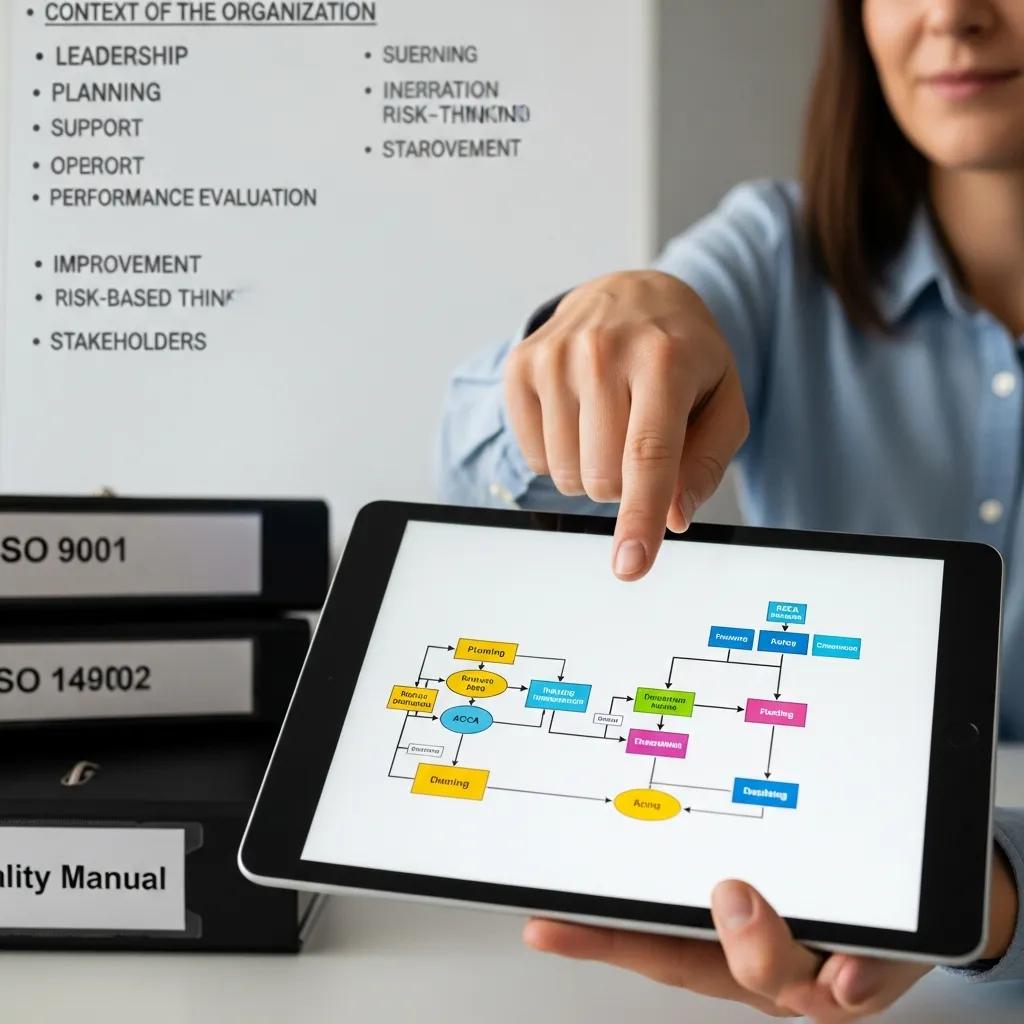
A compact glossary of management-system definitions makes it easier to see each standard’s objectives and controls, while highlighting shared components like policy, process, procedure, scope, and continual improvement. Mastering these terms helps teams map controls to clauses and communicate requirements clearly. Management systems are built on documented policies, defined processes, and measurable objectives that guide behavior and demonstrate conformity during audits. Below is a concise comparison that maps each management system to its core objective, typical controls, and common terms to know.
The following table compares common management system types and their defining attributes.
| Management System | Core Objective | Typical Controls |
|---|---|---|
| ISO 9001 (QMS) | Ensure consistent product/service quality and customer satisfaction | Documented processes, management review, corrective action |
| ISO 14001 (EMS) | Manage environmental impacts and regulatory compliance | Environmental aspects, objectives, operational controls |
| ISO 27001 (ISMS) | Protect information confidentiality, integrity, availability | Risk assessment, access controls, incident response |
| ISO 42001 (AIMS) | Govern trustworthy, ethical AI systems across lifecycle | AI governance, model documentation, ethical use policies |
What Is a Quality Management System in ISO 9001?
An ISO 9001 Quality Management System (QMS) is a structured set of policies, processes, and records that ensure products and services meet customer and regulatory requirements consistently. The QMS is driven by continual improvement through monitoring, measurement, and corrective action. Key QMS terms include context of the organization, interested parties, scope, documented information, nonconformity, and continual improvement—all tied to clauses auditors review during certification. For example, a management review provides documented evidence that leadership evaluates objectives, performance, and resource needs to drive process improvements. Using these terms consistently reduces ambiguity when writing procedures, setting KPIs, and responding to audit findings, helping internal controls align with external expectations more quickly.
How Do Environmental and Information Security Management Systems Differ?
EMS and ISMS both use risk-based approaches but cover different scopes. EMS focuses on physical environmental impacts and compliance obligations, while ISMS protects information assets across confidentiality, integrity, and availability. Typical EMS controls include environmental-aspect registers, pollution prevention measures, and legal-compliance checks. Typical ISMS controls include access management, encryption, incident response, and asset classification. For example, a manufacturer will prioritize emission controls and waste handling under EMS, whereas an IT services firm will focus on data classification and access control under ISMS. Recognizing these differences and their audit terminology ensures teams apply the right clause interpretations and present the correct evidence during assessments.
How Does the ISO Certification and Accreditation Process Work?

Certification is the process where a certification body assesses and issues a certificate for an organization’s management system. Accreditation is the independent recognition of that certification body by an accreditation body. Together they form the conformity-assessment ecosystem that gives certificates credibility. Certification typically follows stages: pre-assessment or readiness review, stage 1 documentation review, stage 2 on-site or remote audit, and regular surveillance audits to maintain certification. Knowing each actor’s role—organization, certification body, accreditation body—helps plan timelines, allocate resources, and prepare objective evidence for auditors. The table below maps Certification, Accreditation, and Audit so you can quickly see who does what and what to expect.
The following table clarifies Certification, Accreditation, and Audit roles in conformity assessment.
| Conformity Activity | Who Issues / Performs | Purpose | Typical Outcome |
|---|---|---|---|
| Certification | Certification Body | Verify organization meets standard requirements | Certificate of conformity |
| Accreditation | Accreditation Body | Validate competence of certification bodies | Accreditation scope and status |
| Audit (Internal/External) | Internal auditors / Certification auditors | Assess compliance and effectiveness of MS | Audit report, findings, nonconformities |
This mapping shows how accreditation supports the trustworthiness of certification and clarifies the relationships between conformity-assessment activities. Below is a numbered list summarizing typical certification stages and what to prepare at each step.
Certification typically proceeds through a few predictable stages:
- Pre-assessment / Readiness: The organization compares processes to the standard and gathers documented information.
- Stage 1 (Documentation Review): An auditor reviews scope, policies, and procedures to confirm the organization is ready for a full assessment.
- Stage 2 (Full Audit): The auditor evaluates implementation, interviews staff, and samples records to confirm conformity.
- Surveillance and Recertification: Ongoing audits verify continued effectiveness and renewal on the certification cycle.
These stages move from documentation to implementation to ongoing assurance. Preparing clear, clause-mapped records reduces the chance of findings during stage 2. The next section clarifies certification versus accreditation for quick reference and highlights common audit terms used during assessments.
What Is the Difference Between Certification and Accreditation?
Certification is the document issued to an organization showing its management system meets a standard. Accreditation is the formal recognition that a certification body is competent and impartial, granted by an independent accreditation body. Certification validates the organization; accreditation validates the certifier. In practice, certificates issued by an accredited certification body carry broader acceptance—regulators and international customers are more likely to trust them because accreditation confirms technical competence and impartiality. Knowing this difference helps buyers and partners evaluate certificate credibility and choose reliable certifiers.
What Are the Key Terms in the ISO Audit Process?
Audits use a concise set of terms to describe evidence, findings, and required actions. Learning these terms improves readiness and response. Below are the top audit terms every team should know, with a short practical tip for each:
- Nonconformity: A deviation from specified requirements; tip: map clause requirements to records before the audit.
- Corrective Action Request (CAR): A formal requirement to address a nonconformity; tip: document containment and root cause analysis promptly.
- Objective Evidence: Records, observations, or statements that support audit findings; tip: keep logs and version-controlled documents accessible.
- Audit Plan: The auditor’s schedule and scope for the assessment; tip: confirm attendees and evidence locations in advance.
- Finding: An auditor’s observed issue, categorized by severity; tip: prepare closure evidence and timelines for each finding.
Using these terms and acting on the tips reduces surprises during audits and shows control maturity. The next section digs into deeper audit vocabulary, including nonconformity management and risk-based thinking.
Decoding ISO Standards: A Guide to Certification Terminology
Audit vocabulary includes classifications for nonconformities, the corrective-action lifecycle, and how findings affect certification decisions. Teams that internalize these definitions work more efficiently and close actions faster. Nonconformities are usually classified by severity (minor, major), which sets timelines and evidence expectations for closure. Auditors expect containment, root-cause analysis, implementation, and verification to be documented. A clear corrective-action flow creates traceability from discovery to closure and provides verifiable evidence during surveillance audits. The next section defines nonconformity management, then explains how risk-based thinking shapes audit planning and control selection.
What Is Nonconformity and How Is It Managed?
A nonconformity is any failure to meet a standard requirement. Management follows a corrective-action lifecycle: identify → contain → root cause → implement corrective measures → verify effectiveness. This sequence fixes issues and helps prevent recurrence. Severity determines urgency: a major nonconformity may require immediate remediation or suspension of certification activities, while a minor nonconformity typically has a set timeframe for correction and verification. Examples include missing records or ineffective controls—each requires documented remediation and verification by internal or external auditors. Organizations that formalize nonconformity handling in procedures reduce repeat findings over time.
How Does Risk-Based Thinking Influence ISO Audits?
Risk-based thinking asks organizations to identify, assess, treat, and monitor risks that could affect conformity and objectives. Auditors use risk assessments to focus audit activities and evaluate whether controls match the identified risks. The practical cycle is identify → assess (likelihood and impact) → treat (controls) → monitor (review effectiveness), and it applies across QMS, EMS, ISMS, and AIMS. Example risks include supply-chain disruption for QMS, regulatory noncompliance for EMS, and data breaches for ISMS—each drives different controls and evidence. Embedding risk-based thinking aligns audit sampling with organizational priorities and helps justify control depth during certification assessments.
How Is AI Transforming ISO Auditing and What Are the Related Terminologies?
AI-driven auditing uses machine learning and analytics to speed evidence collection, detect anomalies, and highlight predictive nonconformities by scanning records and operational telemetry. These tools can improve audit speed, increase consistency, and surface issues earlier than manual review alone. Key AI audit terms include model explainability (how predictions are derived), training-data provenance (where and how training data was sourced), and predictive nonconformity detection (flagging patterns that indicate future issues). While AI adds efficiency, governance and documentation of models are essential so audit evidence stays defensible and transparent. The next section outlines AI-driven auditing benefits and what ISO 42001 requires for AI management systems.
What Is AI-Driven Auditing and Its Benefits in ISO Certification?
AI-driven auditing automates data analysis, detects anomalies, and prioritizes audit focus areas. Benefits include faster evidence aggregation, more accurate trend detection, and earlier identification of potential nonconformities. Operationally, AI can reduce manual review hours by surfacing high-risk records and allowing auditors to concentrate on contextual investigations—shortening audit timelines and improving consistency across sites. For example, automated log analysis can flag unusual access patterns during an ISMS audit, prompting targeted interviews and evidence requests. These capabilities boost audit efficiency while still relying on human judgment to validate findings and ensure objective evidence meets certification criteria.
Stratlane Certification pairs experienced industry auditors with AI-driven tools to streamline evidence collection and prioritize high-risk areas. If you’re interested in AI-enabled audits or ISO 42001 guidance, request a quote for a tailored audit and certificate-management plan.
What Does ISO 42001 AI Management System Standard Entail?
ISO 42001 covers governance and lifecycle management for AI systems, focused on transparency, accountability, ethical use, and risk management for AI-specific risks. Relevant terms include AI governance framework, model lifecycle, data governance, and fairness metrics. Auditors will look for policies on model development, validation, monitoring, and human oversight, plus evidence of explainability and data lineage. Aligning ML model documentation with clause-structured evidence helps auditors see whether controls mitigate risks like bias, privacy breaches, or performance drift. Integrating ISO 42001 terminology into existing management systems creates clearer governance and audit trails for AI-powered processes.
Where Can You Find Reliable Resources and Glossaries to Understand ISO Standards Vocabulary?
Trustworthy resources include official ISO publications, national standards bodies, and curated glossaries that map clause language to practical controls. Structured glossaries and interactive tools help teams translate normative wording into operational procedures. A searchable glossary speeds onboarding, reduces interpretation errors, and harmonizes templates across the organization—creating a single source of truth for terms like “nonconformity,” “objective evidence,” and “management review.” Below we explain how an interactive glossary supports learning and offer a best-practice checklist to operationalize terminology in 30/60/90-day increments.
How Does Stratlane’s Interactive ISO Certification Glossary Support Learning?
Stratlane’s interactive glossary is a searchable hub that links defined terms to guidance notes, auditor tips, and related services like certification, audits, and certificate management. Organized by standard and audit phase, the glossary narrows the gap between clause language and everyday procedures, helping teams update templates and training consistently. For audit prep, linking terms to sample evidence and certificate-management workflows improves readiness and reduces back-and-forth during certification. Using structured data and defined-term schemata in an internal glossary boosts discoverability and keeps usage consistent across documents.
What Are the Best Practices for Using ISO Terminology in Your Organization?
Rolling out consistent ISO terminology takes a deliberate approach: create a living glossary, train staff, update templates, map terms to controls, and review usage regularly to stay audit-ready. The 30/60/90-day starter plan below prioritizes what to do first to embed terminology into governance and operations.
Implementing consistent terminology follows a simple checklist:
- Create a central glossary: Define terms and link them to clauses and sample evidence.
- Train teams: Run role-based sessions with practical examples and audit expectations.
- Update templates: Align procedures, forms, and records with standardized terminology.
- Map to controls: Connect glossary entries to specific process controls and owners.
- Review quarterly: Schedule routine checks to capture updates and stay aligned with standard revisions.
- Create glossary and map to clauses within 30 days: Centralize definitions and assign owners.
- Run targeted training and update templates within 60 days: Make sure staff understand terms in context.
- Perform a live readiness review and embed reviews in policies by 90 days: Confirm consistent application and audit readiness.
Following these steps reduces semantic friction between teams and auditors, improves documentation quality, and makes certification outcomes more predictable.
This article has covered core definitions, comparison tables, audit vocabulary, AI-related terms, and practical rollout steps to help teams demystify ISO language and use it to achieve consistent compliance and better audit outcomes.
Frequently Asked Questions
What are the main differences between ISO certification and ISO accreditation?
Certification is the process where a certification body confirms an organization meets a specific ISO standard and issues a certificate. Accreditation is the independent recognition that the certification body itself is competent and impartial. Certification validates an organization’s system; accreditation validates the certifier, increasing trust in the certificate’s credibility.
How can organizations prepare for an ISO audit effectively?
Prepare by running internal audits to surface gaps, organizing required documentation, and training staff on audit expectations. Assemble policies, procedures, and records that demonstrate conformity, create an audit plan with scope and objectives, and run mock audits to identify weak spots. Regular reviews and targeted training will smooth the certification process.
What role does risk management play in ISO standards?
Risk management is central to many ISO standards. It requires organizations to identify, assess, and treat risks that could affect objectives and conformity. A risk-based approach ensures controls match the level of risk, improves resilience, and helps prioritize resources—resulting in stronger performance and better audit outcomes.
What are the benefits of using AI in ISO auditing?
AI can speed evidence collection, automate anomaly detection, and surface areas needing human review—reducing manual effort and increasing consistency. By highlighting high-risk records, AI lets auditors focus on context and judgment, improving audit quality and shortening timelines when used with proper governance and validation.
How can organizations ensure consistent use of ISO terminology?
Build a centralized glossary that links terms to clauses and sample evidence, run regular role-based training, and update templates to reflect standardized language. Periodic reviews and owner accountability help keep terminology current and consistent across teams and documents.
What resources are available for understanding ISO standards and terminology?
Useful resources include official ISO publications, national standards bodies, curated glossaries, and interactive online tools. Accredited certification bodies offer training and workshops, and industry forums provide practical insights. Combining authoritative standards with practical guides and training helps teams apply ISO requirements effectively.
Conclusion
Clear ISO terminology matters. When teams share the same definitions and structure their evidence around clause language, audits run smoother, risks are easier to manage, and certification becomes more predictable. Explore our interactive glossary and resources to accelerate your compliance program—and get practical support from Stratlane when you’re ready to move from readiness to certification.