
Ensure Patient Privacy: Your Guide to HIPAA Compliance

HIPAA Compliance in Healthcare: A Practical Guide to Patient Privacy and Security
Protecting patient privacy and securing electronic protected health information (ePHI) are non‑negotiable for healthcare organizations. Failure to meet HIPAA obligations risks fines, operational disruption, and loss of patient trust. This guide lays out the core HIPAA rules, explains how an ISO 27001 information security management system (ISMS) supports Security Rule obligations, and shows how AI‑driven auditing speeds risk detection and evidence collection. You’ll get prioritized, practical steps for governance, risk assessment, workforce training, BAA oversight, and technical controls — plus mappings, tables, and checklists you can use to organize your compliance program. By the end, you’ll know what to implement, why it matters for patient privacy, and how to document a demonstrable compliance posture that scales across services and vendors.
What Are the Core HIPAA Rules Healthcare Organizations Must Follow?
HIPAA is built on three complementary rules that together set expectations for protecting patient information. The Privacy Rule limits uses and disclosures of PHI and defines patient rights. The Security Rule requires administrative, physical, and technical safeguards for ePHI. The Breach Notification Rule mandates timely reporting when unsecured PHI is compromised. These rules apply to covered entities and their business associates and require policy, technical controls, and documented processes to manage risk and show compliance. Start by mapping PHI flows, enforcing the minimum‑necessary standard, and ensuring contract and oversight for third parties. The section below breaks down Privacy Rule protections and patient rights, which guide how you classify and control PHI in practice.
What Does the HIPAA Privacy Rule Protect in Patient Data?

The Privacy Rule covers individually identifiable health information—PHI—in all forms: oral, paper, and electronic. That includes demographics, medical history, diagnoses, treatment details, billing records, and identifiers like names, dates, and contact information tied to health data. Patients have rights under the Privacy Rule — access to records, requests to amend information, and an accounting of disclosures — and organizations must honor those rights while applying the minimum‑necessary principle for routine uses. Role‑based access, clear disclosure procedures, and documented request workflows help operationalize these rights and reduce accidental exposures. Those policy choices then drive the technical and administrative safeguards you’ll need under the Security Rule.
How Does the HIPAA Security Rule Safeguard Electronic Protected Health Information?
The Security Rule requires proportional administrative, physical, and technical safeguards to protect the confidentiality, integrity, and availability of ePHI. Administrative controls include documented risk assessments, workforce training, access management, and an incident response plan with clear roles. Physical safeguards cover facility access, device control, and secure media disposal. Technical safeguards require encryption, access controls, multifactor authentication (MFA), and audit logging to control and monitor ePHI use. Layering these safeguards helps prevent unauthorized access and supports timely detection and response. Mapping Security Rule requirements to specific controls lets you prioritize remediation that reduces the likeliest threats to patient data.
- The three core HIPAA rules summarized:
Privacy Rule: Governs uses and disclosures of PHI and defines patient rights.
Security Rule: Requires administrative, physical, and technical safeguards for ePHI.
Breach Notification Rule: Requires prompt notification to affected individuals and regulators after breaches.
These rules form the baseline for the practical steps that follow, including risk assessments and third‑party oversight.
How Does ISO 27001 Certification Support HIPAA Compliance in Healthcare?
An ISO 27001 ISMS gives you a structured, auditable framework to manage information security risk. It documents policy, requires regular risk assessments and treatment plans, and embeds continuous monitoring and improvement — all of which align with HIPAA’s administrative and technical expectations. Earning ISO 27001 certification provides independent assurance to partners and auditors that security controls are managed systematically, helping demonstrate a good‑faith effort to meet the Security Rule’s requirements.
Controls in ISO 27001 Annex A map to many HIPAA Security Rule elements and offer concrete implementation examples to bridge standards and regulatory expectations.
A growing body of guidance highlights how ISO 27001 controls can directly address HIPAA’s technical safeguards.
ISO 27001 and HIPAA: Practical Control Alignment
Annex A in ISO 27001 provides control categories that align with HIPAA’s technical safeguards — helping organizations translate regulatory requirements into implementable controls and evidence for auditors.
| ISO Control Area | HIPAA Security Requirement | Implementation Example |
|---|---|---|
| A.9 Access Control | Access management and authorization | Role‑based access, MFA, periodic access reviews |
| A.12 Operations Security | Audit logging and system monitoring | Centralized logging, SIEM alerts, retention policies |
| A.13 Communications Security | Transmission protection for ePHI | TLS for data in transit, secure APIs with scopes |
| A.17 Business Continuity | Availability and contingency planning | Disaster recovery plans, regular backup tests |
| A.18 Compliance | Legal and contractual compliance | Documented regulatory requirements and internal audits |
This mapping shows ISO controls provide both administrative and technical mechanisms that meet many Security Rule expectations while creating a continuous improvement loop for risk treatment and monitoring. After mapping, identify jurisdictional gaps — for example, breach notification timelines — and add ISMS policy language to ensure full HIPAA alignment.
Stratlane Certification provides ISO 27001 certification services and uses AI‑enabled auditing to improve evidence collection and reduce audit effort. Partnering with an accredited certification body that combines ISO assessment with automated evidence gathering can accelerate readiness and provide recognized third‑party assurance. The next section looks at how AI‑driven auditing further strengthens HIPAA compliance through improved detection and continuous monitoring.
How Can AI-Driven Auditing Enhance HIPAA Compliance Audits?
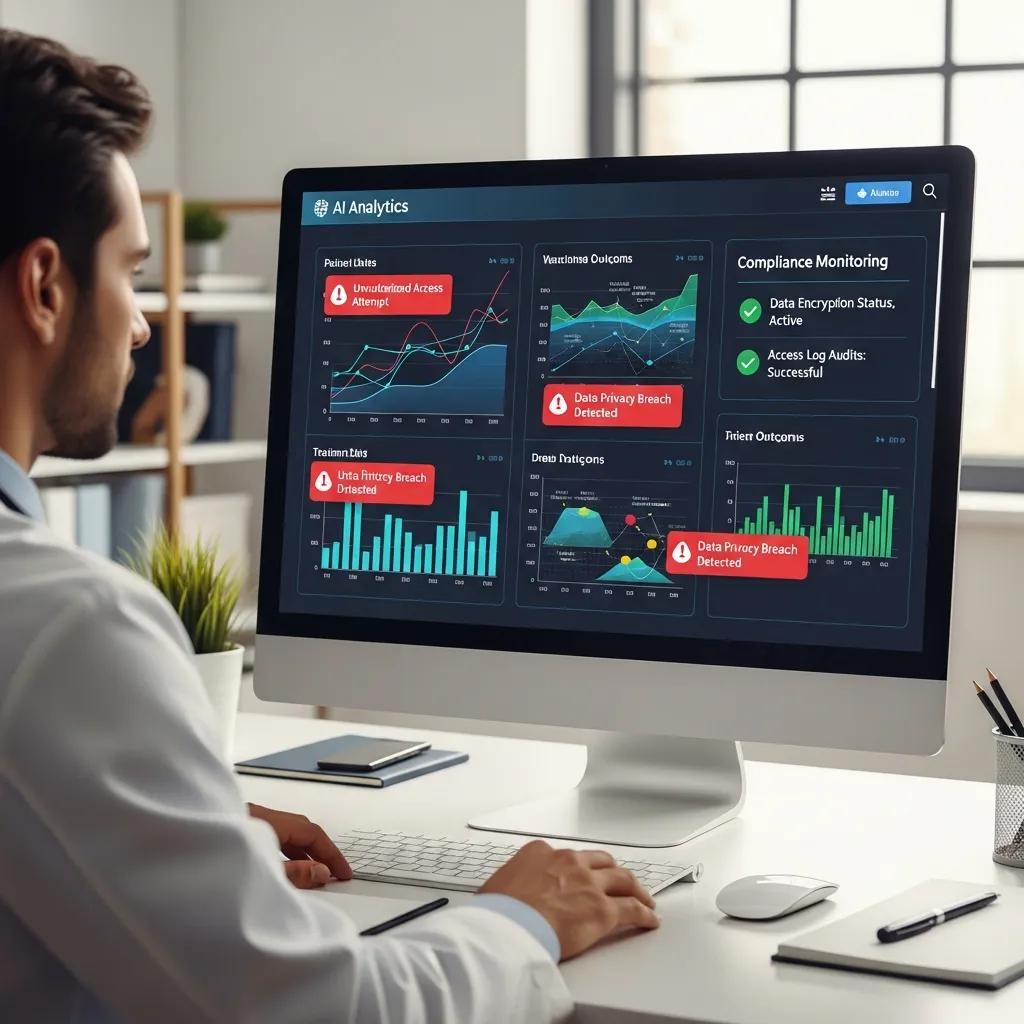
AI‑driven auditing complements traditional approaches by automating log analysis, prioritizing high‑risk findings, and enabling near‑real‑time monitoring of user behavior and system anomalies related to ePHI. AI can surface patterns — for example, unusual access to patient records or unexpected exports — faster than manual review, and it can produce standardized evidence artifacts that simplify auditor verification. These capabilities shorten audit cycles, reduce human error in evidence collection, and expand visibility across systems and vendors. The table below summarizes common AI auditing capabilities, the audit attributes they improve, and the outcomes you can expect.
Research increasingly supports AI’s role in strengthening HIPAA compliance, especially in Identity and Access Management (IAM).
AI for HIPAA Compliance & IAM
Studies show AI enhances IAM by automating access controls, monitoring behavior in real time, and surfacing threats — all of which help meet HIPAA requirements for access controls and ongoing validation.
| Capability | Audit Attribute | Outcome |
|---|---|---|
| Log correlation & anomaly detection | Speed and accuracy of detection | Faster breach identification and prioritized alerts |
| Automated evidence collection | Consistency of documentation | Reduced audit preparation time and reproducible evidence |
| Continuous monitoring | Timeliness of control validation | Ongoing assurance of control effectiveness |
These AI features translate into measurable improvements in risk posture and audit readiness and typically work with human governance processes to deliver prioritized, contextual findings to analysts.
What Are the Advantages of AI in Risk Assessment and Continuous Monitoring?
AI speeds risk assessments by scanning configurations, access logs, and vendor interactions to surface likely exposure vectors and then ranking findings by risk based on context such as data sensitivity and privileged access. Pattern detection highlights abnormal user activity — for example, many patient record queries in a short window — and flags suspected incidents for immediate review. Continuous monitoring tracks deviations over time so teams can remediate faster and iteratively strengthen controls. Useful KPIs to track include mean time to detect (MTTD), mean time to remediate (MTTR), and month‑over‑month reduction in high‑risk findings; these feed management review and show program effectiveness.
How Does AI Improve Accuracy and Cost-Effectiveness in HIPAA Audits?
Automating repetitive evidence collection and applying machine learning to correlate events reduces manual audit hours and lowers the cost of maintaining compliance. Evidence shows automated correlation cuts false positives and lets audit teams focus on high‑impact investigations instead of routine log review. You can calculate ROI with metrics like hours saved per audit cycle, fewer external consultant days, and expanded coverage of monitored systems. With cleaner evidence and prioritized remediation, organizations gain broader control coverage at lower marginal cost — supporting sustainable investment in controls and training.
Stratlane Certification integrates AI‑driven auditing into its certification services to shorten audits and help organizations maintain continuous compliance evidence. To request a quote or discuss audit scope and timing, contact Stratlane Certification’s services team for details.
What Are the Key Challenges and Priorities for Healthcare Data Privacy in 2025?
The 2025 threat landscape highlights ransomware, insider risk, telehealth expansion, and tougher enforcement — which makes demonstrable controls and rapid detection top priorities. Regulators are focusing more on BAAs and vendor security, and breach costs — remediation, fines, and notifications — push organizations to invest in logging, incident response, and documented controls. Telehealth growth adds new endpoints and remote access vectors that need policy coverage and technical controls, while treatment‑specific privacy concerns may demand segmented access for sensitive data. Prioritize fixes that close high‑likelihood, high‑impact gaps and require third‑party assurance via audits or certifications.
How Are Increasing HIPAA Penalties Impacting Healthcare Providers?
Stronger enforcement and higher penalties raise the stakes of noncompliance, placing added value on documented governance, regular risk assessments, and timely breach response. Organizations that can show continuous risk management, training, and vendor oversight are more likely to reduce enforcement severity, while those without documentation face larger fines and reputational harm. The financial impact of breaches — remediation, legal fees, notifications, and loss of patient trust — means prevention and rapid detection are typically more cost‑effective than remediation. Investing in layered protections and clear documentation helps teams respond defensibly and direct limited budgets to the most effective mitigations.
What Are Emerging Risks in Telehealth and Business Associate Agreements?
Telehealth introduces risks from insecure endpoints, third‑party video platforms, and cross‑jurisdiction data routing; these require strong session encryption, secure client apps, and clear vendor accountability in BAAs. Remote workforce device management increases exposure unless organizations enforce endpoint protection, VPN or zero‑trust access, and least‑privilege principles. For BAAs, best practices include security questionnaires, periodic audits, and contract clauses covering breach notification timelines, security standards, and subprocessor disclosure. Treat the BAA lifecycle — onboarding, monitoring, and offboarding — as an operational process to reduce third‑party risk and speed incident response when shared patient data is affected.
- Key telehealth and BAA mitigations:
Encrypt telehealth sessions and require secure client applications.
Enforce endpoint protection and conditional access for remote staff.
Operationalize BAA reviews with a set cadence and clear evidence requirements.
These mitigations help prepare organizations for both technical attacks and regulatory inquiries by ensuring controls cover telehealth and third‑party processing.
What Practical Steps Should Healthcare Organizations Take to Achieve HIPAA Compliance?
A practical roadmap begins with governance, moves through risk assessment and mitigation, and continues with workforce training, BAA management, and technical controls plus monitoring. Assign a clear HIPAA compliance owner, document policies, and maintain an incident response plan. Conduct a scoped HIPAA risk assessment that catalogs ePHI assets, threat scenarios, and existing controls, then prioritize remediation by risk. Implement role‑based access, encryption, centralized logging, and MFA as core technical safeguards, while delivering targeted, role‑based training and phishing simulations. Use documented vendor due diligence and a disciplined BAA lifecycle to ensure third‑party controls match your risk tolerance.
| Activity | Responsible Role | Recommended Frequency |
|---|---|---|
| HIPAA Risk Assessment | Compliance Officer / InfoSec | Annually and after major changes |
| Workforce Training | HR / Compliance | Quarterly role‑based modules |
| BAA Review & Vendor Audit | Vendor Management | Annual reviews and onboarding checks |
| Technical Control Testing | IT/Security | Monthly monitoring and quarterly tests |
This action matrix gives a practical cadence that balances continuous assurance with manageable resource allocation.
- Establish governance and assign a HIPAA compliance owner with documented responsibilities.
- Perform a comprehensive HIPAA risk assessment and record risk treatment plans.
- Implement technical safeguards: encryption, access controls, MFA, and centralized logging.
- Create an incident response playbook and run tabletop exercises to validate readiness.
- Manage BAAs with supplier assessments, contractual security clauses, and periodic audits.
- Train staff regularly with role‑based content and measure effectiveness using KPIs.
These steps build a defensible compliance posture and support audit readiness by producing consistent evidence that controls operate over time.
Organizations pursuing ISO 27001 should map ISMS processes to institutionalize these steps and reduce duplication of effort.
Stratlane Certification helps healthcare organizations across these practical steps with ISO 27001 certification services, AI‑augmented audit workflows to streamline evidence collection, and internationally recognized certificate issuance. Our services are designed to help you reach audit readiness, enable continuous monitoring, and secure third‑party assurance.
How to Develop Effective HIPAA Policies and Employee Training Programs?
Good HIPAA policies are concise, role‑aware, and easy to access. They spell out how PHI should be handled, escalation paths, and procedures for breach reporting and access requests. Training should be role‑based, scenario‑driven, and timed to risk — onboarding immediately, regular refreshers annually or semi‑annually, and focused modules for high‑risk roles (billing, clinical staff). Measure effectiveness with KPIs like policy acknowledgment rates, simulated phishing click rates, and remediation completion times. Keep records of attendance, outcomes, and corrective actions so training becomes part of your audit evidence and supports continuous improvement.
What Are Best Practices for Conducting HIPAA Risk Assessments and Managing BAAs?
Follow a repeatable framework — NIST, ISO‑aligned, or equivalent — to scope assets, identify threats and vulnerabilities, and quantify risk for prioritization. Maintain a treatment register that tracks owners, priorities, and completion dates, and validate remediations through testing and updated risk scoring. For BAAs, keep a vendor inventory, use security questionnaires, require attestation or audit reports, and schedule periodic reviews. Include contractual breach notification timelines and security standards, and ensure offboarding removes access and revokes credentials promptly. These practices reduce exposure and create the documentation regulators expect.
How Do Global Data Privacy Laws Affect HIPAA Compliance for Healthcare Entities?
HIPAA governs PHI in the U.S. context for covered entities and business associates. GDPR and UK data protection laws apply to personal data in those jurisdictions and grant broader data subject rights and different lawful bases for processing. Organizations that operate across borders must reconcile HIPAA with international rules on lawful transfers, data subject rights, and retention. That typically means thorough data mapping, documenting lawful transfer mechanisms, and harmonizing policies to meet the strictest applicable requirements. Cross‑border processing often requires added contractual protections and transfer mechanisms such as adequacy decisions or standard contractual clauses.
What Are the Key Differences Between HIPAA and GDPR in Healthcare?
HIPAA specifically regulates PHI handled by covered entities and business associates and focuses on safeguards and breach notification. GDPR applies more broadly to personal data of people in the EU and grants robust rights like portability and erasure. GDPR’s lawful bases (consent, public interest, etc.) differ from HIPAA’s healthcare‑centric processing model. Enforcement also differs: GDPR fines can be a percentage of global turnover, while HIPAA penalties are administratively imposed and tiered by culpability. When handling EU/UK patient data alongside U.S. obligations, design processes that satisfy both regimes where applicable.
How Should US, EU, and UK Healthcare Organizations Navigate Multi-Jurisdictional Compliance?
Practical cross‑border steps include data mapping to locate where patient data is processed, conducting Data Protection Impact Assessments (DPIAs) when required, and choosing lawful transfer mechanisms — adequacy, SCCs, or tailored contractual protections. Harmonize policies to incorporate the strictest applicable rights, ensure BAAs or data processing agreements include international processing clauses, and train staff on jurisdiction‑specific obligations. Maintain a subprocessors inventory and transfer pathways to respond to data subject requests and regulator inquiries. These measures reduce legal friction and show a consistent approach to protecting patient data globally.
This guide has laid out an end‑to‑end framework — rules, ISO mappings, AI capabilities, prioritized steps, and cross‑border considerations — to help healthcare organizations build a defensible HIPAA compliance program. For teams seeking formal ISO 27001 certification and AI‑augmented audit support, Stratlane Certification delivers accredited ISO services and automated audit tooling designed to shorten preparation time and provide recognized certificates across multiple countries. To request a quote or discuss audit timeline and scope, contact Stratlane Certification’s services team to align certification and HIPAA mapping with your risk priorities.
Frequently Asked Questions
What are the consequences of non-compliance with HIPAA regulations?
Non‑compliance can carry serious consequences: regulatory fines, legal action, remediation costs, and reputational harm. HHS penalties vary by level of negligence — generally ranging from $100 to $50,000 per violation — with maximum annual caps that can reach $1.5 million for repeated failures. Affected patients may also pursue legal claims, and loss of trust can hurt care delivery and revenue.
How often should healthcare organizations conduct HIPAA risk assessments?
Conduct a HIPAA risk assessment at least annually and after significant changes — new technology, operational shifts, mergers, or a breach. Regular assessments help you identify vulnerabilities, validate controls, and ensure security measures stay effective as your environment evolves.
What role do Business Associate Agreements (BAAs) play in HIPAA compliance?
BAAs formalize the responsibilities of third‑party vendors that handle PHI on your behalf. They require appropriate safeguards, breach notification procedures, and accountability. Maintaining up‑to‑date BAAs, performing vendor due diligence, and enforcing contractual security obligations are essential to manage third‑party risk and show regulatory due diligence.
How can healthcare organizations ensure their employees are HIPAA compliant?
Combine role‑based, scenario‑driven training with clear, accessible policies and routine testing. Onboard staff with required training, run periodic refreshers, and measure effectiveness with KPIs like policy acknowledgment rates and phishing simulation results. Pair training with monitoring and corrective actions so compliance becomes part of daily work, not a one‑time task.
What are the best practices for managing electronic protected health information (ePHI)?
Best practices include enforcing strong access controls (role‑based access, MFA), encrypting data at rest and in transit, keeping systems patched, maintaining centralized logging and monitoring, and having a tested incident response plan. Regular audits and control testing help ensure those safeguards are effective.
How does telehealth impact HIPAA compliance?
Telehealth expands endpoints and introduces new vectors for exposure. Secure telehealth requires encrypted sessions, vetted client applications, secure session management, and endpoint controls for remote staff. Update policies to cover telehealth workflows and train clinicians and support staff on secure practices to protect ePHI during remote care.
Conclusion
Meeting HIPAA obligations is essential to protect patient data and reduce the risk of costly breaches. A structured approach — combining governance, risk assessment, and staff training with technical safeguards — builds a stronger, more defensible posture. ISO 27001 provides a proven management framework, and AI‑driven auditing can accelerate detection and simplify evidence collection. If you’d like tailored support, our team is available to discuss certification, audit readiness, and practical steps to harden your compliance program.