
Elevate Supplier Quality with ISO Standards in Supply Chain

Enhancing Supply Chain Performance with ISO Standards, AI Auditing, and Security
Reliable supply chains are built on repeatable standards that deliver consistent quality, resilient logistics, and regulatory compliance across suppliers and transport networks. This article shows how ISO standards—especially ISO 9001, ISO 28000, ISO 14001 and the emerging ISO/IEC 42001—drive measurable supplier quality, operational resilience, and better environmental outcomes. We explain how AI-augmented auditing speeds certification and continuous improvement, outline concrete mechanisms (process controls, risk-based thinking, incident response), and list measurable results (fewer defects, faster recovery, lower emissions). You’ll also find practical, step-by-step guidance for implementing certification across global supply chains and a look at ISO 9001:2025’s implications for digital transformation, supported by anonymized case metrics. Keywords such as supply chain optimization, logistics efficiency, supplier quality, and AI-driven auditing are woven throughout for clarity and discoverability. The section that follows defines ISO 9001 and maps its direct effects on supplier evaluation and quality management in logistics.
What is ISO 9001 and how does it improve supply chain quality management?
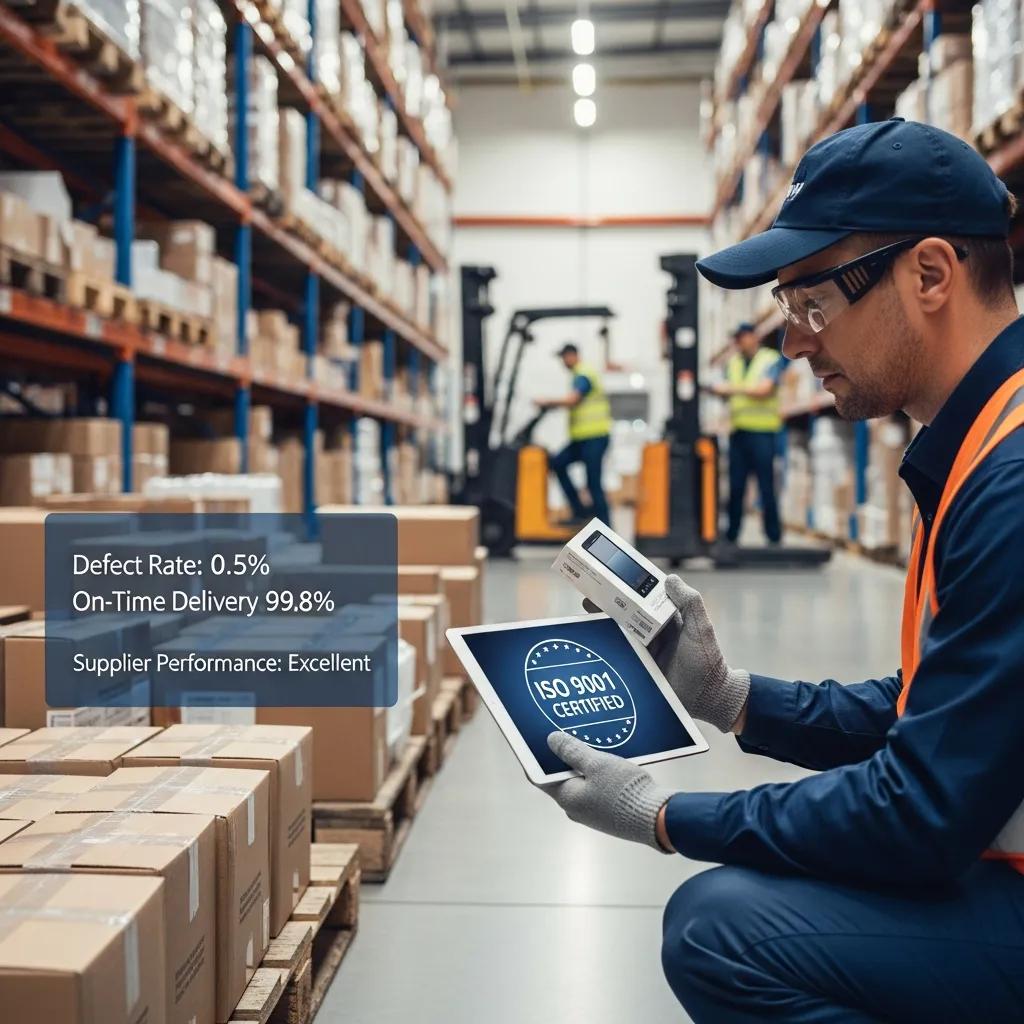
ISO 9001 is the international quality management standard that codifies process controls, supplier evaluation, and risk-based decision-making so products and services consistently meet requirements. By demanding documented processes, objective KPIs, and systematic supplier assessment, ISO 9001 reduces defects and drives supplier performance improvements that lift overall supply chain efficiency. Its focus on evidence-based decisions makes quality issues visible and actionable—cutting rework and returns across logistics operations. Below are the core, snippet-ready benefits for supply chains.
ISO 9001 improves supply chain outcomes in clear ways:
- Reduced defects: Defined process controls and inspection steps lower nonconformities and returns.
- Stronger supplier KPIs: Structured evaluation and corrective action improve on-time delivery and product quality.
- More consistent customer satisfaction: Standardized processes align outputs with customer requirements every time.
Those improvements create a virtuous cycle: fewer defects lower logistics costs, and better supplier performance improves lead-time predictability and inventory control. Next is a concise comparison of ISO 9001 attributes and their direct supply chain outcomes.
| ISO 9001 Attribute | Supply Chain Mechanism | Practical Outcome |
|---|---|---|
| Supplier evaluation | Standardized audits and KPI scorecards | Better on-time delivery and fewer defects |
| Risk-based thinking | Prioritized controls for critical suppliers | Fewer supply disruptions and improved contingency readiness |
| Process controls | Documented work instructions and checks | Reduced rework and higher first-pass yield |
Translating ISO 9001 attributes into operational checks produces measurable supply chain gains and fuels continuous improvement. The following subsections unpack the standard’s core principles and how continuous improvement strengthens supplier evaluation.
Key principles of ISO 9001 for supply chains
ISO 9001 centers on customer focus, leadership, a process approach, risk-based thinking, and evidence-based decisions—principles that directly shape procurement and logistics. Customer focus aligns supplier selection and quality criteria with end-customer expectations, reducing returns and protecting brand reputation. Leadership assigns accountability across procurement and logistics so supplier targets are enforced and resourced. The process approach maps inbound, production, and outbound flows to reveal failure points; risk-based thinking prioritizes controls for high-impact suppliers and routes. Evidence-based decision-making requires measurable KPIs—like defect rate, on-time delivery, and corrective-action closure—that let logistics managers make objective supplier choices and drive continuous improvement.
Those principles feed supplier evaluation tactics and improvement loops, which we cover next.
How ISO 9001 drives continuous improvement and supplier evaluation
ISO 9001 embeds continual improvement through scheduled audits, KPI monitoring, corrective action, and management review—tightening supplier performance over time. Typical supplier evaluation relies on scorecards covering quality, delivery, and responsiveness, with audit cadence set by supplier criticality and historical performance. Corrective actions use root-cause analysis plus verification steps so fixes stick, and supplier training or process changes are tracked. Regular management review closes the loop by adjusting supplier tiers, contract terms, or onboarding criteria based on documented performance data and risk assessments.
A practical supplier-evaluation checklist includes scorecard metrics, audit frequency, corrective-action timelines, and escalation rules; using this helps logistics teams prioritize high-impact suppliers and track objective improvement. This supplier focus naturally leads into the security measures addressed by ISO 28000 to reduce disruption across the logistics chain.
How does ISO 28000 enhance supply chain security and logistics resilience?
ISO 28000 is a security management system for supply chains that formalizes risk assessment, access controls, monitoring, and partner security criteria to reduce disruptions and speed recovery. The standard asks organizations to identify threats across transport, storage, and handling, then implement proportionate controls and contingency plans to lower incident likelihood and impact. Embedding security into supplier selection and logistics processes improves resilience through redundancy, alternate routing, and clear incident-response protocols. Below are the core components that make ISO 28000 effective for shippers and logistics providers.
- Risk assessment and mitigation: Systematic identification and treatment of security risks.
- Security policy and partner criteria: Clear expectations for partners and chain-of-custody safeguards.
- Monitoring and incident response: Real-time monitoring, reporting, and coordinated recovery playbooks.
These components translate to fewer security-related stoppages, faster recovery, and stronger controls at handoff points—reducing overall supply chain fragility. The table below maps specific controls to their operational value.
| Control | Attribute | Logistics Value |
|---|---|---|
| Access control | Physical and digital entry restrictions | Less theft and unauthorized access |
| Incident response | Defined roles and recovery steps | Faster recovery and minimized downtime |
| Partner security criteria | Vetting and carrier audits | Lower risk of compromised shipments |
This mapping shows how specific security measures reduce disruptions and improve recovery performance. The following subsections break down the components and resilience strategies in practical terms.
Core components of ISO 28000 for supply chain security
ISO 28000’s essentials include structured risk assessments, documented security policies, partner vetting criteria, and monitoring systems that combine to form a defensible supply chain posture. Risk assessments highlight high-threat nodes—terminals, cross-docks, storage sites—and match security controls to risk levels. Security policies clarify responsibilities for shippers, carriers, and warehouses and set minimum partner standards. Monitoring systems integrate sensor feeds and reports into incident dashboards so teams detect anomalies and run response playbooks quickly. Together, these measures help logistics providers reduce theft, tampering, and interruptions while keeping throughput and delivery reliability intact.
Risk management and resilience strategies in logistics
Resilience under ISO 28000 means building redundancy, defining alternate routing protocols, diversifying suppliers, and testing incident response plans to limit downtime. Redundancy could be multiple qualified carriers on critical lanes or dual-sourced components to avoid single-point failures. Alternate routing and contingency playbooks let operations shift shipments quickly when a node is compromised, while supplier diversification reduces the chance one supplier halts production. Regular incident-response drills validate communications and recovery timelines so teams act with practiced efficiency. One scenario—combining strict supplier vetting and alternate routing—shows ISO 28000 alignment shrinking recovery from days to hours by removing decision friction.
These resilience practices intersect with faster, data-driven auditing powered by AI, which we discuss next.
What are the benefits of AI-driven auditing in ISO supply chain certification?

AI-driven auditing complements traditional certification by automating evidence collection, spotting anomalies in supplier data, and generating predictive risk scores to prioritize audits. Machine learning and natural language processing speed review of documents, contracts, and supplier records while dashboards synthesize signals across quality, security, and environmental metrics. The result: faster, more accurate audits, fewer travel and manual hours, and continuous monitoring that surfaces issues before they escalate. Below are the primary measurable benefits—optimized for quick stakeholder briefings.
Research continues to show how NLP and other AI techniques accelerate consistent compliance audits across sectors.
AI-Driven Compliance Audits with NLP
AI-based compliance auditing combines machine learning, natural language processing (NLP), and automation to detect regulatory breaches, extract evidentiary material, and deliver audit findings more consistently and quickly. The referenced paper proposes a hybrid model using transformer-based NLP for contract and regulation interpretation, supervised anomaly detection for transaction and reporting streams, plus an explainability layer that maps model outputs to regulation clauses and audit trails. The framework was evaluated on a corpus of synthesized and de-identified financial transaction logs, regulatory filings, and contracts (N ≈ 1.2M records; 12K contract sections).
AI-Driven Compliance Audits: Enhancing Regulatory Adherence in Financial and Legal Sectors, ST Gandhi, 2023
- Efficiency: Faster audits and shorter time-to-certification through automated evidence aggregation.
- Accuracy: Data-driven anomaly detection uncovers issues that sample-based audits can miss.
- Cost reduction: Fewer audit hours and targeted onsite checks cut overall certification spend.
To compare approaches at a glance, the table below contrasts traditional audits with AI-enhanced alternatives on key attributes.
| Audit Approach | Characteristic | Impact |
|---|---|---|
| Traditional audit | Periodic, sample-based review | Slower detection and higher travel/time costs |
| AI-driven audit | Continuous, data-driven analysis | Faster discovery and prioritized interventions |
| Hybrid model | Automated screening plus targeted onsite checks | Balanced coverage with lower overall cost |
AI-driven auditing moves organizations from periodic sampling to continuous, risk-based assurance—enabling proactive supply chain management. Below we note practical market services that combine AI auditing with certificate lifecycle management.
Stratlane Certification includes AI-driven auditing in its ISO certification services, using automated evidence collection and continuous monitoring to accelerate audits and reduce manual overhead. Accredited in over 27 countries and supported by professional auditors in over 29 countries, Stratlane Certification pairs AI auditing with certificate management to streamline surveillance and renewals. Organizations—from large enterprises and academic institutions to SMEs—can request an AI audit or a quote for certification services to align their supply chains with ISO requirements efficiently. This note highlights how teams can operationalize the AI benefits described above.
The broader use of AI in ISO auditing and consultancy—such as for ISO 27001—is also being explored for feasibility and impact.
AI for ISO 27001 Auditing & Consultancy
Research into AI-assisted ISO 27001 consultancy and auditing examines feasibility and potential impacts of AI-driven solutions in this domain.
Automating ISO 27001
Consultancy and Auditing using AI: A Feasibility Study Based on Expert Interviews, CEWM Brachten, 2023
Efficiency and accuracy improvements from AI auditing
AI auditing boosts efficiency by automating routine evidence checks and consolidating supplier data streams into audit-ready dashboards, reducing time spent on manual sampling and document retrieval. NLP quickly parses contracts, shipping logs, and corrective-action reports to surface inconsistencies that once required hours of review. ML models detect statistical anomalies in defect rates or delivery patterns and flag suppliers for prioritized inspection, focusing human auditors where risk is highest. These efficiencies shorten audit cycles, speed corrective action, and broaden audit coverage without proportionate increases in cost.
Automated detection also leaves richer evidence trails that support more accurate certification decisions and more effective supplier improvement plans—leading into AI-enabled cost reductions and predictive analytics described next.
Cost reduction and predictive analytics in certification processes
Predictive analytics lower audit costs by identifying high-risk suppliers for closer oversight while allowing low-risk partners to be monitored remotely—cutting travel and onsite hours. Models use historical defect rates, delivery variance, and security flags to score supplier risk and recommend tailored audit cadences. That targeted approach reduces repeat audits and corrective-action cycles by addressing root causes earlier, translating into measurable savings in audit hours and fewer supply disruptions. The EAV-style comparison below shows cost drivers and expected savings when shifting from traditional to AI-augmented audits.
| Audit Dimension | Traditional Audit | AI-Driven Audit |
|---|---|---|
| Speed | Periodic, slower | Continuous, faster |
| Accuracy | Sample-based | Anomaly detection |
| Cost Drivers | Travel and manual hours | Data infrastructure and targeted checks |
This comparison shows AI-driven auditing reallocates spend from routine manual checks to targeted analytics and monitoring, improving resource use and lowering long-term certification costs. Next we examine ISO 14001 and how environmental management supports logistics efficiency.
How does ISO 14001 support sustainable and efficient supply chain logistics?
ISO 14001 is the environmental management standard that helps organizations measure and reduce impacts—emissions, waste, and packaging inefficiencies—across the supply chain. By setting objectives and operational controls for environmental aspects, ISO 14001 improves logistics efficiency through route optimization, packaging reduction, and energy-focused warehouse practices. Environmental tracking and performance metrics also lower regulatory risk and strengthen stakeholder trust, which improves supplier relationships and market access. The subsections that follow outline practical environmental practices and integration steps for logistics teams.
Real-world examples show how organizations align sustainability with product realization by integrating ISO 14001 into business processes.
ISO 14001 for Environmental Management Systems
Lucent Technologies’ wireless business unit, Mobility Solutions, developed and maintains a Product-Based Environmental Management System (PBEMS) that manages environmental and business processes together. PBEMS integrates sustainability into strategic decisions and product development, aligning sustainability principles with product realization. The PBEMS conforms to ISO 14001 and has received third-party certification.
ISO 14001–effective management of sustainable design, F Blechinger, 2004
Environmental practices that affect supply chains include emissions tracking, eco-design, and packaging optimization:
- Emissions tracking: Monitor fuel use and transport emissions to prioritize reductions.
- Eco-design: Reduce material use and design for lighter, consolidated shipments.
- Packaging reduction: Cut single-use packaging to lower weight and volume.
These practices lower carbon intensity per shipment and yield operational cost savings that boost logistics efficiency and compliance posture. The next subsection explains how to link ISO 14001 to logistics KPIs and compliance workflows.
Environmental management practices in supply chains
Under ISO 14001, environmental management emphasizes measuring and controlling transport emissions, packaging waste, and warehouse energy use—and setting targets to reduce those impacts over time. Emissions tracking typically uses shipment-level data to calculate carbon per ton-kilometer and prioritize interventions on high-emission lanes. Eco-design and sustainable procurement push suppliers toward lighter materials and consolidated packaging, reducing freight costs and handling complexity. Regular environmental audits and supplier scorecards enforce accountability and deliver measurable year-over-year reductions in carbon intensity and waste.
Making environmental performance an operational KPI lets logistics teams manage it alongside quality and delivery metrics, supporting cost-effective compliance and reputation gains.
Integrating ISO 14001 for logistics efficiency and compliance
Integrating ISO 14001 means aligning environmental objectives with operational KPIs, documenting controls, and implementing monitoring to validate improvements in transport and handling efficiency. Start by mapping environmental aspects across procurement and distribution, then set measurable targets (for example, percent reduction in emissions per shipment) and assign ownership for data collection and reporting. Add supplier environmental criteria into contracts and scorecards, and use periodic environmental audits to verify compliance and capture improvement opportunities. These steps reduce regulatory exposure and often produce cost savings from optimized routing, lower fuel use, and reduced packaging spend.
With those controls in place, organizations meet stakeholder and regulatory expectations more effectively while improving logistics efficiency and supplier performance. Next, we cover recent ISO 9001:2025 updates that emphasize digital transformation in quality systems.
What are the latest ISO 9001:2025 updates emphasizing digital transformation in supply chains?
ISO 9001:2025 shifts expectations toward digital evidence, continuous monitoring, and stronger data governance in quality management systems. The revision highlights compatibility with AI tools and tighter requirements for data quality, access controls, and evidence provenance so digital records remain reliable in audits. These changes mean supply chain quality control will increasingly require digital proof of supplier performance and continuous data streams during assessments. The subsection below lists recommended tool categories and governance considerations for modernizing a QMS.
Tool categories and AI integrations that align with ISO 9001:2025 include dashboards, ML anomaly detection, and NLP-based document review:
- Dashboards: Centralize supplier KPIs for real-time oversight.
- ML anomaly detection: Automatically flag deviations in defect or delivery patterns.
- NLP document review: Speed contract and corrective-action analysis.
Adopting these tools requires governance—data lineage, access controls, and auditability—to meet the standard’s evidence expectations and preserve the integrity of digital audits. The next subsection outlines operational impacts and readiness steps.
Digital tools and AI integration in quality management systems
Quality management systems should incorporate dashboards, machine learning models, and NLP-enabled document review to generate continuous, auditable evidence streams that meet ISO 9001:2025 expectations. Dashboards gather supplier KPIs for rapid root-cause analysis when anomalies appear. ML models prioritize suppliers for inspection using predictive risk scores. NLP accelerates review of corrective actions and nonconformance reports so auditors can validate remediation faster. Governance must include versioned evidence storage, access logging, and model explainability so digital artifacts are admissible as audit evidence.
Deploying these tools with robust governance ensures digital transformation enhances auditability and supply chain decision-making instead of introducing new compliance gaps.
Impact of ISO 9001:2025 on supply chain quality control
ISO 9001:2025 raises expectations for digital evidence, continuous monitoring, and supplier data sharing—so organizations must prepare workflows that produce timely, verifiable data from procurement through delivery. Operational changes include instrumenting supplier portals to capture performance, automating evidence retention, and agreeing on common data schemas with partners to enable smooth audit evidence exchange. Organizations should run a digital-readiness gap analysis, prioritize system integrations for high-impact lanes, and develop runbooks for responding to digital evidence requests during audits.
If you want expert help, Stratlane Certification offers guidance to align digital auditing approaches with ISO 9001:2025 and provides consultations to plan transitions and get quotes for digital-ready certification services. This support helps teams move from document-centric audits to continuous, evidence-rich assurance.
How can businesses implement ISO certification to maximize supply chain benefits?
To capture the full supply chain benefit of ISO certification you need a structured roadmap—from gap analysis to surveillance audits—with continuous improvement embedded in supplier management and operations. The numbered steps below give a compact, actionable path organizations can follow to plan certification and realize operational gains.
- Gap analysis: Evaluate current processes, supplier controls, and data readiness.
- System design: Define processes, KPIs, and governance for your QMS, SMS, or EMS.
- Documentation: Create procedures, work instructions, and evidence-retention policies.
- Internal audit: Run internal checks and corrective-action cycles.
- Certification audit: Complete external assessment and close any nonconformities.
- Surveillance and improvement: Use audits and monitoring to sustain gains and iterate.
Practical tips: start gap analyses with supplier-critical processes; design systems with measurable KPIs and clear data flows; use internal audits to test digital evidence and supplier interfaces; and leverage continuous monitoring to reduce onsite audit frequency. Typical timelines run from 3 to 12 months depending on scope and supplier complexity, and AI-driven auditing can shorten key phases by automating evidence collection and focusing audit effort.
Stratlane Certification weaves AI audits and certificate management into this certification path to speed gap closure and sustain compliance. Our AI-driven auditing reduces manual evidence collection, while certificate management tracks renewals and surveillance requirements across jurisdictions. Organizations can request a quote or an AI audit to simplify certification and access accredited auditing expertise.
Step-by-step ISO certification process for supply chains
A practical certification sequence begins with a focused gap analysis, then designs a system mapped to supply chain processes, documents procedures, runs internal audits, and completes external certification and surveillance. Gap analysis pinpoints critical suppliers and data shortfalls so remediation is targeted and faster. During system design, include supplier scorecards and digital-evidence requirements so audits validate operations with minimal friction. Internal audits validate the system and build staff capability, while certification audits formalize compliance and set the baseline for continuous improvement.
Timeline guidance: small-scope projects may finish in 3–4 months; multinational implementations often take 9–12 months. AI-driven evidence collection commonly shortens documentation and verification steps significantly.
Case studies of successful ISO certification with AI auditing
- Manufacturing supplier consolidation: Problem: High defect rate and supplier variability. Solution: AI-driven audits prioritized top-risk suppliers and enforced corrective actions. Outcome: Defects fell 38% in six months and supplier on-time delivery improved 22%.
- Logistics provider resilience: Problem: Frequent route disruptions and slow incident recovery. Solution: ISO 28000 alignment with AI monitoring of carrier performance and alternate-routing triggers. Outcome: Average recovery time dropped from 48 hours to 12 hours, with a 17% reduction in shipment delays.
- Sustainable packaging rollout: Problem: High packaging cost and emissions per shipment. Solution: ISO 14001-driven supplier criteria and eco-design audits. Outcome: Packaging weight per unit decreased 12% and transport emissions per shipment fell 9%.
These summaries show measurable outcomes from pairing ISO frameworks with AI auditing and certificate lifecycle management. If you’re ready to replicate these results, request a quote or an AI audit to explore timelines and expected ROI for certification and ongoing monitoring.
Frequently Asked Questions
What are the key differences between ISO 9001 and ISO 14001?
ISO 9001 targets quality management—process control, customer satisfaction, and continuous improvement—to raise product quality and operational efficiency. ISO 14001 focuses on environmental management—reducing environmental impact through better resource use and regulatory compliance. Both promote systematic management approaches, but ISO 9001 centers on quality outcomes while ISO 14001 centers on sustainability and environmental performance.
How can organizations ensure compliance with ISO standards?
Start with a thorough gap analysis, then build documented systems and procedures that map to the standard. Run regular internal audits and management reviews, train staff on requirements, and foster a culture of continuous improvement. Engaging an accredited certification body for external audits validates compliance and enhances credibility.
What role does AI play in enhancing supply chain resilience?
AI provides predictive analytics that surface likely disruptions early. Machine learning analyzes historical patterns to forecast risks, enabling proactive mitigation. AI tools can optimize routing, monitor supplier performance in real time, and automate incident-response triggers—helping logistics teams react faster and keep operations running.
What are the benefits of integrating ISO standards with AI technologies?
Combining ISO standards with AI improves speed, accuracy, and cost-efficiency. AI automates data collection and analysis—accelerating audits and compliance checks—while real-time monitoring enables data-driven decisions. That leads to earlier detection of trends and anomalies, stronger risk management, and continuous improvement aligned with ISO requirements.
How do ISO standards impact supplier relationships?
ISO standards set clear expectations for quality, performance, and compliance, which improves accountability and transparency with suppliers. Requiring supplier adherence to agreed criteria fosters better communication and collaboration. Suppliers that meet ISO requirements tend to deliver more consistent quality, improving overall supply chain performance.
What challenges might organizations face when implementing ISO standards?
Common challenges include resistance to change, limited understanding of the standards, and insufficient resources for training and documentation. Aligning legacy processes—especially across multiple countries—can be complex. Overcome these by engaging stakeholders early, providing targeted training, and allocating resources for implementation and ongoing compliance.
Conclusion
Applying ISO standards across your supply chain strengthens quality, security, and environmental performance—delivering measurable gains in efficiency and resilience. AI-driven auditing accelerates certification and supports continuous assurance, reducing cost and operational risk. Together, these practices improve supplier relationships and align operations with stakeholder expectations. To see how ISO certification and AI-enabled monitoring can transform your supply chain, reach out for a consultation.