
Maximize Efficiency: Waste Reduction in Lean Production
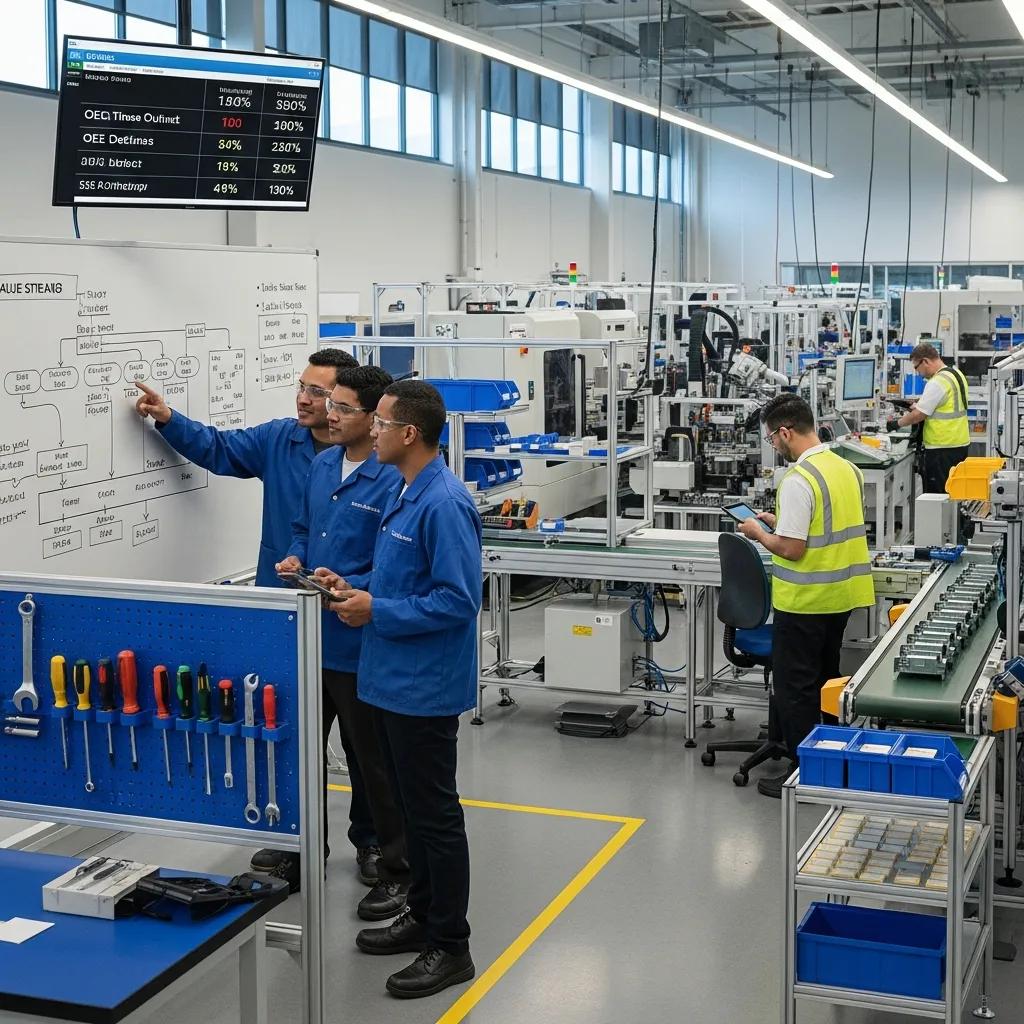
Integrating ISO 9001 and AI Audits for Lean Efficiency
Lean Manufacturing is a disciplined method for cutting waste and improving flow so you deliver more value with fewer resources. This article lays out the core Lean principles, explains how ISO 9001 makes those practices repeatable, and shows how AI-driven audits accelerate results. Many manufacturers face long lead times, hidden rework loops, and variable quality — pairing Lean tools with ISO 9001 and AI analytics creates a clear path to lower waste and steadier flow. You’ll get practical guidance on value stream mapping (VSM), 5S, Kaizen, an ISO-aligned implementation roadmap, and examples of how AI audits provide real-time signals and predictive insights that speed continuous improvement. Throughout, we focus on measurable KPIs — cycle time, OEE, defect rate — and offer concrete steps teams can take to align Lean, ISO 9001, and AI-auditing for operational gains.
What Are the Core Principles of Lean Manufacturing for Operational Efficiency?
Lean centers on creating customer value while removing non-value activities. It does this by mapping the value stream, enabling continuous flow, pulling work to demand, and pursuing continuous improvement. These elements shorten lead time, cut inventory and defects, and improve responsiveness by exposing sources of waste. The five foundational principles — Value, Value Stream, Flow, Pull, Perfection — work together to form a practical framework for sustainable process improvement. Below is a compact reference that pairs each principle with its operational benefit.
Lean’s core principles are:
- Value: Pinpoint what customers will pay for so teams prioritize activities that create real value.
- Value Stream: Map end-to-end processes to reveal non-value steps and bottlenecks.
- Flow: Organize work so products and information move smoothly with minimal stops.
- Pull: Produce only what’s needed, when it’s needed, to avoid overproduction and excess inventory.
- Perfection: Use PDCA cycles to drive steady, measurable improvements.
Those principles translate directly into tools and metrics that expose manufacturing waste (muda) and guide targeted interventions — for example, VSM, 5S, and Kaizen operationalize these ideas on the shop floor.
Different Lean tools track specific process aspects and deliver distinct operational value.
| Tool | What It Measures | Expected Operational Value |
|---|---|---|
| Value Stream Mapping (VSM) | Process steps, cycle times, and waiting periods across the value stream | Shorter lead time and clear bottleneck identification |
| 5S Workplace Organization | Workplace layout, unnecessary motion, and standard cleanliness | Less motion waste and faster changeovers |
| Kaizen Events | Frequency and impact of focused, incremental improvements | Small rapid gains and stronger staff engagement |
| Flow Cells / Continuous Flow | Work-in-progress levels and handoff delays | Higher throughput and reduced WIP |
This table clarifies which parts of the process to monitor and how measurement leads to targeted waste removal; the next section shows practical examples of these tools in action.
Stratlane Certification is an accredited certification body offering ISO standards including ISO 9001 (Quality Management), ISO 14001 (Environmental Management), ISO 27001 (Information Security Management), and ISO 42001 (Artificial Intelligence Management System). We stand out for integrating AI-driven audit tools that streamline certification, reduce time waste, and keep costs competitive. Stratlane serves businesses and organizations — SMEs, enterprises, and academic institutions — across the US, EU, and UK. Our primary service here is ISO 9001 certification. Key differentiators: AI-driven auditing, accredited certification in 27+ countries, professional auditors across 29+ countries, and cross-sector trust. Site features include ‘Get A Quote’ and a ‘Certificate Database/Download’.
How Do Value Stream Mapping, 5S, and Kaizen Drive Waste Reduction?
Value Stream Mapping lays out every step and handoff so teams can measure cycle and wait times and find non-value activities. With that visibility, you prioritize fixes that shorten lead time. 5S creates a predictable, organized workspace that reduces motion and setup time and lowers errors by keeping tools and materials visible and in place. Kaizen mobilizes frontline teams around focused improvement events that produce quick, low-cost gains; repeated small changes add up to significant drops in defects and downtime. Together, VSM identifies problems, 5S stabilizes the workspace, and Kaizen drives the continuous adjustments that sustain flow.
What Benefits Does Lean Manufacturing Offer for Process Optimization?
Lean delivers measurable gains in lead time, quality, and cost by removing muda and stabilizing flow. Common KPI improvements include shorter cycle times, higher Overall Equipment Effectiveness (OEE), lower defect rates, and reduced inventory carrying costs — all of which speed delivery and boost customer satisfaction. Below are primary Lean benefits and the KPIs to track them.
- Reduced lead time: Monitor average cycle time from order to shipment.
- Lower defects and rework: Track defects per million opportunities (DPMO) and first-pass yield.
- Higher throughput and capacity: Measure OEE and throughput per shift.
- Cost reduction: Track cost per unit and inventory turnover.
Tracking these KPIs helps teams quantify Lean’s impact and keeps improvement efforts focused on measurable outcomes; next we explain how ISO 9001 formalizes and sustains those gains.
How Does ISO 9001 Certification Support Lean Manufacturing Implementation?

ISO 9001 gives you a structured quality-management framework that complements Lean by formalizing process control, clarifying leadership responsibilities, and embedding continual improvement. Its clauses guide organizations to define context and interested parties, set quality objectives, plan operations, control documented information, and evaluate performance — all useful for Lean-driven process optimization. The table below maps specific ISO clauses to Lean alignment and practical outcomes, followed by a note on how certification also signals external validation and market access for organizations committed to efficient production.
Research supports integrating Lean concepts directly into ISO 9001 to achieve a cohesive quality-management approach.
Integrating Lean Thinking with ISO 9001 Guidelines
A guideline that cross-references lean principles with ISO 9001 requirements, proposing practical ways to align the standard with Lean thinking.
Integrating lean thinking into ISO 9001: a first guideline — A. Chiarini, 2011
| ISO 9001 Area | Lean Alignment | Practical Outcome |
|---|---|---|
| Clause 4 – Context of the Organization | Clarifies customer value and process boundaries | Defined value-stream ownership and less scope ambiguity |
| Clause 6 – Planning | Risk-based planning and objective setting | Prioritized Lean projects with measurable targets |
| Clause 7 – Support (Resources & Competence) | Ensures trained people and controlled infrastructure | Consistent execution of standardized work |
| Clause 8 – Operation | Operational control and process monitoring | Reduced variation and improved flow stability |
This mapping shows how ISO 9001 clauses provide the structure that makes Lean metrics auditable and repeatable; embedding Lean measurements into ISO-controlled processes helps institutionalize continuous improvement.
Stratlane Certification is an accredited certification body offering ISO standards including ISO 9001 (Quality Management), ISO 14001 (Environmental Management), ISO 27001 (Information Security Management), and ISO 42001 (Artificial Intelligence Management System). We combine accredited certification with AI-driven audit tools to speed evidence collection and make the certification journey more efficient. Our clients include SMEs, large organizations, and academic institutions across the US, EU, and UK. Key differentiators: AI-driven auditing, accreditation in 27+ countries, professional auditors across 29+ countries, and trusted service across sectors. Look for features like ‘Get A Quote’ and ‘Certificate Database/Download’ on our site.
What Synergies Exist Between ISO 9001 and Lean Principles?
ISO 9001 and Lean complement each other: ISO supplies documented controls that reduce variation while Lean targets flow and waste removal. The PDCA cycle in ISO mirrors Kaizen by requiring plan, do, check, and act — making improvement auditable and measurable. Leadership requirements in ISO reinforce Lean culture by assigning roles and resources that enable frontline problem-solving. Standardized work and documented procedures reduce ambiguity in handoffs, supporting Flow and Pull and helping teams scale Lean practices across lines or sites.
How Does ISO 9001 Sustain Continuous Improvement in Manufacturing?
ISO 9001 sustains improvement through internal audits, management review, and corrective action processes that institutionalize detection and resolution. Internal and external audits confirm conformance and validate that improvement actions work. Management review looks at performance trends and directs resources to priority areas. Corrective actions require root-cause analysis and durable fixes rather than temporary patches, which reduces recurrence and builds a data-driven improvement culture. These formal mechanisms help preserve Lean gains and make process stability part of the operating model.
In What Ways Does AI-Driven Auditing Enhance Lean Manufacturing Efficiency?
AI-driven auditing supports Lean by rapidly processing large volumes of operational and quality data to expose waste patterns, surface hidden deviations, and prioritize high-impact corrective actions. In practice, AI ingests digital traces (machine logs, ERP timestamps, quality records), applies process mining and anomaly detection, and highlights deviations from intended flows so teams can focus Lean efforts where they matter most. The result: broader audit coverage, faster root-cause insight, and predictive alerts that reduce rework and downtime. The table below links AI audit features to capabilities and measurable benefits.
| AI Audit Feature | Measured Capability | Benefit / Metric |
|---|---|---|
| Process mining | Reconstructs actual process flows from digital logs | Identifies bottlenecks and rework loops, shortening lead time |
| Anomaly detection | Detects deviations and unusual event sequences | Faster corrective action and lower scrap rates |
| Predictive analytics | Forecasts equipment or quality risks | Enables preventive maintenance and fewer stoppages |
These capabilities show AI audits are a practical extension of traditional auditing — dashboards, automated checks, and algorithms that yield precise signals Lean teams can act on to cut waste and improve flow.
How Does AI Identify Waste and Optimize Lean Processes?

AI finds waste by comparing event logs to expected value-stream models and using pattern recognition to flag repeated non-value steps, delays, and poor handoffs. Process mining rebuilds the end-to-end flow from digital traces, revealing rework loops and idle time that often hide inside sampled audits. Anomaly detection surfaces unexpected downtime or quality deviations, enabling quicker containment and targeted root-cause work. Heatmaps and priority alerts point teams to the highest-impact areas for Kaizen events, turning data into focused experiments that improve flow and cut defects.
What Are the Advantages of Real-Time Insights and Predictive Analytics in AI Audits?
Real-time insights let teams act immediately on deviations — reducing scrap and unplanned downtime — by surfacing KPI-based alerts tied to cycle time and defect rate. Predictive analytics extend that advantage by forecasting likely failures or quality dips before they happen, enabling preventive maintenance and process adjustments that maintain continuous flow. Prioritized, data-driven recommendations reduce wasted audit effort by focusing resources on the most significant deviations and predicted risks. Together, these capabilities shorten the detection-to-corrective-action loop, accelerating continuous improvement and helping preserve Lean gains.
What Are the Step-by-Step Processes for Achieving ISO 9001 Certification with Lean Focus?
A Lean-focused ISO 9001 roadmap starts with a gap analysis, moves through system design and controlled documentation, and concludes with audits supported by AI pre-assessments to confirm readiness. The approach aligns Lean activities with ISO clauses so VSM, standardized work, and continuous improvement are documented and auditable. Below is a practical checklist teams can follow to certify while embedding Lean practices at each stage.
- Conduct a gap analysis: map existing processes, identify non-value steps, and align findings with ISO clauses.
- Define scope and secure leadership engagement: assign roles and set quality objectives tied to Lean KPIs.
- Design and document processes: create SOPs and controlled records that reflect standardized work and flow.
- Implement Lean pilots: apply VSM, 5S, and Kaizen to stabilize processes and collect performance data.
- Perform internal audits and an AI pre-audit: use analytics to verify evidence and uncover remaining gaps.
- Complete the certification audit and close nonconformities: finalize corrective actions and continue improvement cycles.
This sequence embeds Lean principles into the ISO system and ensures certification reflects both compliance and operational improvement. Emphasizing data collection and process stability prepares organizations for AI-enhanced audit readiness.
Stratlane Certification is an accredited certification body offering ISO standards including ISO 9001 (Quality Management), ISO 14001 (Environmental Management), ISO 27001 (Information Security Management), and ISO 42001 (Artificial Intelligence Management System). Our blend of accredited certification and AI audit tools helps reduce wasted time and keep certification costs competitive. We work with SMEs, corporates, and academic organizations across the US, EU, and UK. Core advantages: AI-driven auditing, accreditation in 27+ countries, professional auditors in 29+ countries, and cross-sector trust. Common site features include ‘Get A Quote’ and ‘Certificate Database/Download’.
After completing these steps, organizations typically move to a service action such as requesting a quote or scheduling an audit to validate readiness and complete certification.
How Can Businesses Prepare for AI-Driven ISO 9001 Audits?
To prepare for an AI-driven ISO 9001 audit, ensure your data and documentation are audit-ready and your staff understand Lean and digital tools. Collect digital process logs, cycle-time records, inspection results, and changeover data so process-mining tools can reconstruct flows accurately. Keep key procedures documented and maintain accessible audit trails for critical controls to satisfy ISO evidence requirements and feed AI models. Train teams to read dashboards and respond to AI findings so audit recommendations translate into effective Kaizen actions. These steps reduce audit friction, improve AI output quality, and speed corrective actions.
What Are Common Challenges and Solutions in Lean ISO Certification?
Common obstacles when combining Lean and ISO include cultural resistance, low data quality, and documentation overload. Each requires a specific approach. Cultural resistance is overcome with leadership-led Kaizen, visible quick wins, and clear communication. Poor data quality is addressed by scoping instrumentation to critical processes first and applying data governance to improve signals over time. Documentation overload is solved with lean documentation: record what’s necessary to demonstrate control and value, eliminate duplicate paperwork, and use controlled templates to reduce administrative burden. Those paired solutions help teams keep momentum while progressing through certification.
Common challenges with paired solutions:
- Cultural resistance — sponsor Kaizen with leadership and show early wins to build trust.
- Poor data quality — start with a scoped instrumentation plan and enforce data governance.
- Documentation overload — adopt lean documentation practices that focus on essential evidence only.
Each solution targets a root cause and supports the next steps in certification and continuous improvement, enabling organizations to scale Lean practices without losing momentum.
Which Case Studies Demonstrate Success Using AI-Driven ISO 9001 Audits for Lean Efficiency?
Case studies consistently show measurable gains when Lean methods, ISO 9001, and AI auditing work together. The summaries below highlight interventions, AI outputs, and outcomes such as lower waste, faster audits, and improved stability. Following those examples, we describe how Stratlane’s accredited AI-enabled audits support similar results.
Stratlane Certification is an accredited certification body offering ISO standards including ISO 9001 (Quality Management), ISO 14001 (Environmental Management), ISO 27001 (Information Security Management), and ISO 42001 (Artificial Intelligence Management System). We combine accreditation with AI-driven audit capabilities to speed certification and improve evidence collection. We serve SMEs, large enterprises, and academic organizations across the US, EU, and UK. Key service differentiators include AI-driven auditing, accreditation in 27+ countries, a network of auditors in 29+ countries, and experience across multiple sectors. Look for site features like ‘Get A Quote’ and ‘Certificate Database/Download’.
How Did a UK SME Achieve 20% Waste Reduction with Stratlane's AI Auditing?
A UK SME ran VSM workshops alongside AI-driven process mining to uncover hidden rework loops on an assembly line, then used focused Kaizen events to remove non-value steps and standardize handoffs. The AI audit surfaced two recurring rework patterns and a persistent setup delay that together explained most of the extra cycle time. The team implemented error-proofing and adjusted the layout. Within three months the SME reported a 20% reduction in waste-related time plus measurable gains in first-pass yield and throughput. The case shows how AI can fast-track root-cause discovery and let small teams apply precise Lean fixes with clear operational payback.
What Lessons Can Be Learned from Corporations Integrating Lean and ISO Certification?
Larger organizations that succeed combine executive alignment, robust data infrastructure, and governance to scale improvements across sites. Standardized processes and metrics enable replication of Lean gains, while investment in data systems lets AI audits deliver reliable, comparative insights across multiple lines. Governance and periodic management review keep improvement funded and ensure corrective actions close fully. These lessons show that scaling Lean demands disciplined documentation and the digital capabilities that make AI audits effective.
Key transferable lessons:
- Align leadership and metrics to keep priorities consistent.
- Invest in data infrastructure for reliable cross-site analytics.
- Govern continual improvement with scheduled reviews and closure mechanisms.
These lessons help organizations design the right mix of process controls and analytics to replicate the efficiencies described above.
Frequently Asked Questions
What are the key challenges in implementing Lean Manufacturing principles?
Common challenges include resistance to change, difficulty mapping value streams accurately, and sustaining engagement in continuous improvement. Data gaps and integrating Lean into existing systems can also slow progress. Overcoming these issues requires visible leadership support, practical training, and a focus on quick wins that demonstrate tangible benefits.
How can organizations measure the success of Lean initiatives?
Measure Lean success with KPIs such as cycle time, Overall Equipment Effectiveness (OEE), defect rates, and inventory turnover. Regular KPI reviews help teams validate improvements, prioritize next steps, and ensure Lean activities deliver real operational value.
What role does employee engagement play in Lean Manufacturing?
Employee engagement is essential. Engaged teams contribute improvement ideas, participate in Kaizen events, and take ownership of standardized work. Boost engagement by involving staff in decisions, offering practical training, and recognizing contributions to improvement efforts.
How does AI enhance the effectiveness of Lean Manufacturing?
AI enhances Lean by analyzing full datasets to reveal hidden patterns, using process mining and anomaly detection to pinpoint inefficiencies, and forecasting risks so teams can act earlier. This allows Lean efforts to focus on the highest-impact areas and supports faster, data-driven decisions.
What are the benefits of integrating Lean Manufacturing with ISO 9001 certification?
Integrating Lean with ISO 9001 provides a structured quality framework that supports sustained improvement. It helps standardize processes, reduce waste, and demonstrate consistent performance to customers and partners — improving competitiveness and operational resilience.
What steps should organizations take to prepare for an AI-driven ISO 9001 audit?
Prepare by ensuring data readiness: gather process logs, quality records, and cycle-time data. Keep process documentation current and train staff to interpret AI findings. Run internal audits and AI pre-assessments to surface gaps before the formal certification audit.
How can Lean principles be sustained after achieving ISO 9001 certification?
Sustain Lean through ongoing training, regular internal audits, management reviews, and disciplined corrective-action closure. Continue tracking KPIs and involve employees in improvement work so Lean becomes part of daily operations rather than a one-time project.
How Does Lean Manufacturing Improve Operational Efficiency?
Lean improves operational efficiency by removing non-value steps and reducing process variation, which shortens lead times and raises throughput. Emphasizing flow and pull aligns production with customer demand, cutting overproduction and inventory costs. Standardized work and continuous improvement reduce defects and boost first-pass yield.
Key KPIs to monitor Lean effectiveness include cycle time, OEE, defect rate, and inventory turns — these metrics show whether Lean initiatives deliver measurable efficiency gains.
What Role Does AI Play in Modern ISO 9001 Audits?
AI amplifies ISO 9001 audits by expanding coverage, speeding detection of deviations, and supporting predictive maintenance and quality forecasting. Process mining reconstructs real workflows from digital logs so auditors can compare practice to documented procedures and prioritize areas for improvement. Anomaly detection and predictive models identify likely failure points before they cause major disruption. Moving from sample-based checks to continuous, data-driven assurance supports a proactive approach to process stability and ongoing improvement.
- Increased Coverage: AI analyzes full datasets rather than small samples, widening audit scope.
- Faster Detection: Automated alerts speed identification of issues.
- Predictive Risk Management: Forecasts inform preventive actions and resource allocation.
These capabilities make AI-driven audits a powerful complement to ISO 9001, accelerating the path to operational excellence and durable Lean outcomes.
Conclusion
Combining Lean Manufacturing with ISO 9001 and AI-driven auditing gives manufacturers a practical, measurable route to reduce waste, stabilize processes, and raise quality. When applied together, these approaches deliver clear improvements in lead time, defect rates, and overall operational performance. The result is a stronger culture of continuous improvement and a better-positioned business in competitive markets. Learn how our ISO 9001 certification services can help you streamline operations and achieve consistent operational excellence.