
Navigate Aerospace Regulations: Key AS9100 Insights for You

AS9100 Certification: Navigate Aerospace Regulations and Standards with Confidence
Aerospace companies operate under strict technical rules and demanding customer expectations. Clear, practical guidance helps teams meet those demands without disrupting operations. This guide explains how AS9100 — the aerospace quality standard built on ISO 9001 — fits into the regulatory landscape, how aviation authorities and industry schemes interact with QMS requirements, and which steps organizations should take to achieve and sustain compliance. You’ll learn which standards apply to manufacturers, MROs, and distributors; how to map QMS processes to FAA and EASA expectations; and how AI-assisted auditing and emerging AI-management standards like ISO 42001 are reshaping audits and controls. We include checklists, comparison tables, and step-by-step audit-prep guidance to help protect quality, safety, and supply-chain integrity. The sections below cover key standards, regulatory alignment, AI-assisted auditing, why a specialized certifier matters, audit preparation, continuous compliance, and supply-chain risk controls.
What Are the Key Aerospace Quality Management Standards and Their Importance?
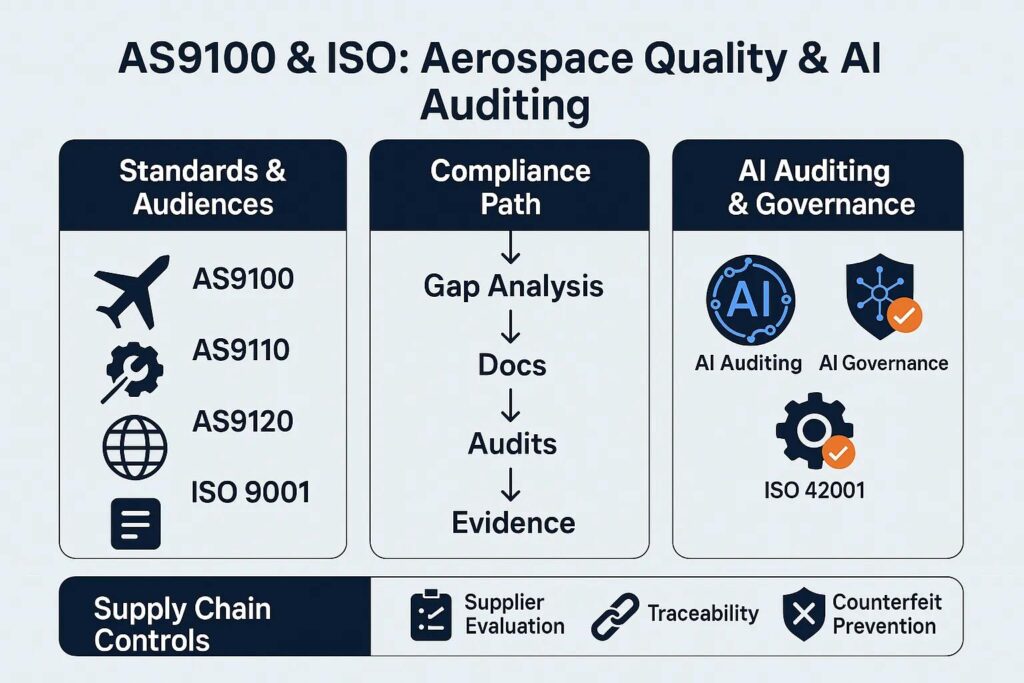
AS9100 is the aerospace industry’s QMS standard that builds on ISO 9001 with aerospace-specific controls for product safety, traceability, and consistency across complex supply chains. It adds requirements such as configuration management, product safety measures, and counterfeit parts prevention so organizations can demonstrate QMS rigor that meets OEM and prime contractor expectations. Holding AS9100 supports market access, satisfies procurement prerequisites, and reduces production and maintenance risk. The table below summarizes the scope and primary audiences for AS9100 and related standards so you can see when each applies and why it matters for safety and market entry.
| Standard | Scope | Applies To |
|---|---|---|
| AS9100 (based on ISO 9001) | Aerospace QMS with added controls for product safety, configuration control, and risk management | Aerospace manufacturers, assembly operations, and production suppliers |
| AS9110 | QMS requirements tailored to maintenance, repair, and overhaul (MRO) operations | Maintenance organizations and continuing airworthiness service providers |
| AS9120 | Distributor-focused QMS emphasizing traceability and control of purchased products | Distributors and stockists of aerospace parts and materials |
| ISO 9001 | Generic quality-management framework focused on process control and continual improvement | Any organization building a systematic QMS foundation |
This comparison highlights the boundaries: AS9100 extends ISO 9001 for aerospace-specific risks, AS9110 adjusts controls for maintenance activities, and AS9120 centers on distributor traceability. Identifying the right standard is the first step toward aligning processes with customer and regulatory expectations.
AS9110, in particular, gives MROs a focused framework for maintenance, repair, and overhaul within aviation, space, and defense.
AS9110 Standard for Aerospace MRO Facilities
AS9110, published by SAE, sets criteria for maintenance, repair, and overhaul facilities serving aviation, space, and defense sectors.
The AS9100C, AS9110, and AS9120 Handbook: Understanding Aviation, Space, and Defense Best Practices, 2014
How Does AS9100 Build Upon ISO 9001 for Aerospace Excellence?
AS9100 layers aerospace-specific requirements onto ISO 9001 by focusing on product safety, flight-safety risk thinking, configuration control, and anti-counterfeiting measures — gaps generic QMS frameworks don’t fully cover. It introduces clauses for product conformity, traceability, and part serialization; strengthens supplier controls; and formalizes approvals for special processes. For example, AS9100’s configuration-management rules require documented change control and verification steps that reduce the chance of unapproved changes reaching flight-critical assemblies. Those targeted additions make ISO 9001 practical for managing aerospace safety and reliability risks rather than replacing it.
Put simply: AS9100 enhances ISO 9001 with controls aimed squarely at aerospace safety and traceability needs.
AS9100 Compliance: Aerospace QMS & ISO 9001 Augmentation
AS9100 augments the ISO 9001 framework with requirements like configuration management, risk management, product safety, and counterfeit parts prevention for aerospace QMSs.
Quality Management Software Design for AS9100 Compliance in Defense and Aerospace Advanced Ceramic Manufacturing
Recognizing these augmentations helps you plan implementation and then apply the maintenance and distribution standards that fit your operations.
What Roles Do AS9110 and AS9120 Play in Aerospace Certification?
AS9110 adapts AS9100 for maintenance, repair, and overhaul organizations by emphasizing continuing airworthiness, tooling control, and maintenance-record retention. AS9120 focuses on distributor responsibilities such as traceability, inventory control, and counterfeit-prevention measures. In practice, MROs certified to AS9110 should have formal release-to-service processes, retained maintenance records, and serviceable-parts management; distributors with AS9120 should show robust incoming inspection, lot traceability, and chain-of-custody controls. The rule of thumb: maintenance providers pursue AS9110, distributors seek AS9120, and manufacturers center on AS9100. Hybrid businesses may need multi-standard alignment so certification scopes clearly reflect operational risk profiles.
For MROs, aligning AS9110 with regulatory frameworks such as EASA Part 145 is key to a complete quality-and-safety solution.
Aerospace Maintenance QMS: ISO 9001, AS9110 & EASA Part 145
Integrated QMS approaches — ISO 9001, AS9110, ISO 45001, and EASA Part 145 approvals — are commonly used to support maintenance, repair, and overhaul organizations in aviation.
Quality and Safety management system in aeronautic maintenance organisation, 2023
How Can Aerospace Companies Achieve Aviation Regulatory Compliance?

Meeting aviation regulations means mapping your QMS to the expectations of authorities such as the FAA, EASA, and ICAO, and ensuring documentation, evidence, and controls support certification and continuing airworthiness obligations. Core steps include a regulatory gap analysis, aligning procedures to regulatory clauses, embedding traceability in production and maintenance records, and preparing objective evidence for audits. Consistent alignment reduces nonconformities during inspections and supports approvals for production, design changes, and continuing airworthiness. Start by identifying the most relevant authority requirements and converting them into measurable QMS actions.
The immediate compliance actions below give a practical starting list:
- Conduct a regulatory gap analysis that maps QMS clauses to FAA, EASA, and ICAO requirements.
- Implement documented processes for product safety, configuration control, and traceability.
- Establish supplier qualification and incoming-inspection controls aligned to regulatory expectations.
- Prepare objective evidence — records, process maps, and test reports — for audits and authority reviews.
- Schedule internal audits and management reviews to confirm compliance readiness.
These steps form the backbone of a compliance program and ready teams for authority inspections and certification activities.
What Are the Main FAA and EASA Regulations Affecting Aerospace Businesses?
FAA and EASA frameworks cover certification, production approvals, and continuing airworthiness rules that affect manufacturing and maintenance approvals. Guidance includes FAA advisory circulars and EASA Parts that relate to design, production, and maintenance. Manufacturers often face requirements tied to production approvals, conformity assessment, and control of special processes and suppliers. MROs must show release-to-service procedures, records retention, and staff competency. Distributors must demonstrate traceability and counterfeit-prevention controls. Translating these rules into operational procedures involves documented processes, targeted training, and clear inspection and test records.
Understanding how authority rules intersect with QMS clauses helps you prepare precise evidence for certification bodies and regulators.
How Do ISO Certifications Support Compliance with Aviation Authorities?
ISO 9001 and AS9100 certification provide a clear, structured signal that your organization runs systematic quality processes that align with many regulatory expectations. Primes and OEMs often use these certifications to pre-qualify suppliers, which cuts down on duplicate audits and helps meet procurement requirements. Mapping AS9100 clauses to specific authority requirements creates traceable evidence trails and simplifies regulator and customer audits. In regulated procurements, holding AS9100 or the appropriate sector standard indicates readiness for participation in certified programs and smooths the path to production approvals.
That alignment between certified QMS frameworks and regulatory conformity helps speed approvals and makes inspections more predictable, reducing friction for aerospace firms.
What Benefits Do AI-Driven ISO Auditing Services Bring to Aerospace Quality Management?

AI-driven auditing accelerates data analysis, improves pattern detection for recurring nonconformities, and enables near-continuous monitoring that complements periodic human audits.
These capabilities cut audit prep time and let auditors concentrate on higher-risk areas highlighted by algorithmic analysis, improving both efficiency and accuracy. AI tools can process production records, supplier metrics, and maintenance logs to surface anomalies and trends that might otherwise go unnoticed, helping teams prioritize corrective actions.
Key benefits that show why AI augmentation is practical for aerospace QMS assurance:
- Reduced audit time: Automated data processing speeds evidence review so auditors can focus on verification.
- Improved pattern detection: Machine learning reveals recurring defects and supplier trends that point to systemic risks.
- Continuous monitoring: Real-time analytics give early warnings before issues become nonconformities.
- Enhanced sampling precision: AI-guided sampling targets high-risk lots and processes, boosting audit effectiveness.
These outcomes deliver tangible gains for aerospace quality programs and set the stage for operational comparisons and capability mapping.
| Tool/Capability | Attribute | Value |
|---|---|---|
| AI Audit | Benefit | Reduced audit time, continuous monitoring, pattern detection |
| Data Ingestion | Attribute | Aggregates production, maintenance, and supplier data for analysis |
| Anomaly Detection | Application | Flags out-of-pattern events indicative of nonconformities |
This table shows how AI components translate into concrete audit benefits and operational use cases.
Stratlane Certification is a certification body offering ISO services — including ISO 9001, ISO 14001, ISO 27001, and ISO 42001 — and highlights AI-driven audit tools to improve audit efficiency and effectiveness. The company serves clients across the US, EU, and UK and operates with professional auditors in 29 countries.
Main service focus for this topic: ISO 9001/AS9100 certification, AI-augmented auditing, and ISO 42001 for AI management systems.
How Does AI Enhance Audit Efficiency and Accuracy in Aerospace Certification?
AI speeds audits through automated document review, NLP-based extraction of requirements-to-evidence mappings, and machine-learning models that prioritize anomalies. Accuracy improves because algorithms spot statistical outliers across large datasets faster than manual review. For example, NLP can cross-check thousands of maintenance records against required procedures and flag missing sign-offs or inconsistent entries in minutes, allowing auditors to focus on high-value verification.
This approach shortens audit cycles, reduces sampling bias, and provides quantitative support for trend-based findings. Organizations that adopt AI-augmented audits gain time savings and clearer insight into underlying quality trends.
What Is the Role of ISO 42001 in Managing AI Systems Within Aerospace?
ISO 42001 defines requirements for AI management systems — governance, risk management, and lifecycle controls for AI tools used in predictive maintenance, autonomy features, or audit automation. In aerospace, the standard helps ensure AI outputs are reliable, explainable, and appropriate for safety-critical use. Key expectations include documented AI risk assessments, model validation, data governance, and human oversight mechanisms that align with safety and regulatory needs.
For organizations using AI in audits or operations, ISO 42001 complements AS9100 by formalizing controls around AI development, deployment, and monitoring so AI adoption remains auditable and safe.
Bringing AI governance into your QMS lets you adopt AI responsibly while preserving compliance and traceability.
Why Choose a Specialized Aerospace Industry Certification Body?
A specialized aerospace certifier brings domain-specific auditor expertise, tailored audit scopes, and an understanding of OEM and regulator expectations that generalist bodies may miss. That expertise reduces friction during supplier assessments and boosts the credibility of certification with primes.
Specialized auditors can effectively assess complex aerospace processes — special process approvals, NADCAP interfaces, configuration management — because they know what evidence regulators and OEMs expect. Global recognition and a network of experienced auditors also help multinational firms keep consistent certification across jurisdictions, simplifying procurement and authority interactions.
The next section highlights specific provider attributes to illustrate that difference.
What Makes Stratlane Certification a Leader in Aerospace ISO Services?
Stratlane Certification focuses on ISO certifications such as ISO 9001 and ISO 42001 and leverages AI-driven audit tools to improve audit quality and efficiency. With professional auditors in 29 countries, Stratlane supports multinational clients who need consistent certification approaches across the US, EU, and UK.
That mix of standards expertise and technology-enabled auditing helps clients align QMS processes with traditional aerospace requirements and emerging AI-governance expectations.
Together, these capabilities support organizations that must demonstrate both established quality controls and modern AI management practices.
Typical service flows for organizations seeking certification support include:
- Initial gap analysis to identify compliance shortfalls and remediation priorities.
- Audit scheduling aligned with production and maintenance cycles to minimize disruption.
- Ongoing certificate management and surveillance planning to keep certification continuous.
How Does AI-Driven Auditing Differentiate Aerospace Certification Providers?
AI-driven auditing differentiates providers by delivering fast, repeatable analysis of large datasets, enabling continuous-assurance models rather than solely periodic audits, and producing quantifiable risk indicators that focus auditor effort. Compared with manual sampling, AI-augmented methods can surface root-cause signals across suppliers, processes, and time windows, lowering the chance that latent systemic issues go undetected. For example, where traditional audits might sample 5% of lot records, AI-guided analytics can analyze 100% to reveal correlated anomalies that indicate process drift. This continuous, data-rich approach reduces surprise nonconformities and supports proactive corrective strategies.
These capabilities make AI-enabled providers attractive to aerospace firms managing complex supply networks and rapidly changing risk profiles.
How to Prepare for and Successfully Navigate AS9100 Certification Audits?
Preparing for AS9100 follows a clear roadmap: gap analysis, documented-process alignment, internal audits, and supplier readiness — all with owners and deadlines. This roadmap makes evidence traceable, ensures personnel can demonstrate competence, and confirms suppliers provide required documentation and traceability. Focused preparation reduces surprises during certification audits and shortens time-to-certification by addressing high-risk areas identified during gap analysis. The checklist below outlines an efficient sequence teams can adopt.
- Conduct a gap analysis: Map current processes to AS9100 clauses and assign corrective actions with owners.
- Document and control processes: Make sure process maps, work instructions, and records meet evidence expectations.
- Perform internal audits: Run internal checks and complete root-cause remediation before external assessment.
- Train staff and suppliers: Ensure personnel understand requirements and suppliers can supply required evidence.
- Compile objective evidence: Organize records, nonconformity logs, calibration certificates, and traceability data for auditors.
Following these steps prepares organizations for certification audits and supports continuous improvement after certification.
What Are the Essential Steps to Prepare for an AS9100 Audit?
Preparation typically starts months before the audit. Immediate tasks focus on gap closure, document control, and assembling evidence; responsible functions usually include quality, operations, procurement, and engineering. Early work includes the initial gap assessment, assigning corrective actions with deadlines, and updating documented-information controls. Mid-cycle tasks emphasize internal audits, management reviews, and supplier verification. In the final week, teams compile evidence, coordinate auditor logistics, and brief interviewees. Clear owners and regular internal checks increase confidence that processes meet AS9100 requirements and smooth the audit experience.
This preparation also supports longer-term compliance and efficient certificate management.
How Can Aerospace Organizations Manage Continuous Compliance and Certificate Management?
Continuous compliance depends on disciplined document control, scheduled surveillance audits, supplier performance monitoring, and certificate-lifecycle processes that cover renewals and scope changes. Useful tools include centralized evidence repositories, automated reminders for surveillance and recertification, and supplier dashboards that track performance and nonconformities. Certificate-management services help teams track expiry dates, surveillance requirements, and scope changes without distracting day-to-day operations. These practices reduce lapse risk, support on-time surveillance audits, and preserve customer and regulator confidence.
These controls form the operational foundation for sustainable certification and cut administrative burden for internal teams.
What Are the Best Practices for Aerospace Supply Chain Quality and Risk Management?
Supply-chain quality in aerospace depends on rigorous supplier qualification, traceability from raw material to finished part, counterfeit-parts prevention, and compliance with special-process approvals such as NADCAP where required.
Priority practices include supplier audits, digital traceability for provenance, dual sourcing for critical components, and contractual controls that define quality expectations and evidence obligations. A risk-based approach helps allocate inspection resources to higher-risk suppliers and processes. The table below compares key supply-chain controls so you can prioritize investments and expected impacts.
| Control Area | Practice | Expected Outcome |
|---|---|---|
| Supplier Control | Qualification audits and performance scoring | Improved supplier reliability and measurable risk reduction |
| Traceability | Serialized part marking and digital ledger tracking | Full provenance and rapid issue isolation |
| Counterfeit Prevention | Incoming inspection and approved-supplier lists | Lower counterfeit risk and stronger safety assurance |
| Special Processes | NADCAP-style approvals and focused process audits | Acceptance by primes and regulators for critical processes |
This comparison helps organizations prioritize controls that meet AS9100 supply-chain expectations.
How Does AS9100 Address Supply Chain Quality and Counterfeit Parts Prevention?
AS9100 includes clauses for purchasing controls, supplier evaluation, product preservation, and traceability — all of which support counterfeit-parts prevention. Practical implementations include approved-supplier lists, incoming inspection procedures, and documented evidence of supplier process controls. Organizations are expected to apply risk-based supplier selection and monitor performance via defined metrics and audits. Anti-counterfeit actions such as source verification, material certificates, and segregation of suspect parts are standard practices tied directly to AS9100 requirements. Mapping these clauses to operational controls helps ensure incoming product integrity and supports downstream safety needs.
Adopting these practices reduces the risk of counterfeit or nonconforming parts entering critical assemblies and strengthens overall supply-chain resilience.
What Strategies Enhance Risk Management in Aerospace Supply Chains?
Effective strategies combine supplier risk scoring, targeted supplier audits, redundancy for critical parts, and digital traceability that enable rapid root-cause analysis and product isolation. Risk scoring uses performance metrics, nonconformity history, and process criticality to prioritize oversight. Dual sourcing and inventory contingencies mitigate single-point failures. Digital tools like serialized tracking and immutable audit trails improve transparency and speed incident response.
Applied with clear governance and contractual terms, these strategies create a layered defense that balances cost and safety priorities for both SMEs and larger firms.
Stratlane Certification’s services support requests for quotations, audit bookings, and certificate management aligned to ISO and AS standards. For teams planning certification activities, common next steps include requesting an initial gap analysis, scheduling a certification audit, and using certificate-management tools to track surveillance dates and scope updates. These flows help translate internal readiness into external certification without adding operational complexity.
Frequently Asked Questions
What is the process for obtaining AS9100 certification?
Obtain AS9100 certification by following a staged approach: perform a gap analysis to identify shortfalls, document and implement your QMS processes, run internal audits and remediate findings, then schedule an external certification audit. If the external audit is successful you receive certification. Maintain it with regular surveillance audits and continuous improvement activities.
How often do organizations need to undergo AS9100 audits?
Organizations typically face annual surveillance audits to maintain AS9100 certification, with a full recertification audit every three years. In between, many organizations run internal audits more frequently to catch and correct issues before the external audit.
What are the costs associated with AS9100 certification?
Costs vary by company size, operational complexity, and the chosen certification body. Typical expenses include certification body fees, internal training and preparation costs, and any investments needed to close gaps. Budget for initial certification and ongoing surveillance, and get quotes from multiple certifiers to compare offerings.
How can organizations ensure continuous compliance with AS9100?
Maintain continuous compliance with disciplined document control, scheduled internal and surveillance audits, ongoing training, and supplier performance monitoring. Track evidence centrally, act quickly on corrective actions, and use performance metrics to measure QMS effectiveness. These practices help sustain certification and drive continuous improvement.
What role does employee training play in AS9100 compliance?
Employee training is essential. It ensures staff understand QMS processes, their responsibilities, and the importance of quality and safety procedures. Regular training reinforces requirements, updates teams on changes, and supports a culture of accountability that improves audit outcomes and operational performance.
What are the implications of non-compliance with AS9100 standards?
Non-compliance can lead to loss of certification, restricted access to contracts, and reputational harm. It may invite greater regulatory scrutiny, potential liabilities, and financial impacts. Non-compliance also risks product quality and safety. Prioritizing adherence to AS9100 minimizes these risks and preserves business continuity.
Conclusion
AS9100 certification helps aerospace organizations manage regulatory complexity while improving product safety and operational efficiency. Aligning your QMS to industry-specific standards reduces risk and strengthens supply-chain integrity. If you’re ready to move toward certification, contact us to discuss a gap analysis, audit plan, or certificate-management support — we’ll help you design a practical path to compliance.