
North America ISO Certification Trends: A Market Overview
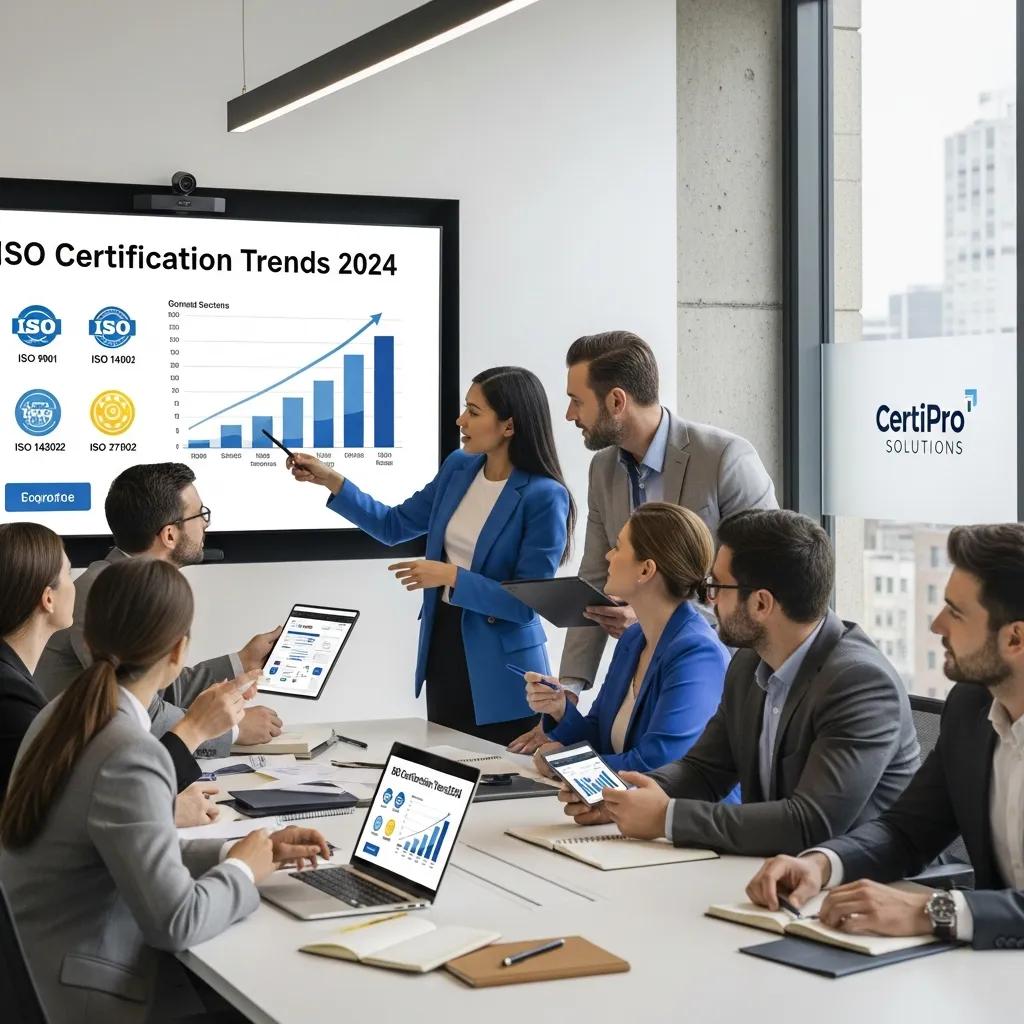
North American ISO Certification: Market Trends, Key Standards, and the Case for AI-Assisted Audits
ISO certification shows that an organization’s management systems meet internationally accepted standards. In North America, demand is rising as businesses prioritize resilience, compliance and easier access to markets. Current estimates place the regional ISO certification market in the low billions of dollars with steady compound annual growth. For procurement teams and any organization bidding on cross‑border work, these market dynamics matter. This piece lays out market size and growth projections, the standards most relevant in the US and Canada, how AI is speeding and sharpening audits, and the practical effects on cost, timeline and operations. You’ll also get a side‑by‑side view of key standards (ISO 9001, ISO 27001, ISO 14001, ISO 42001), pragmatic project tips, and a framework for evaluating audit providers and modern audit tools. The aim: give business leaders, compliance teams and procurement professionals clear context and next steps for efficient certification in North America.
What does the North American ISO certification market look like today?
Procurement rules, regulatory alignment and digital transformation are the primary forces pushing North American organizations toward formal management‑system certification. Market research for 2024 estimates the region’s certification market in the low billions (see table below) and projects steady multi‑year growth through the early 2030s. Adoption is strongest in IT and healthcare—where data protection and patient safety are top priorities—and in manufacturing and aerospace, which rely on quality and environmental systems to meet supply‑chain obligations. Knowing these macro drivers helps teams decide which standards to prioritize and how to time certification projects to match tender and procurement cycles.
The table below summarizes key market figures and drivers for North America, the US and Canada to help with planning and strategy.
| Region | 2024 Market Estimate (USD) | Projected CAGR (mid-term) |
|---|---|---|
| North America (total) | 4,103.3 million | Moderate steady growth (multi-year CAGR) |
| United States | Majority share of regional market | Slightly higher CAGR due to large enterprise demand |
| Canada | Smaller absolute market, high per-capita adoption | Stable CAGR driven by regulatory alignment |
While the US holds the largest share, Canada shows reliable uptake—often driven by procurement rules and cross‑border supply‑chain expectations. Below we unpack those projections and what they mean for organizations planning certification.
What are the latest market size and growth projections for North America?
Analysts peg the North American ISO certification market in 2024 at a value in the low billions, with projected CAGRs over the next five to ten years that point to steady demand. Key enablers include regulatory harmonization, growing ESG expectations and broader digitization of compliance activities. For organizations, the takeaway is simple: certification remains a strategic investment. Procurement teams will increasingly prefer certified suppliers, and certification providers are expanding capacity to support remote and AI‑assisted audit workflows. Planning certification timelines now helps avoid last‑minute costs and missed opportunities.
Which factors are driving demand for ISO certification in the US and Canada?
Demand is rising from a mix of regulatory, commercial and technological pressures. Procurement clauses and RFP criteria often require accredited management systems, so suppliers pursue certification to stay eligible. Integrated supply chains and global trade make consistent standards valuable across borders. Digital transformation and cyber risk make ISO 27001 more relevant, while sustainability and ESG priorities boost interest in ISO 14001 and related frameworks. These drivers reinforce one another: procurement requirements encourage environmental and information‑security certifications, which then open international contracting opportunities.
Which ISO standards matter most in the US and Canada?
Key ISO standards form the backbone of many compliance programs by defining requirements for quality, security, environment and AI governance. Each targets specific risks and business outcomes that influence adoption and supplier selection. The table below gives a compact comparison to help teams decide which standards best match their priorities and sector demands.
| Standard | Core Objective | Relevance / Benefit in North America |
|---|---|---|
| ISO 9001:2015 | Quality Management System | Improves process consistency and supports supplier qualification in manufacturing and services |
| ISO/IEC 27001:2022 | Information Security Management | Protects data assets and supports regulatory compliance in tech, finance and healthcare |
| ISO 14001:2015 | Environmental Management | Shows environmental stewardship and helps meet supply‑chain sustainability requirements |
| ISO 42001 (under development) | AI Management System | Establishes governance for AI systems and aligns with emerging AI regulations |
Use this mapping to prioritize certification efforts around customer expectations, regulatory needs and sector requirements. The sections that follow unpack two high‑priority standards in more detail.
How does ISO 9001:2015 support quality management across industries?
ISO 9001:2015 defines a process‑based Quality Management System focused on customer needs, leadership, risk‑based thinking and continual improvement. It helps organizations standardize work, reduce variability and set measurable quality objectives—outcomes that cut rework, lower defect rates and improve supplier performance. Manufacturers gain tighter production control, while service providers deliver more consistent customer experiences. Practical steps to speed implementation: start with a gap analysis, document critical processes and set a regular internal audit cadence. Those steps shorten time‑to‑certification and deliver measurable efficiency gains.
What roles do ISO 27001, ISO 14001 and ISO 42001 play for North American organizations?
ISO/IEC 27001 provides a structured, risk‑based approach to protect information assets—essential for tech, finance and healthcare organizations that handle sensitive data. ISO 14001 offers a practical framework for managing environmental impacts and meeting buyer sustainability expectations. ISO 42001, still emerging, will help organizations govern AI deployments and demonstrate responsible AI practices as regulatory expectations develop. Together, these standards build a layered compliance posture—covering security, environment and AI governance—that supports market access and reduces operational risk across industries.
How is AI changing the ISO audit process?

AI‑assisted auditing speeds evidence review, improves sampling and enables continuous compliance checks—reducing overall audit cycle time and increasing consistency. By automating document review, flagging anomalies and supporting risk‑based sampling, AI tools amplify auditor judgment and free human auditors to focus on context, interviews and remediation planning. That shifts auditor roles from data gatherers to decision‑focused assessors and makes remote audits and rolling surveillance more practical. The result: lower cost per audit, shorter scheduling windows and faster certificate issuance when tools are paired with efficient audit workflows.
Research supports AI’s potential to boost audit accuracy and efficiency while presenting new considerations for implementation.
AI-Driven Auditing: Applications, Challenges, and Future
The integration of artificial intelligence into auditing is changing how auditors work — improving accuracy, efficiency and fraud detection. This systematic literature review examines current applications, implementation challenges and likely future directions for AI in audit practice.
The list below summarizes the primary operational benefits organizations should expect when evaluating AI‑enhanced audit approaches.
- Faster evidence analysis — AI handles large datasets and document review more quickly than manual processes.
- Better sample coverage — analytics surface high‑risk patterns and guide targeted sampling.
- Lower travel and scheduling costs — remote, AI‑enabled audits reduce on‑site time and related expenses.
Those operational gains improve audit ROI and make ongoing compliance easier to maintain. The next subsection breaks down efficiency and cost benefits in more concrete terms.
What efficiency and cost benefits does AI bring to audits?
AI cuts total audit time by automating repetitive tasks like document indexing and controls mapping, shortening pre‑audit preparation and on‑site activities. Stronger analytics produce higher‑quality sampling and earlier anomaly detection, which reduces repeat findings and shortens remediation cycles. Organizations save on auditor travel and often receive certificates sooner; internal teams benefit from clearer, data‑driven reports that speed corrective action. For example, automating evidence review for a mid‑sized IT firm can shave preparatory hours by as much as 40%, opening earlier audit windows and faster certification.
How does Stratlane Certification use AI in ISO audits?
Stratlane Certification pairs AI audit tools with an experienced global auditor network to streamline the certification journey from quote to certificate management. AI supports pre‑audit data analysis and continuous monitoring, while auditors concentrate on judgment, interviews and corrective planning. The workflow is straightforward: tailored quotes, AI‑enabled audit preparation, scheduled audits and e‑certificate issuance and management. If you want to test a data‑driven path to certification, request a quote or book an AI‑enabled audit with Stratlane to see how these efficiencies apply to your scope and sector.
What business benefits does ISO certification deliver in North America?

ISO certification delivers measurable advantages beyond compliance: stronger customer trust, procurement readiness, operational improvements and smoother access to international markets. A recognized certificate signals disciplined processes and risk management, which builds credibility with customers, regulators and trading partners. Operational gains include standardized work, reduced variation, clearer performance metrics and better supplier integration—outcomes that lower costs and raise quality. These benefits are especially valuable when competing for RFPs or serving regulated sectors where certification is a common requirement.
Here are a few high‑value outcomes organizations commonly see after certification:
- Competitive differentiation — certification often improves RFP scoring and shortlist chances.
- Operational efficiency — standardized processes reduce waste and lift throughput.
- Market access — recognized certificates simplify cross‑border trade and supplier acceptance.
Together, these benefits strengthen resilience and commercial positioning, leading to better supplier relationships and long‑term cost reductions. The next section explains how certification specifically builds customer trust and procurement advantages.
How does ISO certification improve competitive positioning and customer trust?
An accredited ISO certificate is third‑party evidence that your organization follows defined processes and manages key risks—buyers see that as lower supplier risk and higher reliability. In procurement, certified suppliers often score better on technical evaluations and win more contracts. The reputational boost also speeds vendor onboarding and reduces due‑diligence friction. For example, a certified supplier responding to a government or enterprise RFP typically presents a lower operational risk profile, which can translate into faster contract awards and quicker project starts.
What operational and trade benefits come from certification?
Certification standardizes processes and documentation, which reduces variation, cuts rework and creates measurable baselines for improvement. For international trade, a recognized certificate simplifies supplier qualification across jurisdictions and reduces the need for repeated buyer‑specific audits. That lowers administrative overhead and speeds procurement cycles where certification is required. Organizations that standardize on recognized frameworks often see faster integration with multi‑tier suppliers and fewer disruptions during cross‑border procurement.
When you’re ready to act, evaluate providers that offer end‑to‑end certification services—quotes, audit scheduling and certificate management—to turn these benefits into measurable outcomes. Stratlane Certification is one provider that combines AI‑augmented audits, tailored quoting and certificate management to help control cost and scheduling risk while delivering recognized certificates across sectors.
How do certification processes and costs vary across North America?
Certification typically follows a sequence: readiness assessment, gap analysis, internal audits, certification audit and surveillance. Timing and cost vary by organization size, geographic scope and standard complexity. Cost drivers include number of locations, headcount in scope, process complexity and the number of standards pursued—an integrated ISO 9001 plus ISO/IEC 27001 scope usually needs more auditor days than a single‑standard engagement. Remote audits and AI‑assisted evidence review can compress timelines and cut travel costs, while staged or combined audits help spread expense and speed multi‑standard completion. Choosing an accredited body with sector experience and efficient audit methods is key to controlling schedule and cost risk.
| Process Step | Typical Timeline / Cost Range | Notes / How Stratlane Helps |
|---|---|---|
| Gap analysis & readiness | 2–6 weeks (variable cost) | Pre‑audit analysis defines scope; Stratlane provides tailored quotes to plan effort |
| Internal audit & corrective actions | 2–8 weeks | Strong internal readiness shortens certification audit time |
| Certification audit (Stage 1 & Stage 2) | 1–4 weeks scheduling; audit days vary | AI‑augmented audits and remote options can reduce on‑site days |
| Surveillance & recertification | Annual surveillance; 3-year cycle | Certificate management portals simplify scheduling and renewals |
The table shows how remote audits, AI preparation and combined scopes can materially reduce time and expense. The following sections offer practical timelines and a checklist for choosing certification bodies.
What is a typical ISO certification timeline in the US and Canada?
Timelines range from a few months for well‑prepared small organizations to six months or more for larger, multi‑site operations. Key variables are readiness, speed of corrective actions and auditor scheduling. Gap analysis and internal audits usually occupy the initial weeks before certification audits, which may require lead time to book accredited auditors. Remote or hybrid audits shorten calendar duration by cutting travel and enabling parallel evidence review, though on‑site checks remain important in manufacturing and regulated sectors. Plan for annual surveillance and a three‑year recertification cycle to maintain credentials.
How can organizations manage costs and select accredited certification bodies?
Comparing providers and managing costs requires checking accreditation, sector experience and audit approach. Use the checklist below when evaluating partners:
- Confirm accreditation and that the provider’s scope covers your standard and industry.
- Check sector experience and client references for similar scopes.
- Evaluate audit approach — remote, hybrid, AI‑enabled and combined‑scope options.
- Review certificate management and renewal support.
This checklist narrows the field to efficient, accredited providers and supports negotiations on combined audits or staged certification to lower total cost. Providers that offer tailored quotes, remote scheduling and certificate‑management tools reduce uncertainty—Stratlane Certification, for example, provides tailored quotes and AI‑assisted scheduling to help control timelines and costs.
What emerging trends and outlooks will shape ISO certification in North America?
We’re seeing a stronger regulatory focus on sustainability, procurement increasingly conditioned on certified supply chains, and faster adoption of AI and digital tools for continuous compliance. As organizations embed digital governance and data‑driven risk management, standards adoption will shift from periodic certification events toward continuous assurance powered by monitoring tools. Growth is likely to be concentrated in IT, healthcare and manufacturing, where data protection, patient safety and supply‑chain traceability are critical. Teams preparing for future updates should focus on data readiness, governance maturity and integrating AI governance practices.
The next sections describe how regulatory and globalization forces are lifting demand and how AI/digital transformation will reshape standards and audit models.
How do regulatory compliance and globalization shape market growth?
Procurement rules, international supply chains and regulatory harmonization increase the practical value of recognized certifications because buyers want comparable assurance across jurisdictions. Trade agreements and multinational supply chains raise the need for consistent, auditable systems that reduce friction in contracting and regulatory compliance. For suppliers, certification reduces duplicate buyer audits and provides a single credential accepted across borders—driving higher uptake among firms that serve global markets. In short, certification is both a defensive and offensive business investment.
What role will AI and digital transformation play in future certification standards?
AI and digital transformation will push certification toward continuous monitoring and live evidence streams rather than single snapshot audits, enabling proactive compliance and faster corrective cycles. Standards like ISO 42001 and updates to existing frameworks may add requirements for AI governance, transparency and monitoring, prompting organizations to formalize data governance and model‑management practices. Practical preparations include improving data governance, documenting AI lifecycles and investing in tools that support continuous evidence capture and risk analytics. Early adopters of these practices will find audits more predictable and compliance more resilient.
For organizations ready to move faster, look for providers that combine accredited auditing, AI‑driven evidence analysis and certificate management. Stratlane Certification is one such option, pairing AI audit tools with a global auditor network—request an AI‑enabled audit or a tailored quote to evaluate fit.
This recommendation invites teams to turn the insights above into action by evaluating accredited partners that support AI‑enabled audits, streamlined scheduling and central certificate management for sustained compliance and competitive advantage.
Frequently Asked Questions
What are the main benefits of ISO certification for SMEs?
For SMEs, ISO certification raises credibility and makes it easier to compete for larger contracts. It helps streamline processes, reduce waste and lower operating costs. Certification also opens doors: many larger buyers and public tenders prefer or require certified suppliers. In regulated sectors like healthcare and manufacturing, certification can be the difference between being considered and being shortlisted.
How should organizations prepare for an ISO certification audit?
Start with a gap analysis to identify priority areas. Build or formalize your management system, run internal audits and train staff on relevant standards and audit expectations. Keep clear documentation and records to speed evidence collection. Engaging a certification body early for guidance can help set realistic timelines and reduce surprises during the formal audit.
What common challenges come up during certification?
Typical challenges include limited resources, unclear understanding of standard requirements and resistance to process change. Integrating standards across multiple sites adds complexity. After certification, maintaining compliance takes ongoing effort and governance. Successful organizations invest in training, use experienced consultants when needed and foster a continuous‑improvement mindset.
How does ISO certification affect supply chain management?
Certification standardizes processes and improves supplier reliability, which strengthens supply‑chain relationships. Buyers often prefer certified partners to reduce risk, which streamlines procurement. ISO frameworks emphasize risk management and continual improvement, helping organizations spot and remediate supply‑chain vulnerabilities and build more resilient operations.
What role does technology play in the certification process?
Technology simplifies evidence collection, document management and team collaboration. Digital tools automate routine tasks, speeding audit preparation and improving accuracy. AI can identify gaps and monitor ongoing compliance, while cloud platforms make document sharing and version control simpler. Embracing these tools reduces certification timelines and improves audit outcomes.
How often must organizations renew ISO certification?
ISO certifications are usually renewed every three years, with annual surveillance audits in between to confirm continued compliance. Surveillance keeps the system current and responsive to issues; staying proactive with internal audits and corrective actions helps avoid lapses and ensures a smooth recertification process.
Conclusion
ISO certification in North America delivers tangible value: stronger credibility, better operations and easier market access. Understanding the right standards and using AI‑assisted audit tools can speed certification and reduce cost. As the market evolves, staying proactive and choosing efficient, accredited partners will be key to maintaining compliance and competitive advantage. If you’re ready to streamline certification with a modern approach, explore how Stratlane Certification can support your journey.