
Unlocking Opportunities: Asia ISO Certification Insights

ISO Certification in Asia: Trends, Insights, and AI‑Powered Auditing Benefits
The ISO certification landscape across Asia has moved beyond basic compliance to become a strategic lever for market access, risk control, and digital trust. This guide explains why ISO adoption is accelerating across the Asia‑Pacific, how core standards — ISO 9001, ISO 14001, ISO 27001 — and the new ISO 42001 for AI governance are being applied, and where AI‑driven auditing delivers measurable gains. You’ll find practical insight on the forces behind certification growth, regional leaders and sector patterns, hands‑on advice for building AI management systems, and evidence of efficiency wins from AI audits. We also map the common hurdles global firms face when certifying Asian operations and show how an AI‑enabled certification partner can speed quotes, audits, and certificate management. Each section includes regional context, comparative tables, and concise lists to help procurement, compliance, and operations leaders make clearer certification decisions.
What Are the Current Trends Driving ISO Certification Growth in Asia?
ISO uptake in Asia is being driven by three overlapping trends: rapid industrial expansion that raises manufacturing and quality expectations; fast digital transformation that demands stronger information security and AI governance; and tighter regulatory and buyer‑led compliance requirements. These dynamics create both regulatory mandates and procurement filters that favor certified suppliers. The result is growing demand for management system standards across manufacturing, IT services, finance, and logistics, with many organizations treating certification as a market‑access and risk‑management tool. Recognizing these drivers helps teams decide which standards to pursue and where to allocate audit and training resources.
The table below summarizes the core trends, their drivers, and the expected impact on certification uptake for quick strategic reference.
| Trend | Primary Driver | Impact on Certification Uptake |
|---|---|---|
| Industrialization | Factory expansion, export orientation | Higher ISO 9001 and ISO 14001 uptake in manufacturing hubs |
| Digitalization | Cloud adoption, remote work, data services | Surge in ISO 27001 adoption among IT and finance firms |
| Regulatory & Procurement Pressure | Trade rules, corporate supplier requirements | Certification used as proof of eligibility for contracts |
Together, industrial scale, digital risk, and buyer/regulatory expectations raise both the need for standards and the commercial value of certificates. The next section explains how industrialization and digitalization work in practice to increase certification demand.
How Does Industrialization and Digitalization Influence ISO Adoption?
Industrialization raises the bar for standardized processes, consistent quality, and environmental controls — driving demand for ISO 9001 and ISO 14001 in manufacturing clusters. As factories automate and global buyers insist on predictable output, managers adopt ISO frameworks to reduce defects, document controls, and pass supplier audits, which improves export readiness. Digitalization adds new risks — data breaches, cloud dependency, and algorithmic decisions — making ISO 27001 and the emerging ISO 42001 more relevant for IT, fintech, and platform businesses. The mix of physical scale and digital complexity creates hybrid compliance needs, pushing organizations to embed management system standards into enterprise risk workflows and supplier contracts.
This interaction between production and digital services produces regional differences in certification uptake, which we explore next.
Which Asian Countries Lead in ISO Certification Uptake?
Certain Asian markets consistently lead due to industrial scale, export focus, and stronger corporate governance. China and Japan show deep adoption in manufacturing and supply‑chain standards, while India’s IT and services sectors drive ISO 27001 and quality management demand. Southeast Asian economies — Malaysia, Vietnam, Thailand — are recording rising certification growth tied to foreign direct investment and export industries. These patterns reflect local strengths: manufacturing‑focused countries prioritize ISO 9001 and ISO 14001, while digital‑economy leaders emphasize ISO 27001 and emerging AI governance standards.
Understanding these national patterns helps multinational buyers and regional teams allocate certification resources where they matter most. Next, we look at how key ISO standards are applied across Asian markets.
How Are Key ISO Standards Adopted Across Asian Markets?
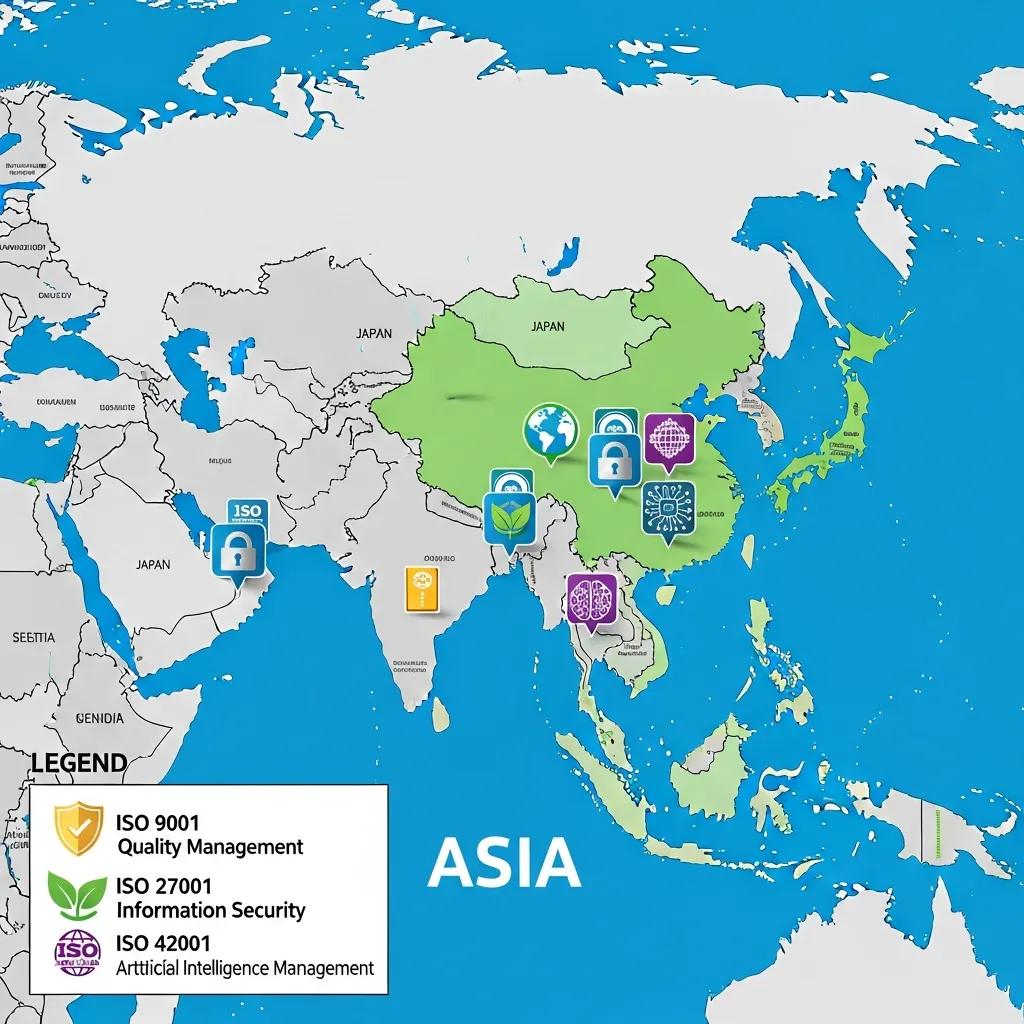
Key ISO standards answer different business needs in Asia: ISO 9001 ensures consistent quality for manufacturers and suppliers; ISO 14001 covers environmental management in export‑oriented plants; ISO 27001 protects data and supports trust for cloud and finance services; and ISO 42001 establishes emerging governance for AI systems. Adoption patterns depend on industry mix, regulation, and buyer expectations, and many enterprises combine standards to manage overlapping risks. The table below maps standards to core benefits and typical adoption examples.
| Standard | Primary Benefit in Asia | Adoption Examples / Industries |
|---|---|---|
| ISO 9001 | Process consistency, export readiness | Electronics and automotive suppliers |
| ISO 14001 | Environmental compliance, resource efficiency | Chemicals, heavy manufacturing |
| ISO 27001 | Information security and customer trust | IT services, cloud providers, finance |
| ISO 42001 | AI governance, risk mitigation | AI vendors, fintech, platform companies |
Many organizations pursue multiple standards together to cover operational, environmental, and digital risks. The following sections examine ISO 9001’s practical role and ISO 27001’s influence across Asia.
What Is the Role of ISO 9001 in Enhancing Quality Management in Asia?
ISO 9001 is the foundation for operational excellence. It defines process controls, performance metrics, and continual‑improvement cycles that high‑volume manufacturers and complex supply chains rely on. Implementing ISO 9001 reduces variability, improves supplier consistency, and supports claims of quality to international buyers — a must for export‑driven firms. Organizations that standardize around ISO 9001 typically see lower defect rates, better on‑time delivery, and improved procurement eligibility, all of which affect revenue and contract success. The standard’s customer focus and improvement loop also make it easier to scale operations and adopt new technologies in a controlled way.
With ISO 9001’s benefits clear, we turn to how ISO 27001 is shaping security practices across digitally driven sectors.
How Is ISO 27001 Shaping Information Security Practices in Asian Businesses?
ISO 27001 structures information security around policy, risk assessment, and technical controls tied to business objectives — critical for Asian firms that handle cloud services, payment data, and cross‑border transfers. Adoption is strong among IT service firms, fintechs, and financial institutions that need to demonstrate governance to partners and customers. The standard helps formalize asset inventories, incident response, and supplier controls, lowering breach risk and smoothing contractual negotiations. As data protection regulations across Asia tighten, ISO 27001 provides a recognized framework for compliance and trust that supports market access and customer assurance.
With quality and security contexts established, we next examine the newest standard shaping AI governance across the region.
What Is the Emerging Impact of ISO 42001 on AI Management Systems in Asia?
ISO 42001 sets requirements for AI management systems, giving organizations a consistent approach to governance, risk assessment, and operational controls for AI. The standard matters because it creates common expectations for safety, explainability, and accountability — areas of growing concern in Asia’s fast‑moving AI sector. Early adopters include AI vendors, large platforms, and regulated industries using algorithmic decision‑making; certification signals maturity to partners and customers. ISO 42001’s impact is technical — enforcing documentation, testing, and performance monitoring — and reputational — showing a commitment to responsible AI in procurement and partnerships.
Below are practical implementation phases and expected benefits for organizations considering ISO 42001 in Asia.
| Implementation Phase | Key Task | Expected Outcome |
|---|---|---|
| Governance & Policy | Define AI roles and accountability | Clear ownership and oversight |
| Risk Assessment | Map AI harms and controls | Prioritized mitigation plans |
| Monitoring & Testing | Implement continuous performance checks | Reduced model drift and bias |
These phases show what teams should plan for when implementing ISO 42001, which leads into common approaches used across Asia.
How Are Asian Organizations Implementing ISO 42001 for AI Governance?
Most Asian organizations use a phased rollout for ISO 42001: set up governance, perform targeted risk assessments on AI systems, then deploy continuous monitoring and validation. Governance typically starts with designated AI stewards and written policies that map technical controls to the company’s risk appetite. Risk work focuses on high‑impact use cases — credit scoring, hiring algorithms, automated decision systems — and prescribes mitigations such as explainability tests and human‑in‑the‑loop controls. Because auditor expertise is still maturing, many firms invest in training and partner with external assessors to validate technical and ethical controls before pursuing certification.
These steps produce clear benefits for AI‑driven businesses, which we outline next.
What Are the Benefits of ISO 42001 Certification for AI-Driven Enterprises?
ISO 42001 certification delivers practical advantages: it builds stakeholder trust by showing independent AI governance, reduces deployment risk through standardized testing and monitoring, and offers commercial differentiation when contracts require AI assurance. For AI vendors and service providers, certification demonstrates systematic risk management and traceability of model decisions. It also supports regulatory readiness — certified organizations are better placed to meet evolving AI rules and cross‑border procurement standards. In short, certification turns responsible AI commitments into verifiable processes buyers can evaluate.
These governance gains intersect with how audits are evolving — AI‑driven auditing tools are reshaping the certification lifecycle.
How Does AI-Driven Auditing Enhance ISO Certification Processes in Asia?

Short answer: AI‑driven auditing strengthens ISO certification by automating evidence collection, surfacing anomalies, and enabling continuous monitoring so audits cover more without proportionally more manual work. Core AI features include automated data ingestion, pattern recognition across large datasets, risk‑based sampling, and continuous control checks that reveal issues earlier than periodic audits alone. These capabilities shorten audit cycles, boost finding accuracy, and free auditors to focus on high‑risk areas. The table below links AI audit features to their functions and measurable benefits.
| AI Audit Feature | Function | Efficiency / Benefit Metric |
|---|---|---|
| Automated evidence collection | Ingest logs and documents | Reduces manual collection time by 40-60% |
| Anomaly detection | Identify unusual patterns | Increases issue detection coverage by 30% |
| Continuous monitoring | Real-time control checks | Lowers time-to-detection for incidents by 50% |
These figures illustrate measurable gains AI brings to auditing and explain why organizations across Asia are piloting AI‑enabled audits. The following paragraphs quantify typical improvements and offer anonymized case examples.
It’s useful to see how an AI‑enabled certification partner packages these capabilities. Stratlane Certification is a certification body that leverages AI‑driven audit tools to make ISO certification faster and more reliable.
Stratlane’s core services include certification for ISO 9001, ISO 14001, ISO 27001, and ISO 42001. The organization is accredited in 27+ countries and works with professional auditors in 29+ countries, with certificates accepted by corporate and academic partners worldwide. Key value propositions: AI‑driven auditing, broad accreditation, and a full certification portfolio.
What Are the Efficiency Gains from AI in ISO Auditing?
AI cuts manual evidence work and repetitive checklist tasks by automating data ingestion and first‑level analysis, significantly reducing prep and onsite audit time. Risk‑based audit planning accelerates because AI can prioritize controls and sites using historical data and anomaly scores, focusing auditor effort where it’s most needed. Continuous monitoring provides near real‑time verification of control effectiveness, lowering the chance of late discovery and costly remediation. These efficiencies translate to fewer total audit hours, wider audit coverage without proportional cost increases, and faster certification turnarounds.
Below are anonymized case summaries that show real‑world results from AI‑enabled audits in Asian industries.
Can You Share Case Studies of AI-Driven ISO Audits in Asian Industries?
Here are anonymized outcomes that illustrate typical improvements when ISO frameworks are paired with AI audit tools. In manufacturing, a major supplier automated document checks and statistical process reviews, cutting supplier qualification time by about 35%. In finance, an IT services firm used anomaly detection during an ISO 27001 assessment to find misconfigured access logs, reducing remediation time by 45%. In a technology provider, continuous model monitoring halved post‑deployment incidents tied to model drift, improving SLAs and lowering compliance exposure.
These examples show how standards plus AI auditing produce measurable results and help explain why global firms pursue ISO certification for their Asian operations.
Why Should Global Businesses Seek ISO Certification for Their Asian Operations?
Global companies — especially those from the US, EU, and UK — gain clear benefits from ISO certification in Asia. Certifications provide standardized evidence of process control, data protection, and AI governance that buyers, regulators, and partners use to assess risk. Certification speeds supplier selection, reduces due‑diligence friction, and helps multinational buyers enforce consistent standards across jurisdictions. It also mitigates supply‑chain risk by creating auditable trails — essential when operating across diverse legal and cultural environments. For teams managing cross‑border data or AI services, ISO frameworks offer common contractual and compliance reference points that streamline negotiations and limit bespoke controls.
- Facilitates access to regulated markets and corporate supply chains.
- Demonstrates standardized processes and controls to customers and partners.
- Reduces compliance and reputational risk through auditable systems.
These benefits make a strong business case for certification, but organizations must also navigate practical challenges. Stratlane can help with quotes, audits, and certificate management to bridge readiness and issuance.
How Does ISO Certification Improve Compliance and Competitiveness in Asia?
ISO certification improves compliance by documenting controls and evidence that regulators and buyers recognize, which reduces negotiation friction for cross‑border contracts. Competitively, certified organizations more easily meet procurement pre‑qualification criteria and can justify premium pricing for verified quality or security services. Certification aligns internal controls with customer expectations, enabling smoother audits and stronger supplier relationships. Together, these operational benefits often translate into higher tender win rates, faster onboarding of new clients, and lower perceived risk in contracts.
Next, we cover common implementation challenges and practical mitigation strategies multinational firms should plan for.
What Challenges Do US, EU, and UK Companies Face in Asian ISO Certification?
Typical hurdles for US, EU, and UK organizations include differing national accreditation systems, language and cultural gaps during audits, logistical complexity of multi‑site programs, and uneven local auditor availability. These factors can delay timelines and raise coordination costs. Common mitigation tactics: partner with certification bodies that have regional accreditation, use AI‑driven workflows to centralize evidence, engage local auditor networks for language and cultural alignment, plan staggered rollouts, standardize documentation templates, and enable remote audit capabilities to reduce friction and keep multinational programs consistent.
These practical considerations point to how a partner like Stratlane can support certification across Asia.
How Can Stratlane Certification Support Your ISO Journey in Asia?
Stratlane combines AI‑driven audit tooling with a broad accreditation footprint to guide organizations through quote, audit, certification, and certificate‑management workflows across Asian markets. The service model prioritizes efficiency — using automation to cut manual tasks — and regional coverage through accreditation in 27+ countries and an auditor network spanning 29+ countries. Stratlane’s portfolio covers ISO 9001, ISO 14001, ISO 27001, and ISO 42001, enabling integrated programs that address quality, environmental, information security, and AI governance needs. For organizations that need a partner blending technology with regional reach, Stratlane aims to streamline multi‑site and cross‑border certification projects.
Stratlane is a certification body that uses AI tools to improve the speed and reliability of ISO certification. Primary services include ISO 9001, ISO 14001, ISO 27001, and ISO 42001. The organization holds accreditation in more than 27 countries and works with auditors in 29+ countries; its certificates are accepted by corporate buyers and academic institutions globally. Core differentiators: AI‑driven audits, wide accreditation, and a comprehensive certification portfolio.
The sections that follow outline Stratlane’s differentiators and the practical steps to begin.
What Unique Advantages Does Stratlane Offer with AI-Driven Auditing?
Stratlane’s advantages center on AI‑enabled efficiency, multi‑country accreditation, and a seasoned auditor network that supports regional audits and remote workflows. AI tools reduce evidence collection time, enable risk‑based sampling, and increase audit coverage without a matching rise in hours. Accreditation across 27+ countries and auditors operating in 29+ countries give multinational clients recognition and logistical flexibility. Certificates issued by Stratlane are positioned for acceptance by corporate buyers and academic partners, supporting both commercial and research use cases.
These capabilities map directly to the practical steps organizations should follow to begin a certification program with an AI‑capable partner, summarized next.
How to Get Started with Stratlane’s ISO Certification Services in Asia?
To engage Stratlane, most organizations follow a clear sequence: request an initial quote and readiness assessment, complete a gap analysis and schedule an AI‑assisted audit, receive certification after a successful audit, and enroll in ongoing certificate management for surveillance and renewals.
- Request a quote and preliminary information: Share scope and site details for an initial estimate.
- Gap assessment and AI-assisted audit scheduling: Use automated evidence collection to prepare for the audit.
- Certification issuance and ongoing certificate management: Maintain certificates with surveillance and renewal support.
Following these steps helps teams move from planning to certified status with predictable effort and measurable outcomes.
Frequently Asked Questions
What is the significance of ISO certification for small and medium-sized enterprises (SMEs) in Asia?
For SMEs in Asia, ISO certification boosts credibility and marketability. It gives smaller firms a competitive edge by demonstrating commitment to quality, environmental management, and information security — qualities larger buyers often require. Certification can open new markets and client relationships, while also helping SMEs streamline processes, cut waste, and raise customer satisfaction. Over time, these improvements support stronger margins and more sustainable growth.
How can organizations measure the ROI of ISO certification?
Measure ROI by tracking operational and commercial KPIs: lower defect rates, reduced operational costs, shorter procurement cycles, and increased sales from new contracts tied to certification. Also quantify time saved in audits and compliance work, and track reputation gains that lead to higher win rates or better contract terms. Combining these indicators gives a clearer picture of certification’s financial and strategic value over time.
What role does employee training play in successful ISO certification?
Employee training is essential. It ensures staff understand the standard, their roles in maintaining compliance, and how to use the controls in day‑to‑day work. Training builds a culture of continual improvement and empowers employees to spot and fix issues before audits. Regular refreshers keep teams aligned with changes in standards and best practices, which makes audits smoother and outcomes more durable.
How does ISO certification impact supply chain management?
ISO certification strengthens supply chain management by standardizing processes that improve reliability and predictability. Certified suppliers are viewed as lower risk, which can deepen supplier relationships and simplify procurement. Certification also helps meet regulatory and buyer requirements, reducing disruption risk and improving quality control across the chain — all contributing to higher customer satisfaction.
What are the common misconceptions about ISO certification?
Common misconceptions include thinking certification is only for large firms or a one‑time project. In reality, ISO benefits organizations of all sizes and requires ongoing effort to maintain compliance. Another misconception is that certification guarantees quality by itself — the standard provides the framework, but results depend on an organization’s commitment to continuous improvement and proper implementation.
How can organizations prepare for an ISO audit?
Prepare by conducting an internal review of processes and documentation to spot gaps, implementing corrective actions, and training staff on audit roles. Keep records organized and evidence easy to access, and establish a clear communication plan for audit days. Working with an experienced certification body can also shorten preparation time and highlight common pitfalls to avoid.
Conclusion
ISO certification in Asia delivers tangible advantages: better market access, stronger compliance posture, and increased stakeholder trust. By understanding the trends and standards driving certification growth, organizations can prioritize the right programs and move more confidently in regional markets. Partnering with a provider that blends AI‑enabled audits and regional accreditation — like Stratlane — can streamline the path from readiness to certificate. Take the next step: assess your scope, talk to an accredited partner, and plan a staged rollout that meets both operational and commercial goals.