
Unlock Efficiency with Free ISO Certification Checklists

Free ISO Templates & Checklists: Practical Tools to Speed Your Certification
Free ISO templates and checklists are ready-made documents and task lists that help teams implement management systems consistently, cut documentation time, and produce audit-ready evidence. They act as management-system forms and compliance records that map to ISO clauses, letting practitioners run gap analyses, assign owners, and capture traceable records for certification. This guide walks through the common template types, explains how checklists support compliance and internal audits, and highlights the templates that accelerate ISO 9001, ISO 27001, and ISO 14001 work. You’ll get practical, step-by-step uses for gap analysis, risk assessment, incident handling, environmental registers, and preparing evidence for machine-readable audits. Each section includes examples of downloadable template formats, comparison tables to match templates to purpose and clauses, and adaptable checklists for internal audits. Finally, we cover project-plan and management-review templates and show how structuring evidence for AI-ready audits improves certification readiness.
What Are Free ISO Templates and How Do They Support Implementation?
Free ISO templates are structured documents—manuals, procedures, registers, checklists—designed to capture the documented information ISO standards require. They support implementation by standardizing inputs, outputs, and the evidence auditors expect. Because templates map clauses to records and responsibilities, they reduce ambiguity and speed the gap-analysis and corrective-action cycle. Practically, templates deliver faster documentation, consistent evidence collection, and clearer audit trails that tie controls to results. Below are the main benefits organizations see when they use templates and checklists to prepare for certification.
Key, immediate advantages of free ISO templates:
- Consistent documentation reduces rework and shortens implementation time.
- Checklist-driven audits broaden coverage and make evidence simple to locate.
- Gap-analysis templates reveal nonconformities and help prioritize remediation.
- Structured registers (for example, SoA or aspect registers) provide traceability during certification audits.
These outcomes produce the consistent records auditors expect and make it easier to choose which templates to adapt for your management system.
What Types of ISO Templates Are Available for Download?
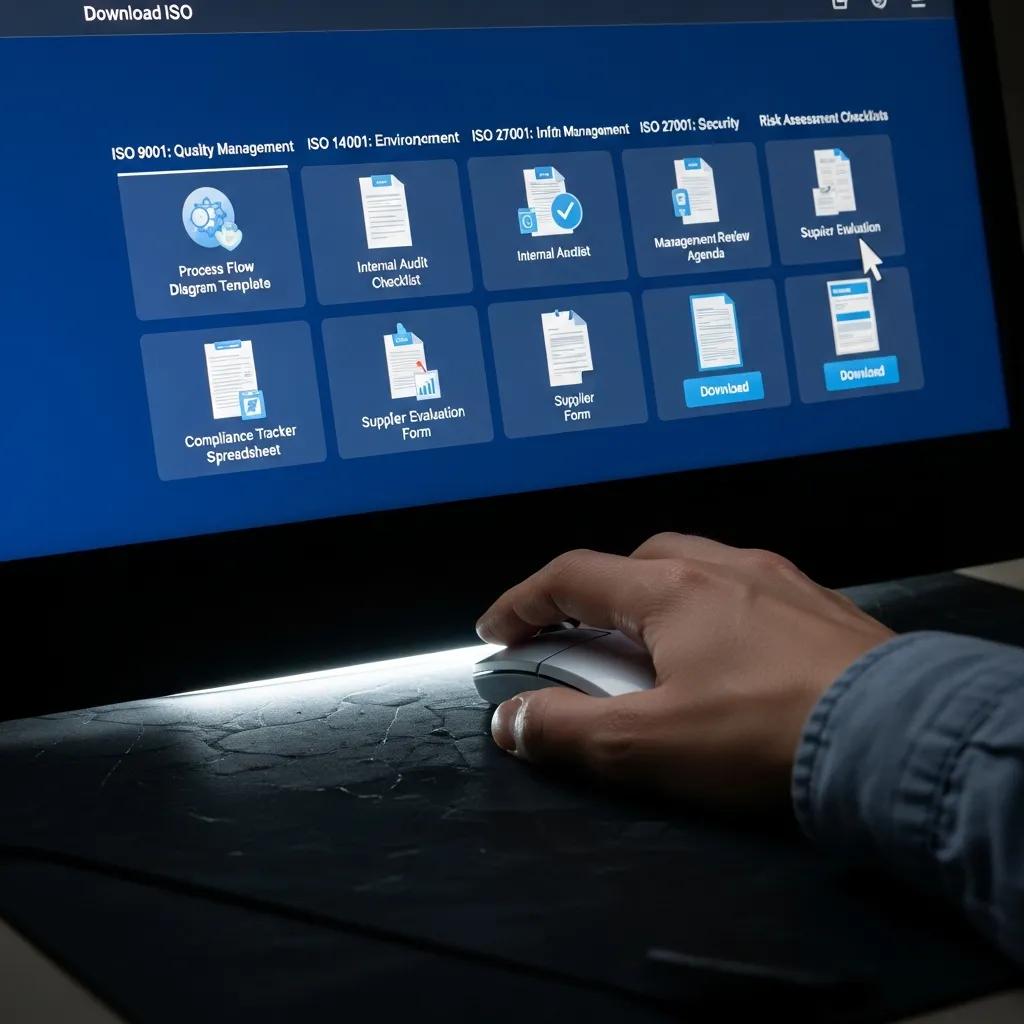
Across ISO standards you’ll find a common set of template types practitioners rely on to build compliant documentation. Each template serves a specific documented-information need: manuals and scope statements set system boundaries; gap-analysis templates compare current practice to clauses; registers track obligations and aspects; procedures describe routine controls; and checklists simplify evidence collection for internal audits. For file formats, use editable Word for narrative documents, Excel for registers and risk matrices, and PDF for controlled, finalized copies.
- Typical templates: quality manual, gap analysis, Statement of Applicability (SoA), risk register, incident log, management-review minutes, and audit checklists.
- File-format guidance: Word for manuals/procedures so teams can edit; Excel for risk matrices and registers to enable sorting and filtering; PDF for finalized distribution.
- Example: an Excel gap-analysis sheet can include clause reference, current state, gap severity, owner, and target date for closure.
Picking the right template type and file format helps keep documents living and useful instead of static artifacts. That brings us to how checklists structure compliance work.
How Do ISO Checklists Facilitate Effective Standard Compliance?
ISO checklists break clauses into discrete, verifiable items and give teams a repeatable way to score findings, tag evidence, and drive follow-up. A good checklist includes clause references, specific verification points, example evidence, and an outcome field (compliant, minor/major nonconformity, observation). Use checklist results to create corrective-action entries that are traceable to owners and deadlines so gaps actually close.
- Audit structuring: Checklists turn clauses into inspection points auditors can verify against records and interviews.
- Evidence mapping: Each checklist item should point to sample evidence (record name, date, location) to speed auditor sampling.
- Continuous improvement: Checklist findings feed corrective actions and management-review inputs.
Structuring audit evidence and corrective actions with checklists closes the compliance loop and prepares organizations for deeper, evidence-driven reviews—an essential step before applying standard-specific templates like ISO 9001, ISO 27001, and ISO 14001.
Which Free ISO 9001 Document Templates Help Streamline Quality Management?
ISO 9001 templates help you build a Quality Management System (QMS) by documenting the quality manual, gap analysis, procedures, and internal-audit records. They speed implementation by linking clauses to processes and evidence. A compact set of core templates will cover most QMS needs: a gap-analysis template to identify scope and nonconformities; a quality-manual template that captures scope, policy, and structure; procedure templates for document control and corrective action; and internal-audit checklists mapped to clauses 4–10. The table below makes it easy to match each template to its purpose and the clause(s) it supports so teams can prioritize what to adapt first.
Use this table to match ISO 9001 templates to their purpose and the clauses they support, helping you prioritize implementation steps.
| Template | Purpose / ISO Clause | When to Use / Frequency |
|---|---|---|
| Gap analysis checklist | Compare current system to ISO 9001 clauses (4–10) | Initial implementation; repeat before certification and annually |
| Quality manual template | Document scope, QMS structure, and policy (Clause 4.3, 5.2) | During system design and after major changes |
| Internal audit checklist | Map audit questions to clause requirements | Planned internal audits (quarterly/annual as risk-based) |
| Document control procedure | Control of documented information (Clause 7.5) | When creating/updating records; continuous use |
| Corrective action form | Capture nonconformities and CAPA (Clause 10.2) | After audits, customer complaints, or incidents |
These core forms and checklists produce the audit evidence and operational consistency auditors expect. Next, we walk through a practical workflow for gap analysis and building the quality manual.
How to Use ISO 9001 Gap Analysis and Quality Manual Templates?
Start with the gap-analysis template to assess procedures, records, and responsibilities against ISO 9001 clauses. Record existing evidence, identify gaps, score severity, and assign owners. Then adapt the quality-manual template to reflect your scope, context, and process interfaces, linking to existing procedures and records. A common workflow is: run the gap analysis, create a prioritized action plan, populate the quality manual with confirmed controls, and update procedures to close high-priority gaps.
- Perform gap analysis: List clauses, current evidence, gaps, owner, and target dates.
- Prioritize actions: Sequence remediation by severity and risk.
- Customize quality manual: Map processes to clauses and reference procedure names.
This sequence keeps your QMS coherent and auditable, and it generates the evidence internal audits use to verify closure of identified gaps.
What Are the Key ISO 9001 Internal Audit and Procedure Checklists?
Internal-audit and procedure checklists turn clauses into verifiable audit items and document-control steps, helping auditors and process owners capture objective evidence. Core topics include management responsibility, resource management, operational control, performance evaluation, and continual improvement. Procedure templates commonly cover document control, control of nonconforming outputs, corrective actions, purchasing controls, and competence/training matrices.
- Essential audit items: evidence of policy communication, process performance indicators, procedure adherence, calibration records where applicable, and records of corrective actions.
- Procedure templates should list scope, responsibilities, inputs, outputs, records, and referenced forms for consistent application.
- Tip: Link each checklist item to a specific record name (for example, “training matrix — version X”) to make sampling efficient.
These templates create an audit trail linking requirements to artifacts. If you want help applying them in your organization, see the support note below.
Need help applying this template? Stratlane Certification provides certification services and AI-enabled audit preparation to help convert templates and checklists into audit-ready systems. Request a tailored assessment for an expert quote, audit support, or certificate-management options.
How Can Free ISO 27001 Checklists Enhance Information Security Implementation?
ISO 27001 templates and checklists structure risk assessment, controls mapping, the Statement of Applicability (SoA), and incident records, turning risk outcomes into documented controls and measurable evidence. Risk templates capture asset, threat, vulnerability, likelihood, impact, and treatment owner; controls checklists map measures to Annex A (A.5–A.18) and list required evidence. Using these templates builds traceable documentation that shows auditors how risks are identified, treated, and monitored.
The table below maps common ISO 27001 templates to controls and the audit evidence you should produce to show coverage and readiness.
| Template / Checklist | Control / Process | Outcome / Audit Evidence |
|---|---|---|
| Risk assessment matrix | Asset-based risk scoring | Documented risk register with owners and treatment plans |
| Statement of Applicability (SoA) | Annex A control selection | Justification for implemented/excluded controls |
| Controls mapping checklist | A.5–A.18 control coverage | Control implementation evidence (logs, configs, policies) |
| Incident management log | Detection & response processes | Incident records, timelines, root cause analysis |
This mapping clarifies what auditors expect and shows how checklists turn controls into verifiable outputs. Next, we detail what to include in risk and controls templates.
What Is Included in ISO 27001 Risk Assessment and Controls Templates?
A practical risk-assessment template records asset descriptions, owner, threat, vulnerability, likelihood score, impact score, overall risk level, treatment option, and review date so you can prioritize quantitatively or qualitatively. Controls templates list Annex A controls with implementation status checkboxes, owner, evidence location, and residual risk to make completing the SoA straightforward. Populate fields with concrete entries (for example, “email server — encryption applied — log archive path”) so outputs serve as direct audit evidence.
- Risk fields: Asset, threat, vulnerability, likelihood, impact, risk score.
- Control fields: Control ID, implementation status, owner, evidence reference.
- Outcome: A traceable register used in management review and internal audits.
These structured outputs are exactly what auditors sample and they feed directly into incident management procedures described next.
How to Apply ISO 27001 Incident Management Procedure Templates?
Incident-management templates guide the lifecycle from detection and logging to containment, eradication, recovery, and post-incident review, ensuring every incident produces the records auditors expect. Key elements include an incident log with timestamps, classification, actions taken, communication checkpoints, root-cause analysis, and lessons learned recorded as preventive actions. Use the template to set escalation thresholds, notification lists, and evidence-retention timelines.
- Log every incident with time, reporter, symptoms, and affected assets.
- Document containment and recovery steps with responsible owners and timestamps.
- Run a post-incident review and update risk assessments where necessary.
Consistent incident records show responsiveness and continual improvement, strengthening ISMS maturity and audit confidence. If applying these templates feels challenging, see the support note below.
Need help applying this template? Stratlane Certification offers ISMS implementation support, audits, and AI-enabled evidence reviews to convert incident records into audit-grade artifacts. Request a quote or an audit-readiness check to evaluate controls and certificate-management options.
What Free ISO 14001 Forms and Checklists Support Environmental Management?
ISO 14001 forms and checklists help teams identify environmental aspects and impacts, track compliance obligations, and apply life-cycle thinking to reduce environmental footprint. These templates make the EMS auditable by linking controls to objectives, targets, and operational controls. Common forms include environmental aspect & impact registers, compliance-obligation registers, monitoring and measurement logs, and life-cycle analysis templates. The table below connects typical EMS forms to obligations and the actions needed to demonstrate compliance.
This table helps teams match EMS forms to environmental aspects and responsibilities so they can keep living registers and show audit evidence.
| Form | Environmental Aspect / Obligation | Action Required / Responsibility |
|---|---|---|
| Aspect & impact register | Process emissions, waste, resource use | Identify impacts, rank significance, assign controls |
| Compliance obligations register | Laws, permits, stakeholder requirements | Track obligations, deadlines, and evidence of compliance |
| Monitoring & measurement form | Emissions, effluent, resource metrics | Record measurements, calibration, and trends |
| Life-cycle analysis template | Product/process stages | Document inputs, impacts, and improvement opportunities |
These forms tie life-cycle thinking to measurable actions and give auditors the records they need to verify conformance and continual improvement. Below we explain how to populate and maintain aspect and compliance registers.
How to Use ISO 14001 Environmental Aspect and Compliance Registers?
Populate aspect registers by listing activities, associated environmental aspects, potential impacts, significance rating, existing controls, and opportunities for improvement. Update the register after operational changes and use it to set objectives and targets. The compliance register should list legal and other obligations, the responsible person, evidence type, and review dates to demonstrate ongoing compliance. Keep registers alive by assigning owners, scheduling reviews, and linking changes to objectives and management-review inputs.
- Identify aspects: Map process step → aspect → potential impact → significance.
- Assign controls: Note existing control, owner, and monitoring method.
- Link to objectives: Turn significant aspects into measurable targets.
Using registers this way ensures the EMS supports informed decisions and provides the records auditors expect during certification.
What Are the Benefits of ISO 14001 Internal Audit and Life Cycle Analysis Templates?
Internal-audit and life-cycle analysis templates speed audit prep by standardizing what to check, which records to collect, and how to score findings. Life-cycle templates guide assessment across raw materials, manufacturing, distribution, use, and end-of-life to reveal reducible impacts. Benefits include faster evidence collection, clearer improvement roadmaps, and stronger sustainability claims backed by auditable records.
- Benefits include reduced audit prep time, consistent performance metrics, and alignment of objectives with significant aspects.
- Life-cycle analysis exposes concrete improvement opportunities for product design and process optimization.
- Templates produce documentary evidence for management review and external verification.
If your team needs help turning life-cycle findings into certification-ready records, see the assistance options below.
Need help applying this template? Stratlane Certification can assist with EMS audits, life-cycle analysis support, and certificate management to translate template outputs into auditable evidence. Contact the team for a tailored quote or an audit-readiness assessment.
How Do General ISO Implementation Tools and AI-Ready Checklists Improve Certification Preparation?
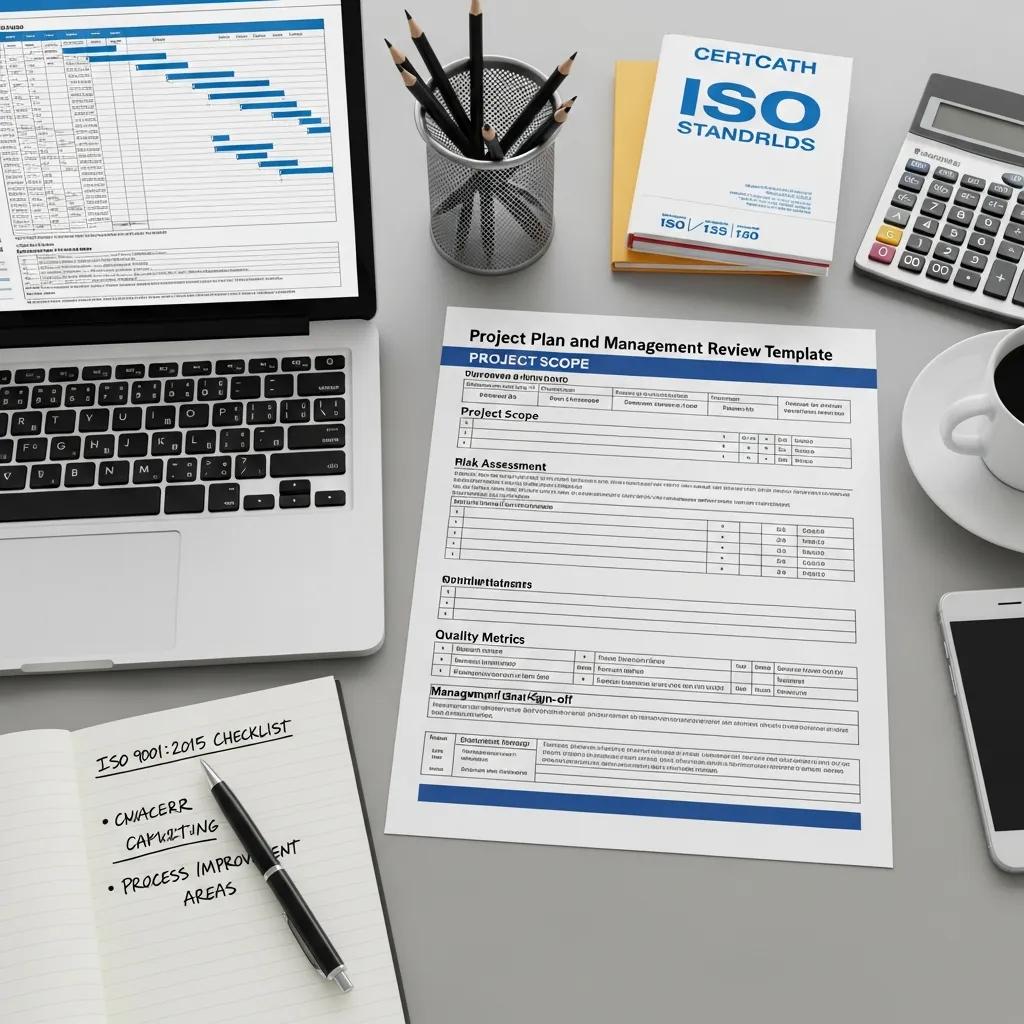
General implementation tools—project plans, management-review templates, training matrices, and AI-ready checklists—add governance, traceability, and structured data that speed certification preparation by aligning activities with audit-evidence needs. A project-plan template captures milestones, owners, resources, and risks; management-review templates collect required inputs and outputs; training matrices record competence evidence; and AI-ready checklists organize metadata and evidence links so automated tools can parse and sample records. Together, these tools let both human reviewers and machine-driven audit utilities verify compliance more efficiently.
- Project plan templates ensure milestones and owners drive timely completion of corrective actions and implementation tasks.
- Management review templates gather performance data, audit results, and decisions for top-management oversight.
- AI-ready checklists use structured fields and evidence links to make records machine-readable.
Below we outline the role of these templates and define what makes a checklist “AI-ready” to support modern auditing approaches.
What Is the Role of ISO Project Plan and Management Review Templates?
Project-plan templates define scope, milestones, owners, resources, and risk mitigations to keep implementation on track and provide traceable records for auditors. They’re especially helpful for staged rollouts and tracking corrective actions. Management-review templates capture inputs (audit results, performance metrics, resource needs) and outputs (decisions, assigned actions, resource changes) required for continual improvement, helping top management demonstrate oversight. Use project plans to schedule internal audits and management reviews so outputs become timely audit evidence.
- Project-plan elements: milestone, owner, resource, due date, status.
- Management-review agenda: inputs, findings, decisions, action items.
- Link outcomes: ensure audit findings translate into project tasks and management decisions.
These governance templates create a controlled timeline and governance evidence certifiers expect to see.
How Does the AI-Ready Audit Preparation Checklist Support AI-Driven Auditing?
AI-ready checklists prepare organizations for automated audits by enforcing structured data capture and evidence tagging, enabling automated sampling, broader coverage, and faster validation. Key items include standardized metadata (document ID, version, owner), timestamps, direct evidence links (record name and storage location), categorical fields for control status, and unique IDs for traceability. When these elements are in place, AI-driven audit tools can ingest the dataset, run statistical sampling, and surface anomalies for human review.
- Metadata fields: Document ID, version, author, and timestamp to support machine parsing.
- Evidence links: Direct references to records or logs the algorithm can access.
- Traceability IDs: Unique identifiers connecting checklist items to process records.
Implementing AI-ready checklists reduces audit time and improves sampling depth. For teams preparing for AI-enabled audits, specialized audit services can add measurable value.
Stratlane Certification integrates AI-driven audit tools into its certification services and helps organizations prepare by reviewing templates for machine readability, running audit simulations, and managing certificates. If you’re preparing for an AI-enabled audit and want a quote or readiness assessment, request a tailored evaluation to map your templates to AI audit requirements.
- Assessment: Review templates for structured fields and evidence tagging.
- Simulation: Run mock AI-driven audits to test data readiness.
- Support: Recommend improvements to machine-readability and traceability.
These services convert template outputs into audit-ready datasets both human auditors and AI tools can evaluate efficiently.
Frequently Asked Questions
1. How can organizations ensure they are using the right ISO templates for their specific needs?
Start with a needs assessment that ties your core processes, risks, and compliance obligations to the ISO clauses you’re targeting. Compare available templates against those requirements and involve process owners to confirm fit. Where helpful, consult ISO experts to validate choices and ensure templates will support an effective, auditable system.
2. What are the common challenges organizations face when implementing ISO templates?
Typical challenges include staff resistance to change, unclear understanding of ISO requirements, and limited training on template use. Teams also stumble integrating templates into existing workflows or keeping them current as operations shift. Overcome these by providing hands-on training, promoting a culture of continuous improvement, and securing visible management sponsorship.
3. How often should organizations review and update their ISO templates?
Review templates at least annually and whenever you have significant process changes, regulatory updates, or revisions to the ISO standards. Also re-evaluate templates after internal audits or when nonconformities appear—those events often highlight practical adjustments that improve usability and compliance.
4. Can ISO templates be customized to fit unique organizational processes?
Absolutely. Templates are frameworks—customize them to reflect your organization’s terminology, workflows, and context. Tailoring templates makes them practical for users and more effective at producing the audit evidence you need.
5. What role do training and awareness play in the successful implementation of ISO templates?
Training and awareness are crucial. They ensure staff understand why templates exist, how to use them correctly, and how compliance supports business goals. Workshops, role-based training, and ongoing support increase adoption and accountability across the organization.
6. How can organizations measure the effectiveness of their ISO templates?
Track KPIs related to compliance, audit findings, and process improvements. Use internal audits to assess template use and outcomes, and collect user feedback on clarity and usability. These measures help you refine templates so they continue to meet operational needs.
7. What resources are available for organizations looking to improve their ISO template usage?
Resources include online courses, webinars, and workshops from certification bodies and consultants, plus industry forums that share best practices. Many teams also bring in ISO consultants for tailored guidance on optimizing templates and compliance strategy.
Conclusion
Free ISO templates and checklists simplify certification by standardizing documentation and improving compliance readiness. When adapted and maintained, these resources accelerate implementation, create reliable audit evidence, and make management systems easier to operate. Explore our library of templates for different ISO standards, start adapting them to your context, and make your documentation audit-ready today.