
Navigating Regulatory Compliance: ISO Certification Insights

ISO Certification for Regulatory Compliance and Risk Management — A Practical Guide for Businesses
ISO certification formalizes your management systems so they meet defined requirements that reduce legal exposure, control risk, and support regulatory compliance. This guide shows how key ISO standards — especially ISO 9001, ISO 14001, ISO 27001, ISO 42001 and related risk frameworks — create consistent processes, measurable controls, and audit-ready evidence regulators and customers expect. Many organizations discover gaps between everyday operations and regulator expectations; certification closes those gaps by codifying controls, enabling continuous monitoring, and creating records that stand up to scrutiny. Below, we cover the business value of certification, how AI-augmented auditing speeds readiness and enables predictive compliance, which standards matter under different regulatory regimes, risk-mitigation techniques tied to ISO 31000, and a step-by-step path to certification using AI-enabled audit services. Actionable lists, comparison tables, and clear timelines will help you plan resources and measure outcomes.
What Are the Key Benefits of ISO Certification for Businesses?
ISO certification gives you a structured management system that links documented policy to measurable controls. That structure reduces variability, makes compliance demonstrable, and lowers operational risk. By requiring defined processes, evidence-based audits, and continual improvement cycles, the standards deliver repeatable performance, clearer accountability, and measurable gains across quality, security, and environmental areas. Third-party certification also strengthens procurement eligibility and limits disputes during regulatory inspections. Knowing these benefits helps leaders prioritize which standards to pursue and how to measure the return on compliance investment.
ISO certification delivers several core business benefits:
- Operational efficiency and reduced variability through standardized processes and PDCA cycles, lowering defects and rework.
- Stronger customer trust and procurement advantage via independent third-party validation of management systems.
- Regulatory alignment and reduced legal exposure by documenting controls and maintaining audit trails.
- Risk mitigation and resilience through risk registers, treatment plans, and systematic incident handling.
- Measurable outcomes — fewer nonconformities, faster incident resolution, and improved customer satisfaction metrics.
Below is a compact comparison linking benefits to the operational mechanism and business outcome.
This table compares primary benefits with the mechanism by which ISO standards deliver measurable results.
| Benefit | Mechanism | Business Outcome |
|---|---|---|
| Operational efficiency | Standardized processes, PDCA, documented procedures | Shorter lead times, fewer defects, improved KPIs |
| Customer trust | Third-party certification, consistent delivery | Higher procurement success and stronger retention |
| Regulatory alignment | Evidence trails, risk-based controls | Fewer compliance findings and reduced legal exposure |
| Risk mitigation | Risk registers, treatment plans, audits | Lower incident frequency and faster recovery |
| Continuous improvement | Internal audits, management review | Ongoing cost savings and capability growth |
This mapping shows how each benefit is produced by specific system mechanisms and yields concrete business outcomes, helping you decide which standards to implement next.
How Does ISO Certification Enhance Quality Management and Operational Efficiency?
ISO certification improves quality and efficiency by requiring documented processes, performance metrics, and regular management review — all of which reduce variability and align teams around priorities. The engine behind this is risk-based thinking and the Plan‑Do‑Check‑Act cycle: set objectives, run processes, measure results, and act on deviations to drive continuous improvement. Audit evidence — like fewer nonconformities, lower scrap rates, and shorter cycle times — demonstrates these gains. For example, organizations using ISO 9001 formalize defect tracking and root-cause analysis, which speeds corrective actions and prevents repeat issues. Those operational improvements also strengthen market positioning through external validation.
In What Ways Does ISO Certification Build Customer Trust and Competitive Advantage?
Certification signals predictable performance and a clear commitment to quality and compliance — attributes procurement teams and customers increasingly demand. A certificate is a compact, independent signal that your processes, controls, and evidence meet an accredited standard, which reduces perceived vendor risk. That credibility helps you win bids, speeds due‑diligence checks, and can enable premium positioning in regulated markets. When you highlight certified processes and measurable KPIs — like on‑time delivery and complaint reduction — you reinforce retention and carve a clearer competitive edge. These commercial benefits guide which standards you choose based on regulatory exposure and market needs.
How Does AI-Driven Auditing Transform ISO Certification Processes?

AI-driven auditing complements traditional audit techniques by automating document review, extracting evidence at scale, and scoring risk across large datasets — all of which speed certification readiness and enable predictive compliance insights. Machine learning finds patterns, NLP pulls relevant statements, and predictive models prioritize risk; together they enable faster sampling, more consistent findings, and earlier detection of emerging gaps before formal audits. AI also supports continuous control monitoring and generates structured reports that human auditors validate. Knowing these capabilities helps organizations plan how AI will change the audit lifecycle and reduce time‑to‑certification.
Research highlights the growing role of AI in compliance auditing and its potential to streamline review while improving accuracy.
AI-Driven Compliance Audits for Regulatory Adherence
AI-based compliance auditing combines machine learning, natural language processing (NLP), and automation to surface regulatory breaches, extract evidentiary material, and produce audit findings faster and more consistently. The paper outlines a hybrid audit model using transformer-based NLP for contract and regulation interpretation, supervised anomaly detection on transaction and reporting streams, and an explainability layer that maps model outputs to regulatory clauses and audit trails.
AI-Driven Compliance Audits: Enhancing Regulatory Adherence in Financial and Legal Sectors, ST Gandhi, 2023
AI-driven audits deliver practical advantages:
- Faster evidence review by automatically extracting control statements and supporting artifacts.
- Better anomaly detection with ML models that flag outliers and trending issues.
- Scalable scope — large volumes of records and logs can be processed without proportional auditor hours.
- Predictive risk scoring that prioritizes remediation and reduces unexpected findings.
Below is a mapping of AI capabilities to specific audit outcomes to show how technology drives measurable improvements.
| AI Capability | Audit Function | Result / Metric |
|---|---|---|
| NLP document parsing | Automated evidence extraction | Fewer manual review hours |
| Machine learning anomaly detection | Trend and outlier identification | Earlier detection of control failures |
| Predictive analytics | Risk prioritization | Fewer high‑severity findings at final audit |
| Continuous monitoring | Ongoing compliance checks | Reduced audit scope and frequency |
This table clarifies how AI features translate into audit efficiencies and stronger compliance confidence, helping you plan an AI-assisted certification program.
What Are the Advantages of AI in Streamlining ISO Audits and Risk Assessments?
AI accelerates audits by locating relevant clauses, correlating evidence across systems, and scoring control effectiveness against risk criteria. Automated pattern recognition links policy text to logs and incidents to create a cohesive audit narrative. Common metrics for success include reduced time‑to‑review, auditor hours saved, and faster remediation closure. For example, automated sampling can significantly cut evidence‑collection time while maintaining or improving the detection rate for nonconformities. Those efficiency gains naturally raise questions about governance for AI itself, which ISO 42001 addresses.
How Does ISO 42001 Govern AI Systems and Support AI Audit Efficiency?
ISO 42001 sets requirements for AI management systems covering lifecycle controls, explainability, and monitoring — creating auditable controls for AI used in certification and operations. It provides a framework for model validation, data provenance documentation, and bias‑mitigation controls so auditors can evaluate AI systems against defined criteria. Applying ISO 42001 helps demonstrate that AI‑assisted audit workflows are trustworthy and under appropriate oversight. When AI supports evidence extraction and risk scoring, ISO 42001 gives auditors the governance evidence they look for, ensuring AI strengthens rather than complicates compliance narratives.
Experts increasingly view ISO/IEC 42001 as a practical standard for building accountable AI management systems.
ISO/IEC 42001 Certification for AI Management Systems
The ISO/IEC 42001 Artificial Intelligence Management System (AIMS) standard is a step change. It addresses the emerging risks and opportunities of AI by providing a framework for organizations to manage AI lifecycle controls, risk, and accountability.
AI Management System Certification According to the ISO/IEC 42001 Standard: How to Audit, Certify, and Build Responsible AI Systems, 2024
If you’re evaluating AI-assisted audits, Stratlane Certification’s approach combines machine-assisted document analysis with human validation to speed evidence review and improve risk visibility while preserving accredited auditor oversight. Organizations can explore service pathways via Get A Quote or Book your audit to assess readiness.
Which ISO Standards Are Essential for Regulatory Compliance and Risk Management?
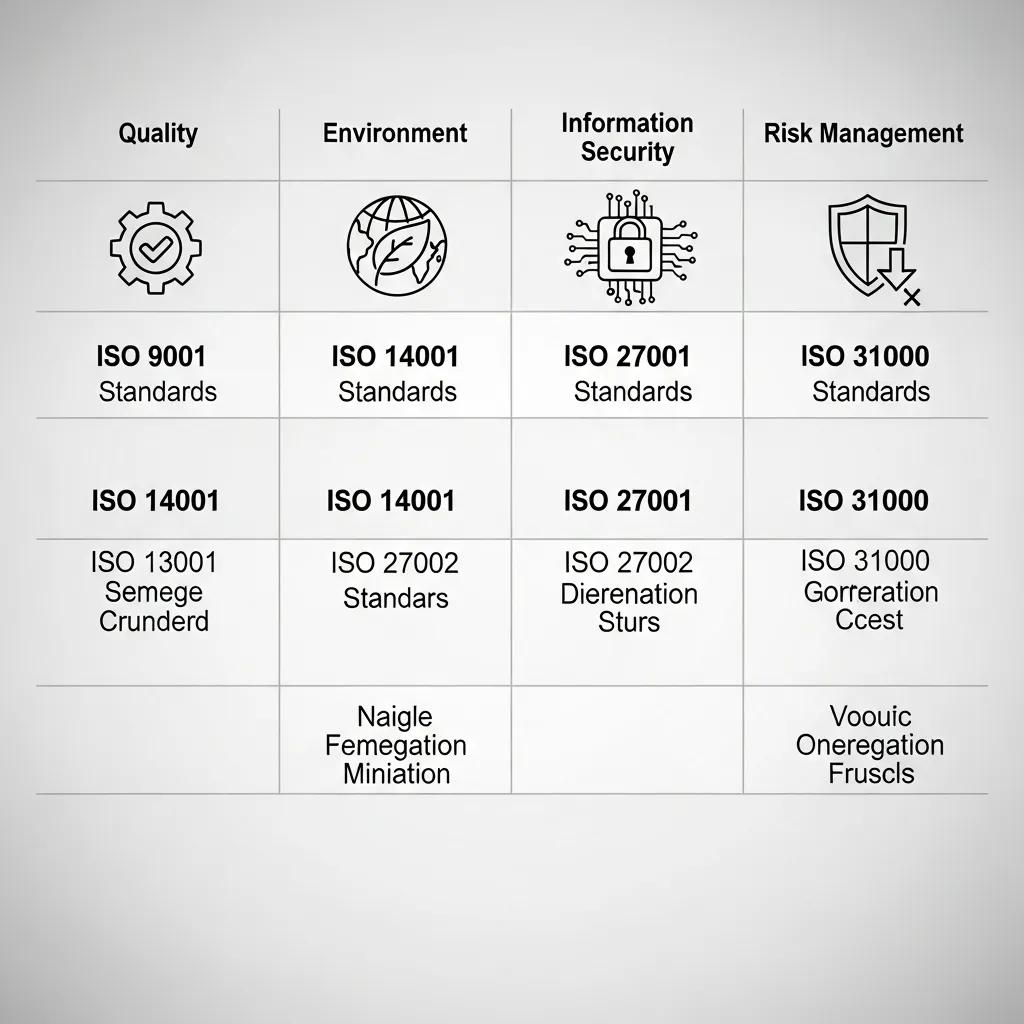
A core toolkit for compliance and risk management typically includes: ISO 9001 for quality, ISO 14001 for environmental management, ISO 27001 for information security, ISO 42001 for AI governance, and ISO 31000 for enterprise risk management. Each standard targets a distinct domain and delivers specific compliance value — quality, environmental controls, data protection, trustworthy AI, and risk governance. Your choice depends on regulatory exposure, stakeholder expectations, and organizational risk profile. Mapping standards to domain needs helps prioritize investment and align certification scope with legal requirements.
The following table compares core standards against their primary domain and the compliance value they provide.
| Standard | Primary Domain | Core Benefit / Compliance Value |
|---|---|---|
| ISO 9001 | Quality management | Consistent product/service quality and controlled processes |
| ISO 14001 | Environmental management | Trackable controls for emissions, waste, and permits |
| ISO 27001 | Information security | Structured ISMS to protect data and support privacy laws |
| ISO 42001 | AI governance | Auditable controls for a trustworthy AI lifecycle |
| ISO 31000 | Risk management | Framework to identify, assess, and treat enterprise risk |
This comparison helps decision‑makers pick standards that map directly to regulatory obligations and corporate risk appetite, making certification planning more targeted and efficient.
How Does ISO 9001 Support Quality Management Systems?
ISO 9001 defines a process‑based quality management system that emphasizes risk‑based thinking, documented controls, and continual improvement via PDCA cycles. Practically, organizations set objectives, map processes, define KPIs, and run internal audits to generate evidence for certification. Outcomes include fewer process failures, tighter supplier oversight, and measurable gains in customer satisfaction. Well‑documented procedures and records serve as audit evidence and reduce ambiguity during regulatory inspections. These quality foundations also ease integration with standards like ISO 27001 and ISO 14001.
What Role Does ISO 27001 Play in Information Security Compliance and Data Protection?
ISO 27001 establishes an Information Security Management System (ISMS) that requires risk assessment, control selection, and continuous monitoring — mechanisms that support compliance with data protection laws like GDPR and HIPAA. Auditors review risk registers, implemented controls, and evidence such as policies, access logs, and change records. Implementing ISO 27001 provides structured processes for data protection, breach response, and accountability. Integrating ISMS outputs with privacy management lowers legal risk and gives auditors clear evidence of control effectiveness.
After assessing standards, organizations commonly choose targeted certification paths. Stratlane Certification offers services for ISO 9001, ISO 14001, ISO 27001, and ISO 42001 that align standards selection with an organization’s risk profile; service pages outline scope options and how AI-assisted audits speed evidence collection.
How Can ISO Certification Help Mitigate Business Risks Effectively?
ISO frameworks reduce business risk by enforcing systematic identification, assessment, and treatment of risks across operations, turning ad‑hoc responses into repeatable controls. Using ISO 31000 principles within an operational management system means risk registers feed into process controls, KPIs track residual risk, and management review keeps priorities aligned with strategy. Measurable KPIs — like time‑to‑detect incidents, mean‑time‑to‑recover, and percent of mitigations completed on schedule — let leaders quantify risk reduction and justify control investments. Systematic risk management also speeds the path from incident detection to corrective action, lowering regulatory exposure.
Risk management relies on clear principles and measurable actions:
- Contextualize risk by defining scope and stakeholders so controls remain relevant.
- Assess risk with qualitative and quantitative methods to prioritize remediation.
- Treat risk by implementing controls, assigning owners, and tracking closure.
- Monitor and review to ensure treatments stay effective and adapt to change.
The structured approach above informs the governance and technical controls in the ISO sections that follow.
What Are the Principles of Risk Management in ISO 31000?
ISO 31000 frames risk management around principles such as being integrated, structured and comprehensive, tailored, inclusive, and dynamic. The lifecycle is straightforward: establish context, identify risks, analyze and evaluate likelihood and impact, select treatments, implement controls, and monitor outcomes. Integrated risk management connects people, processes, and technology so relevant risk data reaches decision‑makers. In practice, teams often link risk registers with operational KPIs and internal audit schedules so treatment plans have measurable targets and accountability — evidence auditors look for when assessing effective risk governance.
Industry guidance reinforces that ISO 31000 provides a practical foundation for embedding risk management across organizational processes.
ISO 31000 for Enterprise Risk Management Programs
Guidance on applying ISO 31000 helps organizations build risk management programs aligned with the standard. TR 31004 emphasizes using ISO 31000 to highlight the importance of risk, integrate risk management into all processes, and provide a framework for better decision‑making.
ISO 31000:2018 Enterprise Risk Management, 2018
How Does ISO 27001 Aid in Cybersecurity Risk Mitigation?
ISO 27001 reduces cyber risk by requiring an ISMS with clear policies, technical controls (access management, encryption), and documented incident‑response processes tested and tracked. The approach uses periodic risk assessments that map threats to controls, prioritize remediation, and collect evidence such as access logs, configuration records, and incident reports. These controls lower the likelihood and impact of cyber incidents and supply auditors with demonstrable artifacts for compliance. Linking ISMS outputs to business continuity planning ensures cyber resilience supports the organization’s overall risk posture.
What Are the Steps to Achieve ISO Certification with Stratlane’s AI-Driven Audit Services?
Working with an AI‑enabled audit partner follows a clear sequence that blends preparation, automated evidence assessment, remediation, and the final audit. The staged assurance model starts with scoping and gap analysis, moves to AI‑powered evidence collection and risk scoring, then remediation, and finally an accredited certification audit. Timelines vary by organization size and complexity but can be compressed when AI accelerates review and sampling. Below is a practical process to plan resources and expectations.
- Initial scoping and gap analysis: define scope, map processes, and review documents to identify gaps (typical duration: 2–4 weeks).
- AI‑powered audit and risk assessment: run automated parsing and risk scoring to prioritize remediation (typical duration: 2–6 weeks depending on data volume).
- Remediation and control implementation: address prioritized findings, update procedures, and gather evidence (typical duration: 4–12 weeks depending on complexity).
- Final certification audit and closure: accredited auditors validate evidence and issue certification on successful completion (typical duration: 1–3 weeks for the audit itself).
- Certificate issuance and ongoing management: set up surveillance audits and continuous monitoring to maintain compliance.
How Does Stratlane’s AI-Powered Audit Process Ensure Transparency and Compliance?
Stratlane’s AI‑powered audit blends automated analysis with certified auditor oversight to preserve transparency and maintain auditable decision trails. The hybrid assurance model has AI extract and link evidence, generate explainable risk scores, and produce draft reports that human auditors review, validate, and annotate. Transparency controls include detailed audit logs, explainable AI notes tied to specific findings, and collaborative remediation workflows with client visibility. That approach reduces manual evidence collection while ensuring auditors can substantiate conclusions for certification decisions — balancing speed with the documentation auditors require.
What Are the Typical Timelines and Requirements for ISO Certification?
Timelines depend on organizational size and system maturity: small organizations often achieve certification in 3–6 months, while larger or multi‑site organizations may need 6–12 months or longer. Effort scales with scope and complexity: broader scopes require more evidence mapping and remediation cycles. Typical documentation includes a scope statement, policies, process maps, risk assessments, procedures, internal audit records, and management review minutes. Resource commitments usually involve a project sponsor, process owners to provide evidence, and an internal lead to coordinate remediation — these roles shape realistic timelines and successful certification outcomes.
How Does ISO Certification Align with Regulatory Frameworks Across US, EU, and UK?
ISO standards provide an auditable structure that maps well to regional regulatory frameworks — ISO 27001 supports GDPR and HIPAA obligations, ISO 14001 helps document environmental compliance, and ISO 31000 strengthens governance practices regulators expect. The practical mechanism is mapping: ISO controls produce evidence artifacts that correspond to regulator requirements such as records of processing activities, breach response procedures, environmental permits, and monitoring reports. Although standards are voluntary, regulators and contracting authorities increasingly accept certification as evidence of due diligence and adequate controls. Organizations should map standard clauses to applicable laws so audit evidence meets both certification and regulatory inspection needs.
How Does ISO 27001 Facilitate Compliance with GDPR, HIPAA, and Other Data Privacy Laws?
ISO 27001 supports privacy compliance by requiring an ISMS that includes risk assessments, access controls, data integrity measures, and incident response — all of which align with GDPR and HIPAA obligations like maintaining processing records and breach notification. The mechanism is control mapping: organizations align Annex controls to legal requirements (for example, access control supports data minimization and security obligations), and auditors review evidence such as DPIAs, processing logs, and notification procedures. Presenting clear mappings and supporting artifacts in audits reduces regulatory risk and speeds demonstrable compliance during inspections or investigations.
What Environmental Regulations Are Addressed by ISO 14001 Certification?
ISO 14001 helps organizations identify environmental aspects and implement controls to manage impacts such as emissions, waste, and resource consumption, creating documented procedures and monitoring regimes regulators expect. The mechanism is systematic environmental management: organizations record legal requirements, track permits and limits, and produce monitoring data and corrective actions as evidence. This alignment supports compliance with national permits, reporting obligations, and sustainability frameworks. Clear documentation of monitoring and corrective action plans strengthens regulatory defense and stakeholder reporting.
As a practical next step, organizations seeking certification and a technology‑accelerated audit path can evaluate Stratlane Certification’s services for ISO 9001, ISO 14001, ISO 27001, and ISO 42001 and start scoping via Get A Quote or Book your audit to set timelines.
In short: ISO certification lowers legal exposure and operational risk, AI‑driven auditing speeds evidence collection and predictive compliance, and accredited providers can shorten timelines while preserving audit rigor. To evaluate readiness and begin an AI‑accelerated certification path, start a scoping conversation via Get A Quote or schedule a readiness assessment through Book your audit.
Frequently Asked Questions
What is the process for selecting the right ISO standards for my organization?
Start by assessing your organization’s priorities, regulatory obligations, and risk profile. Identify core areas — quality, environment, information security, AI governance — and map them to ISO standards such as ISO 9001, ISO 14001, ISO 27001, or ISO 42001. A gap analysis or expert consultation will clarify which certifications deliver the most value and align with strategic goals.
How often should organizations undergo ISO audits to maintain certification?
External surveillance audits typically occur annually, but frequency can vary by standard, certification body, and organizational complexity. Many organizations also run internal audits more frequently to surface issues early and prepare for external reviews. Continuous monitoring and scheduled reviews help keep the management system effective between formal audits.
What are the costs associated with obtaining ISO certification?
Costs vary by organization size, scope, and process complexity. Expect fees for certification bodies, training, documentation effort, and internal resources for remediation. Additional expenses may include consultant support or technology tools. Build a budget that covers certification fees, staff time, training, and any corrective actions needed to meet requirements.
Can small businesses benefit from ISO certification?
Yes. Small businesses gain standardized processes, improved operational efficiency, and stronger customer trust through third‑party validation. Certification can open procurement opportunities and help win contracts where compliance is required. The structured approach also supports continuous improvement and cost control, making certification accessible and valuable for smaller organizations.
What role does employee training play in achieving ISO certification?
Training is essential. Staff need to understand the standards, their roles within the management system, and how to follow documented procedures. Training builds a culture of compliance and prepares teams for internal audits. Regular refresher training helps sustain competence and supports successful certification and ongoing improvement.
How can organizations ensure continuous improvement after obtaining ISO certification?
Maintain continuous improvement through regular internal audits, management reviews, and performance monitoring. Use the PDCA cycle to test changes and set measurable objectives and KPIs to track progress. Encourage feedback from employees, invest in ongoing training, and stay current with best practices to keep your system effective and aligned with evolving risks.
Conclusion
ISO certification delivers clear business value: better operational efficiency, stronger customer trust, and more robust risk management — all of which strengthen your competitive position. By aligning with recognized standards, you make compliance auditable and reduce legal exposure while fostering a culture of continuous improvement. To see how certification can work for your organization, reach out for a tailored consultation and start the process with a personalized assessment.